






NovelAI
An AI platform dedicated to continuing novels, developing characters, and creating worldviews.
Tags:AI writing toolsWhat is NovelAI?
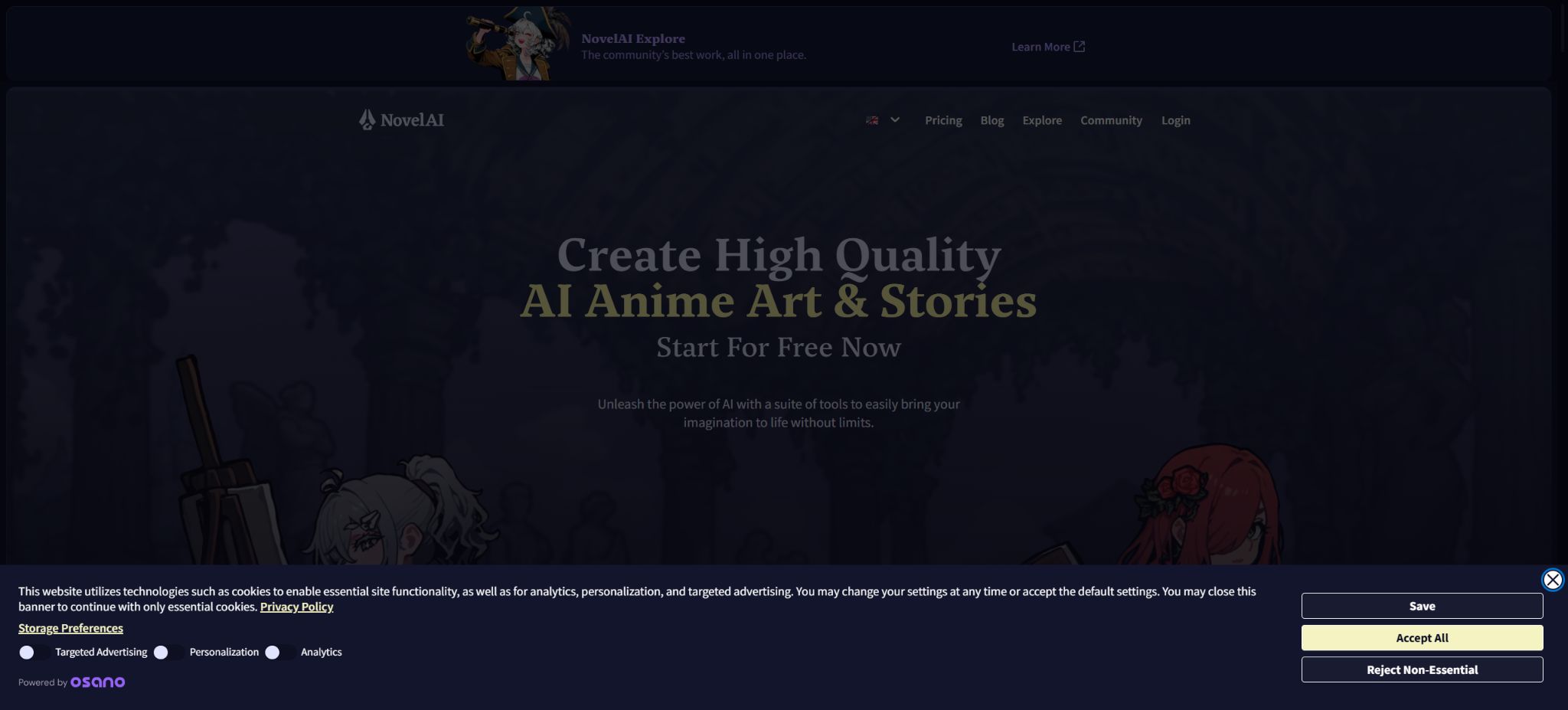
NovelAI is an AI-based platform for creating stories and generating images in anime style, operated by Anlatan Inc. It offers tools such as a continuation editor, Memory, Author’s Note, Lorebook, text-based adventure features, as well as model and sampling parameters, all designed to support long-form narratives; it also enables the creation and editing of characters, scenes, and illustrations through NovelAI Diffusion.
Compared to generic chatbots, NovelAI places more emphasis on allowing the author to maintain control over the story text. The AI predicts the subsequent content based on the existing text, and the author can modify it, try again, undo changes, or create different branches, rather than simply receiving a single complete answer.
The platform also offers adjustable parameters, phrase biases, modules, and a context viewer, making it suitable for creators who are willing to learn about prompting and generation settings.
AI novel continuation editor
The Storyteller editor allows users to enter a beginning, existing chapters, or any paragraphs, after which the model proceeds to write the rest of the content. The generated text is added at the current point in the story, and the author can edit, delete, undo, try again, or choose different paths forward.
The in-line generation feature also allows for text to be inserted at the selected location, without having to start from the end of the text.
The quality of the continuation depends on the preceding text, the model used, the preset parameters, the sampling settings, and the way in which the context is organized. AI may repeat scenarios, alter character personalities, confuse perspectives, or produce factual errors.
In longer works, key settings should be placed in Memory or Lorebook, with the main text being regularly organized manually.
Current text model
NovelAI offers a variety of its own fine-tuned or experimental models designed for storytelling. This document focuses on models such as Xialong, GLM-4.6, Erato, Kayra, and Clio.
Xialong is a model with 355 billion parameters, based on GLM-4.6 and fine-tuned using NovelAI story data; it focuses on maintaining the writing style, ensuring coherence, and minimizing differences in the results obtained from repeated attempts. It is currently a feature exclusive to Opus.
GLM-4.6 boasts strong capabilities in languages such as English, Japanese, and Chinese, but it is an instruction model that has not been optimized specifically for NovelAI’s traditional format; therefore, some older formats like ATTG may not work perfectly with it. Kayra is a story model with 13 billion parameters, while Clio is a fast-paced model with 3 billion parameters; in both cases, the document length limit is set at 8192 tokens.
Erato was further trained based on Llama 3 70B Base and fine-tuned for storytelling.
The available models and packages will be updated; the model selector in the editor should be taken as the reference.
Context and long-term consistency
The context is the range of text that the model can see before each generation. The earlier text outside this window is not automatically retained by the model; therefore, the size of the context is not equivalent to the model’s permanent memory of the entire project.
The subscription level, together with the model, determines the maximum range.
Xialong and GLM-4.6 have a context length of 28,672 tokens on the website, with a sliding window of 8,192 tokens; the actual usable range in the editor varies between 28,672 and 36,864 tokens. The Opus package claims to support a maximum context length of 28,672 tokens.
Other models or packages may be smaller.
Even if the window is large, structured settings should be used to prevent irrelevant content from taking up space.
Memory and Author’s Note
Memory is used to store a wide range of information that the AI is supposed to remember over time, such as the identity of the main character, the rules of the world, the current goals, and previous key events. It is typically located near the beginning of the story context. It is suitable for storing stable settings, but overly long content can consume tokens that could otherwise be used for the main text.
The Author’s Note is inserted closer to the latest text, which has a greater impact on subsequent generations; it is suitable for using a few short sentences to define the tone, perspective, rhythm of the current scenario, or the events that are about to take place. Long-term settings should not all be placed in the Author’s Note, otherwise the model might keep emphasizing the same requirements over and over again.
Lorebook Worldview Database
Lorebook is used to manage characters, locations, items, factions, rules, and other narrative elements. Each entry can have trigger keywords set for it.
When a keyword appears in the recent context, the corresponding entry is automatically added to the model’s input.
This way, the settings can be maintained without having the entire worldview occupy the context at all times.
Entries support classification, always enabled, hidden, insertion position, search range, phrase bias, and cascading triggers. Xialong and GLM-4.6 also allow for setting advanced activation conditions based on models, story modes, random probabilities, numbers, strings, and logical combinations.
Ordinary users should start with short entries and clear keywords, in order to avoid conflicts that may arise from multiple entries being activated at the same time.
The Lore Generator can create content based on characters, locations, or concepts, and it allows users to decide whether to take into account Memory, Author’s Note, recent stories, and other entries. The resulting settings still need to be reviewed manually.
Lorebook can be imported or exported as specialized files or JSON, and it can also be embedded in PNG format for sharing.
Text Adventure text adventure
Text Adventure transforms the continuation editor into an interactive novel. Players enter actions using Do and dialogue using Say; the system converts these into commands marked with special symbols, after which AI narrates the resulting outcomes.
Entries that begin with an exclamation mark can directly control the environment or non-protagonist events.
The input provided by the player indicates what should be attempted, but it does not guarantee that the character will succeed. More detailed instructions cause the model to follow them more strictly, while brief commands give it more room for creativity.
It can function even with a blank start, but it is usually more coherent when scenarios, characters, and objectives are provided.
In the dedicated Text Adventure mode, Xialong processes the player’s inputs as commands; when simulating adventures in the regular story mode, it is recommended to use the command syntax specific to this mode, rather than adhering to the symbol conventions of all the older modes.
Modules, presets, and advanced controls
AI Modules are used to adjust the output theme, style, or specific behaviors. The module library includes categories such as general, style, theme, inspiration, and Text Adventure; the available modules vary depending on the model.
The old custom AI Module training feature has been discontinued; existing module files can still be imported and used, but it should no longer be promoted as part of the current model training services available.
The Config Presets collection includes parameters such as temperature, sampling rate, and repetition penalty. Switching to a preset can sometimes help to resolve issues related to cycles, garbled output, or loss of control over the style.
Phrase Bias increases or decreases the probability of a specified word appearing.
The advanced parameters have a significant impact on one another; beginners should start with the default settings of the model and adjust only a small number of settings at a time.
NovelAI Diffusion image generation
NovelAI Diffusion is primarily designed for visual styles such as anime, illustrations, and Furry; it allows users to describe characters, composition, clothing, background, and style using natural English language or tags. The system suggests available tags, and it also supports negative prompts, seeds, number of steps, prompt guidance, samplers, and various resolutions.
The current document shows six available models, including NovelAI Diffusion V4.5 Full. V4.5 is an image model developed by NovelAI from scratch; it improves the quality of backgrounds, the accuracy of image generation, reduces artifacts, handles multi-character prompts, enhances natural language understanding, and improves the presentation of English text.
The basic prompts and character prompts in V4.5 support a total of about 512 T5 tokens.
Not all Unicode characters are supported in the prompts.
Different models emphasize different aspects of the data and provide different ways of providing instructions. For models V4 and later, labels are usually required to be in lowercase and separated by commas and spaces;
Natural language is written in standard English.
The generated results do not guarantee perfect consistency in terms of the character’s hands, text, perspective, or multiple consecutive images; multiple attempts and partial edits are required.
Multiple Roles, Vibe Transfer, and Precise Reference
Multi-character prompts allow for the description of individual characteristics for different characters, thereby reducing interference between various attributes. Vibe Transfer is used to extract the overall visual atmosphere from a reference image, while Precise Reference places more emphasis on specific reference features.
When using someone else’s images, it is still necessary to check the copyright, portrait rights, and platform rules; the fact that a tool can display such images does not mean that permission to modify them has been granted.
Image2Image and canvas editing
Image2Image allows you to upload images as a basis for composition or color selection; the parameter Strength controls the extent of the changes, while Noise is used to add details. The Canvas toolset includes brushes, erasers, filling tools, selection tools, lasso tools, color picking tools, blur effects, clone functions, layers, 3D model layers, and tools for adjusting size. It enables you to create something from a sketch or make modifications to an existing image.
Inpaint allows you to mask specific areas, generating content only in those selected regions; Enhance and Upscale are used to improve or enlarge the result.
Director Tools also includes editing functions such as removing backgrounds. High intensity, excessive noise, or too narrow mask edges can alter the parts that are not intended to change; original images should be preserved for important works.
Image history and downloads
The generated results are displayed in the current session history, and can be downloaded individually or as a package. For privacy reasons, NovelAI does not retain generated images, prompts, uploaded images, or canvas content for an extended period; they may be lost upon refreshing the page or leaving it.
The final reminder may only be stored in the local browser.
Therefore, once a satisfactory image is seen, it should be downloaded immediately. When the generated file retains metadata such as prompts and settings, it can be dragged back onto the website to restore the configuration; however, exporting, converting the format, or compressing it for use on another platform may result in the loss of this metadata.
Text to speech
The paid plan includes unlimited Text to Speech conversions, while the free trial offers 100 such conversions. The voice settings allow customization of the sound quality, making it suitable for reading out chapters, checking the rhythm of dialogues, or experiencing different character voices.
It is not equivalent to having permission to use the voice of a real person; one should not imitate or pretend to be another person without authorization.
Free trial of Paper
Account verification via email grants a one-time trial of Paper: 50 text generation requests, 30 image generations with a resolution of up to 1024×1024, and 100 text-to-speech conversions. The number of trials available is not refreshed on a regular basis, but the platform may reset it occasionally when new major versions are released.
NovelAI does not offer a complete, free version available for an extended period of time. The stories and settings created during the trial period can be used after subscribing, and users can also download backups in advance.
Price and version comparison
| Package or version | Prices, quotas, and core benefits |
|---|---|
| Tablet package | The price of the tablet is $10 per month; it includes unlimited text generation and text-to-speech functions during the subscription period, as well as 1,000 ImageAnlas units per subscription cycle. It is suitable for users who primarily write content, occasionally create illustrations, and do not need very long contexts. |
| Scroll package | The price of Scroll is 15 dollars per month; it includes access to a Tablet, 1000 ImageAnlas per cycle, and provides a broader context than that offered by a Tablet. The official package documentation does not list the exact number of tokens available with Scroll for each model in a tabular format, so it is necessary to refer to the subscription page and the real-time information displayed for the selected model. |
| Opus package | Opus costs $25 per month; it provides access to the highest-level contexts, as well as to experimental or older models such as Xialong, Krake, and Llama 3 Erato. Additionally, 10,000 ImageAnlas units are included with each subscription period. Opus enables image generation without using ImageAnlas, but under certain conditions: only one image can be generated at a time, no other images can be used as a background, the image size must fall within the specified normal range, and the number of steps involved cannot exceed 28. Generation in batch mode, with reference to multiple images, or at higher resolutions, or under any other conditions that do not meet these requirements, will still result in the consumption of ImageAnlas units. |
Tablet package
The price of the tablet is $10 per month; it includes unlimited text generation and text-to-speech functions during the subscription period, as well as 1,000 ImageAnlas units per subscription cycle. It is suitable for users who primarily write content, occasionally create illustrations, and do not need very long contexts.
Scroll package
The price of Scroll is 15 dollars per month; it includes access to a Tablet, 1000 ImageAnlas per cycle, and provides a broader context than that offered by a Tablet. The official package documentation does not list the exact number of tokens available with Scroll for each model in a tabular format, so it is necessary to refer to the subscription page and the real-time information displayed for the selected model.
Opus package
Opus costs $25 per month; it provides access to the highest-level contexts, as well as to experimental or older models such as Xialong, Krake, and Llama 3 Erato, and it includes 10,000 ImageAnlas units with each subscription period.
Opus can generate images without consuming Anlas, but certain conditions must be met: only one image should be generated at a time, no other images may be used as a background, the size of the image must fall within the specified normal range, and the number of steps involved must not exceed 28. Generating multiple images at once, using references, or achieving higher quality levels, as well as any other situations that do not meet these conditions, will still result in the consumption of Anlas.
Anlas point rules
The main function that Anlas is needed for at the moment is image generation; there are no limits on the number of times paid text and audio can be generated. The size of the images, their quantity, the number of steps involved in the processing, and the methods of editing all affect the amount of resources consumed.
Generating multiple copies at once certainly increases costs; even Opus charges a fee for this.
When renewing a subscription to Anlas, the amount refunded is only up to the limit specified in the plan; the unused balance is not added back in its entirety. For example, if there are 500 points left on a Tablet plan, then 500 points will be refunded upon renewal, bringing the total back to 1000 points.
The additional Paid ImageAnlas purchased will be used once the subscription credits are exhausted, and it is not taken into account in the monthly top-up calculation.
After canceling the subscription, the current benefits remain valid until the end of the paid period; however, the official documentation states that no additional Anlas can be purchased after cancellation. The prices for paid credits and the real-time consumption of images are to be determined according to the information displayed on the account interface.
Renewal and cancellation
Tablet, Scroll, and Opus are all subscriptions with automatic renewal every 30 days, rather than on a fixed calendar month basis. Cancellation does not result in an immediate loss of access; the benefits remain valid until the end of the paid period.
Before making a purchase, it is necessary to confirm the payment method, taxes and fees, exchange rates, and refund terms.
Story storage, encryption, and backup
By default, stories can be saved on the server, or it is possible to store them in the local browser. Remote stories are encrypted before being saved in the browser, so the authorities cannot directly access the content stored there.
When generating text, the server must temporarily receive the unencrypted segments of the text required for processing, but the authorities state that such requests are not recorded and are transmitted only over secure connections.
The encryption key is linked to the account’s email address and password. Losing these credentials or resetting the password through the login page can result in the remote story being permanently undecipherable, with no possibility of recovery by the authorities.
It is necessary to back up your email address or password before making any changes; local stories may be lost as a result of clearing browser data, extensions, or device failures.
Users can export individual stories, story files that include branch history, plain text, interactive scenarios, or shared images; they can also download all the stories in a single ZIP file. The official terms state that an export option will be provided reasonably after the subscription ends, and this process must be completed within 45 days. After that, the platform retains the right to delete the content, so the cloud should not be used as the only backup source.
Image privacy and content ownership
The official FAQ states that image requests, uploads, edits, and generations are not stored or retained for an extended period of time; they are encrypted during processing. The new terms specify that in order to reduce the bandwidth used for repeated uploads, reference images, masks, and background images may be temporarily encrypted and cached. The encryption keys are provided by the client side, and the platform cannot decrypt them on its own; such cached data is deleted automatically.
NovelAI does not claim ownership over user-generated images; however, this does not mean that all such generated content automatically enjoys legal copyright protection, nor does it eliminate the risks related to training data, trademarks, characters, portraits, or third-party materials. Commercial users should assess the situation themselves in accordance with the laws of their jurisdiction and the rules of the platform where they are posting content.
NovelAI Explore
Explore is a feature for discovering works that one can choose to join; it focuses primarily on images at the moment. The content is not made public automatically – it is only displayed after the user uploads it and it passes the approval process.
Some features that rely on reference images are not available in Explore, in order to enable review and reduce the risk of abuse.
PWA, browsers, and APIs
NovelAI is compatible with Chrome, Firefox, Safari, and Edge, and can be installed as a progressive web app using mobile browsers. The account settings also allow for the generation of Persistent API Tokens.
Regeneration will invalidate the old token; it is necessary to save it securely and update the client side in a timely manner.
The official documentation provides APIs for the NovelAI scripting environment, which enable management of Lorebooks, Memory, Author’s Notes, stories, and storage. The availability of tokens and scripting interfaces does not mean that all model weights or the entire service are made open source, nor does it guarantee that third-party clients will have unlimited access to these functions.
Company and open-source status
NovelAI is operated by Anlatan Inc. and is a commercial cloud-based subscription service. Basic models such as GLM-4.6 may be available under an open license, but NovelAI’s specialized fine-tuning tools, editor, image models, inference services, and product backend are not made available as a complete package; as a result, the tool itself is not open-source software, nor is it a platform that can be deployed privately in an immediate manner.
NovelAI usage guide
Complete a basic task.
- Identify the audience, purpose, tone, length, and the facts that must be included;
- Enter the topic and the verified reference materials in NovelAI;
- An AI novel continuation editor is used to create an outline, after which a preliminary draft with segmented sections is produced using the current text model.
- Replace generic content with your own data, examples, and terminology;
- Verify facts, citations, keywords, repetitions, and brand tone;
- It is published only after manual editing, plagiarism checking, and approval have been completed.
Create reusable professional workflows
- Create a brand term list, prohibited expressions, and approved sample texts;
- Establish a fixed process for organizing the AI novel continuation editor, the current text model, as well as context and long-term consistency.
- Designate responsible persons for research, the first draft, editing, and fact-checking respectively;
- Randomly check whether the model fabricates numbers, sources, or examples;
- Compare readability, conversion rates, search performance, and rework time;
- The templates and rules are continuously updated based on actual outcomes;
Which users is it suitable for?
- Novelists who need interactive continuation, branching, and detailed parameter generation;
- Worldbuilders who create information on characters, locations, and factions;
- Players who enjoy text adventures and AI-driven role-playing;
- Creators who need anime characters, scenes, and illustrations for novels;
- Individual users who wish to take into account both the narrative text, audio narration, and image editing;
- Advanced users who are willing to learn about context, tags, sampling, and Anlas rules.
Product advantages
- Designed specifically for long-form stories, rather than general office-related questions and answers;
- Memory, Author’s Note, and Lorebook manage contexts at different levels;
- It supports text adventure, branching, retry, phrase bias, and model presets;
- It features its own anime image models, as well as tools for multiple characters, partial redrawing, and canvas manipulation;
- There are no limits on the number of times paid text and text-to-speech services can be used;
- The remote story browser features end-to-end encryption and supports various export options for backups;
- Opus offers a broad context, dedicated models, and conditional image generation without Anlas fees.
Restrictions and Precautions
- The interface, prompt system, and most of the documentation of NovelAI are primarily in English.
- Models such as GLM-4.6 have the capability to handle Chinese language, but the quality of their output in terms of Chinese literature, punctuation, and cultural expression still requires practical testing.
- The so-called “infinite text” is subject to subscription validity periods, service availability, and fair use rules.
- The images are not available in an unlimited manner; billing is primarily based on Anlas, while Opus offers no charge only under strict conditions.
- Story encryption enhances privacy, but it also prevents the platform from restoring the text in cases where the password is forgotten.
- Regular offline backups are necessary, especially before modifying account information.
- AI may repeat itself, deviate from the topic, forget information, or generate inconsistent settings or inappropriate content.
- Lorebook and the broader context can only provide assistance, but they cannot replace the author’s review process;
- The commercial viability of generated images and text requires evaluation in terms of copyright, trademarks, portraits, contracts, and the policies of the platforms used for distribution.
- NovelAI does not argue that the absence of ownership means that third parties will not raise any claims;
Frequently Asked Questions
Is NovelAI free?
There is no long-term free full package, but after email verification, a one-time trial of Paper is available, which includes 50 text transmissions, 30 images with a maximum size of 1024×1024, and 100 voice generation sessions.
How much is NovelAI?
Tablet costs $10 per month, Scroll costs $15 per month, and Opus costs $25 per month; all subscriptions are renewed every 30 days. Taxes, exchange rates, and any additional fees are specified on the settlement page.
Is NovelAI suitable for Chinese novels?
According to the official documentation for GLM-4.6, it possesses strong capabilities in handling Chinese language; Xialong uses this model to fine-tune stories. However, different models have varying styles in their handling of Chinese text as well as different permission levels, so it is recommended to first test them using the trial version.
What’s the use of Lorebook?
It inserts characters, locations, and world rules into the current context based on keywords or conditions, helping to maintain consistency in long stories while preventing all of these elements from consuming too many tokens.
Can Opus truly generate images indefinitely?
Anlas exemption is only available for one image at a time, in specified dimensions, without the use of a background image, and when the number of steps does not exceed 28. Processing multiple images, using higher specifications, or having reference images all result in charges; therefore, not all image processing tasks can be handled indefinitely without any restrictions.
Will the story be seen by NovelAI?
When remote stories are stored statically, they are encrypted in the browser, and the developers claim that it is not possible to access them directly. During generation, the necessary sections are temporarily sent to the server for processing, but the content of these requests is not recorded.
Can the story be restored if you forget your password?
Usually, it’s not possible. The email address and password are encrypted locally, and resetting the password can make it impossible to decrypt the data remotely; therefore, it is necessary to export a backup in advance.
Is NovelAI open-source?
It is not open source. Some of the basic models may be made available, but NovelAI’s full editor, specialized models, image processing services, and backend systems are commercial products.
Tools similar to NovelAI




 Guigong Network Security Registration No. 45132202000164