






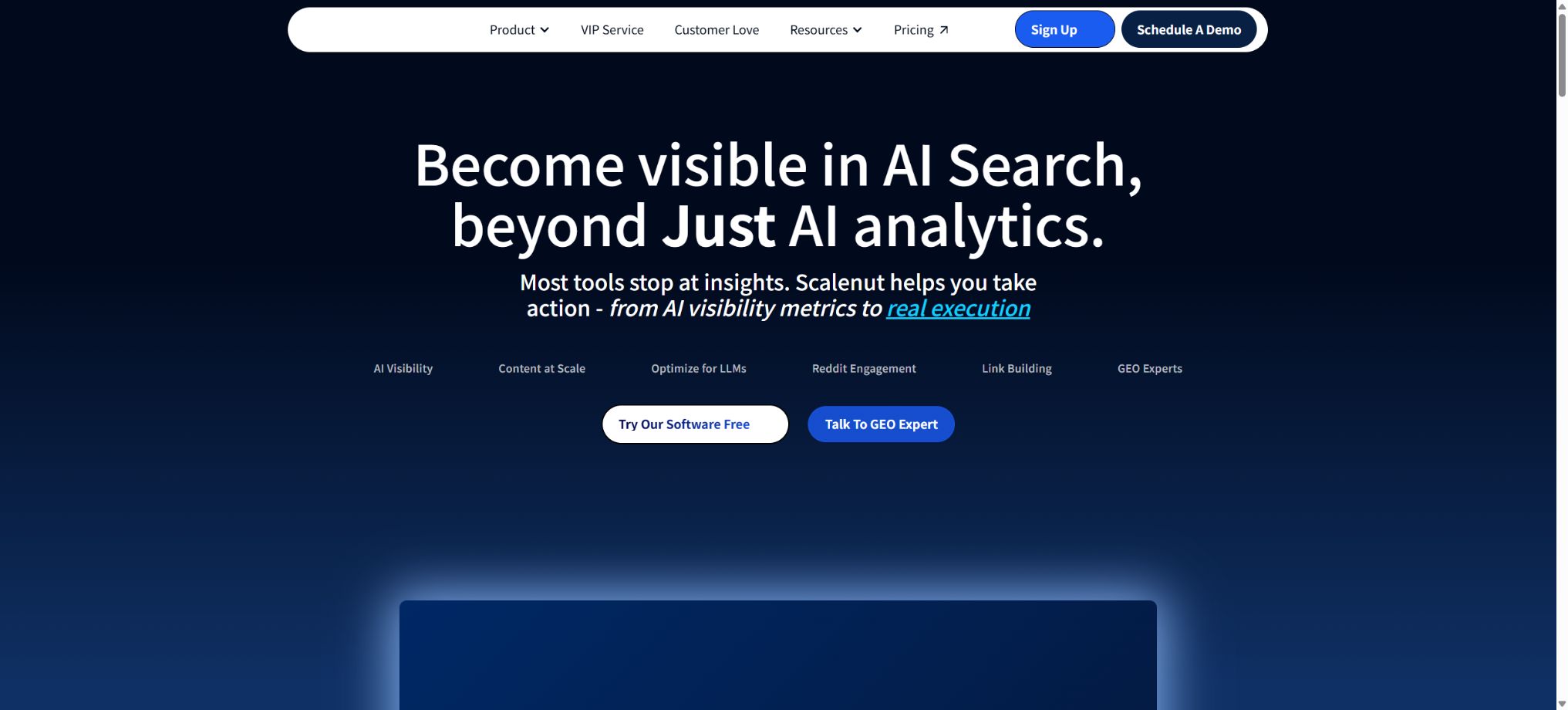
Scalenut
A content platform that covers keyword planning, SEO article creation, and optimization.
Tags:AI writing toolsWhat is Scalenut?
Scalenut is a platform for content research, creation, optimization, and enhancement of AI visibility, designed for teams focused on SEO, content marketing, and brand growth. It starts by analyzing keywords, search results, and the questions users pose through generative AI; it creates topic clusters, generates lengthy content, evaluates both new and existing pages, and keeps track of how the brand is mentioned and cited in responses from tools such as ChatGPT, Google AI Overviews, and Perplexity.
In its early stages, Scalenut focused more on SEO-related writing; today it has upgraded its product positioning to that of a GEO content growth engine. GEO stands for Generative Engine Optimization, and its goal is to increase the likelihood that content will be understood, cited, and recommended by AI systems, in addition to improving its ranking in traditional search results.
No platform rating can guarantee the actual ranking or citations.
Keywords and Prompt Planner
The keyword planner generates relevant keywords, search intents, and topic clusters around the core theme, helping websites to develop from a single article to achieving topical authority. The current version also includes AI Prompts, which are the specific questions that users might ask in generative searches.
The results of clustering are useful for creating content maps, but search volume, difficulty levels, and user intent vary depending on region and time. Teams should take into account their own business needs, the value of conversions, and existing pages, in order to avoid creating duplicate content for minor variations and thus preventing wasted effort on keywords.
Article generation in Cruise Mode
Cruise Mode is the core workflow for handling long articles in Scalenut. The user enters the main keywords, additional keywords, the target region, as well as the first 10, 20, or 30 ranking pages to be analyzed; they also specify the article type, brand requirements, reference materials, and AI-related questions. After that, they select a title and an outline to generate a complete draft.
The outline can be based on ranking pages, AI suggestions, as well as actual questions from sites like Reddit and Quora; once the main text is created, it’s possible to edit the title, metadata, URL, Schema, FAQ, links, and call-to-actions.
The system also offers expansion, simplification, rewriting, version history, comments, and Detect & Humanize.
The official website claims that its content is “factually accurate and free of plagiarism,” but the generation models can still produce fake data as well as incorrect information regarding products. The feature called Humanize does not guarantee that it is possible to bypass detection systems or prove that the content is originally created by humans; it is therefore necessary to verify the facts, sources, and copyright information before publishing anything.
SERP competition analysis
The platform extracts the title structure, NLP keywords, content length, questions, and statistical data from the ranking pages of the target searches. Users can compare the top 10, 20, or 30 competing pages, select reference articles, and identify any gaps in the content.
Copying competitive outlines can lead to homogenization and copyright issues. A more appropriate use is to identify users’ problems and then add original data, examples, experiences, and clearer answers.
GEO AI Editor and dual scoring
The editor was originally named SEO Hub; it now evaluates both traditional SEO and AI explainability. The content score is determined based on around 11 different parameters, including Prompt Coverage, Schema, key terms, meta tags, URL, summary, H1 tags, outbound links, H2 to H6 tags, content depth, and keyword density.
Fix It and Auto Optimizer can suggest or apply metadata, NLP terms, titles, and structural adjustments with just one click. Automatic replacements should be reviewed individually; it is not acceptable to add keywords, irrelevant content, or untrustworthy external links merely to improve scores.
Optimization of old articles with Content Optimizer
After the user enters the URL of the existing page along with the target keywords, Content Optimizer re-analyses the current competitive data, compares the topic, title, NLP-related terms, questions, and depth of the content, and provides a list of shortcomings. It is suitable for updating pages whose rankings have dropped, that are outdated, or that do not receive sufficient coverage.
A drop in page rankings can also be caused by technical issues, broken links, changes in users’ search intentions, or algorithm updates; it’s not sufficient to simply add more text. Before making any updates, it’s necessary to save the original version and to monitor rankings, click rates, and conversion rates, rather than focusing only on the platform’s scoring system.
Internal links and Link Manager
Internal linking tools identify relevant pages among the connected domains and suggest internal links while editing content, thereby helping search engines and AI crawlers to understand the website’s structure. Link Manager may require an additional payment when used as a separate module.
For automatic internal links, it is necessary to check the status of the target pages, the naturalness of the anchor text, and the number of links. After a page is deleted or moved, these settings should be adjusted accordingly, to prevent a large number of pages from pointing to invalid or irrelevant addresses.
OnPage Pro
OnPage Pro is used for auditing and batch-fixing titles, descriptions, page elements, and other issues on a website; the official site claims it can handle a large number of pages automatically. It is usually billed as an additional module, and it is not included indefinitely in all core packages.
Batch changes can affect the brand’s image and click-through rates. Before enabling automatic correction, tests should be conducted on a small number of pages, and mechanisms for version control, approval, and rollback should be in place.
Traffic Analyzer and Google Search Console
After connecting to Google Search Console, Traffic Analyzer allows one to view the performance of various pages and keywords, identifying drops in traffic, keyword competition, and opportunities for improvement. It helps to link content planning with actual search data.
GSC data is delayed and anonymized, so it cannot be used to explain all changes directly. It is necessary to combine website analysis, crawl logs, conversion rates, and technical audits in order to determine the reasons behind these changes.
AI Visibility
AI Visibility monitors brand mentions, sentiment, source citations, competitors, and the performance of prompts on generative platforms. Prompt Insights displays issues, AI responses, Query Fanouts, and Citation Intelligence.
Traffic Monitor also tracks AI crawlers and visits from AI sources.
The recommendations provide action suggestions based on missing prompts, competing citations, and potential content opportunities; they also allow one to switch to Cruise Mode to create articles. The AI’s responses may change from day to day, so when monitoring the results it is important to focus on long-term trends and multiple instances rather than just a single screenshot.
Content auditing and GEO Action Center
Action Center brings together keyword planning, article creation, optimization of existing articles, and site issues, helping teams to transform gaps in AI visibility into concrete content tasks. Content auditing is used to identify pages that need to be updated, merged, or deleted.
Pages with low traffic don’t necessarily need to be deleted; they may serve a purpose in terms of branding, compliance, or aiding conversions. Before merging or restructuring such pages, it’s necessary to check external links, internal links, and user pathways.
Brand tone and collaboration
Users can enter a brand URL or sample text to train the Brand Tone, which can then be applied in Cruise Mode. Comments, version history, completion status, and team member permissions enable multiple people to review the content.
Domain permissions are currently assigned on a per-domain basis; once a member gains permission for a certain domain, they can access multiple modules associated with that domain.
The agent should isolate domain names and members according to the customers, and regularly revoke access rights.
Export and Publish
Once the article is completed, it can be exported in PDF, DOC, HTML, or Markdown format, and integrated into the publishing process using tools such as WordPress. Meta tags, Schema markup, and internal links still need to be checked after the page is rendered in the actual CMS.
7-day free trial
Scalenut currently offers a 7-day free trial. The number of articles that can be used for testing, the options for optimization, the level of AI visibility, and the additional modules available may vary depending on the promotions in effect; it is therefore necessary to check the account usage page at the time of registration.
Current package prices
| Package or version | Prices, quotas, and core benefits |
|---|---|
| Professional | The Professional plan costs $199 per month; the annual rate is approximately $80 per month. |
| Individual | On the internet, one can still find the old package options such as Individual, Growth, Pro or Essential, Growth, Pro, at prices of 12, 32, 60 dollars or 49, 79, 149 dollars. These are historical versions and should not be considered as the current pricing. |
| Starter | According to the official information available for 2026, the Starter plan costs $59 per month, which is equivalent to about $24 per month when billed annually. |
| Plus | The Plus plan costs $89 per month, which is approximately $36 per month when billed annually; |
According to the official information released for 2026, the Starter plan costs $59 per month, which is equivalent to about $24 per month when billed annually; the Plus plan costs $89 per month, equivalent to around $36 per month on an annual basis.
The Professional plan costs 199 dollars per month; the annual rate is approximately 80 dollars per month. The VIP Service comes with a customized quote.
Starter is suitable for individuals or websites with low traffic, Plus is better suited for growing teams, while Professional is intended for agencies and those with higher traffic levels. The number of articles, optimized pages, domain names, number of members, and the amount of AI visibility allowed in each plan are subject to the prices listed on the current page, as Scalenut has adjusted the names of its packages and quotas several times in recent years.
On the internet, one can still find the old package options such as Individual, Growth, Pro or Essential, Growth, Pro, at prices of 12, 32, 60 dollars or 49, 79, 149 dollars. These are historical versions and should not be considered as the current pricing.
Additional modules and extra costs
Public information on the official website for the periods 2025 to 2026 indicated that Link Manager costs around $19 per month, AI Detect & Humanizer around $9.90 per month, and OnPage Pro also around $19 per month; AI Visibility Watchtower, Social UpReach, and Backlinks Marketplace may be charged separately or on a pay-as-you-go basis.
Additional modules, promotions, and bundles can vary; before making a purchase, it is necessary to determine which features are included in the core package and which ones require separate subscriptions or are paid on a usage basis. The Backlinks Marketplace is a purchasing channel, but it does not mean that all links available there are safe or comply with search engine policies.
VIP hosting service
The VIP Service is intended for clients who wish to have SEO, AEO, and GEO tasks carried out by an expert team; it includes strategies, content development, technical audits, link management, reports, and regular communication. The specific volume of work to be done, the number of edits, responsibilities for publication, as well as performance metrics must all be specified in the contract.
Chrome extensions and Copyscape
Chrome extensions can be used to create paragraphs, continue text, rewrite it, and simplify it within web pages. The platform also allows users to connect their own Copyscape accounts for additional plagiarism checks.
The plagiarism checking service and the Scalenut subscription may be charged separately.
API and open-source status
Scalenut’s public products are primarily used through web platforms, as well as through extensions and integrations. The current self-service packages do not guarantee the availability of a complete set of public APIs. Companies that need to connect their systems on a large scale should consult sales to determine the available interfaces, the number of calls that can be made, data processing requirements, and the commercial terms.
Scalenut is a commercial cloud-based SEO and GEO platform; it does not make available the complete source code for its article analysis tools, SERP analysis functions, AI visibility features, or optimization systems. As such, it is not an open-source project, nor does it offer an official version for private deployment.
Scalenut usage guide
Complete a basic task.
- Identify the audience, purpose, tone, length, and the facts that must be included;
- Enter the topic and the verified reference materials in Scalenut;
- Use keywords and Prompt Planner to create an outline, and then generate a preliminary draft with the Cruise Mode article to carry out segmentation;
- Replace generic content with your own data, examples, and terminology;
- Verify facts, citations, keywords, repetitions, and brand tone;
- It is published only after manual editing, plagiarism checking, and approval have been completed.
Create reusable professional workflows
- Create a brand term list, prohibited expressions, and approved sample texts;
- Establish a fixed process for organizing keywords with Prompt Planner, article generation in Cruise Mode, and SERP competitive analysis;
- Designate responsible persons for research, the first draft, editing, and fact-checking respectively;
- Randomly check whether the model fabricates numbers, sources, or examples;
- Compare readability, conversion rates, search performance, and rework time;
- The templates and rules are continuously updated based on actual outcomes;
Which users is it suitable for?
- SEO specialists who plan theme clusters around keywords and AI-related issues;
- A team capable of quickly creating and optimizing the content of long articles;
- Website operators who refresh pages whose rankings have dropped or become outdated;
- Companies that monitor the visibility of the ChatGPT, Google AI, and Perplexity brands;
- A content agency that manages multiple domain names and clients;
- A team is needed to handle SEO and GEO implementation.
Product advantages
- Integration of keywords, AI prompts, SERPs, and content workflows;
- The Cruise Mode process is clear, from research to the first draft;
- Evaluate both SEO and AI citation structures simultaneously;
- It can optimize existing URLs and fix common issues with one click;
- Includes internal links, content auditing, GSC, and AI traffic insights;
- Monitor brand mentions, sentiment, citations, and competitive gaps.
Restrictions and Precautions
- The content score, Humanize factor, and AI visibility provided by the platform do not guarantee rankings, citations, or the ability to bypass detection mechanisms;
- Important articles require original research, credible sources, and manual editing;
- Packages and additional modules change frequently, and there are many old price pages.
- Before making the payment, it is necessary to verify the current name, annual commitment, article and page quotas, as well as any additional fees.
- One-click optimization, batch in-site modifications, and link marketing carry SEO risks;
- Before automation, testing, approval, and backing up should be carried out, in addition to complying with the search engine’s policies regarding spammy content.
Frequently Asked Questions
Is Scalenut free?
A 7-day free trial is available; for long-term use, you need to choose among the Starter, Plus, Professional plans or a customized VIP service.
Can Scalenut generate complete articles?
Yes. Cruise Mode generates a preliminary draft of a longer text based on keywords, region, ranking pages, brand tone, and an outline; however, the facts, citations, and wording need to be reviewed manually.
Can it monitor AI searches?
Yes, AI Visibility is used to track brand mentions, sentiment, prompts, source citations, and AI crawler traffic; the actual coverage and limits depend on the package chosen.
How much is Scalenut?
The current monthly prices are 59 dollars for Starter, 89 dollars for Plus, and 199 dollars for Professional; the annual rates correspond to approximately 24, 36, and 80 dollars per month, with custom pricing available for VIP users.
Why are the prices different online?
Scalenut has adjusted its packages and promotions on multiple occasions; the old prices for Individual, Essential, Growth, and Pro are still shown in search results, but the current prices listed on the payment page should be taken as the authoritative ones.
Is Scalenut open source?
It is not open source. It is a commercial cloud-based SEO and GEO content platform, and its complete core source code is not made public.
Tools similar to Scalenut




 Guigong Network Security Registration No. 45132202000164