






Frase
An SEO writing platform that takes into account SERP research, content summaries, and optimization scores
Tags:AI writing toolsWhat is a Phrase?
Frase is a platform designed for content marketing, SEO teams, and agencies, offering services for content research, writing, optimization, and maintenance. It starts with target queries and actual search results to analyze the topics, issues, and structure of the pages that appear in search results; it then generates content summaries or articles, while also providing an SEO score during the editing process.
Currently, Frase has been expanded to GEO, which stands for Generative Engine Optimization. In addition to traditional search engines such as Google and Bing, it evaluates whether content is easy to be cited by systems like ChatGPT, Perplexity, Claude, Gemini, and Google AI, based on criteria such as authority, readability, and structure; it also monitors the visibility of brands in AI-generated responses.
SERP Research and Content Briefings
After entering the target keywords, Frase captures and processes the top-ranking pages, compiling information on titles, sections, key terms, questions, content length, and the extent to which competing pages cover those topics. Users can use this information to create outlines, determine writing requirements, and prepare content summaries, thereby saving time that would otherwise be spent manually reviewing numerous result pages.
Search results vary depending on country, language, device, time, and personal preferences. The competitive landscape identified through Frase extraction serves as a starting point for research; it should not be copied from ranking pages, nor can it guarantee that all actual search intentions are covered.
AI writing and brand voice
Frase can generate articles, paragraphs, titles, and images based on research results, and it can also help in defining the brand’s voice. Users can establish a Style Guide, define the brand voice, recommend or prohibit certain terms, as well as provide reference documents, so that both the AI and team members adhere to a consistent tone, format, and vocabulary.
The reference documents can be in PDF, DOCX, TXT, or CSV format; a single document should not contain more than around 6,000 words. The number of reference documents available and the enterprise permissions vary depending on the chosen package.
Product specifications, legal provisions, and research data must be kept up to date; outdated references can directly affect the output of AI.
SEO real-time optimization score
The editor calculates the SEO score in real time based on the semantic themes, keywords, and level of coverage used on the ranking pages, and it indicates any themes that are missing or not utilized enough. Users can compare the average scores of their competitors; the platform recommends setting a target score that is about 30% higher than the average score of competitors, but this is merely an internal method employed by the platform.
Content quality is not a factor in Google’s ranking system, nor does it guarantee a better ranking. An overemphasis on word frequency can lead to spammy content and a decline in readability; in reality, SEO depends on search intent, the authority of the website, backlinks, technical performance, the frequency of updates, and the user experience.
GEO score
The GEO score evaluates authority, readability, and structure. The platform recommends citing reliable sources, using data to support statements, shortening complex sentences, providing clear titles and lists, and placing answers in prominent locations – all to make the content easier for generative systems to extract and understand.
No tool can guarantee that a piece of content will be cited by a particular AI platform. The indexing, retrieval, and response mechanisms for different models are constantly changing; therefore, the GEO score can only serve as an internal indicator of content quality and extractability.
Combinatorial optimization
The Optimize tag displays both the SEO and GEO scores as well as the overall score, helping teams to find a balance between keyword coverage and readability, as well as between an authoritative structure. It is necessary to prioritize addressing users’ questions and ensuring factual accuracy before focusing on semantic themes and formatting; redundant paragraphs should not be created merely to boost scores.
Google Search Console and SEO Analytics
After connecting to Google Search Console, Frase imports queries, pages, and click performance data, and clusters similar queries. The system assigns labels such as Top Result, Quick Win, Ranked, Decay, Opportunity, or Unranked to the pages, thereby helping to identify opportunities for quick optimization as well as areas where the content’s performance is declining.
Users can create optimization documents directly from queries or pages, and they can also export the filtered SEO reports to Excel. GSC data is delayed and does not cover all queries; changes in rankings and clicks may be caused by seasonal factors, algorithmic changes, or issues with the website itself, and it is necessary to use analysis tools to determine these factors.
Site Auditor and Content Guard
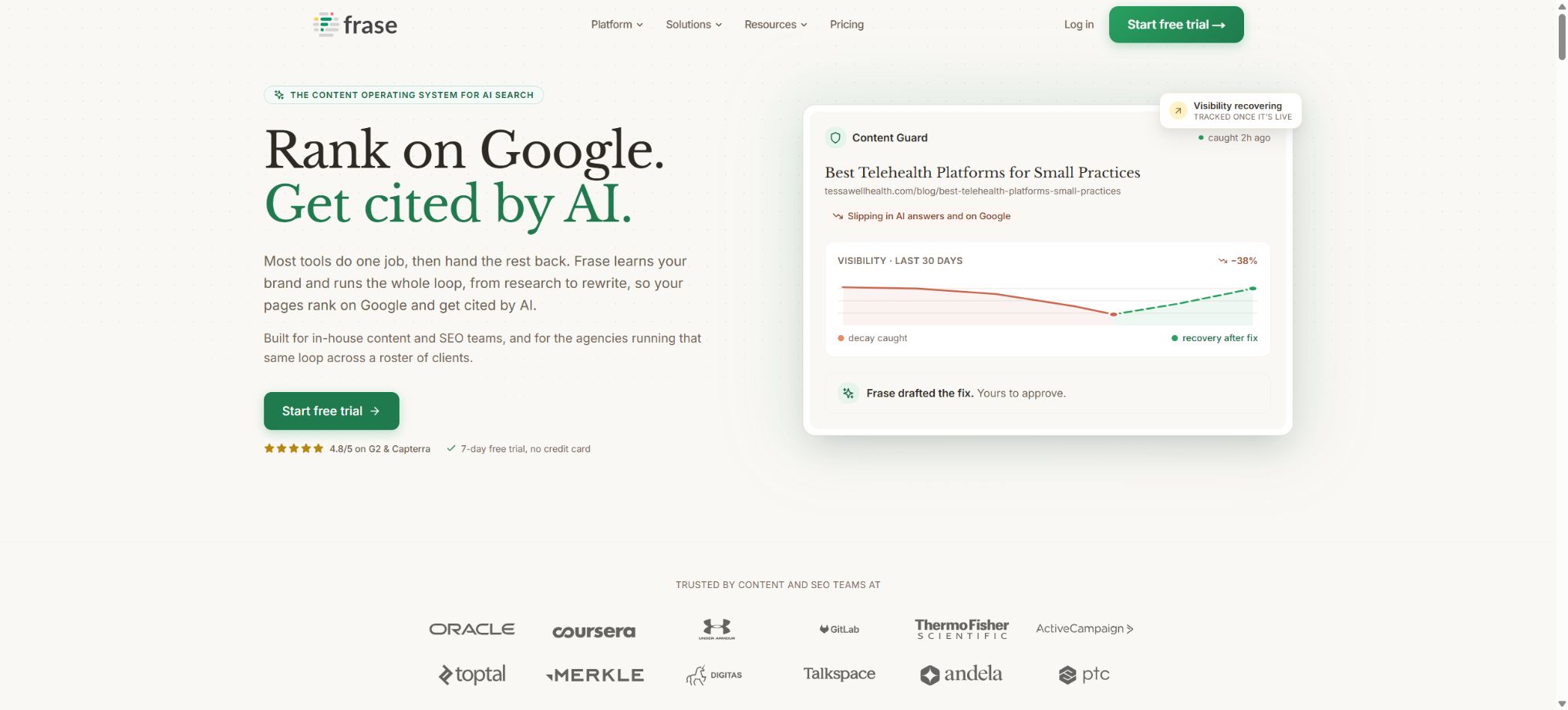
Site audits evaluate the technical SEO of existing pages, the quality of their content, and their readiness for AI use, and prioritize the tasks that need to be addressed based on their potential impact. Content Guard monitors the Google rankings of published pages as well as any decline in traffic; when such a decline is detected, it drafts updates, waiting for manual approval before releasing them again.
For some packages, it is possible to choose to have low-risk revisions published automatically, but this is an option that must be activated manually; it is not the default setting. When automatic revisions are used, version backups, approval processes, rollback capabilities, and change logs should be in place to prevent the AI from deleting important facts, internal links, or text that is required for compliance.
AI Visibility
The AI Visibility feature monitors, based on the chosen package, whether a particular brand is mentioned or cited by platforms such as ChatGPT, Google AI, Perplexity, Claude, and Gemini in certain searches, and alerts users when there are changes in this situation. The Starter package covers ChatGPT and Google AI; the Professional package adds Perplexity, while the Scale package includes Claude and Gemini as well.
AI responses are variable; the absence of a response in one instance does not indicate that the brand is completely invisible, while the appearance of a response in one instance does not guarantee a steady flow of traffic. The report should be interpreted by taking into account the set of questions asked, time trends, the pages cited, and actual visit data.
Frase Agent and Publishing
The Frase Agent handles natural language tasks, carrying out research, drafting content, working on branding, and performing SEO/GEO optimization, before arranging for the content to be published. The content can be sent to WordPress, Webflow, Sanity, Wix, or it can be hosted on FraseCMS using one’s own domain name.
Starter covers the core content; Professional offers a higher level of automation for FAQs, terms, how-tos, and similar items; Scale allows the inclusion of more content within the monthly limit. By default, users retain control over publishing, while automatic publishing capabilities will be made available gradually.
Frase Answers
Frase Answers is an interactive Q&A component placed on websites; it responds to visitors based on the content of the site and shows relevant references, while also collecting the actual questions raised by users. These questions can be used in content planning, creating a cycle that goes from identifying needs to the release of new pages.
Each package typically includes one free tier component per site; higher levels of traffic may require additional packages. Before going live, it is necessary to set up answer ranges, a privacy policy, error escalation procedures, and access to human customer service – AI should not be used to replace essential support services.
Content calendar, internal links, and reuse
The Professional and higher-tier plans offer a content calendar as well as suggestions for internal links; Scale enables the conversion of a piece of content into shorter versions suitable for use on social media, in emails, etc., and it also allows for the generation of reports for clients.
Automatic internal linking should check the relevance of the target page, the anchor text, and broken links.
7-day free trial
A 7-day free trial is available at the moment, and no credit card is required. The trial includes the main features of Professional: up to 5 articles, 50 audit pages, 25 AI suggestions, and a maximum of 3 user accounts.
Automatic publishing and higher levels of autonomous operation are kept disabled.
Price and version comparison
| Package or version | Prices, quotas, and core benefits |
|---|---|
| Starter price and quota | The Starter plan costs $49 per month, or $39 per month when billed annually. It includes 1 seat, 1 site, 10 articles per month, 50 audit pages, and 25 AI-generated responses as needed. It allows monitoring of 3 Content Guard pages and 50 AI-related issues, covering ChatGPT and Google AI, along with 250 API requests per month. Once the limits of this plan are reached, service delivery stops without any additional charges; upgrading is required if more resources are needed. This plan is suitable for individuals, freelancers, and teams with a single site. |
| Professional prices and quotas | The Professional plan costs $129 per month, or $103 per month when paid annually. It includes 3 seats, 5 sites, 40 articles per month, 250 audit pages, 100 AI-generated items, and 20 AI-based infographic creations. It also allows monitoring of 15 declining pages and 200 AI-related issues, as well as providing Perplexity scores, a content calendar, suggestions for internal links, and 1000 API calls per month. Additional seats can be purchased for $29 per month. Users can opt to enable paid extra services: $5 per additional article, $0.50 per audit page, and $0.25 per AI prompt; this option is disabled by default. |
| Scale prices and quotas | Scale costs 299 dollars per month; when paid annually, the cost is 239 dollars per month. It includes 5 seats, up to 10 domain names, 100 articles per month, 1,000 audit pages, 350 AI-generated items, and 50 infographic charts. It allows for monitoring of 50 declining pages and 500 AI-related issues, covers five types of AI platforms, and provides customer reports as well as the possibility to reuse content. The optional additional charges for Scale are 4 dollars per article, 0.40 dollars per audit page, and 0.20 dollars per AI prompt; extra seats still cost 29 dollars per month. |
Starter price and quota
The Starter plan costs $49 per month; when paid annually, the cost is $39 per month. It includes 1 seat, 1 site, 10 articles per month, 50 audit pages, and 25 instances of AI generation on demand. It allows monitoring of 3 Content Guard pages and 50 AI-related issues, covering ChatGPT and Google AI, along with 250 API requests per month.
The Starter plan stops once it reaches its limit, and no additional charges are incurred automatically; upgrading is required if more capacity is needed.
Suitable for individuals, freelancers, and single-site teams.
Professional prices and quotas
The Professional plan costs 129 dollars per month; when paid annually, the cost comes to 103 dollars per month. It includes 3 seats, access to 5 sites, 40 articles per month, 250 audit pages, 100 AI-generated items, and 20 AI-based infographic creations. It also allows for monitoring of 15 declining pages and 200 AI-related issues, along with features such as Perplexity scores, a content calendar, suggestions for internal links, and 1000 API calls per month.
An additional seat costs $29 per month. Users can opt for premium pricing: $5 for each additional article, $0.50 for each audit page, and $0.25 for each AI prompt.
It is off by default.
Scale prices and quotas
Scale costs $299 per month; the annual rate is equivalent to $239 per month. It includes 5 seats, up to 10 domain names, 100 articles per month, 1,000 audit pages, 350 AI-generated items, and 50 infographic charts. It allows for monitoring of 50 declining pages and 500 AI-related issues, covers five types of AI platforms, and provides customer reports as well as options for reusing content.
The optional surcharge for Scale is $4 per article, $0.40 per audit page, and $0.20 per AI prompt; the additional seats still cost $29 per month.
Enterprise
Enterprise offers customized quotes based on the organization’s size; it provides custom seats and domain names along with specified quotas, white-label reports, a branded customer portal, custom domain names, SSO and SAML solutions, dedicated account managers, SLAs, custom APIs, as well as historical data spanning up to two years. This service is suitable for large enterprises and agencies that require a white-label solution.
API, MCP, and automation
The API can handle SERPs, web pages, and documents. The current package comparison shows that the Starter plan allows 250 requests per month, the Professional plan allows 1,000 requests per month, and the Scale plan allows 3,000 requests per month.
Higher quantities are customized by Enterprise.
The help documentation still lists the old URL-based API packages; therefore, the actual billing should be based on the current account and contract terms.
The platform also offers MCP and automation capabilities, enabling research to be carried out, results to be generated, and data to be exported via AI assistants or internal workflows. There are specific rules regarding the use of API data for third-party displays, white-labeling, and attribution; such data cannot be resold or have its identifying elements removed without approval.
Integration and support platform
- Web content workspace;
- WordPress plugins;
- Google Docs extensions;
- Chrome extensions;
- Google Search Console;
- Released for WordPress, Webflow, Sanity, Wix;
- Hosted by FraseCMS;
- APIs, MCPs, and automation interfaces.
Is it open source?
Frase is a commercial cloud-based SEO and GEO platform; it does not provide public access to complete SERP analyses, optimization scores, AI visibility data, or the source code for its writing and publishing systems, which is why it is not considered open-source software. While its API and MCP features allow for integration, this does not mean that the core functionality of the platform is made available, nor that it is possible to deploy the entire platform independently.
Frase Usage Tutorial
Complete a basic task.
- Identify the audience, purpose, tone, length, and the facts that must be included;
- Enter the topic and the verified reference materials in Frase;
- Use SERP research and content briefs to create an outline, then use AI writing along with the brand’s voice to draft the sections initially;
- Replace generic content with your own data, examples, and terminology;
- Verify facts, citations, keywords, repetitions, and brand tone;
- It is published only after manual editing, plagiarism checking, and approval have been completed.
Create reusable professional workflows
- Create a brand term list, prohibited expressions, and approved sample texts;
- Establish a standardized process for organizing SERP research, content briefs, AI-driven writing and brand voice, as well as SEO real-time optimization scores.
- Designate responsible persons for research, the first draft, editing, and fact-checking respectively;
- Randomly check whether the model fabricates numbers, sources, or examples;
- Compare readability, conversion rates, search performance, and rework time;
- The templates and rules are continuously updated based on actual outcomes;
Which users is it suitable for?
- SEO specialists who can quickly create content summaries from search results;
- Teams that need to generate and optimize blog content in bulk;
- Pay attention at the same time to brands with good Google rankings and AI citations;
- Maintain a large number of existing articles and monitor websites that are declining in performance;
- Content agencies that manage multiple clients and locations;
- Development teams that wish to integrate research, publishing, and monitoring into their workflows.
Product advantages
- Focus on research, briefings, writing, SEO, and GEO optimization;
- Real-time SEO, GEO, and comprehensive scoring;
- Connecting GSC reveals opportunities as well as content decline;
- Monitor brand mentions across multiple AI platforms;
- It can be published to major CMS platforms while retaining manual approval.
- It offers APIs, MCP, Frase Answers, and site auditing.
Restrictions and Precautions
- SEO, GEO, and AI visibility scores are not guarantees of ranking or citations;
- Articles generated may contain errors, fictitious sources, and repeated expressions; they must be reviewed by editors familiar with the subject matter.
- The package imposes limits separately for articles, audit pages, AI-generated content, websites, seats, and monitoring issues;
- Extra charges for Professional and Scale are incurred only when they are activated actively; teams should set up budget alerts.
- Connections to GSC, CMS, and automated release systems grant higher levels of access; therefore, the principle of least privilege, approval processes, version backups, and regular revocation of tokens should be applied.
Frequently Asked Questions
Is Frase free?
A 7-day free trial is available, without the need for a credit card; it allows for 5 articles, 50 audit pages, and 25 AI prompts. Paid subscription is required for longer use.
Can Frase guarantee a good ranking on Google?
No. It provides suggestions and scores based on competing pages, but the ranking is still determined by the quality of the content, its authority, technical SEO aspects, backlinks, and user needs.
What is the GEO score?
It evaluates content based on authority, readability, and structure to determine whether it is easy for generative AI to understand and cite, but it does not guarantee that it will be adopted by any AI platform.
How much is the Frase?
The monthly rates are 49 dollars for Starter, 129 dollars for Professional, and 299 dollars for Scale; the corresponding annual rates are 39, 103, and 239 dollars per month respectively. A quote is available for Enterprise plans.
Does Frase provide an API?
Available. The current packages include 250, 1000, and 3000 requests per month, with options for customization by businesses;
The specific endpoints and excess policies are subject to the account documentation.
Is Frase open source?
It is not open source. It is a commercial content management platform that can be integrated via APIs and MCP, but it is not possible to deploy its core system independently.
Tools similar to Frase




 Guigong Network Security Registration No. 45132202000164