






Anyword
An AI platform centered on marketing outcome prediction and brand copy generation
Tags:AI writing toolsWhat is Anyword?
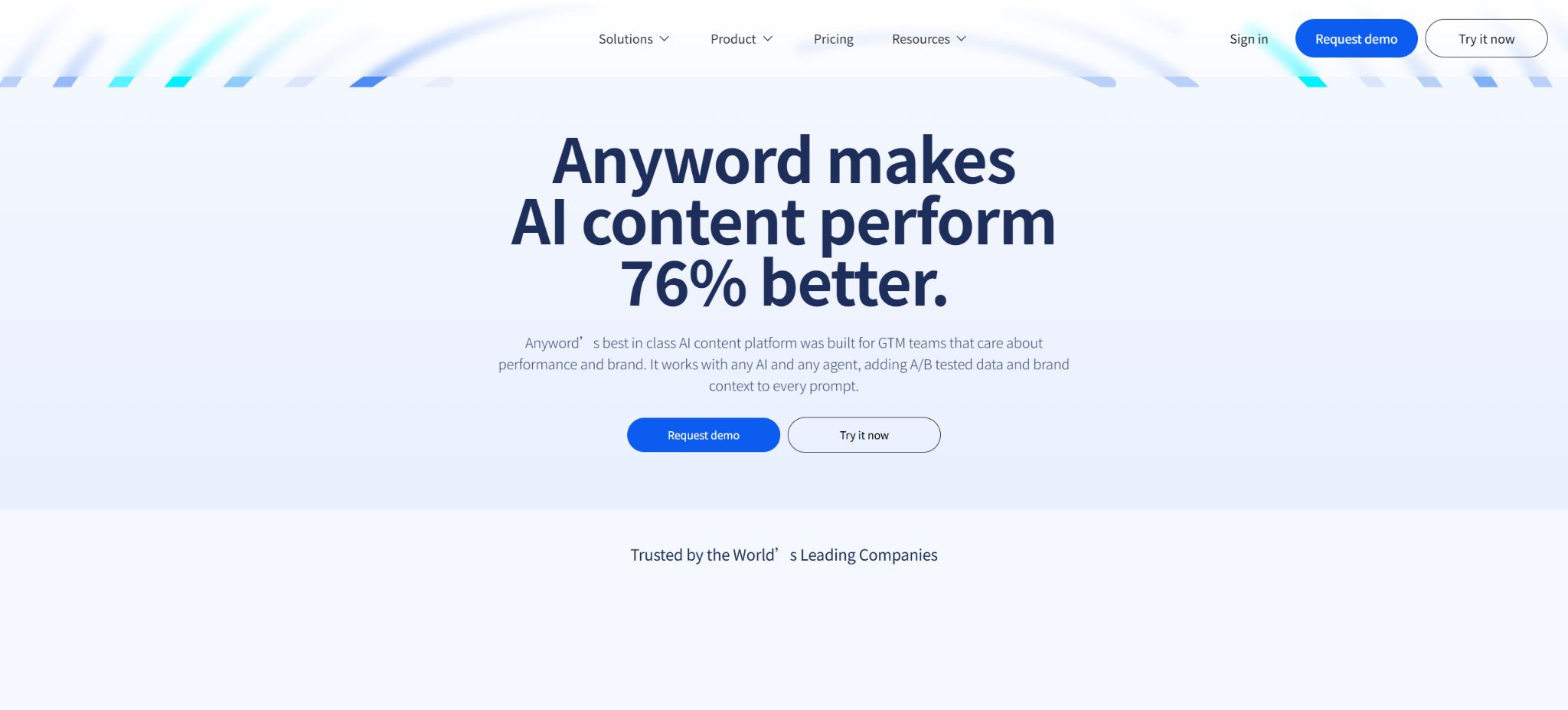
Anyword is an AI-powered platform for creating copy and content, focused on marketing performance data. It can generate ads, emails, social media posts, landing pages, product descriptions, and blog content; it also provides predicted performance scores for different versions of such content, helping teams to select the most promising options before publishing or deploying them.
Compared to general AI writing assistants, Anyword places more emphasis on brand guidelines, target audience segmentation, channel formatting, and historical campaign data. It is suitable for teams responsible for growth marketing, content management, e-commerce, and brand development; it is not a system designed to guarantee click-through rates or conversion rates, and its predictions still need to be verified through actual A/B testing.
Short Text Editor
The Short-Form Editor offers templates for ads, social media posts, emails, websites, images, etc.; it also allows users to describe their requirements freely in a general prompt format. After the user specifies the tone, key features, target audience, brand terminology, and format, the platform generates multiple versions and displays performance scores for them.
The template takes into account the character limits of different channels, such as the required or recommended lengths for ad titles, body text, and posts on social media platforms. The specifications for these platforms can change over time depending on platforms like Meta, Google, LinkedIn, etc.; it is therefore necessary to check them in the ad management interface before launching the ads officially.
Long Articles and Blog Wizard
Blog Wizard is used to create themes, outlines, titles, introductions, and main text; it also includes tools for research and plagiarism checking. The advanced text editor allows brand guidelines, target audience considerations, structure, formatting rules, and vocabulary rules to be applied across all chapters, thereby reducing the need to repeat these settings for each paragraph.
AI research and plagiarism checks cannot prove that something is factually correct or entirely original. Citations, statistics, product data, and expert opinions must all have their true sources identified; moreover, SEO content requires an independent analysis of keyword requirements, search intent, and competing pages.
Predicted performance score
The Predictive Performance Score assesses the potential level of interaction or conversion that a given text might generate, and it is used to rank the different versions created. When users make changes to the text, users with Data-Driven plans or higher can see the changes in this score in real time.
Boost Performance allows you to try to increase scores with just one click.
The predicted scores are based on Anyword’s industry data and models; they do not represent guarantees from the platform regarding actual clicks, sales, or revenue. Factors such as the source of traffic, the images used, bidding amounts, the landing page, brand awareness, and the season can all affect the results. These scores should be used as a tool for filtering, rather than as a reason to abandon actual testing.
Custom Score and historical benchmarks
Business and enterprise capabilities allow integration with marketing accounts such as Meta Ads, Google Ads, LinkedIn Ads, HubSpot, etc.; they enable access to historical content and performance data, and it is possible to set custom benchmarks based on metrics like click-through rate, impressions, and conversions. New copy can receive a generic Anyword Score, or it can be compared with the brand’s own historical campaigns.
The quality of historical data has a direct impact on the benchmarks. Data with different attribution windows, audiences, budgets, and campaign objectives should not be combined into one group.
Before connecting the channels, it is necessary to verify the account permissions, data processing protocols, and organizational privacy requirements.
Brand voice and guidelines
Brand Voice provides centralized management of tone, target audience, brand terminology, key messages, format, and custom formulas. The tone can be defined using custom models, preset styles, up to three personality traits, or textual descriptions;
The glossary can mark recommended terms, terms to be used with caution, and prohibited terms, and it allows for the specification of case sensitivity and synonyms.
Messaging Bank stores the brand’s key features and common information, while Talking Points can be drawn from prompts or connected channels; star ratings are used to indicate the likelihood of resonance with the target audience. Rules help ensure consistency, but legal statements, claims regarding the efficacy of drugs, financial promises, and comparative ads still require manual approval.
Target audience
Anyword can determine characteristics of the target audience such as profession, age, gender, and key concerns based on the briefing, or it can use pre-saving Personas. When generating content, by selecting one or more target audiences, the platform adjusts the wording and selling points while also providing insights into those audiences.
The population attributes inferred automatically may contain stereotypes or lead to unfair discrimination. Recruitment, housing, credit, healthcare, and political advertisements must comply with the platform’s rules as well as those in place in the relevant region regarding sensitive targeting.
Content Intelligence
Content Intelligence analyzes the performance of published ads, emails, and social media content, identifies high-performing topics, messaging approaches, and materials, and uses these insights to generate content in subsequent steps. Business accounts can import around 5,000 pieces of performance data, while Enterprise accounts can handle more than 10,000 pieces or offer customized solutions.
\"High performance\" should be understood in terms of cost, the quality of conversions, and statistical significance. Exaggerated copy that leads to high short-term click rates can damage the brand or result in low-quality conversions; optimization should not rely on just one single indicator.
Automatic optimization of Website Agent website
Website Agent creates multiple versions of copy on landing pages or product pages; by adding JavaScript code snippets, it allocates traffic, tracks conversions, and automatically displays the versions with better performance. Conversion targets can be set using URLs, CTA buttons, or custom code events.
The code needs to be placed in the header of the webpage; the current official instructions cannot be provided through Google Tag Manager, and Shopify requires editing of the theme files.
Before enabling it, it is necessary to test in a development environment the page speed, flickering, consent management, analysis for attribution, and rollback capabilities; moreover, for automatic decision-making, a minimum sample size and a duration for the experiment should be set.
AI image generation and scoring
The platform allows for the creation or uploading of marketing images, with the possibility of adding logos, fonts, colors, and overlay text; it also provides predictive scores for visual elements as well as titles and CTA buttons. It is ideal for quickly developing multiple advertising concepts.
Images generated may contain brand logos, portraits of people, text, as well as errors regarding product details. Before using them in official contexts, it is necessary to check the copyright of the materials, the authorization for using portraits, the authenticity of the products, and any AI-related markings on the content.
Language support
Anyword supports more than 25 languages and is currently in the multi-language testing phase; the available languages include Chinese, English, Japanese, German, French, Spanish, Portuguese, Italian, Dutch, Russian, Ukrainian, Vietnamese, and Thai. The language used for input can be different from the language used for output.
The price comparison page may be available in over 30 languages, while the documentation provides a more detailed list of the languages supported for testing. The quality of generation, prediction scores, and brand rule application can vary across different languages; therefore, it is necessary to carry out proofreading in the native languages of the target markets as well as conduct small-scale tests.
Expansion and Integration
- Chrome extensions can generate, revise, and score content in common web writing tools;
- Figma plugins allow for editing of selected marketing text within the design files;
- It supports data connections to platforms such as Google Ads, Meta, LinkedIn, and HubSpot.
- Website Agent runs experiments on websites through code snippets;
- The Enterprise version offers custom integration and full API access.
Third-party integration requires appropriate account permissions and may involve the access to advertising, content, and performance data. Tokens and member permissions should be revoked promptly in cases of resignation, agent turnover, or project completion.
7-day free trial
Anyword offers a 7-day free trial; the limit for this trial is around 2500 words, and it allows users to experience text generation as well as some data-driven functions. The status of the account after the trial period and whether payment is required shall be determined according to the registration page – the information regarding free plans provided on older blog posts should not replace the details listed on the current pricing page.
Price and version comparison
| Package or version | Prices, quotas, and core benefits |
|---|---|
| Starter package | The Starter plan costs $49 per month; when paid annually, the cost comes to $39 per month. It includes 1 subscription slot, unlimited text generation, a basic brand voice option, over 100 templates, Blog Wizard and plagiarism detection tools, a Chrome extension, and features for improving performance with just one click. With the monthly plan, 50 performance predictions are available; the annual plan offers 100 such predictions, along with around 50 performance metrics. The price page shows either 1 or 3 different options regarding the number of brand voices available, and it is necessary to refer to the details in the account summary before making a purchase. The Starter plan is suitable for individual marketers and freelancers. |
| Data-Driven package | Data-Driven costs $99 per month; the annual plan comes to $79 per month, and it includes 3 seats as well as up to 5 workspaces. It also provides real-time performance predictions that can be adjusted manually. The monthly plan offers around 100 predictions, while the annual plan provides around 175 predictions, in addition to about 50 performance metrics. Additional seats can be acquired for $59 per month or $49 per month on an annual basis, with a maximum of 10 seats available. This package is suitable for small marketing teams that need collaboration and real-time scoring. |
Starter package
The Starter plan costs $49 per month; when paid annually, the cost is $39 per month. It includes 1 subscription slot, unlimited text generation, a basic brand voice profile, over 100 templates, Blog Wizard and plagiarism checking tools, a Chrome extension, and features for improving performance with just one click. With the monthly plan, 50 performance predictions are available; the annual plan offers 100 such predictions, in addition to around 50 performance metrics.
On the pricing page, the number of brand voices displayed varies by region – it is either 1 or 3 – and it is necessary to refer to the details in the account balance sheet before making a purchase. The Starter plan is suitable for individual marketers and freelancers.
Data-Driven package
Data-Driven costs $99 per month; the annual plan comes to $79 per month, and it includes 3 seats as well as up to 5 work areas. It also provides real-time performance predictions that can be adjusted manually. The monthly plan offers around 100 predictions, while the annual plan provides around 175 predictions, in addition to about 50 pieces of performance data.
The additional seats cost $59 per month, or $49 per month when paid annually; a maximum of 10 seats can be added. This package is suitable for small marketing teams that need to collaborate and provide real-time ratings.
Business and Enterprise
Business offers customized pricing packages that typically include 3 seats, 10 workspaces, 250 predictions, 5,000 performance metrics, 15 brand voices or higher quotas, custom models, historical benchmarks, high-performing scripts, automatic website A/B testing, role-based permissions, initial implementation support, and priority assistance.
Enterprise also offers quotes; it provides more than 500 predictions or customized forecasting options, over 10,000 data entries, SSO, private language models, custom integrations, comprehensive APIs, security and legal reviews, as well as a dedicated customer success manager. The exact volume of data and the specific features are determined by the contract.
Unlimited word count and number of predictions
For all paid plans, the default word count is indicated as unlimited, which means that there is no monthly limit on the number of variants that can be generated; however, there are separate limits for prediction performance, data rows, brand assets, workspaces, and seats.
It should not be assumed that an “infinite number of characters” means unlimited data processing capabilities.
Cancellation and refund
Both monthly and annual subscriptions can be canceled, and once canceled, further renewals will not take place. The official price FAQ states that no refund is provided for canceling a subscription; therefore, it is necessary to determine one’s budget and the duration of use before purchasing an annual plan.
Fees, currency, and activities are subject to the settlement page.
API and open-source status
Full API access is available as part of the Enterprise package; the specific interfaces for Business or other plans require confirmation by the sales team. APIs are useful for integrating brand rules, content generation, and scoring functions into internal systems, but it is necessary to clarify matters related to usage volume, data retention, model versions, and approval processes.
Anyword is a commercial AI platform for cloud-based marketing; its source code for generating scores, making predictions, conducting website tests, and handling content intelligence is not made available publicly. As such, it is not an open-source project, nor does it offer an official self-hosted version for ordinary users.
Anyword usage guide
Complete a basic task.
- Identify the audience, purpose, tone, length, and the facts that must be included;
- Enter the topic and the verified reference materials in Anyword;
- Use a short-text editor to create an outline, and then use the Long Text and Blog Wizard to draft the text by dividing it into sections.
- Replace generic content with your own data, examples, and terminology;
- Verify facts, citations, keywords, repetitions, and brand tone;
- It is published only after manual editing, plagiarism checking, and approval have been completed.
Create reusable professional workflows
- Create a brand term list, prohibited expressions, and approved sample texts;
- Organize the short-text editor, long-text and Blog Wizard tools, as well as the performance prediction scoring system into a fixed workflow.
- Designate responsible persons for research, the first draft, editing, and fact-checking respectively;
- Randomly check whether the model fabricates numbers, sources, or examples;
- Compare readability, conversion rates, search performance, and rework time;
- The templates and rules are continuously updated based on actual outcomes;
Which users is it suitable for?
- Marketing professionals who need to create ad versions in bulk and compare their performance;
- A content team that ensures consistent branding across emails, social media, and websites;
- Companies that use historical advertising data to guide the creation of new copy;
- Agencies that manage a brand’s voice for multiple clients;
- E-commerce and SaaS teams that wish to implement automated testing for page copy;
- Large organizations that require enterprise security, SSO, APIs, and custom models.
Product advantages
- It generates copy along with predictions of performance before publication;
- It supports the creation of custom benchmarks based on a brand’s historical data;
- Centralized management of brand voice, audience, terminology, and formatting rules;
- Covering ads, emails, social media, websites, blogs, and images;
- It offers automatic A/B testing for websites as well as multi-channel integration;
- The enterprise version includes private models, SSO, and comprehensive APIs.
Restrictions and Precautions
- The predicted score is not a guarantee of actual performance; the real outcome is determined by creativity, the target audience, budget, marketing channels, and the landing page.
- Any high-score version should be verified through actual experiments;
- Linking advertising data with CRM data expands the scope of privacy and permissions.
- Personal information should be cleared and the data processing agreement confirmed before import.
- The WebsiteAgent code also needs to undergo evaluations regarding security, performance, and consent management.
- The price of this platform is higher than that of generic AI writing tools, and its value lies in prediction, brand management, and data integration.
- Those who only need basic text generation may not require advanced packages.
Frequently Asked Questions
Is there a free version of Anyword?
The current main pricing page offers a 7-day free trial with 2,500 words, after which users can choose a paid plan; the information about long-term free plans available online may refer to older pricing structures.
Is the predicted performance score accurate?
It is a probabilistic signal based on industry or brand historical data, which can be used to rank versions; however, it does not guarantee click-through rates or conversion rates, and A/B testing is still required.
Does Anyword support Chinese?
Chinese text generation is supported, and this falls within the scope of multilingual testing. The tone and prediction accuracy of Chinese-language content should be reviewed by native speakers and validated through actual use cases.
How much is Anyword?
Starter costs $49 per month, or $39 per month when paid annually; Data-Driven costs $99 per month, or $79 per month on an annual basis. Custom quotes are available for Business and Enterprise plans.
Does Anyword provide an API?
Enterprise includes complete APIs as well as the option for custom integrations; for the scope of interfaces available in other plans, it is necessary to contact sales for confirmation.
Is Anyword open source?
It is not open source. It is a commercial AI marketing and forecasting platform, and the complete source code of its core system is not made public.
Tools similar to Anyword




 Guigong Network Security Registration No. 45132202000164