






iFlyText
A one-stop AI writing and formatting platform for WeChat official accounts and new media management
Tags:AI writing toolsWhat is iFlyText?
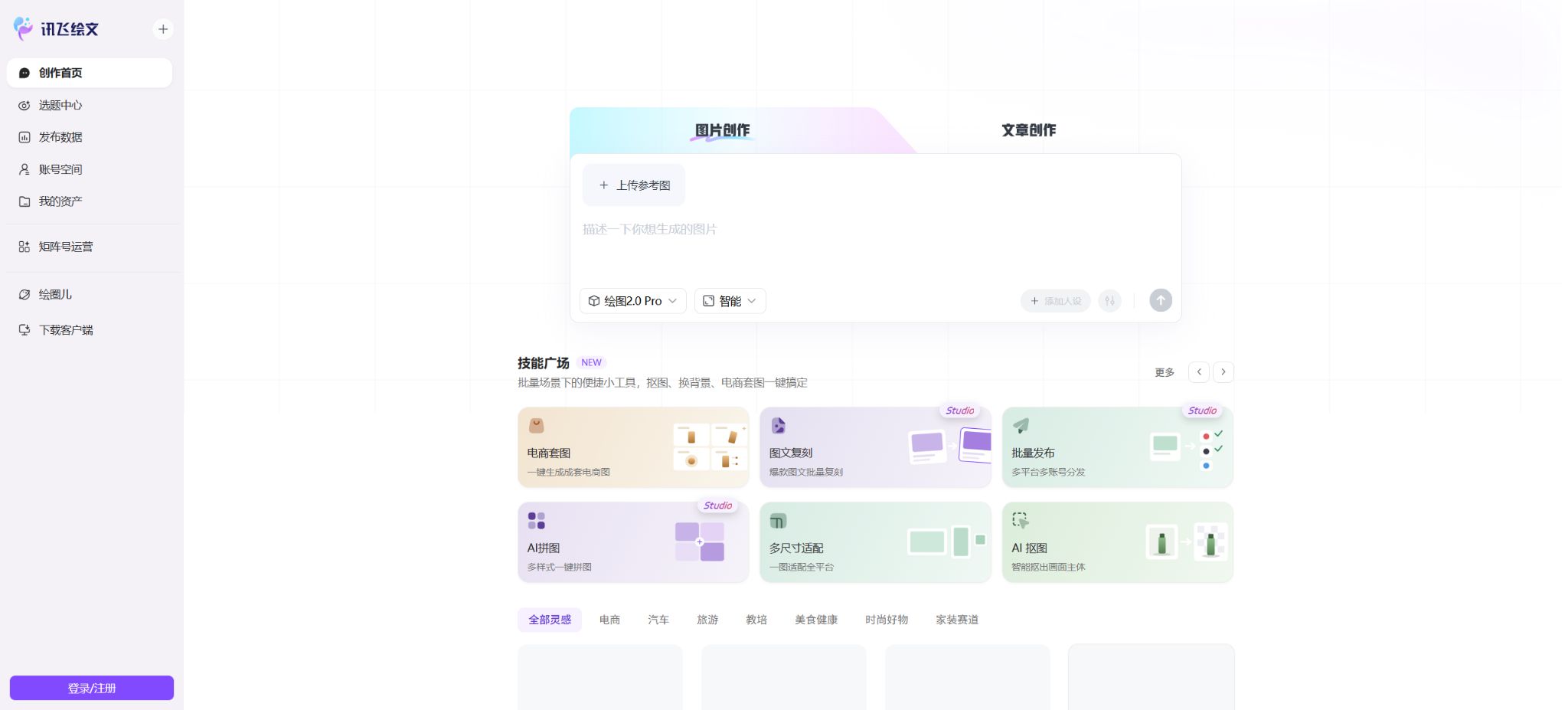
iFlyText is a one-stop AIGC content management platform developed by iFlytek, leveraging its iFlyFire large model and automated publishing capabilities. It is not merely an AI article generator; rather, it integrates various steps such as topic selection, data collection, writing, review, image addition, formatting, account publishing, comment management, and data analysis into a cohesive process. It is designed for use on content platforms such as WeChat Official Accounts, Today’s Headlines, REDnote, Baidu Baijiahao, and Zhihu.
In its early stages, the platform focused on AI-driven writing, image addition, and formatting for official accounts; it has since expanded to include functions such as content management agents, skill-based tools, subscription services for popular content in specific categories, multi-account management, GEO-based content creation, and batch production of images and text. The old \"Express Version\" has been upgraded and replaced by the Professional Version, with account data being synchronized directly.
Users who prefer a simple creation process can start creating freely in the Professional version by going to the \"Creation Home Page – Blank Document\".
Core functions
| Package or version | Prices, quotas, and core benefits |
|---|---|
| Pro | Under the current membership benefits, Lite and Pro typically offer 3 avatars, while Studio provides up to 20 avatars. Pro allows binding of 3 accounts per platform, whereas Studio supports 20 accounts per platform. |
| Lite | Under the current membership benefits, Lite and Pro typically offer 3 avatars, while Studio provides up to 20 avatars. |
1. Trending and niche topics
iFlyText provides a topic selection center that helps keep track of current trends, popular content, and industry-specific developments; it also offers personalized suggestions for topics based on the user’s profile. Users can start creating content by using these trending topics, or they can subscribe to the most popular content in their field, thereby reducing the time spent searching for materials across different platforms every day.
The hot topics list merely indicates the level of visibility of certain content, and it does not mean that such content is suitable for all accounts. In cases involving breaking news, policies, medical issues, or social events, it is necessary to verify the time of publication, the original source, and the latest developments; one should not simply rewrite the aggregated summaries and publish them as is.
2. AI article generation
The platform supports direct text creation, multiple versions for the same topic, free-form writing, and industry-specific workflows. Users can enter the topic, target audience, purpose of the content, word count, tone, and the platform to be used, after which the AI generates a draft.
The official homepage identifies users from the self-media sector, media journalists, as well as those interested in brand planning and creation as typical users.
\"Writing multiple versions of one topic\" is suitable for creating content from different perspectives on the same product or event, but it is essential to avoid posting highly repetitive text across multiple accounts. The final version should include real-life examples, verifiable data, and personal insights, while eliminating vague generalizations.
3. Imitation, rewriting, and secondary creation
Users can learn the structure, rhythm, and style of writing from reference articles, and use this knowledge to replicate, rewrite, or create new content based on those articles. They can also adapt the content for different platforms. When replicating text, it is appropriate to draw on methods rather than copying the original sentences, unique examples, and opinions.
The fact that the platform offers such functions does not mean that users automatically obtain the copyright to the reference works.
4. Cross-platform compatibility
The same content can have its title, length, tone, and structure adjusted for platforms such as WeChat official accounts, Toutiao, REDnote, and Zhihu. For example, WeChat official accounts are better suited for longer articles, while REDnote emphasizes thumbnails, short paragraphs, and topic tags; Toutiao focuses on information density.
Cross-platform adaptation can reduce the amount of work required for rewriting, but manual verification of the format, sensitive terms, and community rules for each platform is still necessary.
5. GEO content creation
The current homepage offers tools for creating GEO content. GEO is designed for use in generative AI and intelligent query-response scenarios; it helps brands organize content around user questions, entity information, and key keywords, thereby enabling more accurate recognition in AI-driven searches and responses.
iFlyText provides functions for searching for popular content as well as for publishing it, making it suitable for combining topics, keywords, and distribution channels.
GEO does not mean simply stuffing in keywords, nor does it guarantee that a brand will appear in the AI-generated responses. High-quality content still requires identification of the author and organization, inclusion of verifiable facts, addressing real user questions, and regular updates.
Exaggerating data, creating large numbers of low-quality pages, or falsifying professional experience can damage both search rankings and brand reputation.
6. Private content and personalized writing
Users can import their own files and materials, incorporating product information, brand descriptions, past articles, and case studies into the creation process. The platform also allows for the creation of customized creator profiles, ensuring that the articles maintain a consistent identity, tone, and style.
Under the current membership benefits, Lite and Pro typically offer 3 avatars, while Studio provides up to 20 avatars.
Private domain knowledge can enhance the relevance of the information, but it does not automatically determine whether the data is outdated. Before uploading, customer privacy information, keys, unpublished financial data, and any content that cannot be processed should be removed, and the update dates for prices, policies, and product parameters should be indicated.
7. Agent and Skills
iFlyText integrates the steps of topic selection, data collection, writing, review, and image addition into content operation Agents and Skills. Users can choose industry-specific workflows for creating content, or they can utilize batch processing capabilities to generate multiple sets of content.
The official homepage currently shows the use case of generating 50 sets of images and text at a time, which is suitable for events, matrix accounts, and material testing.
Batch generation tends to increase factual errors, copyright risks, and duplicate content. When using Skill, it is advisable to first test the input fields, facts, and layout with a small number of samples before increasing the batch size.
Each batch requires random testing, and important accounts cannot be released automatically.
8. Title generation and content processing
The platform can generate multiple titles, and it can also refine the text, expand or abbreviate it, as well as adjust its style. The titles should be suitable for A/B testing, but exaggerated claims that do not match the content of the text should be avoided.
Titles related to healthcare, finance, education, and product efficacy must particularly comply with advertising and platform rules.
9. Content review and proofreading
The official homepage emphasizes the proofreading of manuscripts and the assessment of content risks, in order to identify spelling errors, issues with expression, and potential risks. The results of this assessment serve as helpful suggestions only, and they do not constitute proof of compliance with legal requirements.
Policy statements, sensitive topics, commercial advertisements, citations, and portraits still require final approval by the editor or legal department.
10. AI image matching and image generation vouchers
iFlyText can generate images based on the semantics of the text, or it is possible to use high-quality image libraries. Current members have access to advanced models through special \"image generation vouchers\": 35 images per month for the Lite version, 120 images per month for the Pro version, and 1200 images per month for the Studio version.
Image quotas and drawing points are distinct resources; the concept of \"unlimited drawing points\" does not mean that all advanced image generation functions are also unlimited.
For automatically generated images, it is necessary to check the hands of the people depicted, logos, text, product details, and copyright issues. News reports should not use AI-generated images that could be mistaken for real scenes;
When releasing content to the public, it is also necessary to comply with the requirements regarding the labeling of AI-generated content.
11. Formatting for light graphics and official accounts
The platform offers simple graphic templates, AI-generated images, and automatic layout functions, making it suitable for use in articles for official accounts, social media cards, and materials aimed at attracting customers. Users can further edit the titles, paragraphs, images, and styles.
After copying it to a public account or another backend platform, it is necessary to recheck the font style, spacing, image clarity, links, and the preview on mobile devices.
12. Multi-platform accounts and one-click publishing
iFlytek Text-to-Image allows users to link accounts from content platforms and publish content with just one click, while also enabling the specification of the location from which the content is published. The Pro version supports linking 3 accounts per platform, whereas the Studio version supports 20 accounts per platform.
Lite also supports multi-platform distribution, but the exact number of accounts is subject to the information on the member page.
One-click publishing requires authorization from the target platform as well as a valid interface status. Platform rules, login verification, QR codes, risk control measures, and changes to the interfaces can all lead to failure.
Before publishing, verify the account details, cover image, originality statement, scheduling settings, and visibility options to avoid posting for the wrong brand or repeating posts.
13. Comments and data review
Pro and Studio offer the ability to aggregate comments and responses across multiple accounts, as well as to compile data on exposure, interactions, and performance across different platforms, thereby assisting managers in comparing the effectiveness of various topics and content. The data dashboards are useful for analyzing trends, but since each platform uses different metrics, views, plays, interactions, and conversions cannot be simply added together.
Free point drawing and membership system
iFlyText for Image Generation relies on free credits, drawing points, image creation vouchers, and membership subscriptions. The available product tiers include three main membership levels: Lite, Pro, and Studio, with options for monthly or annual payment.
On the home page, options for continuous monthly and annual subscriptions are available; the annual subscription is offered at a 30% discount.
The actual amount is provided by the member interface after logging in to the account; without logging in, the complete settlement price may not be displayed correctly on the official website, so the information shown on the payment page should be taken as the reference.
Lite
- 3,000 drawing points per month, plus 35 drawing points awarded daily;
- 35 new image credits per month, for advanced models;
- Subscription to popular content in specific categories and personalized topic selection for accounts;
- The industry’s most popular workflows, as well as those for imitation and rewriting, each enable the creation of over 300 pieces of content;
- 3 exclusive creator avatars; the current configuration is marked as free of charge.
- AI-generated images, image libraries, and multi-platform publishing.
Lite is more suitable for steady updates with a single account or a small number of accounts. The public price listed on the website is usually 29 yuan per month, but the actual price is shown in the real-time product list after logging in; promotions and different distribution channels can change this price, so 29 yuan should not be considered a fixed price forever.
Pro
- Unlimited drawing points – unlock endless creative possibilities;
- 120 premium image generation vouchers per month;
- Various practical skills and batch operations;
- Each platform is associated with 3 accounts, and it is possible to specify the location where the content will be published.
- Aggregated comment responses, subscription to niche content, and personalized topic selection;
- Industry workflows, paraphrasing and rewriting, as well as simple graphics, are usually available in unlimited quantities;
- 3 exclusive creator personas and releases across multiple platforms.
On current market pages, a short-term trial of Pro is often available for 3 yuan per 3 days; there are also options at around 69 yuan per month or as annual subscriptions. However, different plans may be offered for short-term trials, first purchases, and renewals. Before making a purchase, it is necessary to check whether automatic renewal will occur, the amount charged after the trial period ends, the rules regarding fair use of unlimited benefits, and the number of image-generation vouchers available.
Studio
- Infinity drawing points and higher-order batch Skills;
- 1,200 premium image generation vouchers per month;
- Each platform can be linked to 20 accounts;
- 20 exclusive creator avatars;
- It includes multi-account commenting, topic selection, unlimited workflow options, as well as the ability to rewrite and publish content;
- It is positioned as a matrix-number management solution.
Studio is intended for organizations, MCNs, and brands that have content portfolios. On external public pages, the price is usually 599 yuan per month; however, the official party will determine the actual cost based on whether payment is made on a monthly or annual basis, the level of the Studio account, any discount coupons available, and the number of accounts. The final amount will be indicated on the settlement page after logging in.
Companies should also address multi-person collaboration, invoices, account permissions, data, and after-sales support.
How to estimate the usage cost?
Low-frequency individual users should first count the number of articles they produce each month, the number of AI-generated images they use, and the platform accounts that need to be linked. For articles, the consumption is determined by the number of drawing points used, while for images it is determined by the number of image generation credits utilized.
If a large number of images are generated, even Pro’s “ Unlimited Drawing Points” option may run out of its 120 image-generation credits first.
For matrix operations, it is also necessary to count the number of accounts on each platform; only when there are more than 3 accounts does a comparison with Studio take place.
Although the annual plan is listed at a 30% discount, it is necessary to determine whether the benefits are provided in one lump sum or refreshed on a monthly basis, whether unused credits and vouchers for creating images carry over, and what the expiration date will be after automatic renewal is disabled. One should not focus only on the term “unlimited creation”; it is also important to check aspects such as concurrency, batch processing, image models, and any restrictions related to abnormal usage.
Multi-platform publishing process
- In account management, link accounts of content platforms that possess administrative rights;
- Create articles from hot topics, subscriptions, private content, or custom themes;
- Select the persona, workflow, and target platform to generate and refine the text;
- Conduct proofreading and risk assessments to verify facts, citations, and advertising statements;
- Create or upload images to finalize the lightweight graphic content and the platform layout;
- Check the title, cover, tags, originality statement, and publication date;
- After publication, check the results on the data dashboard and the comments section;
- Adjust the topics for the next round based on exposure, interaction, and conversions.
When binding an account for the first time, it is recommended to first publish a draft or conduct tests on a small scale. Third-party authorizations should be checked regularly, and accounts that are no longer in use should have their bindings removed promptly.
The matrix team should clarify who is responsible for generating, reviewing, and ultimately releasing the content.
Commercial use and copyright
Users can use the generated content for their own business activities, but they must still ensure that the input materials and the final output are legal. Reference articles, news photos, image libraries, fonts, portraits of people, trademarks, and product data may be subject to the rights of third parties.
When paraphrasing an article, it is not allowed to copy the original expressions; moreover, AI-generated images must also be checked to ensure that they do not contain protected trademarks or are too similar to existing works.
The results generated by the platform clearly state that they are for reference only. Health, investment, legal, educational policies, and news content must not be published without verification.
Commercial promotions must also indicate the advertising nature, the actual price, and the applicable conditions; it is not allowed to use fake examples or fabricated customer reviews.
Is it open source and does it have an API?
The iFlytek Writing Tool website, its agents, operational workflows, multi-platform publishing capabilities, and data dashboards are not open-source products; the weights of the iFlytek Xinghuo models as well as the complete source code of the products are not made public by iFlytek Writing Tool. The SDKs, examples, or other projects that iFlytek releases on GitHub do not mean that the Writing Tool platform is open-source.
The official website offers online products to ordinary users; for needs related to enterprise automation, bulk integration, and private deployment, it is necessary to consult iFlytek. There are no official documents indicating that the points earned by individual members can be used as a credit for the general writing API, so one should not confuse web-based membership accounts with the interfaces of the open platform.
Supported platforms
iFlyText Writing focuses on the Web Professional version, and users of the old Quick version have been guided to switch to the Professional version. The product architecture of the official website still maintains the capability to link clients with content platforms.
Data from different interfaces can be synchronized, but complex editing, batch generation, account management, and data dashboards are better suited for desktop browsers.
Whether independent Windows, macOS clients, or mini-programs are available is determined by the current download and account page.
IFLYTEK Text Drawing Tutorial
Create reusable professional workflows
- Create a brand term list, prohibited expressions, and approved sample texts;
- Organize hot topics and niche subjects, AI-driven article generation and paraphrasing, as well as rewriting and secondary creation into fixed processes.
- Designate responsible persons for research, the first draft, editing, and fact-checking respectively;
- Randomly check whether the model fabricates numbers, sources, or examples;
- Compare readability, conversion rates, search performance, and rework time;
- The templates and rules are continuously updated based on actual outcomes;
Which users are it suitable for
- Self-media creators who maintain active WeChat official accounts, Toutiao, REDnote, Zhihu, and Baidu Baijia accounts;
- Media editors and journalists who need hot-spot tracking as well as rapid drafting and publication;
- Marketing teams that use private data to create brand content, product promotions, and campaign materials;
- Enterprise new media professionals who need to rewrite content, add images, arrange layout, and publish it across multiple platforms;
- MCN and matrix teams that manage multiple accounts as well as handle comments and data;
- Brands and content marketers who wish to use GEO content to address issues related to AI search.
Usage restrictions and precautions
- The faster the writing speed at a hot topic, the greater the risk of factual errors.
- It is necessary to verify the time of the event, the identities of the individuals involved, the original documents and any recent developments, as well as to distinguish between reports, comments and advertisements.
- The data aggregated by the platform and the AI recommendations cannot replace news interviews or professional review processes;
- One-click publishing across multiple platforms has real-world implications, so it is essential to avoid using the wrong account, using an incorrect cover image, including sensitive content, and posting content repeatedly.
- The team should establish permissions for “creation—editing—review—publication,” and not allow the AI to bypass the final approval process.
- Uploading company information and linking an account involves cloud data as well as authorization from third-party platforms;
- Materials that require organizational permission should be used, and unnecessary authorizations should be revoked on a regular basis to prevent multiple people from sharing the same personal account.
- Manual checks should also be carried out for automated comment responses, in order to prevent inappropriate promises or incorrect replies to questions from sensitive users.
Frequently Asked Questions
Is iFlyText free?
You can register and take advantage of free credits such as points awarded daily. For frequent creation, advanced image generation, more workflows, account linking, and matrix management, a Lite, Pro, or Studio membership is required.
Which content platforms does iFlyText support?
The product’s targeting covers platforms such as WeChat Official Accounts, Today’s Headlines, REDnote, Baidu Baijiahao, and Zhihu; however, the available platforms for integration and content publishing are determined by APIs, account types, and platform rules.
What is the difference between Lite and Pro?
Lite offers 3,000 drawing points and 35 image generation credits per month, making it suitable for light-level creation; Pro provides unlimited drawing points, 120 image generation credits, more batch processing options, 3 accounts per platform, and unlimited workflows.
Who is Studio suitable for?
Studio is designed for matrix-based operations; each platform can be linked to 20 accounts, offering 20 different avatars as well as 1,200 premium image generation credits per month. It is suitable for MCNs, agencies, and brand teams.
Can iFlyText be posted directly to a public account?
It supports binding and publishing across multiple platforms, as well as providing formatting capabilities. When using it for the first time, it is necessary to test the authorization and draft versions first, and to manually check the format, cover page, statements, and account details before publishing.
Can iFlyText create GEOs?
The current homepage offers tools for creating GEO content, which is used to organize material around AI-driven questions and brand-related keywords. It does not guarantee that such content will be cited by AI systems; genuine, professional, and regularly updated content remains essential.
Is iFlyText open-source?
It is not open-source. The platform, agents, and automated deployment systems are proprietary cloud services; Xunfei’s other publicly available SDKs do not equate to the source code for Xunfei Huiwen.
Tools similar to iFlyText for drawing text




 Guigong Network Security Registration No. 45132202000164