






ContextClue - Next-Gen Knowledge Management for Engineering
ContextClue – Next-Gen Knowledge Management for Engineering, making AI-driven searches more efficient and simpler.
Tags:AI search engineWhat is ContextClue?
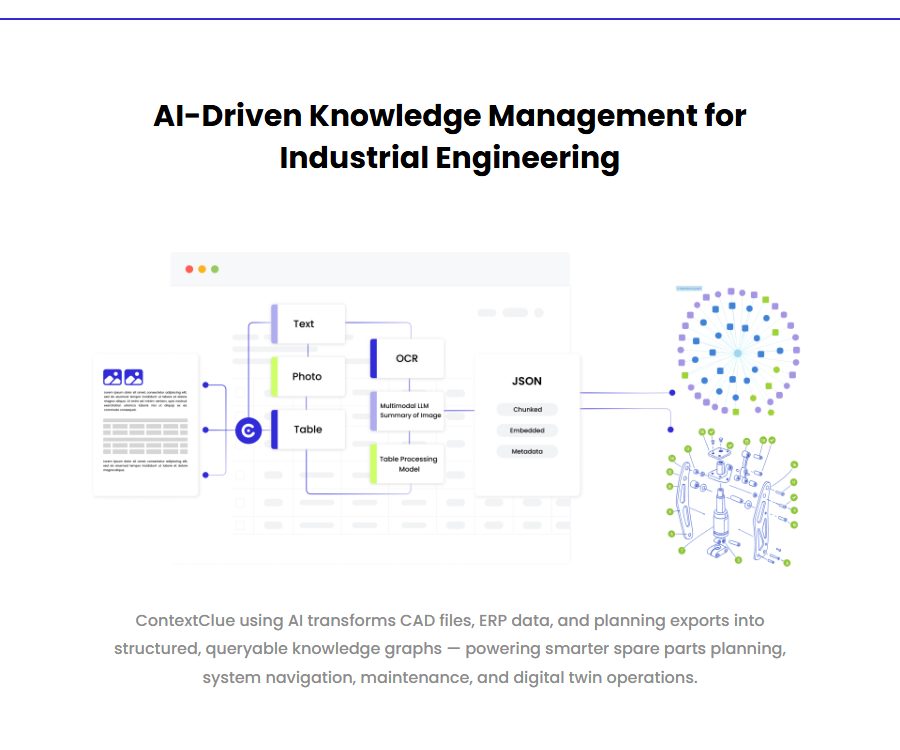
ContextClue is a corporate knowledge management platform developed by the AI and data consulting company Addepto; it currently serves teams in industrial engineering, manufacturing, research and development, and maintenance. It connects CAD, ERP, PLM, technical documents, and planning data into a searchable and trackable knowledge base.
The platform is not a lightweight SaaS that can be used independently once registered; rather, it is an enterprise-grade PaaS that requires consultation, data integration, permission settings, and implementation support. Organizations can opt for the complete product or deploy only the modules for data ingestion, retrieval, or content generation.
Three types of core modules
Data ingestion and standardization
- It connects to existing PLM, ERP, document management, and file systems, reducing the need to migrate all data in order to launch a knowledge platform.
- It can handle files in CAD, PDF, Word, Excel, as well as export formats for planning purposes; it also supports scanned documents and code repositories, covering more than 20 different types of technical document formats.
- Through OCR, classification, entity recognition, and metadata completion, scattered documents are organized into a unified structure suitable for use by AI.
- It automatically establishes connections between parts, drawings, equipment, locations, system levels, and maintenance records.
Retrieve: Search and knowledge navigation
- It supports queries using keywords, natural language, metadata, and structural relationships; information can be found by part, function, behavior, location, or role.
- The results can be presented through chat-based queries, system trees, semantic search, and visual knowledge graphs, making them suitable for identifying specifications and historical records across different systems.
- The platform can synchronize connected data, and manual refreshes are also possible as per the settings; the frequency depends on the specific system and implementation approach.
- Role-based access control is used to limit the datasets that departments and users can see, while communication tools such as Slack and Teams can serve as entry points for work.
Generate – creation and visualization
- Utilize the organized information in the knowledge base to create drafts of SOPs, technical documents, compliance materials, project reports, and template-based files.
- The output can be intended for human reading, or it can take the form of machine-readable data such as JSON, knowledge graphs, and coordinate mappings.
- Map relationships can be used for component planning, maintenance analysis, factory layout navigation, and the preparation of digital twin data.
- The generated content still needs to be reviewed by engineers or business managers, especially with regard to security measures, regulatory requirements, and device parameters.
Key capabilities and values
- Cross-document understanding: Maintains the context across different files and systems, linking components, assemblies, locations, and maintenance events.
- Reuse of engineering assets: enables faster access to existing specifications, drawings, and standard components, thereby reducing redundant design work and loss of knowledge.
- Maintenance support: Track faults, past operations, and related documents from the device view to assist with diagnosis and spare parts planning.
- Report automation: Data is gathered using organizational templates, which reduces the time required to prepare SOPs, audit, and compliance reports.
- Dialog-based data analysis: Access SQL databases, BI dashboards, and business reports using natural language.
- Model replaceability: The platform adopts a plug-and-play approach for models, allowing the actual LLMs to be configured in accordance with customer requirements and deployment constraints.
Input and output
| Data type | Common inputs | Handling method | Output or purpose |
|---|---|---|---|
| Engineering documents | CAD, drawings, BOM, plan export | Parsing, entity recognition, relationship mapping | Component diagrams, system trees, digital twin data |
| General documents | PDF, Word, scanned documents, reports | OCR, classification, summarization, semantic indexing | Search results, Q&A, SOPs, and reports |
| Structured systems | ERP, PLM, SQL, BI data | API connection, standardization, regular synchronization | Cross-system querying, analysis, and metric interpretation |
| Interactive input | Natural language questions, templates, and generation requirements | Search-enhanced generation and permission filtering | Answers, drafts, JSON, or graph structure |
Implementation process
- Free consultations are available to clarify business issues, target users, data scope, compliance requirements, and expected benefits, along with the opportunity to view targeted demonstrations.
- Choose a full-stack product or the Ingest, Retrieve, Generate modules, and decide on whether to opt for pilot, cloud, on-premises, or hybrid deployment.
- The IT and implementation teams establish connections between systems such as ERP, PLM, and document repositories, and configure identity authentication, role permissions, and data residency settings.
- The sample files are acquired, and parsing, classification, entity standardization, and knowledge graph construction are carried out; thereafter, domain experts verify the quality of the relationships.
- Enable search, Q&A, graph navigation, and workflow generation; set up report templates, approval rules, and business system interfaces.
- Conduct user acceptance testing and training, and after deployment, continuously monitor search quality, hallucinations, permissions, synchronization, and model costs.
Basic integration usually takes weeks to months, with the scale, complexity of the files, number of connectors, and model optimization all affecting the duration. Enterprise-level deployment requires involvement from IT professionals; it cannot be carried out solely by end users.
Comparison of deployment methods
| Plan | Composition | Deployment features | Suitable for users |
|---|---|---|---|
| All-in-one Product | Pre-configured complete knowledge management process | Fewer customizations on the backend, faster time to deployment, and more standardized processes | Large and medium-sized organizations that are establishing a unified knowledge platform for the first time |
| Modular Integration | Select the ingestion, retrieval, or generation module as needed. | Integrated into existing systems, with greater customization; pilot implementation is possible before further expansion. | Teams that already have a technology stack or only need to address specific bottlenecks |
| Cloud deployment | Managed infrastructure and enterprise connectivity | It is easy to expand; the location of the data and the boundaries of the services require confirmation through a contract. | Organizations that embrace cloud environments and place importance on elasticity |
| Local or hybrid deployment | Customer environment or cloud combined with on-premises solution | Greater data sovereignty and control, along with higher requirements for hardware and operations. | Sensitive data scenarios such as manufacturing, healthcare, and law. |
Price and procurement methods
ContextClue does not disclose any fixed prices per user or per volume of usage; for official projects, quotes are determined based on the amount of data, the modules used, the connectors, the method of deployment, and the extent of customization required. A free consultation does not mean that the product or trial version is free of charge.
| Package or version | Price | Billing cycle | Core benefits or quota | Suitable for users |
|---|---|---|---|---|
| Plan: Planning phase | Free | One-time initial communication | LLM consulting, feature selection, and demonstrations; production systems are not included. | Organization responsible for assessing needs and feasibility |
| Implementation Execution | Custom quote | Fixed project price | Use case analysis, environment deployment, data ingestion, customization, acceptance, and deployment | Pilot or formal project team |
| Maintenance – upkeep | Custom quote | Monthly | System maintenance and support; the specific service levels are defined in the contract. | Customers that are already online and require ongoing maintenance. |
The public page does not provide information on the trial quota, number of users permitted, refund policy, costs associated with the models, hardware expenses, or SLA specifications. Before making a purchase, it is necessary to verify in detail, through the quote and contract, the requirements for implementation and acceptance, any changes that may be made, third-party costs, procedures for exiting the service, and data migration arrangements.
APIs, models, and integration
- The platform adopts an API-first architecture that enables it to connect with enterprise systems and integrate modular functionalities into existing processes; however, it does not provide complete product API documentation or universal SDKs.
- According to public information, the models can be configured according to customer requirements; no particular model supplier or specific model should be considered as a fixed option.
- The hardware requirements depend on the volume of data, the number of concurrent users, and how the model is deployed; there is a significant difference between small pilot projects and enterprise applications that handle millions of files.
- There is no fixed upper limit for storage; the actual capacity is determined by the infrastructure in place, projected growth, and the terms of the contract.
Open-source projects and product licensing
| Project | Open-source status | Primary uses | Relationship with ContextClue |
|---|---|---|---|
| ContextClue complete platform | Unpublished open-source license | Enterprise knowledge management and customized deployment | Commercial products |
| ContextClue Graph Builder | MIT License | Extract a knowledge graph from documents and tables, with implementations in Python and FastAPI. | Public graph construction tools |
| ContextCheck | MIT License | Test LLMs, RAG, and chatbots using YAML; integration with CI is possible. | Public quality assessment framework |
The two open-source projects are merely independent tools within a complete product ecosystem; based on these it cannot be concluded that the entire ContextClue enterprise platform is open source. In the current version of Graph Builder, the graphs created during operation are not persisted across API restarts, and a persistence mechanism needs to be implemented for use in production environments.
Privacy, security, and copyright
- The platform supports local, cloud, and hybrid deployment, and it is possible to configure strong authentication, role-based permissions, encryption, and monitoring; whether these features are enabled depends on the implementation plan.
- An organization can restrict the systems and datasets to which ContextClue has access, and choose where the data should be stored based on regional requirements.
- Addepto’s public privacy policy covers website visits and contact data; it specifies that its company in Poland is the data controller, and it addresses topics such as cookies, website analysis, marketing, hosting, and the service providers needed for these purposes.
- The roles involved in handling corporate documents, prompts, model invocations, and generated results, as well as the retention periods, cross-border data transfers, and uses for training, should be specified separately in the product contract and data processing agreement.
- The content of the website is owned by Addepto; the rights to use the commercial platforms are determined by contracts, while the open-source modules are governed by the MIT license.
- The public page does not provide details regarding product refunds; the payment stages, acceptance processes, termination procedures, as well as maintenance and cancellation options should be specified in the contract.
Capacity boundaries
- The quality of parsing for CAD files, scans, and historical documents is influenced by the file format, image clarity, consistency in naming, and the completeness of metadata.
- Incorrect entities or relationships in knowledge graphs can affect search results and the content generated, so it is necessary for domain experts to conduct checks and make corrections.
- Answers to dialogues and automated documents may contain omissions or errors; they cannot be used directly in safety-critical operations without prior review.
- Modular solutions reduce the need to replace systems, but integrating with older ERP, PLM systems or custom-built systems may still require custom development.
Frequently Asked Questions
Which types of companies are ContextClue best suited for?
It is more suitable for organizations that have a large volume of engineering documents, ERP or PLM data, and that need to perform searches across different systems, utilize knowledge graphs, as well as automate documentation tasks.
Is ContextClue a regular SaaS product?
It is not a simple self-service SaaS solution; it belongs to the category of enterprise platforms that require consultation, IT integration, implementation, and ongoing support, with the initial integration process typically taking weeks to months.
Can it be deployed locally?
Yes. The platform supports cloud, on-premises, and hybrid deployment; the location of data, the models used, the hardware, as well as security controls need to be determined during the implementation phase.
Is there a free version of ContextClue?
The free phase includes only consultation, feature selection, and demonstrations; it does not include a production platform. Implementation is offered at a fixed project price, while maintenance services are charged on a monthly basis.
Is ContextClue open source?
The complete enterprise platform does not have an open-source license made public. Graph Builder and ContextCheck are companion tools that utilize the MIT license respectively.
Which files and systems are supported?
Common inputs include CAD, PDF, Word, Excel, scanned documents, plan exports, and code repositories; it is also possible to connect to ERP, PLM, SQL, BI, and document management systems.
Tools similar to ContextClue – Next-Gen Knowledge Management for Engineering



 Guigong Network Security Registration No. 45132202000164