






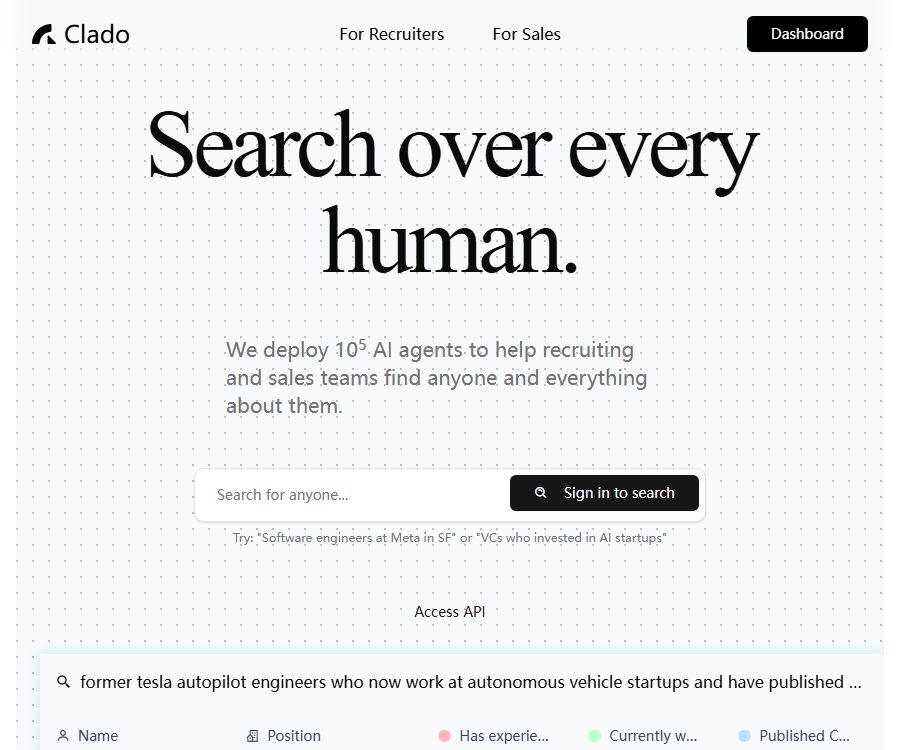
Clado
Clado – makes AI-powered searching more efficient and simpler.
Tags:AI search engineWhat is a clade?
Clado is a platform for searching for individuals, conducting in-depth research, and completing professional profiles; the current web-based version of this product is called Clado Atlas. Hiring, sales, and investment teams can describe the target audience in natural language, and the system will then filter candidates or potential contacts from a large database of professional profiles.
The product doesn’t only rely on keyword matching; it also converts natural language into structured criteria, and uses AI to determine whether the data meets the specified standards. The results can be supplemented with information such as email address, phone number, GitHub profile, Google Scholar details, and other public professional profiles.
Current product and company status
| Project | Status verified | Usage meaning |
|---|---|---|
| Clado Atlas | The website and API are still online. | The character search and completion feature is available for registration and use. |
| Founding team | Eric Mao and Tom Zheng | The same team is currently showcasing Freesolo at Y Combinator. |
| Clado brand | It was listed among the items previously released by the team. | It does not mean that the product has been discontinued or sold out. |
| Main text of the terms | Linkd Inc. | Before signing a contract, a company should verify the current contracting party. |
| Web package | Not yet made public | Atlas seat and team prices require confirmation from the account or sales team. |
| API | Public documents and pay-as-you-go pricing | Suitable for programmed search and data completion. |
There are differences in timing and wording among the brand page, the Y Combinator page, and the legal documents. Companies should not assume on this basis that Clado has been acquired or ceased operations; instead, they need to obtain written confirmation regarding the entity responsible for providing the services, the product roadmap, the duration of support, and data responsibilities.
Index of characters and unified information
- The official website claims to cover over 800 million individuals, more than 60 billion records, and over 640 million email addresses.
- The system connects different social and professional profiles into a unified profile, enabling a comprehensive understanding of an individual’s experiences and skills across various channels.
- Examples of public pages include professional or research profiles on LinkedIn, GitHub, Twitter, and Google Scholar.
- The large-scale digital index represents the range claimed by the platform; it does not guarantee that everyone’s profile is complete, up-to-date, or legally usable in all regions and situations.
- Same name, name changes, resignation, part-time employment, and privacy settings can lead to merging errors; manual verification of identity is required before getting in touch.
Natural language character search
- Users can directly describe skills, companies, positions, education, location, work experience, and composite criteria.
- The system converts English natural language queries into search criteria, and then performs a relevance match on the candidate documents.
- Complex conditions can express combined requirements such as “having worked at a certain company,” “holding a certain degree,” or “being located in a certain area.”
- The number of search results can range from dozens to thousands, making it suitable for analyzing talent pools, sales lists, and investors.
- Natural language is interpreted by the model, and vague requirements can introduce biases; important filtering criteria should be expressed as verifiable facts.
AI agent screening and in-depth research
- Clado claims to use multi-agent parallel processing to evaluate each candidate material individually to determine whether it meets the user’s criteria.
- Deep Research runs as asynchronous tasks, making it suitable for large-scale searches; it also allows users to view the status, cancel operations, and continue expanding the search results.
- The platform can provide the reasons for each match, but the team still needs to refer back to the original materials to verify the key experiences.
- In-depth research is charged based on the number of results returned; the broader the search, the more results are obtained, and the higher the amount of points consumed.
- Cancelling requests and checking status do not consume any points, but the results that have been successfully returned may have incurred costs.
Complex condition matching
| Condition type | Input example | Suitable scenarios | Key points for review |
|---|---|---|---|
| Professional experience | Once worked at a designated company | Competitor talents and industry experts | Job duration and company entity |
| Educational background | A professional degree or a doctoral degree | Recruitment for research and technology roles | Names of schools, degrees, and specialties |
| Skills | Machine learning, backend, or specific frameworks | Search for technical positions and consultants | Actual project depth |
| Location | Currently living in the Bay Area or New York | Local recruitment and sales regions | Data update time |
| Multiple condition combinations | The industry, position, education level, and location must all be met. | Search within a narrow demographic group | Do not introduce discrimination based on protected attributes. |
Complete the information
- Profile Enrichment allows for the addition of email addresses, phone numbers, and other professional profile links.
- A fee is charged for email addresses or phone numbers only if they are successfully found; no points are deducted if no such information is available.
- Batch completion is suitable for processing existing LinkedIn addresses or candidate lists, and it allows for tracking tasks in an asynchronous manner.
- The completed data may be personal data, and having contact information does not constitute a legitimate basis for sending marketing emails or recruitment messages.
- Before use, checks for duplicate removal, unsubscribe processes, blocked contact lists, regional compliance, and data minimization should be carried out.
Monitors provide continuous monitoring.
- The official website describes Monitors as a feature that alerts users when new candidates meet the required criteria, making it useful for identifying potential employees or founders.
- Monitoring can reduce the need for repeated manual searches, but the public page does not specify the refresh frequency, the channels for receiving notifications, or any restrictions on packages.
- The monitoring conditions should be checked regularly to prevent the continued collection of irrelevant personal data after changes in the organization’s objectives.
- When recruiting, human decision-making must be retained; candidates cannot be rejected solely based on automatic matching.
Recruitment, sales, and investment scenarios
| Team | Typical tasks | Primary value | Main risks |
|---|---|---|---|
| Recruitment | Build a candidate pool based on complex experiences and skills. | Reduce the time required for manual searches | Expired data, discrepancies, and employment compliance |
| Sales | Find the decision-maker and obtain their contact information. | Quickly create a list of target accounts | Anti-spam, consent, and unsubscribe |
| Venture capital | Identify founders by field and experience | Continuously monitor newly matched entities. | Misidentification of identity and expectations regarding privacy |
| Research | Linking careers, codes, and academic records | Create a unified character profile. | Incorrect merging and incomplete background |
Usage process of the Atlas web version
- Create an account and confirm the team’s purposes for recruitment, sales, or research, as well as the legal basis for processing the data.
- Describe the target person in natural English, giving priority to verifiable skills, experiences, education, and geographical details.
- First, return a small number of results to see how the model interprets the conditions, and then adjust the query accordingly.
- View the unified information and the reasons for the match, and verify the name, current company, date, and external records.
- Email or phone number completion is applied only to those results that truly require contact, in order to avoid collecting large amounts of irrelevant data.
- Remove duplicates before exporting or entering the workflow, and record the time when the data was obtained, its purpose, and whether contact was declined.
- When sending messages, comply with the applicable rules regarding recruitment, fair employment, privacy, and electronic marketing.
- Regularly delete unnecessary data, and establish procedures for access requests, correction requests, and deletion requests.
Web package and free quota
The Clado official website does not disclose the fixed monthly fee for Atlas, the number of seats available, the benefits associated with team usage, the number of free searches permitted, or the rules regarding renewal. The information about free searches and monthly fees mentioned on third-party sites cannot replace the current benefits offered by the account; therefore, no definite prices can be stated.
| Package or version | Price | Billing cycle | Core benefits or quota | Suitable for users |
|---|---|---|---|---|
| Atlas web version | Not yet made public | Not yet made public | Character search, in-depth research, and data completion; the specific limits depend on the account. | Recruitment, sales, and investment teams |
| Enterprise solutions | Contact sales | Contractual agreement | Team, support, custom speed limits, and compliance requirements need to be confirmed. | Widespread use of tissues |
| Pay-as-you-go API usage | 0.01 US dollar per point | Deduction is made based on successful operations. | Searching, researching, data extraction, and contact completion | Development team |
API features
| API capabilities | Main inputs | Main output |
|---|---|---|
| People Search | Natural language, number of results returned, and filtering settings | Standardized character profiles and correlation results |
| Deep Research | Parameters for complex queries and asynchronous tasks | Large-scale results verified by AI |
| Contact Information | LinkedIn profiles and contact types | The email address or phone number was successfully found. |
| Profile Scrape | LinkedIn profile address | Detailed professional profile |
| Bulk Enrichment | Information on multiple characters | Batch contact information and task status |
| Post Reactions | LinkedIn post | Interactive users and participation in analysis |
All endpoints require Bearer token authentication, and API Keys use a specific prefix. Responses are returned in standardized JSON format, and the documentation warns that the instructions generated by AI may contain errors.
API credit price
| Operation | Price | Billing method | Usage tips |
|---|---|---|---|
| AI-based filtering for person searches | 1 point for each result | Based on the actual results returned | Advanced filtering is enabled by default. |
| Standard character search | 5 points per time | Fixed | Turn off advanced filtering. |
| In-depth research | 1 point for each result | Initiate or continue returning results | Status and cancellation are free. |
| Complete email address | Success: 4 points | No free options found. | A free trial is not available. |
| Phone completion | 10 points for success | No free options found. | A free trial is not available. |
| Email and phone number | Up to 14 points | Charges are applied separately to each item that is found. | Points must have been purchased. |
| Fetch LinkedIn data | 2 points per time | Successful request | Pay attention to the platform and privacy rules. |
| Read database data | 1 point per time | Successful request | Cached results are still billed. |
| Post interaction analysis | 1 point per time | Successful request | Suitable for interactive research |
Each point is worth 0.01 US dollar; therefore, completing the email field earns approximately 0.04 US dollars, while completing the phone field earns about 0.10 US dollars. Server-side errors do not incur any cost, but both cached responses and responses to new data require the same number of points.
API rate limiting
| Endpoint | Free | There is a paid option. | Total payment: 50 dollars | Total payment: 250 dollars |
|---|---|---|---|---|
| Character search | 20 times per minute | 20 times per minute | 200 times per minute | 400 times per minute |
| Contact information completion | Unavailable | 5 times per minute | 60 times per minute | 120 times per minute |
| Data extraction | 15 times per minute | 15 times per minute | 150 times per minute | 300 times per minute |
| Database information | 20 times per minute | 20 times per minute | 200 times per minute | 400 times per minute |
| Post interactions | 10 times per minute | 10 times per minute | 100 times per minute | 200 times per minute |
| In-depth research | 5 times per minute | 5 times per minute | 50 times per minute | 100 times per minute |
- If the limit is exceeded, a 429 response is returned along with a suggested time to retry.
- The client should employ exponential backoff, a rate limit on reads, smooth request transmission, and appropriate caching.
- Companies can contact sales to request customized speed limits, but the price and service level will need to be agreed upon separately.
- For cached profiles, mechanisms for updating, correcting, and deleting them must be in place; they cannot be stored indefinitely just to save on retrieval costs.
Privacy and personal data risks
Clado deals with information such as professional experience, education, skills, interests, social profiles, and contact details; it relates to categories of personal data that are highly sensitive. The privacy policy states that account information, user data, content, communications, device details, usage patterns, and Cookie data are collected, and that this data may be shared for purposes such as serving service providers, fulfilling legal requirements, handling transactions, and with the user’s consent.
- The policy outlines rights such as access, correction, deletion, restriction, portability, and objection to processing, but it does not disclose the specific procedures for submitting requests or the time frames for responses.
- It does not specify the sources of the data related to the 800 million character indexes and the 600 billion records, nor the legal basis for their use, the duration for which they are stored, how brokers must disclose this information, or the ways in which users can opt out.
- There is no information provided regarding subcontractors, data regions, cross-border transmission mechanisms, model training policies, or accuracy standards for contacts.
- The privacy policy still describes user profiles in the context of a networking site for alumni and professionals, which does not fully align with the current approaches to person search and data completion.
- Employers and sales teams should carry out data protection impact assessments, regional marketing regulations, and fair hiring reviews on their own.
Safety instructions
| Security projects | Statement on the official website | Purchasing decision-making |
|---|---|---|
| SOC 2 Type I | Certified | It is possible to request information regarding the scope and date of the report. |
| SOC 2 Type II | In Observation | It should not be considered as an audit that has been completed. |
| ISO-related | ISO/IEC 27001:2025 Conformation | A statement is not equivalent to an official certification. |
| Transmission encryption | SSL/TLS | The endpoints and the minimum protocol should be confirmed. |
| Static encryption | AES-256 | It is necessary to verify the data storage and key management in place. |
Public security badges and encrypted statements are not sufficient to replace supplier audits. Companies should request up-to-date reports, penetration tests, incident notifications, access logs, data deletion records, and information related to subcontractors.
Terms and Commercial Restrictions
- The terms designate Linkd Inc. as the entity responsible for the services and intellectual property rights, but they do not clearly explain the contractual relationship between Clado Atlas and Freesolo at present.
- The terms describe the service as a social network for alumni and professionals, which does not align with functions such as searching for real people, carrying out recruitment, or offering sales-related services.
- Users are not allowed to collect or store the personal data of other users without permission, nor to carry out commercial activities without written consent.
- The aforementioned terms may be in conflict with current commercial uses; the paying party must obtain the appropriate corporate contracts and data licenses.
- The content submitted by users grants Linkd Inc. a worldwide, non-exclusive, royalty-free license to use such content.
- The service is provided as it is, and the account may be suspended or terminated in cases of default or similar situations.
API, SDK, and open-source status
- Clado provides public REST API documentation, information on authentication, endpoint details, as well as details regarding pricing and rate limits.
- No official client SDK or official GitHub organization and source code repository for the product were found.
- The link in the database to Tom Zheng’s personal GitHub account does not correspond to the open-source version of the Clado product.
- Clado is a closed-source hosting service; there is no public product license available, and while the API can be used, it does not grant the right to copy datasets or the platform’s code.
Suitability for users and restrictions
- It is suitable for teams that need to identify technical talent, industry experts, potential customers, or founders using complex criteria.
- It allows developers to integrate functions such as person search, data retrieval, and contact completion into their internal processes via APIs.
- It is not appropriate to collect personal contact information in bulk or send unsolicited messages in the absence of a legal basis.
- It is not appropriate to rely solely on AI to automatically reject applicants, make decisions regarding credit, housing, or other matters of significant impact.
- It is not suitable for enterprises whose requirements regarding legal entities, data brokers, deletion mechanisms, and international data transfers are already fully described in the public documents.
Advantages and limitations
| Aspect | Actual judgment |
|---|---|
| Search expression | Natural language and complex conditions are more flexible than traditional keywords. |
| Data coverage | It claims to be large in scale, but its completeness, updating, and legal compliance need to be verified. |
| In-depth research | Asynchronous multi-agent approach is suitable for large volumes; however, manual verification of identity and background is still required. |
| Contact information completion | Charged based on successful results, with associated marketing and personal data obligations |
| API transparency | The endpoints, unit prices, and speed limits are made public, whereas the details related to the Atlas web package remain unclear. |
| Safety | There are Type I and encryption statements; other authentication statuses need to be confirmed. |
| Legal documents | The main text and product descriptions show signs of an older version; the company’s contracts need to be clarified. |
| Privacy transparency | Insufficient instructions for processing large amounts of data related to non-users. |
| Open source | No verified official SDKs, product repositories, or open-source licenses available. |
Summary
Clado Atlas is suitable for teams that wish to create lists of candidates, sales leads, or founders more quickly using natural language and AI agents. It integrates person search, in-depth research, unified profiles, completion of contact information, and API connections on a per-use basis into a single workflow.
The true focus of procurement lies not only in ensuring the right quality and price per unit, but also in considering the parties involved in the contract, the legal basis for handling personal data, mechanisms for correcting errors and deleting unnecessary information, fairness in employment practices, consent for marketing activities, and security audits. Companies should first conduct tests on a small scale in non-sensitive scenarios, and obtain the same legal and data-processing documents as those used for current products before expanding their use.
Tools similar to Clado




 Guigong Network Security Registration No. 45132202000164