






CamoCopy
CamoCopy – makes AI-powered searching more efficient and simpler.
Tags:AI search engineWhat is CamoCopy?
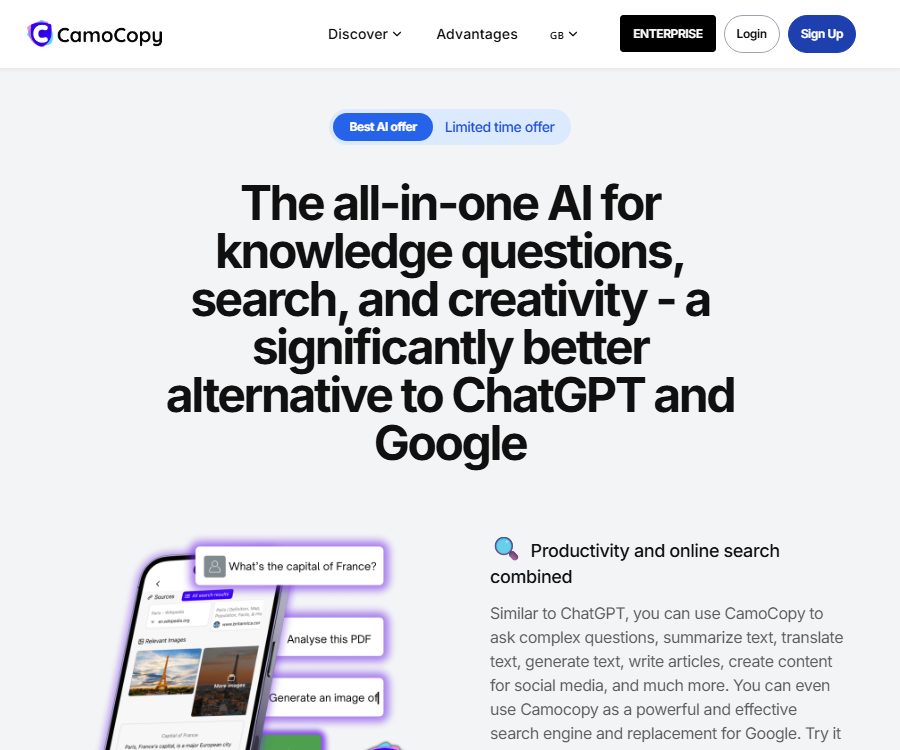
CamoCopy is a privacy-focused AI assistant operated by Restoflix Sàrl.-s in Luxembourg, designed for individuals, teams, and developers. It integrates AI chat, internet searching, document analysis, image understanding, image generation, and file management in a single account.
The product can be used on web browsers as well as on iOS and Android devices, and it offers an API based on a pay-as-you-go model that is compatible with OpenAI. The emphasis is on processing data using European infrastructure, but the specific data pathways vary depending on the model chosen by the user and the payment method used.
Main functions
Multi-model AI chat
- Users can enter questions, writing requirements, code, or text that needs to be organized, and the system will generate answers, summaries, translations, rewrites, and structured content.
- The standard mode utilizes a self-hosted open model and allows for task scheduling among models such as Llama, Mistral, and DeepSeek.
- For the paid features, it is also possible to choose non-public models such as GPT, Claude, and Gemini; the actual models available depend on package options and product updates.
- Custom commands allow you to save settings related to tone, role, and output preferences; the workspace is ideal for managing conversations and related materials related to the same project in one place.
- AI outputs may be incorrect, outdated, biased, or similar to those produced by other systems; important facts must be verified against the original sources.
Private search and web page information
- The built-in search function can handle requests for up-to-date web information, providing search results, images, and answers generated based on the retrieved content.
- Search keywords are processed by the search and crawling services; according to the privacy policy, only non-personal search terms are transmitted to these services.
- By using image proxies, the product reduces the tracking risks associated with the loading of external images, making it suitable for users who do not wish to have their browsing behavior exposed.
- To use the search function, you need to register and log in; moreover, the search results may still be incomplete, misinterpreted, or refer to low-quality web pages.
- The API model name can be supplemented with a suffix for online or advanced search; in addition to the cost associated with using the model, there may be additional fees for carrying out such searches.
Document, Image, and File Workspace
- Users can upload documents in PDF, Word, CSV, image formats, etc., and then request that key points be extracted, tables be explained, the content summarized, or questions related to the files be answered.
- Image analysis accepts photos, screenshots, or scanned documents, and is suitable for identifying interface information, document content, and visual context.
- The image generation feature creates images based on textual prompts; standard images and advanced images require different amounts of resources.
- Files can be placed in folders and reused across multiple conversations; it is also possible to set an automatic deletion time or to delete them permanently manually.
- Permanent deletion and automatic destruction imply that the data cannot be restored; therefore, it is necessary to keep copies required for business operations before deleting them.
Templates, security, and team control
- It includes over 1,000 prompt templates, ideal for quickly getting started with writing, marketing, analysis, learning, and everyday office tasks.
- The account supports two-factor authentication, which helps reduce the risk of unauthorized access in the event that the password is leaked.
- The enterprise solution offers capabilities for managing teams, departments, roles, centralized settlement, custom assistants, as well as restrictions on permissions related to models, searches, and images.
- Enterprise administrators should first define the types of data that can be uploaded, the scope of the models, and the permissions for users, before making them available to all employees.
Usage process
- Register an account via email and enable two-factor authentication; first use the free features to check whether the interface and language meet your requirements.
- Select ordinary chatting, internet search, document analysis, image analysis, or image generation based on the task.
- When dealing with private data, remove names, account numbers, and third-party personal information first, and then select an appropriate model.
- Enter the clear objectives, background, output format, and constraints; when processing files, specify the pages or fields that need to be analyzed.
- Examine the facts, figures, and reference clues in the results; for search tasks, it is necessary to open the original web pages to verify them.
- Place reusable materials in the workspace or folders, and set an automatic expiration time for temporary files.
- Check the account balance when approaching the limit, and compare subscription plans, one-time quota packages, and API usage-based fees.
- When it is no longer in use, cancel the subscription, export the necessary content, and delete the account and related data in the settings.
Input, output, and support platforms
| Category | The content has been verified. | Primary uses | Precautions |
|---|---|---|---|
| Text input | Questions, instructions, articles, code, and search terms | Q&A, writing, translation, summarization, and retrieval | Do not submit personal data for which you do not have permission to process. |
| File input | PDF, Word, CSV, and other documents | File Q&A, extraction, and summarization | The size, number of pages, and package restrictions are determined by the account. |
| Visual input | Photos, screenshots, and scanned images | Image understanding and information extraction | The identification results require manual verification. |
| Generate output | Text, search answers, analysis results, and images | Office work, research, content, and creative tasks | No guarantee of accuracy, uniqueness, or freedom from infringement. |
| Web version | Browser account and workspace | Complete chat and data management | A network connection is required. |
| Mobile version | Native iOS and Android apps | Chat, take photos, and handle documents on the go | In-app purchases are subject to the store’s rules. |
| Desktop and extensions | The native client or browser extension has not been confirmed yet. | It can be used via a web page first. | Web interfaces cannot be considered native applications. |
Suitable for users and scenarios
- Individual users who focus on the data area: handling daily tasks such as answering questions, writing, translating, and searching the web.
- Research and learning users: Search for up-to-date information and ask questions about their own PDFs, tables, and classroom materials.
- Content and marketers: Use templates, rewriting, image generation, and workspace organization to manage materials.
- Small and medium-sized teams: Standardize common tasks and model permissions through roles, departments, and custom assistants.
- Developers and automation teams: Use OpenAI-compatible APIs to integrate with existing code, robots, or self-hosted n8n workflows.
- Model responses should not be used directly in medical, legal, or financial decisions, nor should sensitive third-party data be processed without consent.
Price packages
| Package or version | Price | Billing cycle | Core benefits or quota | Suitable for users |
|---|---|---|---|---|
| Free | 0 euros | Free | Limited core functions; the exact quota has not been disclosed yet. | Registered trial and low-frequency use |
| Plus+ | Promotional price: 14.90 euros | Monthly subscription | No limit on text; 500 standard images and 70 advanced images per month; no limits on searches; paid model | Continuous high-frequency use |
| Lite | Promotional price: 15 euros | One-time purchase | 20,000 words, 400 standard images, 50 advanced images, 100 searches – the quota remains valid indefinitely. | Low-frequency long-term use |
| Standard | Promotional price: 39 euros | One-time purchase | The main pricing page lists 100,000 words, 1,000 standard images, 150 advanced images, and 500 search queries. | Individuals with moderate usage levels |
| Ultra | Promotional price: 99 euros | One-time purchase | 500,000 words, 500 images, 5,000 searches, analysis of files and images, continuous updates | Large number of one-time quota requests |
| Enterprise | 59 euros per user | Monthly subscription | 14-day trial, team management, custom assistants, and centralized settlement | Organization and department deployment |
The page displays the current promotional price; the original price, taxes, region, and payment methods may affect the final amount. Before making a purchase, it is necessary to refer to the actual billing page, the account dashboard, or the corporate contract.
There is a conflict in the quotas listed on different sales pages for Standard: the main pricing page indicates 1,000 standard images, 150 premium images, and 500 search queries, while another sales page shows 100 images and 1,000 search queries. Users should save their order details before making a payment and verify that the allocated quotas have been applied.
Subscriptions, quotas, and refunds
- Plus+ is a subscription with automatic renewal; the terms allow for cancellation via the account or in writing, and the cancellation date shall be as indicated on the account.
- Lite, Standard, and Ultra are one-time quota or access plans; the page states that these quotas do not expire or offer long-term access, but no fixed time frame is specified for the duration of the service.
- The fair use policy allows platforms to limit requests with abnormally high load; the fact that there are no restrictions on text does not mean that automated abuse is permitted.
- The direct contracting party for purchases via the website may be Digistore24 or Creem; rules regarding refunds, cancellations, and order processing are governed by the rules of the respective seller.
- In-app purchases for iOS and Android apps are subject to Apple’s or Google’s respective rules regarding payments and refunds.
- The general terms of CamoCopy do not specify a uniform deadline for refunds across all channels; it is necessary to check the refund and cancellation conditions on the settlement page before making a payment.
API and developer integration
- Register for a CamoCopy account and create an API key in the developer area.
- Change the base address of the existing OpenAI-compatible clients to the CamoCopy interface address, and submit the key using the Bearer method.
- Choose models such as DeepSeek V3.2, Llama 3.3 70B, or Pixtral 12B to which access is granted.
- Use the online search suffix when real-time web information is needed, and use the advanced search suffix for more in-depth searches.
- First, use test data to verify the response structure, the quality of the Chinese text, error handling, and costs, before integrating it into the production process.
- Monitor the number of requests per minute, the number of tokens per minute, the cost associated with the models, and any additional fees for searches, in order to prevent unexpected expenses.
- Rotate keys regularly; do not store them in frontend code, public repositories, or client installation packages.
| Model or project | Enter price | Output price | Licenses or restrictions |
|---|---|---|---|
| DeepSeek V3.2 | 0.90 euros per million tokens | 2.10 euros per million tokens | The document is licensed under MIT. |
| Llama 3.3 70B | 0.80 euros per million tokens | 0.80 euros per million tokens | Applicable to Llama’s specific commercial license. |
| Pixtral 12B | 0.35 euros per million tokens | 0.35 euros per million tokens | Access requires application; Apache 2.0 |
| Default rate | 50 requests per minute | 100,000 tokens per minute | Higher limits require separate confirmation. |
| Search enhancement | Charging in addition to the model fee | Calculated by search type | The exact surcharge is subject to the developer’s backend settings. |
The API documentation states that request conversations are not saved nor used for training, and it can be integrated with self-hosted n8n. In a production environment, it is still necessary to implement measures for logging consent, access control, retrying failed attempts, and minimizing data usage.
APIs, GitHub, and the boundaries of open source
| Project | Current status | Correct understanding |
|---|---|---|
| CamoCopy online service | Available now | The terms reserve the rights to the software, design, and underlying technology; it cannot be considered a fully open-source product. |
| CamoCopy public API | Available now | Pay-as-you-go hosting services are not equivalent to open-source server code. |
| Open model | Partially available | Each model is governed by its own license; this does not mean that the platform code is open source. |
| xPrivo AI Chat | Public GitHub repository | Self-hostable open-source projects related to CamoCopy should be evaluated separately based on their repository licenses. |
| CamoCopy complete server-side repository | Not confirmed yet | It is not possible to conclude that an entire product can be replicated or deployed commercially based solely on information about its open core. |
| SDK | OpenAI-compatible clients can be used. | Compatibility with existing SDKs does not mean that a dedicated open-source SDK has been released. |
Privacy and security
- Registration usually involves collecting email addresses; in business relationships, names and payment-related information may also be collected. IP addresses are anonymized and used in hashed form to prevent abuse.
- Account data is stored on infrastructure providers based in the EU, such as Hetzner, Scaleway, and Nebius, while chat messages are processed on the infrastructure of the selected models.
- When choosing GPT, Claude, or Gemini, the processing may be carried out by Microsoft, AWS, or Google Cloud’s European entities, respectively; furthermore, third-party partners or sub-processors located outside the country might be used under the framework of standard contract terms.
- Therefore, EU hosting should not be construed as meaning that all technical participants have no connections outside the EU; companies should use appropriate models to conduct an assessment of data transmission.
- The platform claims it does not use ads, third-party or performance tracking cookies, nor does it sell personal data; however, necessary session and security cookies are still required for logging in.
- Personal data is retained for the original purpose and in accordance with legal obligations; no uniform timeframe is specified for all types of data.
- Users can delete their account and associated data in the settings, or they can request the deletion of their personal content separately; files that are permanently deleted cannot be recovered.
- No Internet service can guarantee absolute security; industries with high sensitivity still need to review their protocols for data processing, permissions, retention periods, and incident response procedures.
Copyright, Commercial Use, and Usage Restrictions
- Users retain the right to enter content and must ensure that they have the authority to submit text, files, images, and third-party personal data.
- Subject to compliance with the terms, the platform transfers its rights to the user-generated content to the users, and such content can be used for commercial purposes.
- This arrangement does not guarantee that the output will be unique, nor does it eliminate the risks related to third-party copyrights, trademarks, portraits, privacy issues, and unfair competition.
- Services must not be used to create illegal, fraudulent, hateful, violent, child pornography, or other prohibited content, nor must competitive products be developed or the platform’s algorithms be reverse-engineered.
- Robots, scrapers, or other automated systems must not be used to bypass service restrictions; API automation must comply with the developer quotas and contractual terms.
- High-risk content must undergo fact-checking, copyright verification, and quality assessment before it is published or used for commercial purposes.
Advantages and capabilities boundaries
| Aspect | Actual advantages | Boundary |
|---|---|---|
| Functional integration | Chat, searching, files, and images are all used together. | Each function is affected by the package, quota, and availability of models. |
| Data area | Emphasis on minimizing European infrastructure and data. | Non-open models still involve external cloud service providers. |
| Purchase method | Free, subscription, one-time quota, and enterprise plans are all available | There are differences between promotions and the limits across pages. |
| Development and integration | The OpenAI-compatible interface reduces the cost of migration. | The rate, model, and search costs need to be monitored continuously. |
| Commercial output | The terms allow commercial use, provided compliance is maintained. | No guarantee of accuracy, uniqueness, or non-infringement of third-party rights. |
| Open-source ecosystem | Open model and xPrivo self-hosted option available | The entire CamoCopy platform does not become open source as a result of this. |
Summary
CamoCopy is suitable for individuals and teams who wish to carry out tasks such as chatting, searching, file analysis, and image processing on a European AI platform; it is also appropriate for developers who need an interface compatible with OpenAI. Before making a purchase, it is essential to check the promotional price, the actual amount that will be credited, the path where the model data is stored, the refund policies of the sales channel, and the limits regarding fair use under heavy loads.
Tools similar to CamoCopy




 Guigong Network Security Registration No. 45132202000164