






Branded
Branded makes AI-powered searching more efficient and simpler.
Tags:AI search engineWhat is Branded?
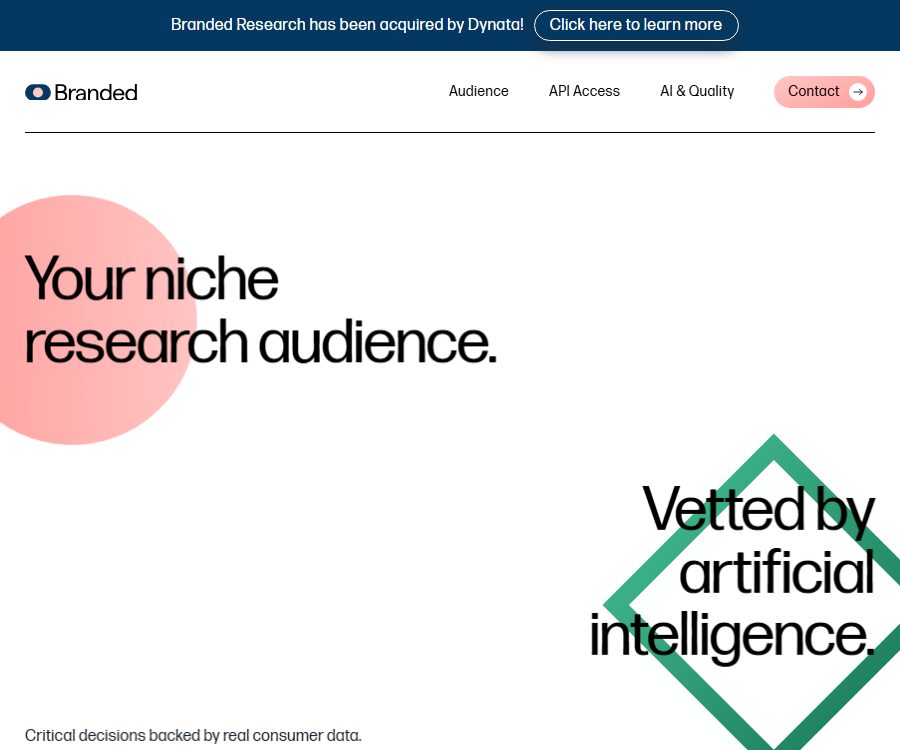
Branded is a platform for data collection and audience sampling aimed at market research; it consists of corporate research services, the Branded Supply API, and the respondent community Branded Surveys.
Branded Research was acquired by Dynata in 2022; the current terms for respondents state that the Branded Surveys panel is owned and operated by Dynata.
Two types of user entry points
| Products | user | Main tasks | Fees or rewards |
|---|---|---|---|
| Branded Research | Brands, research institutions, consulting firms, and academic teams | Find target samples, conduct quantitative or qualitative research, and obtain research data | Request a quote by project |
| Branded Supply API | Sample platforms and research teams with development capabilities | Programmatic feasibility assessment, creation of surveys, control of quotas, and completion of sample settlement | Business access is billed based on the completed samples and contracts. |
| Branded Surveys | Individual respondents who meet the regional and age requirements | Fill out profiles, take matching surveys, participate in studies, and earn rewards | Registration is free; points are earned based on activities. |
The study shows that customers are purchasing access to the audience and data collection capabilities; the points obtained by the respondents serve as an incentive for their participation, and the accounts, contracts, and purposes of use for these two aspects are different.
AI data quality capabilities
- Real-time robot protection: Checks for automated behavior and suspicious registrations before research begins, thereby preventing machine accounts from participating in customer surveys.
- Identity and behavior assessment: Machine learning, combined with continuously updated signals, is used to determine the credibility of an identity, as well as behavior related to answering questions and the level of risk involved.
- Audience rating: New members are rated based on over thirty quality metrics, which determines whether they are approved, require further verification, or should be removed from the panel.
- Ongoing quality checks: After registration, users still undergo tests related to quality, consistency in responses, and behavioral patterns, rather than only being evaluated during their first registration.
- Third-party verification: By leveraging external IP information and cross-community verification, it helps to identify duplicate or abnormal locations as well as other signs of fraud.
- Intelligent routing: Participants who meet the relevant eligibility and quality criteria are given priority in being included in surveys, thereby improving the efficiency of achieving the set quotas.
- In-depth profiling: Organizes the audience based on industry, demographics, location, and custom criteria, supporting both B2C and B2B target groups.
The AI here is primarily used for sample matching, scoring, and fraud prevention; it does not mean automatically generating questionnaires, analyzing all open-ended questions, or drawing conclusions on behalf of researchers.
Research methods and practical value
- Quantitative surveys: Samples are recruited based on population, region, industry, or custom criteria; they are suitable for concept testing, brand tracking, and research on purchasing intentions.
- Qualitative research: It can incorporate camera-based studies, methods related to emotions, and custom projects in order to observe attitudes, motivations, and feedback on experiences.
- Product development: Gather information on the needs of target consumers, the obstacles they face when using a product, their preferences regarding functions, and the factors that drive their purchasing decisions, to help determine priorities.
- B2B research: Samples are selected from professional groups such as human resources professionals, IT decision-makers, financial experts, and small business owners.
- Academic and public research: Participants are recruited based on qualifications and quotas, but researchers are still responsible for carrying out ethical reviews, obtaining informed consent, and designing questionnaires.
- Cross-market projects: The use of consistent quotas and quality processes in multiple countries or regions; the specifics and feasibility of this approach need to be determined separately.
Main functions of the Supply API
| Ability | Enter | Return or result | Use value |
|---|---|---|---|
| Configuration and Qualifications | API credentials, region, and target profile | Eligibility, answer encoding, and application configuration | Understand the conditions that can be used for sampling. |
| Feasibility assessment | Region, qualifications, quotas, and estimated incidence rate | Reachability scale and project feasibility | Estimate the sample supply before official release |
| Survey management | Name, language, duration, unit price, survey entry point, and quota | Survey identifier, status, and results of creation or modification | Programmatic creation, initiation, viewing, and closing of projects |
| Qualifications and Quotas | Qualification code, allowed answers, and target completion count | Real-time quota rules and remaining quotas | Control the composition of the sample and avoid overcompletion. |
| Investigation team | Multiple investigation identifiers | Group-level exclusion and status | Prevent the same participant from participating in mutually conflicting projects. |
| Output and participants | Survey status, participant identifiers, and completion results | Real-time statistics, allow or block status | Monitor efficiency and deal with participants suspected of being of low quality. |
| Settlement verification | Successful completion of identification and reasons for rejection | Final record of approval or rejection | Complete sample verification after the project is closed. |
API integration process
- Contact the integration team to specify the target region, the volume of projects, the survey tools, the estimated sample size, and any customizations required.
- Obtain two sets of credentials for the sandbox and production environments, and first read the application configuration and eligibility codes.
- Submit a feasibility request in the sandbox to check whether there is sufficient supply of the target audience, incidence rate, and quotas.
- Create a survey and specify the language, estimated duration, cost per completion, device requirements, quotas, and an external link to the survey.
- Add eligibility and quota rules, and configure return statuses such as successful configuration, failure, quota reached, and safe termination.
- One-time participant identifiers and signature verification are used to protect the survey entry points and the data transmitted back, thereby preventing fraud.
- After initiating an investigation, check its status and outcomes, and adjust quotas or pause/close the project as needed.
- Upon completion of the project, a verification is carried out to confirm successful completion; abnormal samples are rejected for clear reasons, and the final settlement is finalized.
Key technical points
- The Supply API v2.0 uses a REST-style architecture, receiving and returning data in JSON format, and employs standard status codes to indicate success or error.
- The request must be sent over an encrypted connection, and the secret key provided by Branded must be included in the request headers.
- The sandbox only invites accounts from an approved list; its security checks and shutdown procedures differ from those in the production environment, so the results obtained in the sandbox cannot be considered as actual costs.
- The developer center provides endpoint references and Postman collections, but the official team has not confirmed the existence of a universal language SDK.
- The completed samples generated by the production credentials may incur costs; keys should be stored on the server side, access to them should be restricted, and their rotation should be logged.
Process for Using Branded Surveys
- Confirm your country, age, and eligibility to use the service, then create a unique account using the web page, Android app, or iPhone app.
- Provide accurate and consistent demographic, interest, and spending profiles so that the system can match suitable surveys.
- Check the estimated time for completing the survey as well as the points available; first, you need to answer the screening questions. If you do not meet the target profile, the survey may end early.
- Conduct the survey independently and thoroughly, without using bots, fake identities, multiple accounts, proxy services, or speeding up the answering process.
- Wait for the investigation team to complete the verification; once the funds are credited, check your points and available rewards in the account.
- Once the minimum threshold indicated on the regional account is reached, you can apply for available options such as PayPal, gift cards, bank transfers, or charitable donations.
- Before making the payment, verify the name, payment account, as well as any tax and regional restrictions, and save the application details and payment records.
Platforms and applications
| Platform | Products | Key capabilities | Restrictions |
|---|---|---|---|
| Web page | Branded Research | Corporate solutions, audience, and project consulting | Full project functionality requires activation through business processes. |
| Developer Center | Supply API v2.0 | Guides, endpoint references, sandbox, and Postman collections | Production credentials must be requested from the integration team. |
| Web page | Branded Surveys | Registration, profiling, surveys, points, and redemption | The number of surveys and the eligibility requirements vary depending on the region and demographic profile. |
| Android | Branded Surveys | Mobile surveys, points, and exchanges | The availability of stores and features is restricted by region. |
| iPhone | Branded Surveys | Mobile surveys, points, and exchanges | The fact that it is currently labeled as an iPhone app does not mean that there are native versions for iPad or Mac. |
Price and points
| Package or version | Price | Billing cycle | Core benefits or quota | Suitable for users |
|---|---|---|---|---|
| Corporate research projects | Custom quote | By project or contract | Sample collection, project management, quantitative and qualitative research, customized services | Brands, research institutions, and academic teams |
| Supply API | Contact sales | Based on completed samples and contracts | Sandboxes, production APIs, real-time sampling, quotas, statistics, and settlement | High-frequency or automated research platforms |
| Branded Surveys Members | 0 dollars | Free registration | Conduct surveys to earn points, and participate in loyalty and regional rewards programs. | Qualified individuals who wish to share their opinions |
| Rewards for respondents | 100 points are equivalent to 1 dollar. | Obtained through activities | The application page indicates that rewards available locally can be requested starting from 500 points. | Members who have passed quality and regional audits |
For business clients, there are no public standards regarding monthly fees, minimum order values, or fixed prices per task; the costs depend on factors such as the complexity of the sample, its occurrence rate, duration, location, quotas, and the scope of services provided.
The application page indicates that 500 points are equivalent to 5 dollars, while the general membership terms state that the default threshold is 50 dollars, unless the account offers a lower amount; the actual amount displayed on the account depends on the region in which it is located.
Limits on rewards for Branded Surveys
- The full score displayed on the page may not be available in cases of failed screening during the survey, full quotas, inconsistent answers, or failure in the quality review.
- Points are a form of incentive for participation, rather than being wages calculated on an hourly basis; there is no guarantee of ongoing surveys nor of a fixed income.
- The credits usually expire one year after they are issued, and they may also be revoked earlier due to an inactive account, violations, incorrect postings, or account termination.
- Members must participate in surveys or update their information at least every six months to remain active; specific requirements may vary by region.
- Once the exchange is submitted, it is usually the final step; the options for gift cards, PayPal, bank transfers, and charitable donations vary depending on the country and the account in question.
- Using multiple accounts, forging profiles, conducting repeated investigations, automating answers, or manipulating results may result in a ban and the confiscation of unclaimed rewards.
Main advantages
- Companies can carry out feasibility studies, sampling, quota setting, quality control, and final settlement within the same supply system.
- The REST API provides endpoints for the entire project lifecycle, making it suitable for research teams that already have survey systems to use for automated tasks.
- AI scoring and real-time bot detection are applied before participants start the survey, which helps to reduce significantly low-quality traffic.
- The in-depth profiles for B2C and B2B scenarios are useful for identifying specific customer segments, and further filtering can be carried out using custom criteria.
- Web and mobile entry points for respondents expand participation coverage, while providing individuals with a transparent display of their survey points.
Capacity boundaries
- The platform provides samples and execution infrastructure, but it does not replace questionnaire design, statistical methods, ethical review, or professional interpretation of the results.
- The AI quality score serves as a signal for risk control; it cannot guarantee the accuracy of each response, and it may also mistake legitimate users for those with high risk.
- A larger panel size does not guarantee that there will be sufficient samples for a particular sub-group; those with a low incidence rate should first undergo a feasibility assessment.
- Cross-regional investigations require separate handling of issues related to language, privacy, consent, research involving children, sensitive topics, and regulations on incentives.
- The API documentation contains some legacy terms and examples; before going into production, it is necessary to test the endpoints, fields, and response logic in a sandbox environment.
- The surveys seen by respondents come from different sponsors, and the qualifications, data controllers, and privacy terms may vary from survey to survey.
API, SDK, GitHub, and open-source status
| Project | Current status | Explanation |
|---|---|---|
| Supply API | Already provided | The v2.0 documentation is available publicly; production credentials require an application. |
| sandbox | Already provided | Used for whitelist testing; it is different from the production environment. |
| Postman Collections | Already provided | Endpoints can be imported for testing; they are not equivalent to the official SDK. |
| Official SDK | Not confirmed yet | No publicly maintained language client libraries were found. |
| Official GitHub product source code | Not confirmed yet | No public source code repository for the current platform has been identified. |
| Open-source product | No | Branded is a managed business service; the availability of public interface documentation does not mean that the platform uses an open-source license. |
Privacy and security considerations
- The platform may collect names, contact information, postal codes, gender, location, occupation, income, family details, device information, location data, and usage records.
- Survey matching may also involve sensitive categories such as race, health, political views, religion, sexual orientation, or biometric data; it is necessary to confirm whether participation is voluntary and essential before proceeding.
- Survey responses and response metadata may be provided to the survey initiator, research firms, customers, suppliers, and anti-fraud partners.
- In some areas, policies permit the use of individual or aggregated data for purposes other than research, marketing analysis, or similar audience modeling, subject to obtaining the appropriate consent; users should read the regulations applicable in their region.
- Optional context tracking may log activities related to the use of websites and apps; users can pause or turn it off, but this may result in a reduction in certain matching opportunities.
- Data can be transmitted, stored, and processed in the United States; cross-border users should assess local laws as well as the identity of the controller who initiates the investigation.
- The platform uses encrypted connections, firewalls, and access controls, but it does not guarantee absolute security for data transmission over the network or for the system itself.
- The retention period is determined based on the nature of the data, as well as investigative, legal, and dispute-related requirements; a detailed list of retention periods can be obtained by contacting the privacy team.
- Users may, in accordance with local laws, request access to, correction of, deletion of, restriction of, objection to, or transfer of their personal data, and may also delete their membership details from their account.
Copyright, Commercial Use, and Refunds
- The research client should have the necessary rights to access questionnaires, brand materials, and survey content, and the ownership of data, reports, and any derived outputs must be specified in the contract.
- The accounts of the respondents are intended for personal, non-commercial use only; it is not allowed to sell these accounts, transfer points, copy restricted research materials, or disclose confidential information.
- The party that initiates the survey usually holds the relevant rights to its survey data, and respondents should not share screenshots of unreleased products, advertisements, or concepts.
- There is no unified standard regarding the cancellation of corporate projects, failure to meet quotas, rejections due to low quality, refunds, and rules for fee adjustments; these details must be specified in the order.
- The exchange of points for rewards by respondents is usually the final step; any incorrect credit can be reversed, while unclaimed rewards in cases of termination due to violations may be confiscated.
Summary
The core value of Branded lies in its use of audience profiles, AI-based quality control, and Supply API to help research teams acquire and manage target samples, while Branded Surveys is responsible for connecting with and motivating individual participants.
When selecting a company, it is necessary to first verify the viability of the sample and the costs associated with the contract; when participating as an individual, it is important to understand the regional requirements, the purposes for which the data will be used, the selection criteria, the deadline for accumulating points, and the actual thresholds for redemption.
Tools similar to Branded




 Guigong Network Security Registration No. 45132202000164