






Algolia
Algolia makes AI-powered searching more efficient and simpler.
Tags:AI search engineWhat is Algolia?
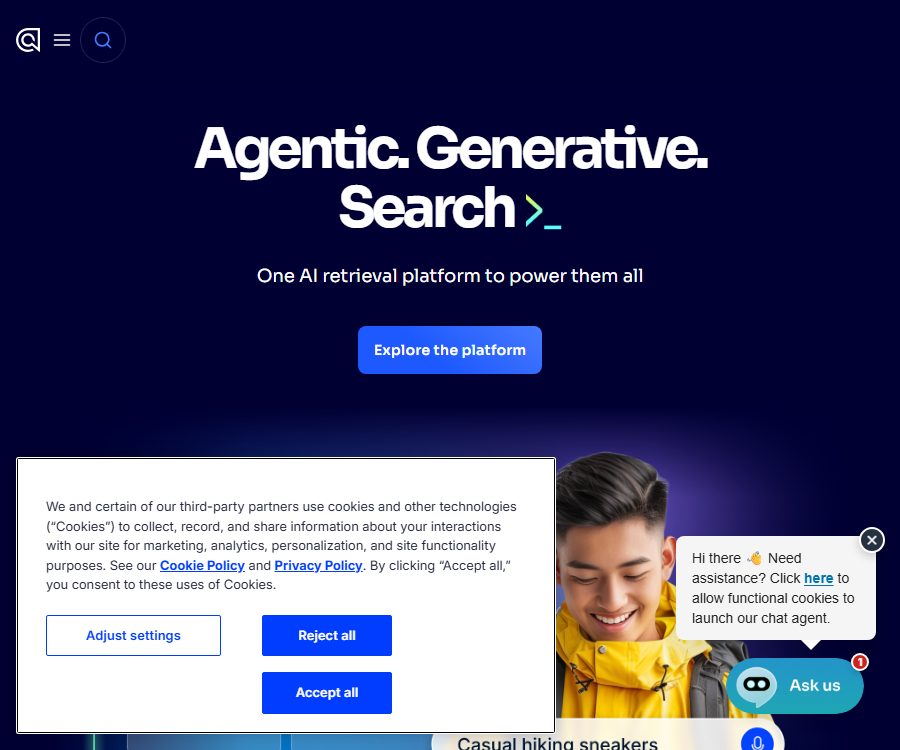
Algolia is a hosted search and discovery platform that helps businesses implement fast search functions in their websites, applications, e-commerce catalogs, documents, and content repositories. Developers upload data to Algolia’s index, and then use APIs and interface components to offer end-users capabilities such as searching, filtering, recommendations, and interactive question-answering.
It is not a general search engine designed for ordinary users to search the entire Internet; rather, it is a basic service that helps product teams implement search functionality on their own websites. The platform offers traditional keyword-based searching, AI-enhanced sorting, semantic search, as well as generative experiences tailored for intelligent agents.
Main functions
1. Keyword search and instant results
Algolia can return results in real time as users type, and it supports spelling tolerance, prefix matching, filtering, faceting, sorting, and query suggestions. It is suitable for product catalogs, help centers, media content, application data, and other structured indexes.
- Search by typing and auto-completion.
- Typos tolerance, synonyms, and rule configuration.
- Filtering by categories, brands, prices, and other criteria.
- Sort by business fields and customize the result display.
- Multiple indexes and combined search scenarios.
2. NeuralSearch hybrid retrieval
NeuralSearch combines keyword matching with vector-based semantic search. Even if a query does not contain the exact words present in the records, the system can still find relevant results based on concepts and intentions, and then merge and sort these two types of candidates.
To enable this feature, it is necessary to upload data to the index and collect click and conversion events in accordance with the official requirements. The training of the index, its availability, and its performance are affected by the amount of data, the quality of the events, and the configuration settings.
3. AI Ranking and relevance optimization
AI Ranking adjusts the order of results dynamically based on real interaction data, with the goal of improving metrics such as clicks, conversions, and other business indicators. The team can also manually raise, lower, fix, or hide specific results using rules.
- Rankings are automatically optimized based on user behavior.
- Configure promotion, inventory, and operational rules.
- Use A/B testing to compare different search strategies.
- Analyze reports to view query results and conversion performance.
4. Personalization and product discovery
The platform can offer personalized searches and recommendations based on users’ behaviors and preferences, and it also enables the operation team to manage the way products are displayed. E-commerce teams can influence the results according to factors such as promotions, profits, inventory levels, or brand strategies.
Personalization requires the proper collection and management of user data. When it comes to creating user profiles, identifying users across different devices, or using such data for advertising purposes, it is necessary to provide clear information, a legal basis for such actions, and options for users to opt out.
5. Ask AI for conversational Q&A
Ask AI can transform technical documents, blogs, or help center content into conversational assistants. It first retrieves relevant content from the Algolia index, and then uses the large language model selected by the user to generate context-aware responses.
- It can be used on document sites, help centers, and content-based websites.
- It supports the DocSearch interface, the SiteSearch component, or a custom frontend.
- Customers connect to the selected model provider and manage their own API keys.
- It allows for the configuration of prompts, permitted domain names, filtering criteria, and suggested questions.
Ask AI provides answers based on the searched content, but it may still misunderstand the original text or generate inaccurate information. Before going live, it is necessary to test features such as citation handling, refusal to answer questions, permission isolation, and handling of high-risk queries.
6. Agent Studio, Generative Experiences, and MCP
Algolia is expanding its search capabilities to the realm of agents, including the ability to create and deploy AI agents, to generate dynamic content based on indexed data, as well as MCP capabilities that allow external agents to query, analyze, or update the indexes.
The scope of availability, costs, and level of maturity of these capabilities can vary; it is not possible to determine whether they are included in existing packages merely by looking at the product interface. Before initiating production integration, it is necessary to verify the current documentation, permission models, and available regions.
7. Crawler and data access
Algolia Crawler can capture web page content and create indexes; the platform also offers data transformation, connectors, and integration with third-party services. Development teams can use APIs to write, update, and delete records in bulk.
When extracting content, it is necessary to comply with the website’s authorization policies, access rules, and copyright requirements. For databases or private content, it is advisable to synchronize only the fields that are needed for searching, and to avoid including management keys in the front-end code.
8. InstantSearch interface components
InstantSearch is a set of open-source libraries for building search interfaces, covering technologies such as JavaScript, React, Vue, and mobile platforms. It provides common components like search boxes, result lists, pagination, filtering, and sorting.
A component library can reduce development time, but the search indexing and hosting services still operate on Algolia’s commercial platform. Using an open-source front end does not mean that one can host Algolia’s search backend for free.
What scenarios are it suitable for?
- Product search, filtering, sorting, and recommendations on e-commerce websites.
- In-site search for SaaS products, mobile apps, or enterprise portals.
- Search in developer documentation, knowledge bases, and help centers.
- The discovery functions for news, media, courses, and content platforms.
- I hope to join a product team that works on semantic search or conversational Q&A.
- Companies that require a search infrastructure capable of handling high concurrent loads with low latency.
How to integrate with Algolia?
- Create applications and indexes, and determine the fields that can be searched, the fields used for filtering, and the criteria for sorting.
- Write data to the index through APIs, connectors, or crawlers.
- Read-only search keys are used for queries at the frontend, while management keys are stored only on trusted servers.
- Choose either the InstantSearch component or a custom interface, and configure the search box, results, and filtering options.
- Set synonyms, rules, relevance, and product management strategies.
- Collect query, click, and conversion events to provide data for analysis, personalization, and AI sorting.
- Use real traffic to test the failure rate, latency, click-through rate, and conversion effectiveness.
- Set up usage alerts, key permissions, and monitoring for abnormal access before going live officially.
Algolia prices
As of August 25, 2026, the official website offers four types of search solutions: Free, Grow, Grow Plus, and Elevate. Grow and Grow Plus operate on a pay-as-you-go basis with a free quota, while Elevate is available through annual corporate contracts.
| Plan | Includes quota | premium price | Key capabilities |
|---|---|---|---|
| Free | 10,000 searches per month, 50,000 records, 5,000 recommendations, 5,000 crawls | No public premium unit price is provided. | Used for development and small-scale testing; no credit card required. |
| Grow | 10,000 searches per month, 100,000 records | $ | Keyword search, browsing, query suggestions, manual synonyms, basic rules, 30-day analysis |
| Grow Plus | 10,000 searches per month, 100,000 records | $ | Built on Grow, it adds AI synonyms, AI-based sorting, advanced personalization, query categorization, collections, and 90-day analysis. |
| Elevate | In accordance with the terms of the contract | Custom quote | NeuralSearch, AI Collections, Smart Groups, real-time personalization, enterprise security, improved SLAs and support |
Different pages on the official website may still display historical names such as Build; the main page showing current pricing options is labeled Free, Grow, Grow Plus, and Elevate. The number of records is usually calculated based on the peak storage volume for that month, while searches, recommendations, crawls, and other features may also be charged separately.
The figures above represent the public dollar prices as of August 25, 2026; they do not include taxes, exchange rates, support services, or professional services. The actual costs will depend on the usage level in the console, the settlement page, and the enterprise contract, and it is advisable to set up budget alerts in advance.
How to choose a package?
- Prototypes, learning projects, and low-traffic projects can use Free first.
- When only keyword search is required in the production environment, the pay-as-you-go cost of Grow can be compared.
- When AI sorting, automatic synonym replacement, and advanced personalization are needed, Grow Plus is a good option to consider.
- If full semantic mixed search, enterprise SLAs, SSO, or dedicated support are required, Elevate should be considered.
- For high-traffic services, a monthly cost model should be developed based on peak requests, the number of records, and recommended volumes.
APIs, SDKs, and development support
Algolia is an API-first service that provides clients in JavaScript, Java, Go, Python, PHP, Ruby, Swift, C#, Kotlin, Dart, among others, as well as various front-end components. Developers can handle index management, searching, recommendations, event analysis, and the configuration of business rules.
The frontend can only use search keys with limited permissions; keys that grant write or management rights must be stored on the server. It is recommended to assign minimum permissions as well as revocable keys to different applications, environments, and tenants.
Is Algolia open source?
Algolia’s search platform and core services are not fully open-source products that can be deployed on one’s own; accounts, indexes, search processing, and billing still rely on the official cloud services.
The official GitHub organization makes available a large number of clients, InstantSearch components, DocSearch tools, CLI interfaces, examples, and integration projects; many of these are distributed under open-source licenses such as MIT. An open-source SDK merely means that the relevant code is made available publicly, and this does not allow a commercial search platform to be labeled as open-source.
Data security and permissions
- Distinguish between management, writing, searching, and monitoring keys, and apply the principle of least privilege.
- Use index-level, filtering-level, or tenant-level restrictions to prevent unauthorized queries.
- Do not write sensitive raw fields to publicly searchable indexes.
- Audit records are maintained for deletion, update, and bulk import operations.
- Verify the hosting region, data retention, backup, SLA, and compliance requirements.
- Set up alerts for abnormal search volumes, crawler abuse, and sudden increases in costs.
Usage restrictions and precautions
- Search quality depends on the index structure, data quality, rules, and event collection.
- Semantic search does not guarantee business correctness; recall and ranking still need to be tested.
- Ask AI generates answers using large models, which may lead to hallucinations or the ignoring of permission boundaries.
- Pay-as-you-go pricing increases with traffic and peak usage levels, so it is necessary to continuously monitor costs.
- Not all packages offer different AI capabilities; it is necessary to check the plan before enabling them.
- Managed services create a dependency on the supplier; it is necessary to consider index adjustments and front-end modifications before migration.
Product advantages
- A mature API and multilingual SDK ecosystem.
- Supports keyword, semantic, vector, and hybrid searches.
- It features a rich set of instant search components, enabling fast integration on the frontend.
- Take into account both development configurations and business operation rules.
- It offers analysis, recommendations, personalized experiences, and generative features.
- It can be expanded gradually from the free tier to enterprise-level solutions.
Product limitations
- Complete AI search capabilities are available in the higher-tier packages.
- Under high traffic and large indexes, costs need to be carefully estimated.
- The core of the platform is not open source, so it cannot be deployed locally directly.
- Correlation optimization still requires business data and ongoing operations.
- Generative responses require additional models, permissions, and accuracy governance.
Frequently Asked Questions
Can Algolia search the entire Internet?
It cannot be simply regarded as a public web search engine; it primarily searches for data that has been uploaded by users, scraped, or synchronized into its own index.
Does Algolia have a free version?
Yes. The current Free plan includes 10,000 searches per month, 50,000 records, as well as a certain amount of quota for recommendations and data extraction; it is suitable for trials and small-scale projects.
What is NeuralSearch?
It combines keyword search with vector semantic search, then merges and sorts the results together, enabling the identification of related concepts that do not contain exactly the same keywords.
Does Ask AI include the costs associated with large models?
The official documentation indicates that users need to connect to the model provider of their choice and manage API keys; therefore, external model calls, data processing, and billing costs should also be taken into consideration.
Can Algolia be deployed on a private basis?
The current core product is the officially hosted service; no complete open-source, self-deployable version available for download has been found. Companies can contact sales to discuss custom architecture options and contract terms.
Does the open-sourcing of the official SDK mean that Algolia is also open-source?
No. The client and interface components can be open source, but the hosting of indexes, search engines, and enterprise platforms remain commercial services; these two aspects must be indicated separately.
Tools similar to Algolia



 Guigong Network Security Registration No. 45132202000164