






C knows.
C knows that this makes AI-driven searching more efficient and simpler.
Tags:AI search engineC knows what it is.
C is an AI-based search and programming Q&A tool provided by CSDN for programmers, students, and technical professionals. It combines generative Q&A with developer-related content, using natural language to help users find information, understand code, and organize technical solutions.
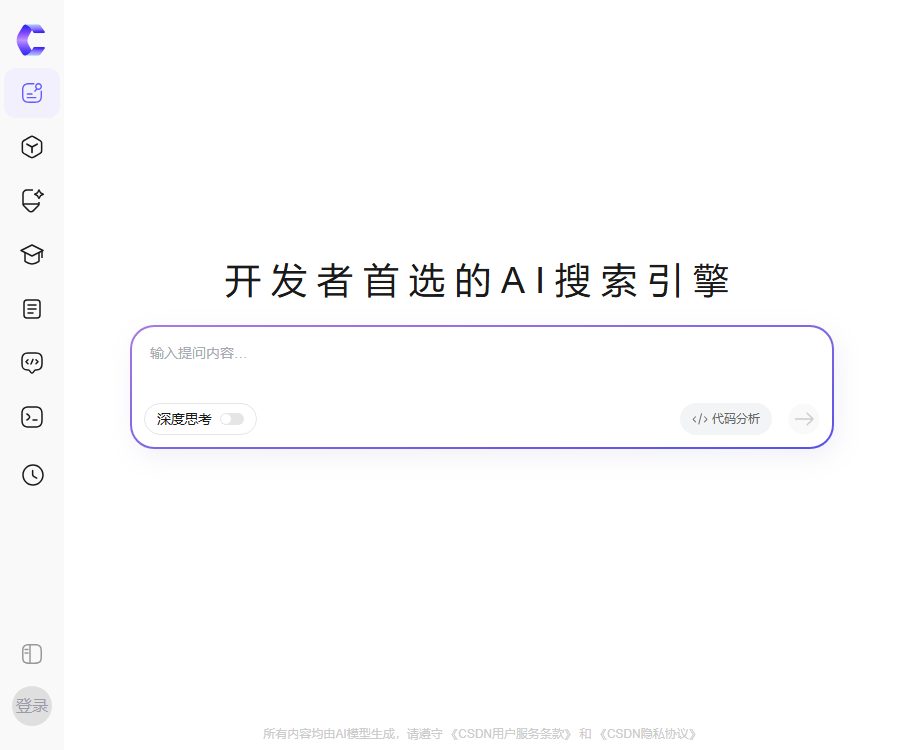
The current product page positions it as the preferred AI search engine for developers, offering options such as AI search, AI models, AI assignments, graduation projects, interviews, AI programming, and agents. Different options may utilize various models, quotas, and interaction methods; the actual functions available depend on the page after logging in.
A one-sentence summary
CKnow is an AI search and programming assistant that builds on the CSDN developer ecosystem; it can be used for answering technical questions, analyzing code, searching for content, providing learning support, and organizing development ideas.
Core functions
Developer AI search
Users can directly enter programming languages, frameworks, databases, cloud services, or engineering issues; the system then organizes the relevant information and generates responses. It is useful for quickly identifying potential directions for troubleshooting, but it cannot replace official documentation, actual runtime results, or version verification.
- Explain technical concepts, differences in tools, and common usage.
- Explain the causes of the errors, the steps for troubleshooting, and the approaches to fixing them.
- Generate code examples or pseudocode based on requirements.
- Summarize the learning path for inductive learning, key points for interviews, and project proposals.
Deep thinking
The search input area offers an option for in-depth analysis, which is suitable for multi-condition comparisons, architecture analysis, and more complex reasoning tasks. When this option is enabled, a longer waiting time is usually required, and the responses tend to be more detailed; nevertheless, users still need to verify the key assumptions within the reasoning process.
Code analysis
The code analysis mode provides explanations based on code snippets, error messages, and execution logic, to help identify potential issues. To obtain more effective results, it is necessary to specify the language version, dependency versions, expected behavior, and actual errors as well.
Code generation and rewriting
Users can request that C provide information on the generation functions, example interfaces, data processing logic, testing approaches, or suggestions for restructuring. The code generated may contain non-existent interfaces, unsafe default values, and outdated usage patterns; therefore, testing and security checks must be carried out before it is put into use.
File analysis
The product overview includes file analysis capabilities, which allow for the understanding of the content of documents, code, and other materials. The supported formats, file sizes, quantities, and retention periods may vary depending on the account and product version; it is necessary to check the instructions on the current page before uploading.
AI model entry point
The product navigation provides access to AI models, and CSDN will also incorporate different models as its services are upgraded. The page does not consistently display the exact version of the model used in each conversation, so the text does not refer to any particular third-party model as a permanent foundation.
Learning and job hunting scenarios
The AI-assisted tasks, graduation projects, and interview resources are designed for helping with learning planning, breaking down tasks into smaller parts, reviewing knowledge, and practicing through mock questions. These tools can aid understanding and practice, but they should not be used to write assignments, papers, or assessment materials that require independent completion by the individual.
Agent
The agent selector is used to choose an AI assistant designed for specific tasks, encapsulating common prompts and workflows into a more straightforward experience. The capabilities, creators, and data scope of different agents may vary; it is advisable to check the relevant instructions before using them.
Comparison of current function entry points
| Entrance | Primary uses | Suitable for tasks | Precautions |
|---|---|---|---|
| AI search | Search for and answer technical questions. | Concepts, tutorials, solutions, and error messages | Time and version for verifying information |
| AI models | Utilize the capabilities of different models | Q&A, writing, and reasoning | The available models may be adjusted. |
| AI assignments | Assisted learning and problem-solving | Knowledge explanations, step-by-step guidance | Comply with the school’s academic guidelines |
| Graduation project | Breaking down tasks and development plans | Topic selection, architecture, task breakdown | It cannot replace original research. |
| An amazing tool for interviews | Review and mock interviews | Question bank, follow-up questions, answer commentary | The answer should be based on real experiences. |
| AI programming | Generate and analyze code | Examples, debugging, refactoring, and testing | Verification must be run. |
| Agent | Execute vertical tasks | Repetitive processes and professional Q&A | Check the capabilities boundaries of the agent. |
Usage tutorial
- Log in using your CSDN account, and start a new conversation from the AI search or AI programming section.
- Describe the development language, framework, runtime environment, dependency versions, and task objectives.
- Paste the minimal code that reproduces the issue along with the full error message; remove any keys, accounts, and customer data.
- Complex problems can prompt deep thinking, requiring that assumptions and the order of investigation be established first.
- Have the system explain the reasons for the modifications, and request additional boundary conditions and test cases.
- Run the code in a local or isolated environment to examine the output, performance, and security risks.
- After confirming everything is correct, merge it into the project and record any manual modifications as well as the dependent versions.
Methods for asking high-quality questions
Provide the minimum information required to reproduce it.
It is difficult to obtain reliable advice merely by saying “the code will not run”; it is necessary to provide the relevant code, error stack traces, example inputs, and the expected outputs. The more specific the issue, the easier it is to verify the response.
Clarify versions and constraints
The interfaces of the same framework may vary across different versions; it is necessary to specify the runtime, operating system, database, and version of the dependencies. It is also possible to require that the solution utilize only a specified set of technologies, in order to avoid introducing unnecessary components.
Phased verification
For complex functions, AI is first used to produce designs and identify potential risks, after which a minimal implementation is created; testing and optimization are then carried out. This approach makes it easier to detect errors compared to trying to generate the complete project in one go.
Price and usage quota
The price information was verified on August 24, 2026; C noticed that the public, unlogged-in page does not display any individual membership packages, fixed prices, or a clear list of daily usage limits. The basic page is accessible for free, but to initiate full conversations and save historical records, logging in is required.
| Project | Current public information | Usage suggestions |
|---|---|---|
| Basic access | The product page can be accessed for free. | Confirm the actual conversation privileges after logging in. |
| Number of AI searches | The fixed number of times has not been made public yet. | The real-time alerts on the account page shall prevail. |
| Depth of thought quota | An independent price has not been made public yet. | Check whether a message about consumption is displayed before submitting. |
| File analysis quota | A unified upper limit has not been established yet. | Verify the format and size when uploading. |
| CSDN member | It belongs to the platform’s membership system. | Do not assume that it is equivalent to C being aware of the package. |
| Corporate procurement | No independent public quotes available at the moment. | Contact the platform for confirmation if necessary. |
CSDN platform members may enjoy benefits such as resource downloads, courses, or other advantages, but it cannot be assumed that they have unlimited access to CKnow functions without proof from the relevant settlement page. Any gifts offered as part of promotions, limited-time access to certain models, or account-specific differences should all be based on the information displayed on the actual page.
Which users are it suitable for
- Programmers who need to quickly search for Chinese development materials and concepts.
- Developers who encounter errors, difficulties in reading code, or issues with code refactoring.
- Students who are learning programming languages, data structures, databases, and frameworks.
- Job seekers preparing for technical interviews and wishing to practice answering questions.
- Students who need to clarify the scope, modules, and development plan of their graduation project.
- Chinese users who hope to obtain additional insights from CSDN’s content ecosystem.
Product advantages
- Designed with developer issues in mind; the technical Q&A section is easy to find.
- Integrated with CSDN’s Chinese-language technical content and user account system.
- It supports targeted modes such as deep thinking and code analysis.
- It covers a range of scenarios including learning, interviews, graduation projects, and AI programming.
- No separate software needs to be installed on the web version; it can be used right away after being opened.
Restrictions and Precautions
- AI responses may cite outdated tutorials, older versions of interfaces, or low-quality code.
- On the unlogged-in page, the full amount and prices are not displayed, and no guarantee of unlimited usage can be provided.
- Models and intelligent agents adjust according to the platform, and information provided by third parties may become outdated quite quickly.
- The generated code may contain security vulnerabilities, license conflicts, and fictitious dependencies.
- Answers cannot replace compilation, unit testing, integration testing, and official documentation.
- Before uploading company codes, logs, and files, the keys and personal information should be deleted.
- The use of assignments, papers, and interviews must comply with the rules set by the school and the employer.
Code security recommendations
Do not submit access tokens, database passwords, private keys, production logs, undisclosed vulnerabilities, or complete private repositories. When it is necessary to analyze real issues, the domain names, account credentials, customer identifiers, and business data can be replaced first.
The installation commands and system operations generated by AI can be destructive; it is necessary to read the parameters first and test them in an isolated environment. Code related to authentication, payment, file uploading, and permission control requires additional security reviews.
Privacy and content usage
C is aware that it is subject to the terms of service and privacy policies of CSDN; during use, account, conversation, device, log, and interaction data may be processed. The specific retention period, the scope of data processing by the models, and the methods of deletion are determined in accordance with the agreements and settings displayed upon logging in.
Users must also ensure that the content they upload is lawful to use, and that it does not violate the copyright of source code, articles, question banks, or third-party data. The responses generated can serve as supplementary material, but fact-checking and authorization verification must be carried out before they are made public.
Interface and open-source status
As of the date of verification, no dedicated interface documentation for CKnow, a self-service key console, or fixed pricing for calls were available to ordinary developers. The existence of interfaces for other models, computing resources, or development services offered by CSDN does not mean that the CKnow chat product automatically provides similar capabilities.
C is aware that the web-based product constitutes a commercial online service, and it has not been found that the complete source code for its front-end and back-end components is made publicly available. The use of open-source models, third-party models, or community examples at the underlying level does not mean that C knows the product itself is open-source.
Supported platforms
| Platform | Support status | Main explanation |
|---|---|---|
| Desktop web page | Support | Current primary usage method |
| Mobile web page | Accessible | The reading experience of complex code is limited by the screen. |
| CSDN mobile app | Some entrances may offer it. | Functions change with different application versions. |
| Independent desktop client | Not yet made public | Give priority to using the web version. |
| Browser extensions | No independent official expansions known of C at the moment. | Do not mix in third-party plugins. |
| Develop interfaces | Dedicated interfaces are not yet available publicly. | Other CSDN interfaces are not equivalent to the C-know interface. |
Basic information
| Project | Content |
|---|---|
| Product name | C knows. |
| Operation platform | CSDN |
| Tool type | AI search, developer Q&A, and programming assistance |
| Primary language | Chinese |
| Is login required? | A complete conversation usually requires |
| Price pattern | Basic access is free; individual packages are not yet available. |
| Is a dedicated interface provided? | Not yet made public |
| Is it open source? | No |
Recommendation score
It has a rating of 4.2 points and is suitable for developers who need Chinese-language technical questions, code explanations, and learning support. Its advantages lie in its focused scope and integration with the CSDN ecosystem; however, key engineering decisions should still be based on official technical documentation and actual testing.
Frequently Asked Questions
Does C know that it can be used for free?
The product page is accessible for free, but full conversations usually require logging in. Public pages do not offer unlimited access forever; the specific quota should be checked in the account details.
Does C know how to generate code?
It can be used for code generation, interpretation, rewriting, and debugging, but the results generated may not be runnable or may contain vulnerabilities. It is necessary to verify them locally and conduct code reviews.
Is file analysis supported?
The product overview includes file analysis capabilities; the specific format, size, and number of files allowed may vary depending on the account. Follow the instructions displayed on the current page when uploading files.
Does C know which model to use?
CSDN will adjust its access model, and the current navigation interface also provides access to AI models. No stable, publicly available version mapping has been established yet; therefore, it is not recommended to set a particular model as a permanent configuration.
Are there any public APIs?
To date, no dedicated public development interfaces or self-service key pages for C Know have been identified. Other CSDN development services cannot be used as alternatives to the C Know interfaces.
Does C know about open source?
It is not open source; C knows that it is an online product operated by CSDN. The use of open-source models or third-party scripts at the underlying level does not mean that the source code of the product is made public.
Summary
C understands that by gathering AI-based search, code analysis, learning, and interview functions in a single developer portal, it is possible to obtain technical information in Chinese quickly. When using this tool, it is necessary to specify the environment and version, protect sensitive code, and verify the obtained answers through tests and official documentation.
Tools similar to those known in C




 Guigong Network Security Registration No. 45132202000164