






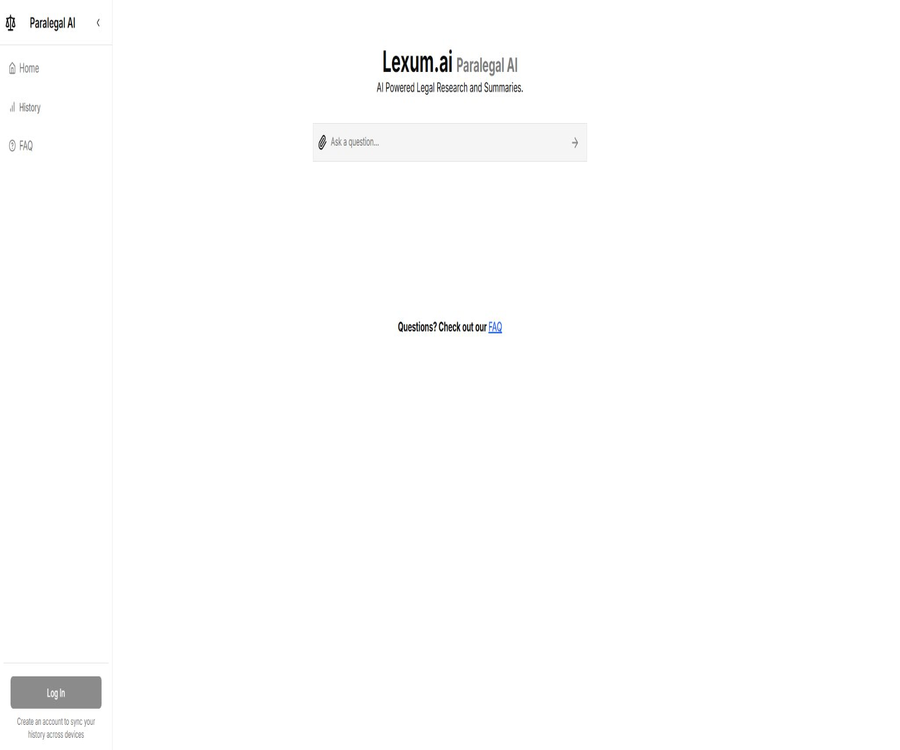
Paralegal AI
Paralegal AI, an intelligent tool focused on AI-driven searching.
Tags:AI search engineTool Introduction
Paralegal AI is an AI-based tool for legal research and summarization available on legalquestions.help; the official website currently displays both Lexum.ai and Paralegal AI as names. Users can enter legal questions, and a specialized model will identify key terms, search through web pages and case texts, and generate relevant summaries.
This service makes it clear that it can only provide legal information and cannot replace the professional advice or representation of licensed lawyers. Any decisions that affect rights, deadlines, lawsuits, or transactions should not be based solely on AI responses.
Main functions
Natural language legal Q&A
Users do not need to master legal search syntax in advance; they can simply describe the dispute, relevant legal concepts, or case issues. The system extracts keywords from these descriptions and then forms a response that is easy to read.
- It is suitable for quickly understanding terms, the background of cases, and areas that may require further research.
- The more specific the question, the easier it is to narrow down the scope of the response and eliminate irrelevant information.
- The tool does not disclose the full range of jurisdictions it covers, and therefore cannot be assumed to be applicable in all countries, states, or regions.
Organization of case and web page information
The official FAQ states that the model searches web pages and case texts to generate summaries through pattern matching. It is not a formal legal database, and the scope of cases included, the frequency of updates, or the completeness of the searches are not made public.
- It can be used to create keyword lists and lists of key issues for further searching.
- The answer may omit subsequent judgments, procedural status, local rules, or exceptional provisions.
- Before citing any case, it is necessary to verify the full text, the court, the date, and its validity in an authoritative database.
History and account details
The website offers a history function; after creating an account, it is possible to synchronize the record of questions across different devices. The duration for which unsigned-in users’ data is stored locally, as well as the mechanism for deleting such data, have not yet been made public.
- Suitable for consecutive questions that review the same research topic.
- History may contain sensitive information; it is necessary to log out of the account promptly when using shared devices.
- Do not enter real names, identification numbers, or confidential information until the encryption and deletion policies have been confirmed.
Usage tutorial
- First, determine the applicable jurisdiction, time period, and type of issue, and compile the necessary facts that do not include identity information.
- In the input field, pose a single question in one sentence, and specify any limiting conditions such as the court level, region, or year.
- After reading the answers, record the relevant legal provisions, case names, keywords, and conclusions separately.
- Verify the original text, its validity, and any recent changes using government, court, or professional legal databases.
- For unclear conditions, pose more specific questions to avoid combining multiple issues at once.
- Before taking any action, submit the verification materials and complete facts to a licensed lawyer in the relevant jurisdiction for review.
Which users are it suitable for
- It is intended for ordinary users who wish to first understand legal terms and the basic issues at stake.
- Students and researchers who need to organize keywords and a list of questions for further searching.
- Legal professionals who wish to quickly browse case topics before turning to authoritative databases for verification.
- Those who wish to organize the facts and the issues they want to ask about before consulting a lawyer.
- Editors and creators who produce legal education content and are willing to verify the original text item by item.
Which scenarios are not suitable?
- Calculate the statute of limitations, appeal deadlines, filing dates, or other statutory deadlines that must not be missed.
- Decide whether to sign a contract, plead guilty, reach a settlement, file a lawsuit, dismiss someone from a position, or transfer assets.
- Handling high-risk matters such as criminal cases, immigration issues, domestic violence, guardianship, medical concerns, and significant property disputes.
- Tasks that require a lawyer’s confidentiality privilege, formal legal advice, representation in litigation, or proof of compliance with regulatory requirements.
- It is not possible to determine the jurisdiction applicable to the answer, the validity of the case, or the date of any legal updates.
Price and usage status
The official FAQ states that the product is free of charge at the current time, and that the focus during the initial phase is on improving the model. Paid services may be added in the future, but the names of these services, their prices, usage limits, release dates, and payment rules have not yet been disclosed.
- The current free status does not constitute a promise of permanent free access.
- The official website does not disclose the number of questions per day, the character limit, the concurrency limit, or the maximum amount of data that can be stored historically.
- There are no verifiable subscription and refund terms, so future fees should not be estimated based on old catalogs or third-party websites.
Product advantages
- Natural language input lowers the barrier to initial legal research.
- Summarizing web pages and case texts can help users quickly identify potential research directions.
- The interface is simple, and it offers cross-device synchronization of account history.
- The official website clearly states that it cannot replace a lawyer, and the boundaries of the product are reasonably defined.
Usage restrictions and precautions
- The authorities admit that the model is not perfect; the responses may be incorrect, incomplete, or outdated.
- Pattern matching cannot reliably assess complex facts, the credibility of evidence, procedural strategies, and judicial discretion.
- Laws vary depending on the country, state, court, and time period; answers that do not specify the jurisdiction carry a higher risk.
- Case summaries may omit key facts and opposing arguments, and cannot replace reading the full judgment.
- Do not present AI responses as legal advice, nor guarantee their accuracy to others.
- In case of urgent or high-risk issues, contact a lawyer, court, government agency, or local legal aid service immediately.
Platform and public capabilities
| Category | Current situation | Explanation |
|---|---|---|
| Web version | Available | Enter a legal question and view the generated summary. |
| Account | You can register or log in. | Used for synchronizing history across devices |
| Mobile apps | The authorities have not made this information public yet. | Websites can be accessed via a mobile browser. |
| Jurisdictional scope | The authorities have not yet made the complete list public. | The examples include U.S. case law, but it cannot be assumed that they cover everything. |
| Language range | The authorities have not made this information public yet. | The quality of questions in languages other than English needs to be verified by yourself. |
| Document upload | The authorities have not made this information public yet. | The current main entry point is the text question. |
APIs, SDKs, and open-source status
The official website does not disclose APIs, Webhooks, SDKs, or developer documentation; as a result, it is not possible to determine whether programmed calls, bulk processing, or integration with third-party services are allowed. Do not attempt to bypass the restrictions on the website using automated methods.
To date, no official open-source repository, model weights, or license related to this legal Q&A product have been found. The ability to use it online for free does not mean it is open source; the models and hosting services should be considered proprietary systems.
Privacy and data security
The official website does not currently provide accessible pages with a verifiable privacy policy and terms of service; as a result, it is impossible to determine the retention period for data, the purposes for which models are trained, the third parties involved in data processing, the location where the data is stored, or the procedures for its deletion. In cases involving real situations, only the minimum amount of information necessary for de-identification should be provided.
Lawyers and corporate clients are also required to abide by confidentiality obligations, professional responsibilities, and client authorization requirements. Until data regulations are clarified, it is not appropriate to upload content that is subject to a lawyer’s confidentiality privilege or contractual confidentiality obligations.
Frequently Asked Questions
Is Paralegal AI available for free now?
The official FAQ states that the service is free at present, but it also mentions that paid services might be introduced in the future; the specific timing and prices have not yet been disclosed.
Can it replace a lawyer?
No. The official website clearly describes it as a supplementary and informational tool; it does not provide professional legal advice or representation by lawyers.
Can the answer be used directly in court or in contracts?
It should not be used directly. It is necessary to first verify the authoritative source text, the jurisdiction, the validity period, and the legitimacy of the case, and a qualified lawyer must make a judgment based on all the relevant facts.
Tools similar to Paralegal AI




 Guigong Network Security Registration No. 45132202000164