






Metix AI
Metix AI, an intelligent tool focused on AI-driven search.
Tags:AI search engineWhat is Metix AI?
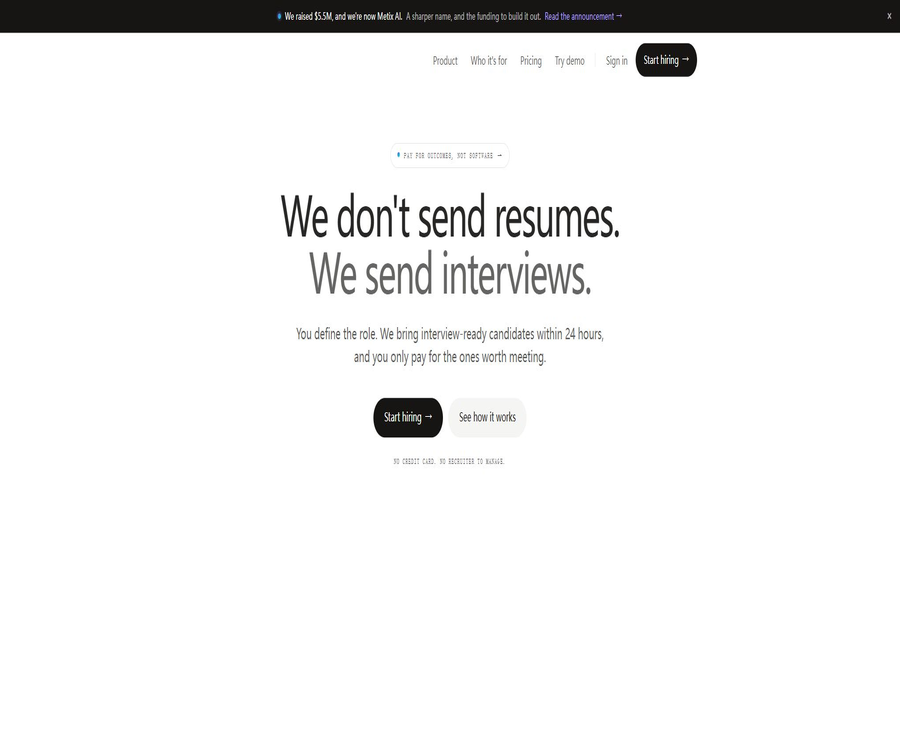
Metix AI is an AI-based recruitment platform developed by OpenJobs AI Inc.; it was originally known as OpenJobs AI, and its brand name was changed in 2026. Its core recruitment agent is named Mira, and it is used to convert job requirements into processes for searching for candidates, matching them with suitable roles, reaching out to them, confirming their interest, and scheduling interviews.
It is not a regular talent pool where recruiters have to go through large numbers of resumes on their own, nor is it a traditional headhunting service. The platform handles most of the job-search tasks automatically, while a supervisor checks the quality of the candidates; the company is ultimately responsible for conducting interviews and making hiring decisions.
Main functions
- Understanding of the position: Users spend about five minutes describing the job, the mandatory requirements, the optional requirements, the location, and the experience needed; Mira converts this information into search and filtering criteria. Vague descriptions of the position reduce the quality of matches, so it is important to clearly distinguish between mandatory and preferred requirements.
- Talent search: The system identifies potential candidates from public job listings and performs searches based on job-related criteria such as skills, experience, position, industry, location, education, and language. Candidate information may be delayed, incomplete, or inaccurate, and it cannot serve as a substitute for verification by the individual themselves.
- AI matching and screening: It compares a candidate’s experience with the job description in order to determine the level of relevance, assess qualifications, or rank candidates. The scores provided are probabilistic estimates; employers still need to consider factors such as work experience, actual projects completed, relevant certifications, and any legal requirements for the position.
- Automatic outreach: Personalized messages are generated based on the position and the candidate’s background, and a user approval step is required before sending them. The platform monitors responses and genuine interest, ensuring that candidates who do not respond are not considered as suitable candidates for an interview.
- Candidate management: Provide a centralized view of positions, candidate statuses, communication records, and candidates of interest, facilitating the transition from searching to arranging interviews. After cancellation of subscription, existing data will enter a read-only mode and be retained in accordance with the relevant terms.
- Interview scheduling: Candidates who are interested and have passed the quality assessment are added to the calendar, allowing the recruitment team to move from manual search to conducting interviews for evaluation. The publicly stated delivery time is a target; it should not be interpreted as meaning that suitable candidates can necessarily be found for all positions at the same time.
- Manual quality review: The person in charge of delivery will check the quality of the candidate before he/she arrives at the client; Scale also includes a dedicated success manager. Human intervention can reduce issues that arise from purely automated processes, but it cannot eliminate errors, inaccuracies in the information, or wrong judgments.
- Credits consumed based on the results: One Credit corresponds to one qualified, willing candidate who is eligible to proceed to an interview; no Credits are consumed if a candidate is not considered suitable for an interview. Companies should define the criteria for considering someone as \"qualified\" and \"willing\" as well as the procedures for resolving any disputes at the time of making purchases.
- Recruitment infrastructure: A standalone platform that enables searching for talents, job openings, companies, and scholars; it also allows for the evaluation of candidates, comparison between them, access to their details, and obtaining their contact information. Developers can integrate their capabilities into internal workflows using REST API, MCP, or public proxy services.
Recruitment workflow
- Registration can be done using a work email; eligible new users can start a 14-day trial without the need to provide a bank card.
- Create a Role by specifying the job responsibilities, required skills, location, experience level, salary range, and negotiable terms.
- Check Mira’s understanding of the role, remove any filtering criteria that might relate to protected characteristics, and verify the tone to be used.
- The system searches for and matches candidates; users can review the reasons for the recommendations, as well as the public career information and any potential gaps in that information.
- After approving the outreach message, initiate the outreach process and continuously monitor the statuses of replies, rejections, interests, and requests for additional information.
- The delivery manager reviews the candidates of interest; once they meet the interview criteria, Credit is used to unlock their profiles and an appointment is scheduled.
- The interview team independently verifies experience and qualifications, records structured evaluations, and human beings make the final hiring decision.
- After leaving the position, export the necessary records and delete any information that is no longer needed in accordance with the applicable employment, privacy, and data retention rules.
Input, processing, and output
| Stage | Enter | Processing | Output |
|---|---|---|---|
| Job description | Job description, skills, location, experience requirements, and flexible conditions | Analyze the requirements and establish search criteria. | Role and candidate profile |
| Talent sourcing | Job profile and work-related filtering fields | Public data retrieval and matching | List of candidates and relevance |
| Candidate evaluation | Resume text, public information, and job description | AI scoring, comparison, and manual review | Qualification details and interview list |
| Outreach | Job details, candidate background, and user approval | Generate messages, send and read intentions | Response status and candidates of interest |
| Delivery | Confirmed candidates and calendar requirements | Quality inspection and appointments | Interview schedule and communication records |
Suitable for users and scenarios
- Founders without dedicated recruitment staff: quickly define the first position and identify candidates suitable for interviews.
- Recruitment teams that spend a lot of time on talent sourcing: leave the tasks of searching, initial outreach, and confirming interest to the system.
- Growing companies that are hiring for multiple positions: Choose a package based on the number of active roles and the monthly quota for candidates.
- Development teams that need capabilities for talent data: they use APIs or MCPs to establish processes for identifying positions, companies, conducting talent research, and matching candidates.
- Researchers and technical recruitment teams: use academic search tools to find information on research areas, citations, educational background, and job history, followed by manual verification.
- It is not appropriate to use protected attributes such as age, gender, or race for filtering, nor can AI scores be used as the sole basis for automatic rejection or acceptance.
Subscription price and trial period
| Package or version | Price | Billing cycle | Core benefits or quota | Suitable for users |
|---|---|---|---|---|
| 14-day trial | 0 dollars | One-time use | 3 roles, 12 credits; no need for a bank card; the credit limit is not renewed. | New organizations that meet the criteria |
| Starter | 49 dollars; 528 dollars for annual payment | Monthly or annual payment | 1 new role and 3 candidates interested in interviews per month; email support available | Single recruitment position |
| Growth | $ | Monthly or annual payment | 3 new roles and 12 candidates per month; priority delivery | Team for recruiting across multiple positions |
| Professional | $ | Monthly or annual payment | 6 new roles and 30 candidates per month; supports multi-user organizations | Companies with stable hiring levels |
| Scale | $ | Monthly or annual payment | 12 new roles and 75 candidates per month; a dedicated success manager, custom integrations, and SLAs | Large-scale recruitment team |
| Customized solutions | Contact sales | In accordance with the contract | Large-scale recruitment, special positions, or greater human involvement | Complex corporate projects |
Annual payment is about 10% cheaper than monthly payment; both options involve automatic renewal, and taxes may be added at the time of settlement. The home page and pricing page display the current lowest price options; older terms or search cache results might show higher prices, so the actual price to be paid should be based on the account settlement page and the current terms in effect.
Limits, renewal, and refunds
- The Role quota is reset on a monthly basis; one unit is consumed each time a new position is created, and no units are returned when a position is closed. Any unused quota does not carry over to the next month.
- Credit subscriptions are issued on a monthly basis; to find out the exact expiration date, any changes between different subscription packages, and the status of usage after cancellation, one should check the account records. It is not cash, nor can it be transferred or exchanged.
- The trial period starts from the moment of verification via email and lasts for 14 calendar days; no charges are applied automatically upon its end. If the trial quota is not used, it expires, and access to the data becomes read-only for 90 days.
- Voluntary cancellation takes effect at the end of the current cycle; for monthly payments, no refund is given for the remaining days if cancellation occurs midway, and for annual payments, no refund is usually given for the remaining months. In some cases, refunds for annual payments are assessed by the support team.
- If the service interruption lasts for more than 72 hours, a proportional deduction from the service fees may be applied; in the absence of subsequent billing periods, a proportional refund may be given. In cases of repeated deductions or billing errors, the incorrect amount can be refunded.
- Payments are processed by Stripe, and Metix AI states that it does not store the full card number, CVV, or any other complete payment card details.
API, MCP, and development access
- Create a Mira API Key on the developer platform, and assign only the scope, quotas, and expiration period required by the workflow.
- Store the key in the environment’s secret management system; do not include it in chats, code repositories, screenshots, or shared configurations.
- Call the key status interface to verify the availability status, RPM limits, and user/key quotas before proceeding with the billing process.
- First, use natural language or structured criteria to search for candidates, job positions, companies, or scholars in order to obtain string IDs.
- Read the details in batches again; for details of talents, positions, and companies, a maximum of 100 IDs or professional profile addresses can be accepted at a time.
- For candidates, it is possible to apply individual scoring, batch scoring, or side-by-side comparison for groups of two to ten people; there are limits on the length of the resumes and job descriptions used for scoring.
- The contact information is made available only once the final candidate is selected; a maximum of ten addresses can be used at a time, and each time such information is unlocked 200 quota points are consumed.
- Record the timestamp of the results and the version of the data snapshot, while adhering to reasonable rates, using them solely for recruitment purposes, and avoiding the filtering of sensitive attributes.
Examples of API capabilities and quotas
| Ability | Enter | Output | Public quota point |
|---|---|---|---|
| Natural language search for talents | A description of up to 5,000 characters. | Up to 1000 data IDs | Successful result: 10 points |
| Structured search for talents | Fields such as skills, experience, location, etc. | Up to 1000 data IDs | Successful result: 5 points |
| Job or company search | Structured filtering criteria | Up to 1000 IDs | Successful result: 5 points |
| Scholar search | Research fields, citations, institutions, etc. | Up to 1000 entries | Successful result: 3 points |
| Read details | Up to 100 IDs | Public details field | 3 points when there is a result. |
| Candidate scoring | Resume and job description | 0 to 100 points and reasons | Single player: 2 points |
| Unlock contact information | Up to 10 professional profile addresses | Personal or work email addresses can be used. | 200 points for each successful result |
The public documentation also supports two types of MCP connections: stream-based network transmission and the older SSE version; this allows compatible clients to utilize the same recruitment functions. The specific price of API Keys, the free usage quota, and the price for excess usage are not clearly stated in the current public documentation – these details can be found in the developer dashboard.
GitHub and the open-source status
- The official organization has made available the skills required for recruiting with OpenClaw; these functions include talent search, candidate matching, job search, company search, and scholar search, and it is licensed under the Apache 2.0 license.
- These skills involve the instructions for calling the Mira API as well as the integration layer; being open source does not mean that Metix AI’s recruitment platform, datasets, search engine, models, or API services are themselves open source.
- The old OpenJobs CLI has been marked as no longer under maintenance; new integrations should use the REST API, MCP, or the current proxy capabilities.
- Official organizations also have other public repositories, and the licenses for each of these repositories need to be checked separately; the license of a single Apache 2.0 repository cannot be applied to the entire product.
Privacy, security, and recruitment compliance
- The platform handles data related to accounts, companies, job descriptions, candidate notes, communications, usage levels, and billing units; it also collects candidate information from sources such as public profiles, company pages, code, and portfolios.
- Upon responding, candidates may provide their contact information, professional background, and employment status; the data may only be used for legitimate recruitment purposes, and must not be used for marketing, spam, or resale.
- AI is used for searching, resume screening, matching, and outreach, and it may employ aggregated and anonymized data to improve models. Third-party AI or machine learning services may also handle candidate data.
- The privacy policy states that no fully automated decisions with legal or significant implications will be made without human intervention; employers must make recruitment decisions in a non-discriminatory manner on their own.
- Cross-border data may be processed in the United States, and standard contract clauses are used for transfers to the European Economic Area and the United Kingdom; candidates have the right to access, correct, delete, and object, among other rights.
- The website uses Microsoft Clarity, Google Analytics, Stripe-related technologies, as well as marketing attribution cookies; these attribution cookies are retained for a maximum of 14 days.
- After cancellation, the role and candidate data, as well as outreach records, can remain readable for 90 days before being moved to cold storage; account settings are retained for 180 days before being softly deleted. Financial and credit logs must be kept for at least 7 years.
- SOC 2 Type II and ISO 27001 are currently marked as in progress; it cannot be stated that certification has been obtained. The privacy policy also indicates that efforts are underway to finalize data processing agreements with the current service providers.
Advantages and limitations
- Advantages: It integrates search, outreach, interest confirmation, and scheduling into a single streamlined process, reducing the manual work that recruitment staff have to carry out with regards to cold leads.
- Advantages: Credit allows for the identification of candidates who are interested and available for interviews; the cost is more closely aligned with the actual results achieved in recruitment, as compared to using a pricing model based on clicks or the number of resumes received.
- Advantages: It offers both web-based recruitment tools as well as REST APIs, MCP, and open-source capabilities, making it suitable for use by both teams and developers.
- Limitations: Public occupational data may be outdated or incorrect, and models can inherit data biases; all candidate qualifications and conclusions must be reviewed manually.
- Limitations: The platform cannot guarantee the number of candidates for each position, the time required to complete tasks, the rate of responses, or the final hiring outcomes.
- Restrictions: Refunds for annual subscriptions are limited if requested midway through the subscription period; roles are not transferred, and any remaining credits after cancellation cannot be used to unlock additional features.
- Restrictions: The certification process is still in progress; companies should request the current security report, information on subcontractors, data processing agreements, and the actual SLAs at the time of making a purchase.
Summary
Metix AI is suitable for companies that wish to reduce the efforts involved in talent sourcing and initial outreach. Its core advantage lies in combining AI-driven automation with manual verification, while taking into account the number of candidates who can be interviewed. During the trial period, it is important to assess the relevance of candidates, the quality of outreach efforts, the cost of manual verification, the risks associated with discrepancies, as well as the actual cost per qualified candidate.
Tools similar to Metix AI




 Guigong Network Security Registration No. 45132202000164