






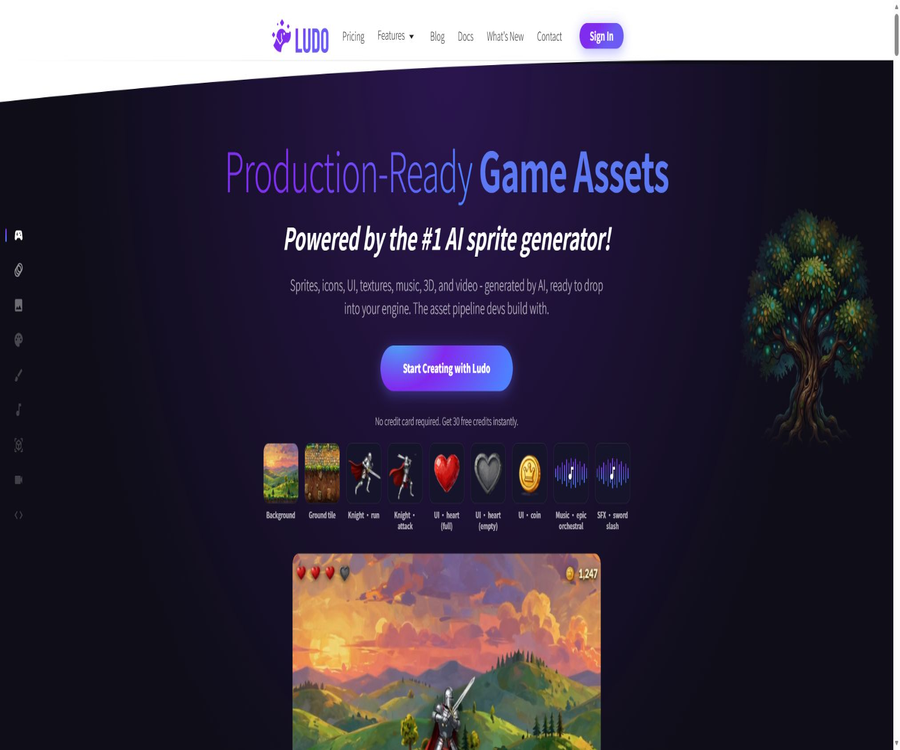
Ludo.ai
Ludo.ai, an intelligent tool focused on AI-driven search.
Tags:AI search engineWhat is Ludo.ai?
Ludo.ai is an AI game research, design, and asset creation platform developed and owned by Jet Play, Inc. It brings together market research, creative brainstorming, game design documentation, simple playable prototypes, and multimedia asset creation within a single project workspace.
The product is designed to serve independent developers, game designers, and studios, and it is not just a general search tool. Users can start by using trends or keywords to come up with game concepts, and then proceed to create visual elements, animations, 3D models, sound effects, as well as various development resources.
Main functions
Game research and concept validation
- Game and market search: It allows users to search for existing games, popular lists, trending topics, and information on competing products; the search results can be filtered by store, country, genre, or platform, making it useful for preliminary research on various topics.
- Ludo Score: This score evaluates a concept based on factors such as relevance to current trends, potential for growth, competitiveness of new releases, and level of originality. It serves as an indicator from market research, but it does not guarantee that the game will be commercially successful.
- Ask Ludo: Allows you to inquire, through dialogue, about specific games, market trends, and rankings; it also enables discussions on mechanisms, target audiences, and competitive dynamics related to current concepts. The conversations are saved in the history record.
- Game Ideator: Enter keywords, themes, genres, mechanics, or reference games, and specify the platform, art style, and perspective; the system will then generate creative cards with a title, description, and concept art.
Projects, design documents, and prototypes
- Project workspace: Converts the selected ideas into a structured game design document; it allows the use of templates or custom sections to organize elements such as gameplay, characters, world setting, mechanics, visuals, and marketing content.
- AI collaborative editing: It allows for the completion, rewriting, or expansion of individual sections within a document; it is also possible to pass the current content to Ask Ludo for further discussion. This approach is suitable for making incremental improvements rather than generating the entire document at once.
- Playable prototype: Simple 2D or 3D web game sketches are created using text and reference images; rules, visuals, and gameplay elements can then be modified via natural language, in order to test the core gameplay loop rather than producing a fully developed commercial game.
- Personalized tutorials: Starting from established game concepts, the user can choose a development engine as well as a beginner or advanced difficulty level; these options enable the generation of step-by-step implementation guides, code outlines, and debugging suggestions.
Generation of game assets
- Images and interfaces: Concept sketches, scenes, character portraits, icons, interface elements, map tiles, backgrounds, and seamless textures can be created using text, style references, or partial editing; the background can also be removed.
- Sprites and animations: It is possible to create sprites with a transparent background from text, or upload images and then use motion cues, keyframes, or motion transfer to generate animations lasting up to four seconds; the resulting sprite sheets, atlas data, frame-by-frame images, animated sequences, or videos can be exported.
- 3D assets: It supports converting text into 3D format as well as single images into 3D format; it allows for the redrawing of PBR textures, optimization of the number of polygons, automatic bone binding, and the application of preset animations or text-based animations. Models with bones and animations are exported in GLB format, while other formats usually contain only the mesh data.
- Audio: It can generate sound effects, ambient loops, music, human or non-human voices, preset voices, and cloned voices; it can also provide synchronized audio for animated characters or videos.
- Video: It allows for the creation of short videos using text or an initial image; the ending frame, duration, and model can be selected. Some models can generate audio as well, and double zoom is available.
Input, output, and file formats
| Task | Main inputs | Results or export | Suitable uses |
|---|---|---|---|
| Creativity and projects | Keywords, reference games, genre, platform, art style | Concept cards, concept diagrams, structured design documents, tutorials | Project initiation, proposal submission, and gameplay analysis |
| 2D image | Text, reference images, masks, and style settings | Images such as transparent or regular PNG files | Concept maps, icons, interfaces, textures, and backgrounds |
| Elf animation | Static sprites, action cues, keyframes, or reference actions | Sprite sheets: PNG, JSON asset packs, frame-by-frame ZIP, GIF, MP4 | Character movements, special effects, and prototype demonstrations |
| 3D model | Text, a single image, or a user model | Models with PBR textures; bindings and animations are primarily exported as GLB. | Unity, Godot, Unreal, and Blender workflows |
| Audio and video | Text, audio samples, images, or video references | Audio files and MP4 videos | Sound effects, music, dialogue, marketing, and prototype feedback |
The workflow from idea to usable asset
- First, enter the theme and reference works in Game Ideator, trends, charts, or game searches to identify areas that merit further investigation.
- Establish the selected idea as a Project, and determine the platform, type, perspective, target audience, core loop, and main sections of content.
- Use Ask Ludo and market analysis to examine competitors, trends, and differences, and then revise the concept based on the team’s judgment; do not consider market ratings as predictions of sales volume.
- Fix a satisfactory main visual as a style anchor; for subsequent images, sprites, 3D models, and videos, try to reuse the same reference images and prompts in order to minimize style drift.
- Generate sprite sheets, 3D models, sound effects, or short videos as required by the project; after downloading them, perform tasks such as cleaning, compression, and adaptation using image, 3D, audio tools, or game engines.
- When batch processing or automation is required, generate API keys using a Pro or Studio account; then choose between REST API, MCP, or Unity plugin for integration, and monitor the points consumed with each call.
Price and points
| Package or version | Price | Billing cycle | Core benefits or quota | Suitable for users |
|---|---|---|---|---|
| Free trial | Free | One-time trial | 30 points required, no bank card needed; assets can be generated and downloaded, API and MCP are not included. | First, verify the users involved in the output and export processes. |
| Indie | 20 dollars; the annual fee amounts to 15 dollars per month. | Monthly payment; or $180 per year. | 250 points per month; 3000 points per year, delivered in a single payment; 1 seat and 5 event slots, without API and MCP. | Independent developers with well-defined small projects |
| Pro | $ | Monthly payment; or $420 per year. | 1000 points per month; 12,000 points per year, delivered in a single payment. There are no restrictions on the types of activities, and unlimited use of core creative tools and image functions on the web interface, along with API and MCP access. | High-frequency creators and automated individual developers |
| Studio | $ | Monthly; or $3,600 per year. | 10,000 points per month; 120,000 points per year, delivered in a single payment; 10 seats, real-time collaboration, high concurrency, including API and MCP. | Workshops that require collaboration and a large amount of assets |
| Enterprise | Contact sales | Customization | Custom integration, licensing, capacity, and support | Purchases by large teams and enterprises |
All generation tasks in the Indie plan deduct points from the shared credit balance; for the Pro and Studio plans, core operations such as creating content on the web, working with project text and images are available without any limit, but tasks that require high computational power, such as those involving 3D models, videos, or prototypes, are still subject to charging. Every API and MCP call consumes points, even if the same operation is allowed to be performed indefinitely on the web interface.
Common integral consumption
| Operation | Typical integral | Precautions |
|---|---|---|
| Generate image | 0.5 per piece | The mask editing setting is usually 1; the Pro and Studio web versions allow an unlimited number of uses. |
| Generate 3D models | 3 | When converting text into 3D, a concept diagram is generated first; textures, optimization, binding, and animation are each charged separately. |
| Sound effects or ambient sounds | 2 | Music and mixing are usually set to 3, while voice is usually set to 1. |
| Video | Charged by model and number of seconds | The range of what is made public is approximately 1.3 to 27 units per instance, depending on the model and duration. |
| Playable iteration | 5 | Each package has its amount deducted from the pool of high-computing-power credits. |
A new generation usually incurs additional charges, even if the result does not meet expectations; certain operations such as adjusting the sprite table, removing the background, and downloading items repeatedly are free of charge. The points and prices of models are updated, especially for 3D animations with time-limited discounts; the final amount charged shall be based on the real-time notifications displayed in the account.
Points renewal, additional purchases, and refunds
- Unused points remain valid while the subscription is active and can be carried over. After the subscription is canceled or payment fails, the remaining points are available for another 30 days; re-subscribing during this period preserves them, while they are deleted after that deadline.
- The payment options allow users to purchase amounts ranging from 250 to 10,000 points as needed, and it is also possible to set up automatic reorders. Once a one-time order for points is completed, no refund is available; therefore, it is necessary to confirm the threshold and amount for automatic reorders before using them.
- The monthly subscription plan is non-refundable, but subsequent charges can be canceled allowing continued use until the end of the current billing period.
- The annual payment plan must be requested within 30 days of purchase, and users on the Indie plan must have used fewer than 250 credits, while users on the Pro or Studio plans must have used fewer than 1000 credits; the amount approved will also include the standard monthly fee for one month.
- A generation quality that does not meet subjective expectations is not a reason for a refund. Refund requests are reviewed in terms of account activity, and it is necessary to use free credits to verify the type of asset required before making a purchase.
API, MCP, and Unity plugins
| Access method | Permission requirements | Tasks that can be completed | Main limitations |
|---|---|---|---|
| REST API | API keys for Pro or Studio | Programmatic generation of images, sprite animations, 3D content, audio, video, and more | Each invocation is charged based on the number of points; it is necessary to protect the keys and handle asynchronous results. |
| MCP service | API keys for Pro or Studio | Invoke asset tools using natural language in AI assistants or development environments that support MCP. | Server-side tools still rely on Ludo accounts and the network; making calls also results in point deductions. |
| Unity plugin | Unity 2019.4 or later, along with paid API access rights | Generate and save images, sprite sheets, 3D, and audio assets within the Unity editor. | It is used only during the editor development phase; it is not generated offline when the game is running. |
Open-source status and license
- The Ludo.ai web platform, generation services, and models are proprietary products; they cannot be considered open-source platforms just because there are public repositories available for them.
- The authorities have made available the repositories for Unity plugins and MCP configurations, to facilitate understanding of how to install and use them; the MCP repository is explicitly labeled as having a proprietary license, while the Unity repository does not indicate any clear open-source license.
- The public repository mainly contains client integration and configuration materials; it does not include Ludo.ai’s server models, market databases, or the complete source code of the platform.
Copyright and Commercial Use
- The original concepts, designs, and assets submitted by users remain the property of those users. Users must ensure that the images, models, sounds, code, and reference materials they upload possess the necessary rights.
- Subject to compliance with the terms and laws, the platform grants a non-exclusive global license to use the service materials for personal and commercial purposes, to modify them, distribute them, and to create derivative works; the products generated as part of the free trial can also be used in commercial games.
- A business license does not mean that the platform guarantees that the content created will be original or free from any infringement issues. It is still necessary to check for any rights conflicts regarding trademarks, character designs, music, sound samples, reference images, and third-party materials before publishing the content.
- The platform itself, its interface, databases, and service code remain protected by proprietary rights; the right to use the generated assets does not imply that these assets can be copied, resold, or the services behind them can be reverse-engineered.
Privacy and security
- The Ludo.ai brand relies on Jet Play for data processing. Its privacy policy states that it does not claim ownership of the content created by users, it does not disclose private game concepts to other users, and it does not use such private content to train AI models that would allow others to access the created content.
- The platform can collect account and contact information, content submitted by users, cookies, and data on usage patterns; this information may be shared with authorized employees, service providers, business clients, or agencies as required by law.
- Personal data is usually stored on servers in the Netherlands, and is retained for as long as it is necessary to achieve the purposes for which it was collected or to comply with legal requirements; there is no fixed deadline for deleting specific project files and their creation history that is publicly specified.
- Users can request corrections or deletions. The platform employs reasonable technical and organizational safeguards, but it cannot guarantee absolute security for data transmission and storage over the Internet.
Capacity boundaries
- The results generated from the same prompt are not always identical; consistency in characters, artistic style, and details relies on a fixed style, repeated prompts, and reference images, rather than on using a dedicated model trained for that specific project.
- The playable generator is suitable for testing simple 2D or 3D mechanisms; it is not a substitute for a full-fledged engine, an online backend, performance optimization, or deployment testing.
- 3D tools are more suitable for single entities; the export of complete animations for bound models is primarily limited to GLB format, while complex topologies, professional-level binding, and final textures may still require Blender or other tools for processing.
- Market analysis and Ludo Score rely on existing databases and trend signals; they are unable to predict the quality of a product release, marketing efforts, user retention, monetization potential, or player feedback.
- Legal authorization is required for voice cloning and the reference materials used; it is prohibited to upload any content that is infringing on rights, illegal, or explicitly forbidden by the terms.
Summary
The value of Ludo.ai lies in its ability to integrate game market research, creative work, design documents, early prototypes, and various other assets into a cohesive workflow; it also provides APIs, MCP, and Unity integration for teams that need automation. A free trial is suitable for testing the output first, while when choosing a subscription plan, it is important to pay attention to factors such as computational power, the number of available seats, the number of projects that can be handled, interface permissions, and the conditions related to refunds.
Tools similar to Ludo.ai



 Guigong Network Security Registration No. 45132202000164