






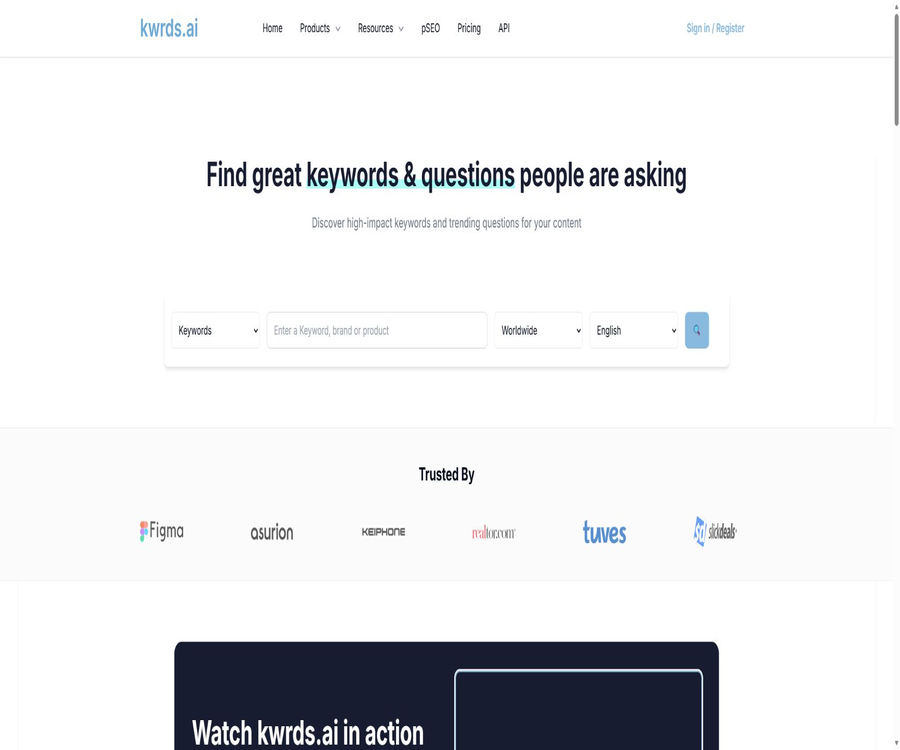
kwrds.ai
kwrds.ai, an intelligent tool focused on AI-powered search.
Tags:AI search engineA one-sentence summary
kwrds.ai is a multi-platform tool for keyword research and SEO data analysis; it allows users to obtain information on search volumes, trends, CPC costs, competition levels, user intent, PAA issues, and SERP results. It can also be integrated into automated processes via API or MCP.
Tool Introduction
kwrds.ai is operated by KWRDS AI, Inc, and it serves SEO professionals, content teams, digital marketers, as well as developers who need data related to programmatic SEO. It has evolved from its initial form as a Google keyword tool to include an AI assistant, video features, a community platform, e-commerce tools, and international search capabilities.
It is important to note that kwrds.ai is not the same as the Apple ASO application with the same name, KWRDS. The former provides SEO and API services for web pages, while the latter is used for tracking keywords and managing metadata in the App Store.
Core competencies
| Ability | Main data or output | Typical uses | Precautions |
|---|---|---|---|
| Keyword research | Related terms, search volume, trends, CPC, competition, and intent | Selection of topics and keywords | The metrics used on different platforms may vary. |
| PAA research | Frequently Asked Questions by Users and AI Answers | FAQ and content structure | The answer requires factual verification. |
| SERP analysis | Search results and ranking page | Analysis of competitive content | The results vary depending on region and time. |
| URL ranking | Page coverage and ranking keywords | Content auditing and competitor analysis | It cannot replace site analysis platforms. |
| Thematic research | Theme structure and Excel results | Content clustering and thematic planning | Asynchronous tasks need to wait for completion. |
| API and MCP | Structured SEO data and tool calls | Automation and intelligent agents | Subject to constraints regarding keys, packages, and limits. |
Main functions
Multi-platform keyword discovery
After the user selects the target platform, enters a seed word, and sets the region and language, the system generates relevant search expressions. Different platforms have their own logic for conducting searches, which allows for comparing the linguistic differences in Google-style searches, e-commerce purchases, video viewing, and AI-driven Q&A.
Search volume and trends
The results can include monthly search volumes and their trends, which help to determine the scale of demand as well as any seasonal variations. The search volumes are estimated figures and should not be regarded as the actual number of visits to the website.
CPC and ad competition
CPC and competitive metrics can help identify words with high commercial value, as well as assist in determining the priority of ads and content. Ad competition is not equivalent to the difficulty of natural searches; the two cannot be exchanged directly.
Search intent
The platform categorizes keywords as being related to information, business, transactions, or other intentions, which helps teams determine the appropriate type of page. Automatic intent classification may overlook multiple meanings of a word or mixed intentions; it is necessary to check the actual result page for important keywords.
Related words and semantic words
Relevant keywords and LSI-based interfaces are used to derive long-tail terms, synonyms, and contextual concepts from the core topic. Users should filter them based on relevance to the topic, rather than including all variations mechanically in the text.
People Also Ask
The PAA tool gathers the questions that users frequently ask on a particular topic, and it can generate short, detailed, or similar responses. It is suitable for creating FAQs, explanatory subheadings, and lists of content gaps.
SERP analysis
SERP tools are used to view the ranking results for a given region as well as the competitive landscape of the relevant pages. When conducting analysis, it is important to consider factors such as content type, site authority, update frequency, and user intent, rather than simply copying the ranking titles.
URL keyword analysis
URL Rankings allows one to see the keywords that a particular page has been ranked for or is covered by, and it is useful for evaluating one’s own content in comparison with competing pages. The ranking data can vary depending on the frequency of data collection and the region, and it cannot replace the first-party data provided by site management tools.
Thematic research workflow
Topic Research generates a content structure containing keyword data based on themes and regions, and delivers it in Excel format. It is suitable for creating thematic clusters and editorial plans; however, the relationships between various sections as well as search intentions still require manual evaluation by an editor.
AI research answers
AI Research can generate short answers, detailed answers, or content related to similar questions for use in research and draft preparation. The results produced may contain factual errors, outdated information, or repeated statements, and therefore cannot be published directly.
Free SEO resources
Unsubscribed users can access free tools such as popular industry keywords, PAA pages, categorized search lists, and Robots.txt verification. These free resources are suitable for identifying trends, but they do not equate to full access rights associated with a registered account.
13 supported platforms
| Platform type | Supported platforms | Suitable for research |
|---|---|---|
| AI assistant | ChatGPT, Perplexity | GEO and query-based searches |
| Videos and Communities | YouTube, Reddit | Video topics and discussion language |
| Traditional search | Bing, Yahoo, Baidu, Yandex | International and regional SEO |
| E-commerce | Amazon, eBay, Google Shopping | Product title and search terms |
| Vertical Google | Google News, Google Images | News and Image Discovery |
According to the product description, new results are obtained in real time with each search, rather than reusing cached data. Real-time availability does not guarantee that the data is completely up-to-date; changes in the platform’s interface, location settings, and sampling methods can still affect the results.
Methods for selecting a platform
- For ordinary web content, traditional search platforms should be given priority.
- To understand how AI responses are generated, it is necessary to examine the query expressions used by ChatGPT and Perplexity.
- Video titles and scripts should be analyzed separately on YouTube.
- Community insights help to gain an understanding of the real opinions on Reddit.
- The product titles are analyzed separately for Amazon, eBay, and Shopping.
- For the Chinese market, Baidu can be used as a reference.
- For news and image content, use the respective vertical search functions.
- Comparison across platforms for the same topic, without directly mixing metrics.
Keyword research process
- Define the product, target audience, region, language, and content objectives.
- Select the search or discovery platform that the user actually uses.
- Enter a specific seed word, rather than a broad industry name.
- View related terms and remove those that are unrelated to the brand or that are ambiguous.
- Filter by search volume, trends, CPC, competition, and intent.
- Open SERP to check the content type of the current ranking page.
- Collect PAA issues and group them by theme and purchase stage.
- Use URL analysis to examine existing content and competitive pages.
- Establish mappings for primary keywords, secondary keywords, and question words.
- After publication, verify the hypotheses using real site data.
How to understand indicators correctly
| Indicators | What does it represent? | It doesn’t tell us anything. | Usage suggestions |
|---|---|---|---|
| Search volume | Estimate the scale of demand | Actual ranking and traffic | Combine trends with regional considerations |
| Trends | Demand changes over time. | It will definitely continue in the future. | Identify seasons and conduct multi-period comparisons |
| CPC | Commercial competition in ad clicks | Difficulty of natural ranking | Used to determine commercial value |
| Competition | Degree of competition in advertising or among platforms | Quality of page content | Do not use it in conjunction with SEO difficulty. |
| Intent | The main purpose of system inference | The true motives of each user | Review the results page for verification. |
| SERP position | Ranking results at a certain point in time | Long-term stable ranking | Record the location, device, and date. |
Content planning and PAA
The PAA approach can help address the questions that users have at the stages of understanding, comparing, and purchasing a product. A good practice is to first cluster these questions, and then determine which of them require separate pages, sections within the main text, or brief FAQs.
- Combine questions with different expressions but the same intent.
- Remove generic questions that are not related to the target business.
- Raise the review level for medical, legal, and financial issues.
- Check authoritative and up-to-date sources before answering.
- Avoid creating weak, redundant pages just for the sake of quantity.
- Write the title in the user’s language, without copying it mechanically.
- After publishing, check the visibility, clicks, and actual conversions.
SERP and competitor research
- Set the correct region and language for the target keyword.
- The result page shows whether it is articles, products, videos, or tools.
- Compare the topic scope, structure, and update time of the top ten pages.
- Use URL analysis to view the keywords covered by competitive pages.
- Identify the areas where users’ needs have not yet been fully addressed.
- Create pages with independent value, rather than rewriting competitive content.
- After going live, continuously compare the rankings with the actual visit data.
Website price
On the current page of kwrds.ai, the pricing options shown are free resources, UI Full Access, and Full API Plan. The annual price for UI Full Access is $39 per month; however, the monthly payment amount is not clearly indicated on the page.
| Plan | Price | Limit | Core rights and interests | Suitable for users |
|---|---|---|---|---|
| Free | $ | Basic tools and limited results | Popular keyword lists, PAA pages, free SEO tools, and categorized searches | Learning and preliminary assessment |
| UI Full Access | $ | 1,500 comprehensive queries and 500 AI Research queries per month | Keywords, PAA, SERP, URL ranking; all tools – the page states that it includes an API. | SEO and content team |
| Full API Plan | The amount is not displayed on the current public page. | 1,200 API calls per month and 40 calls per day | All API endpoints and comprehensive SEO metrics | Developers and programmatic SEO |
| Enterprise | Contact sales | Customizable or with no usage limits | Higher limits and corporate arrangements | Teams with high usage levels |
Conflicting pricing information
The pricing sheet states that UI Full Access includes API, but the FAQ on the same page says that there is no overlap between the website plan and the API plan, and it indicates that Basic does not include API. The package names are used interchangeably for UI Full Access, Basic, and API Pro; it is necessary to confirm these details with the team before making a purchase.
- Verify whether the $39 plan indeed provides API keys.
- Confirm whether the 1,500 queries fall under a shared quota or are handled independently by each tool.
- Verify whether 500 instances of AI Research are included within the total quota.
- Verify whether the monthly and daily limits for the API are applied simultaneously.
- Confirm how the asynchronous tasks of Topic Research are billed.
- Confirm whether failed requests and retries deduct the quota.
- Confirm that the monthly price is based on a 20% annual discount.
- Save the ultimate rights and interests in the order or email.
Trial, cancellation, and refunds
| Project | Current rules | Usage suggestions |
|---|---|---|
| Free trial | The basic keywords and PAA each display the first result. | First, verify the data for the target region and industry. |
| Payment | Common bank cards are supported through Stripe. | Check the currency and taxes at the time of settlement. |
| Upgrade or downgrade | It can be handled through the account or the support team. | Confirm the limit and effective date. |
| Cancel | Applications can be submitted at any time, and use is allowed until the end of the billing period. | Export the required data in advance. |
| Refund | A 30-day refund guarantee is provided from the start. | Retain payment and application records |
| Excess | The system sends in-app and email reminders. | Analyze the reason for the call before upgrading. |
API capabilities
kwrds.ai offers structured interfaces that utilize API keys for authentication, covering keyword research, semantic terms, search volume data, PAA, SERP information, usage queries, and topic analysis. Developers can integrate this data into their internal tools, content workflows, and intelligent agents.
| API module | Main inputs | Main output | Typical uses |
|---|---|---|---|
| Keyword Research | Keywords and regions | Related terms as well as indicators such as scale and competition | Topic Selection and Long-Tail Discovery |
| LSI | Keywords and regions | Semantically related words | Expanded content context |
| Search Volume | A set of keywords and regions | Search volume data | Batch evaluation requirements |
| People Also Ask | Keywords, country, and language | Related questions | FAQ and content outline |
| SERP | Keywords, regions, and optional scales | Search results | Competing pages analysis |
| Usage Count | API key | Used quota | Budget and limit monitoring |
| Topic Research | Theme and Region | Asynchronous tasks and Excel results | Content cluster planning |
API integration process
- Register an account and verify that the purchased plan indeed includes API.
- Generate a key within the account and save it in a secret management tool.
- First, call the usage interface to verify authentication and the initial quota.
- Use a keyword to test the region and the returned fields.
- Set timeouts, retry options, and a daily limit on requests.
- Save a task identifier for asynchronous topic tasks and poll their status.
- Verify the handling of empty results, error codes, and exhausted quotas.
- Check the returned data for type, missing values, and outliers.
- Monitor daily and monthly usage levels and set up alerts.
- Confirm the commercial display and redistribution permissions before going live.
MCP server
The product team’s blog introduces a public MCP server that allows compatible clients such as Claude Desktop to use tools for handling keywords, PAA, SERP data, URL rankings, AI-generated content, and usage metrics. This repository is located on the developer’s personal GitHub account rather than within a company organization, yet it is recommended directly in the official product articles.
This MCP server uses Python 3.11 or later as well as kwrds.ai API keys, and is licensed under the Apache-2.0 license. The fact that the MCP code is open source does not mean that kwrds.ai’s web platform, data services, or API backend are also open source.
- Install dependencies in an isolated Python virtual environment.
- Place the API key in the client’s environment variables.
- Do not include the keys in configuration examples or repositories.
- Only the SEO tools required for the task are made available.
- Set limits on the number of calls and costs for proxy usage.
- Verify whether the client saves the queries and results.
- Check dependencies, submission, and licenses before updating.
- Production use should handle timeouts, failures, and service unavailability.
Open-source status
| Project | Status | License | Correct understanding |
|---|---|---|---|
| kwrds.ai web platform | Commercial hosting | Not open source | The core platform cannot be deployed in a private manner. |
| SEO API backend | Business services | Not open source | Called through keys and packages |
| kwrds.ai MCP Server | Public code | Apache-2.0 | Just the API client and MCP adaptation layer. |
| The official company’s GitHub organization | Not verified. | Not applicable | The warehouse is maintained by a personal account and is recommended in official articles. |
| Dataset | Available via web page or API | Subject to service rights and obligations | Making results public does not equate to making datasets available. |
Privacy and security
The privacy policy states that the platform may collect names, email addresses, contact information, IP addresses, browser details, operating system information, usage patterns, and cookies. This data is used to provide services, respond to requests for support, improve functionalities, ensure security, personalize experiences, and carry out marketing activities with user consent.
The security page states that both transmitted and static data are encrypted, and that MFA, access control, continuous monitoring, security audits, and vulnerability assessments are employed; GDPR and CCPA serve as the compliance frameworks. The page does not disclose specific certification reports, data storage locations, encryption algorithms, or the number of days data is retained.
| Security or privacy projects | Public explanation | Usage suggestions |
|---|---|---|
| Account data | Collect registration and contact information | Provide only the necessary information and use strong authentication. |
| Use with Cookies | Record devices and interaction data | Check Cookies and marketing preferences |
| Encryption | Transmission and static data encryption | Enterprises verify technical details when making purchases. |
| Access control | Sensitive systems use MFA and strict access controls. | The API key remains under the customer’s protection. |
| Data retention | Retained only for as long as necessary for the purpose or by law. | Specify the time limit for account deletion. |
| Service provider | May share necessary information with the entrusted service provider. | Highly sensitive teams should request sub-processors. |
| Claim for rights | Supports access, correction, and deletion. | Retention requests and completion records |
Which users are it suitable for
- SEO professionals in need of low-cost keyword data.
- Plan the editing of content for blogs, products, and landing pages.
- The content marketing team that studies PAA issues and FAQ structures.
- People who need to compare Google, AI assistants, e-commerce platforms, and community search tools.
- Study the creators who decide on the topics and titles of YouTube videos.
- Developers who need search volume, CPC, and intent APIs.
- A team responsible for creating programmed SEO strategies or content clusters.
- Users who wish to use SEO tools from within the MCP client.
Typical use cases
| Scene | Recommended features | Final product |
|---|---|---|
| Blog topic selection | Keywords, PAA, SERP, and intent | Article plan with priority sorting |
| E-commerce products | Research on Amazon, eBay, and Shopping | Title words that are more in line with the platform’s language |
| Video content | YouTube keywords and trends | List of issues regarding topic selection, titles, and scripts |
| GEO and AEO | ChatGPT, Perplexity, and PAA | AI Q&A-based content framework |
| Competitor content | URL ranking and SERP | Keyword gap and page opportunities |
| Programmatic SEO | APIs, thematic research, and usage monitoring | Automatically generated data workflow |
Product advantages
- It covers traditional search, AI assistants, communities, videos, and e-commerce platforms all at once.
- It displays search volume, trends, CPC, competition, and intent in one place.
- PAA, SERP, URL rankings, and topic research together form a complete research chain.
- It provides a free glossary, a database of questions, and basic SEO tools.
- The official API documentation covers multiple common endpoints.
- The MCP adaptation layer has its source code made public and is licensed under Apache-2.0.
- It supports region and language settings, making it suitable for international research.
- The annual UI package is cheaper than the SEO packages for large enterprises.
- A 30-day refund guarantee and options for cancellation at any time are provided.
Main limitations
- Package cards and FAQs directly conflict with API access.
- The amount for the Full API Plan is not displayed on this page.
- The monthly price for the website is not clearly shown in the verified information.
- Monthly and daily API quotas exist simultaneously, on a smaller scale.
- The search volume and competition metrics across different platforms cannot necessarily be compared directly.
- The search volume is an estimated figure and does not guarantee the actual traffic volume.
- AI responses may contain errors, be outdated, or include repetitive content.
- Real-time extraction is still affected by platform interfaces, region, and sampling.
- The security page lacks details on authentication reports, the data area, and the retention period.
- The core web pages and API backend are not open-source products.
- The MCP repository does not provide officially released packages; it requires manual deployment and maintenance.
- It cannot replace the tools provided by website administrators or the analysis data generated by the website itself.
Pre-purchase checklist
- Use three target keywords to test regional and platform coverage.
- Compare the results with the data from the search advertising backend and sample site data.
- Verify whether the $39 plan indeed includes an API key.
- An explanation is requested regarding the relationship between web pages, AI research, and API quotas.
- Obtain the API plan cost, daily limit, and rules for exceeding that limit.
- Test PAA, SERP, URL ranking, and the quality of topic research.
- Confirm how failed requests, asynchronous tasks, and exports are billed.
- Check the conditions for annual renewal, cancellation, and 30-day refund.
- Before connecting to the enterprise, confirm the data area, sub-processor, and retention period.
- The way in which audit codes, dependencies, and keys are stored before MCP is used.
Frequently Asked Questions
What is kwrds.ai mainly used for?
It is used for keyword discovery, analysis of search volume and trends, CPC analysis, competitive analysis, understanding of search intent, PAA analysis, SERP analysis, URL ranking, and topic research; it can also be integrated in an automated manner via API or MCP.
Which search platforms are supported?
Currently listed are ChatGPT, Perplexity, YouTube, Reddit, Bing, Amazon, eBay, Yahoo, Baidu, Yandex, Google Shopping, Google News, and Google Images.
Is kwrds.ai free?
Free resources and a limited trial are available, allowing access to popular keyword lists, PAA pages, and some SEO tools. Full access to keywords, SERP data, URL rankings, and AI-related research requires corresponding paid subscriptions.
How much is UI Full Access?
Currently, the price is shown as $39 per month with annual billing; a 20% discount is indicated on the annual plan page. The monthly payment amount is not clearly stated on the verified page.
Does it include an API?
The information on the page is contradictory: the package card states that UI Full Access includes API access, while the FAQ claims that the web interface and API solutions are not overlapping. It is necessary to obtain written confirmation from the account holder or the sales team before making a purchase.
What is the API quota?
The Full API Plan allows 1,200 calls per month and 40 calls per day, with access to all API endpoints. The cost of this plan, as well as the prices for higher usage levels, are not disclosed.
Can it be canceled and a refund issued?
It can be canceled at any time and used until the end of the payment period; the page offers a 30-day refund guarantee. The specific eligibility criteria and application process should be documented for reference.
Is kwrds.ai open source?
The core web pages and API services are not open source; only the MCP server adaptation layer has its code made available under the Apache-2.0 license. The open-source MCP version does not include a backend for commercial SEO data.
Is it the same tool as the KWRDS Apple app?
No, kwrds.ai is a web-based SEO and API platform, while KWRDS is a native ASO application designed for the Apple App Store. Although their names are similar, their products, pricing, and use cases differ.
Summary
kwrds.ai is suitable for SEO and content teams that wish to study keywords related to traditional search, AI assistants, videos, communities, and e-commerce at the same time. With features such as multi-platform data, PAA, SERP analysis, URL ranking, topic research, APIs, and MCP, it can be used manually or integrated into automated processes.
Before making a purchase, it is essential to resolve any conflicts between the package details and the FAQ regarding API permissions, and to clarify the monthly pricing, API costs, quota calculations, and data metrics. Keyword indicators and AI-generated answers can serve only as reference points; ultimately, verification should be done using the actual results page, website management tools, and business data.
Tools similar to kwrds.ai




 Guigong Network Security Registration No. 45132202000164