






Kuration
Kuration, an intelligent tool focused on AI-driven search.
Tags:AI search engineA one-sentence summary
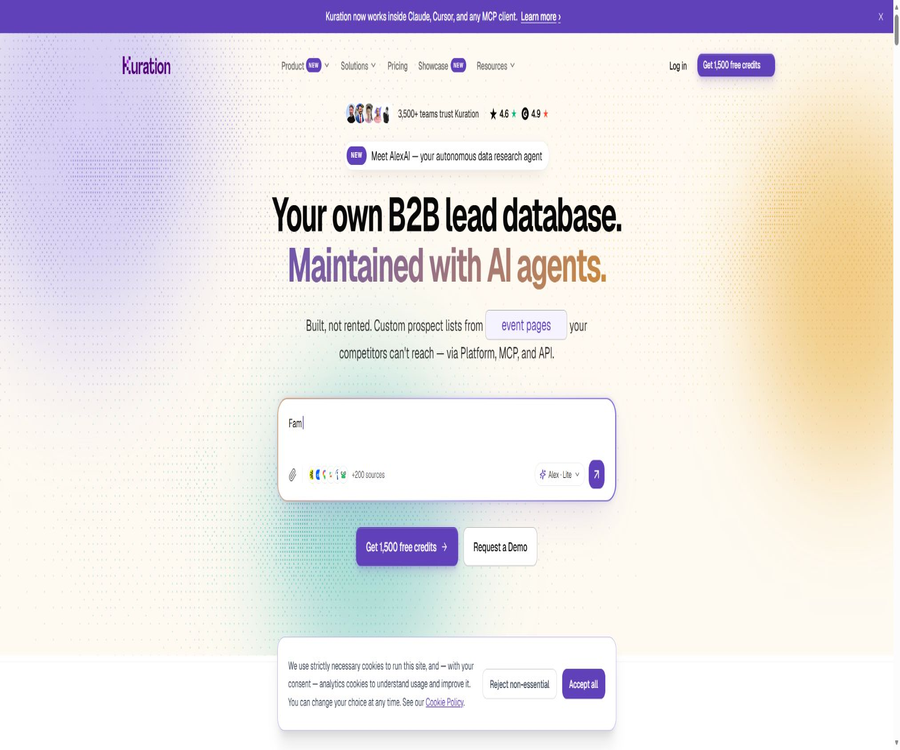
Kuration AI is a platform that uses AI agents to create and maintain one’s own B2B lead database; it enables the conversion of catalogs, event pages, maps, PDF files, and existing tables into sales lists that have been completed, rated, and continuously updated.
Tool Introduction
Kuration AI is operated by Kuration AI Limited, a company registered in Hong Kong, and it is aimed at teams responsible for sales development, growth, RevOps, recruitment, and research. It does not merely provide a shared contact database; instead, it allows users to create custom lists based on their ideal customer profiles, using real-time public data as well as data from authorized sources.
Users can describe the target companies or contacts in natural language, or they can import data from CSV files, web directories, event lists, and PDF documents. The system then plans the steps for data collection and completion, organizing information about companies, decision-makers, contact details, business indicators, and research results into searchable tables.
Core working method
| Phase | Main operations | The obtained results | Common uses |
|---|---|---|---|
| Build | Describe ICP or import web pages, maps, PDFs, CSVs | Initial list of companies or contacts | Event list, local businesses, industry-specific research |
| Complete | Run contact, company attribute, and custom research tools | Email, phone number, position, size, and business indicators | Sales development and account research |
| Filtering | Set conditions, AI scoring, and priorities | Target accounts sorted by degree of matching | Reduce unnecessary outreach. |
| Delivery | Export tables or synchronize CRM with outreach platforms | Data that can be incorporated into existing workflows | Collaboration in marketing, sales, and operations |
| Refresh | Set up Cadence or automated tasks | The dedicated database being updated as planned | Monitor changes in positions, companies, and markets. |
Main functions
Alex AI natural language table creation
The user only needs to specify the type of company or decision-maker they are looking for; Alex AI will then choose the appropriate list builder, data tools, and processing sequence. It is useful for transforming vague sales research objectives into actionable workflows, but the user should still verify that the filtering criteria are accurate.
Multi-channel list construction
The platform offers a variety of methods for creating lists; users can start by using sources such as Google Maps, web directories, PDF files, LinkedIn, Indeed, Alibaba, Yellow Pages, Amazon, Trustpilot, and Apify tasks. Users can also import their own CSV files or use existing data on companies and contacts.
Web directory and event updates
Kuration can extract lists of exhibition exhibitors, sponsors, speakers, associations, as well as professional directories; it is useful for identifying companies in the offline industry that are not covered by traditional contact databases. Changes in the page structure, login restrictions, and anti-automation measures may affect the completeness of the extracted data.
Complete company and contact information
Users can add fields to the table such as the company’s website, industry, size, financing status, job positions, qualifications, professional profile page, work email address, and mobile phone number. Different tools may deduct points based on the success of the operation, the actual results achieved, or the number of entries returned.
Cascading data completion
For fields such as email addresses and phone numbers that cannot be covered through a single source, the platform can call on multiple providers one after another to improve the rate of successful data filling. Sequential calls may increase the amount of points used; therefore, it is necessary to test the success rate using the actual location and target position before making a purchase.
Decision-maker search
The Find People tool allows users to search for contacts based on position, department, experience level, and company criteria, with charging based on the actual number of results returned. Users should set a maximum limit to avoid generating an excessively large list at once.
Custom AI Research Column
Users can define questions, prompts, and the desired format, allowing the AI to analyze products, certifications, recruitment efforts, marketing activities, or other business indicators for each line. Such tools are usually charged based on their usage, and points may still be generated even if no results are obtained.
Clue scoring and sorting
The platform can assign scores to potential customers based on the ideal customer profile and custom criteria, thereby helping the team to focus first on those accounts that match better. The quality of these scores depends on the rules applied, the completeness of the data fields, and the validation samples used; they cannot replace the judgment of sales staff.
Conditional execution and selective completion
Users can perform completion only on those rows that meet the filtering criteria, are missing certain fields, or correspond to specific entries, thereby avoiding unnecessary consumption of credits for the entire table. Before running the operation in batch mode, the estimated number of rows, the order in which they need to be processed, and the associated cost are displayed.
Automatic refresh and Cadence
Paid teams can set the list to be refreshed periodically, in order to continuously monitor any changes in companies, positions, and contact details. Automatic tasks should have defined frequencies, filtering criteria, and budget limits, to avoid unnecessary repeated processing.
Project and Team Workspaces
The team can manage projects, lists, members, and point allocations in the shared workspace; it is also possible to create new projects from the data that has been filtered. Different plans offer varying numbers of workspaces and different levels of permissions.
Supported inputs and outputs
| Category | Supported content | Instructions for use |
|---|---|---|
| Natural language | Description of ICP, industry, region, position, and business signals | Suitable for having the process planned by Alex AI. |
| Web page data | Directory, event pages, corporate websites, and map results | Dynamic pages and login pages need to be tested in practice. |
| Document | PDFs and files containing company or contact information | The quality of the scan affects extraction. |
| Table | CSV, Excel, and existing projects | Standardize column names and encoding before import. |
| Table delivery | CSV, Excel, and Google Sheets | The export range is influenced by the package rules and the number of rows. |
| System delivery | CRM, outreach tools, Webhooks, and REST APIs | An authorization key and the corresponding plan are required. |
Multilingual and Cross-regional Studies
The platform claims to be able to handle more than 12 languages, and it is designed to work with materials in various languages such as Chinese catalogs, Arabic registration information, and French-language event pages. However, multilingual processing does not mean that contact data is available for all countries; the team should conduct tests separately for each target market.
- Check the mapping between the local language name and the English name of the company.
- Standardize country, region, phone area code, and address formats.
- Verify the encoding of non-Latin characters in CSV and CRM.
- Determine the basis for using a company’s contact information in accordance with local laws.
- Avoid equating language comprehension ability with data integrity.
- Manual review is reserved for translations with low confidence and industry classifications.
Recommended usage process
- Define the target industry, region, company size, position, and exclusion criteria.
- Choose natural language, web directory, map, PDF, or CSV as the starting point.
- Generate a small number of samples first to check whether the company meets the ICP requirements.
- Delete obviously irrelevant or duplicate records.
- Only for qualified banks are the enterprise attributes, decision-makers, and contact information completed.
- Add custom research fields and define a fixed output format.
- Use scoring rules to determine priorities and sample high-scoring records for verification.
- Export or synchronize the results to CRM and external contact systems.
- Set refresh schedules and score limits for lists intended for continuous use.
- Regularly process requests for cancellation, deletion, correction, and data expiration.
How to design a high-quality list
A good list should not only include the industry and the number of employees, but also define verifiable purchase indicators, exclusion criteria, and the roles of those who make decisions. At the beginning, the objectives should be formulated as rules that can be assessed line by line.
| Rules section | Suggested wording | Wrong approach |
|---|---|---|
| Target company | Region, industry, scale, and business type | Only list high-quality companies. |
| Trigger signal | Participation in exhibitions, recruitment, expansion, certification, or technology stack | State that there is a demand in the near future. |
| Contact person | Specific departments, functions, qualifications, and maximum numbers | Find the person in charge |
| Exclusions | Competitors, existing customers, those without a website, or certain industries | After generation, manually delete a large number of them. |
| Output field | Field names, data types, enums, and null value rules | Let AI operate freely. |
| Acceptance | Sample accuracy, repetition rate, and effectiveness of contact information | Only consider the total number. |
Table operation and cost control
The price information was verified on August 23, 2026; the actual amounts, taxes, exchange rates, and discounts may vary, and the final figures will be those displayed on the settlement page.
Kuration enables batch execution of tools either row by row or column by column, with the order of execution determined by field dependencies. Users can choose to process 10, 25, 50, or 100 rows, or to handle only the rows with missing data or all rows that meet the criteria.
- Filter first and then complete the process; do not run expensive tools on the entire original table.
- For simple searches, it is preferable to use lighter tools or proxies.
- In-depth analysis is conducted only on high-value accounts.
- Check the charging details and estimated points before proceeding.
- Set thresholds and maximum limits for the number of transactions per cycle for automatic top-ups.
- View the score history for the account and the workspace separately.
- For duplicate entries, first check the existing companies and contacts.
- Retain a small sample as a benchmark for accuracy and cost.
How are points deducted?
| Payment method | When to deduct | Representative task | Control recommendations |
|---|---|---|---|
| Charging after success | When available results are found | Email, phone number, and some corporate fields | Preferentially used for fields with uncertain hit rates. |
| Charging per run | The fee is deducted as soon as the tool is used. | AI research, web searching, and scraping | First, test the prompts in small batches. |
| Charge based on results | By number of returned entries | Decision-makers and content generation | Set a clear upper limit on the quantity. |
| Free tools | No points will be deducted. | Scoring, partial list creation, and CRM operations | First, narrow down the range using the free steps. |
Under the current standard rates, most individual tools are worth 1 point; a verified email address is worth 5 points, a mobile phone number is worth 10 points, and locating the decision-maker is worth 2 points. Kura Pro research, Kura Max in-depth research, data extraction from event pages, and automatic database updates typically cost 5, 15, 20, and 30 points respectively.
Price packages
Kuration offers a monthly or annual subscription model along with a points system; the annual plan comes with a 20% discount. The pricing page displays the available monthly subscription options, while taxes, currency rates depending on the region, and the settlement amounts in the account may vary.
| Package | Monthly price | Monthly points | Core rights and interests | Suitable for users |
|---|---|---|---|---|
| Free | $ | 1,500 points | Single user; up to 25 rows can be exported per list; community support available. | Evaluating products and conducting low-frequency research |
| Starter | 79 dollars | 4,500 points | No limit on the number of rows in the list; support for CSV and Google Sheets; up to 3 seats; email and chat support available | Individual sales and small teams |
| Pro | 229 dollars | 14,000 points | Unlimited workspaces, APIs, Webhooks, regular updates, private databases, HubSpot integration, and priority support | A team that is continuously engaged in outreach activities |
| Scale | 799 dollars | 70,000 points | Multiple work areas, custom categorization, dedicated success manager, 99.5% availability guarantee | Agency and multi-project growth team |
| Enterprise | Starting at $2,500 | Customized point pool | Annual contracts, SSO, regional data hosting, custom contracts, and invoices | Companies with over 50 seats and high compliance requirements |
On some pages of the product details, the old pricing levels are still shown: Starter at 49 dollars, Pro at 149 dollars, and Scale at 499 dollars, which do not match the current main pricing options. Before making a purchase, one should refer to the amount calculated after logging in, the selected loyalty level, and the terms of the contract.
Trial, renewal, and point carryover
- The free version receives 1,500 points added each month and remains free on a permanent basis.
- The product offers a 14-day trial period; the trial details indicate that it includes 500 points and no credit card is required.
- The registration button shows 1,500 free points at the same time; the actual amount of points granted depends on the new account.
- Unused subscription credits can be carried forward up to three times the monthly quota.
- The annual plan grants points for the entire year at once.
- Users can purchase additional point packs or set up automatic top-ups.
- Automatic top-up can be performed up to 3 times per billing cycle.
- After canceling the subscription, it can be used until the end of the current billing period.
- Unless otherwise specified by law or order, paid fees are generally non-refundable.
Additional points package
| Points package | Price | Price per point | Effective rules |
|---|---|---|---|
| 1,000 points | 25 dollars | 0.0250 dollars | The subscription remains valid throughout its duration. |
| 5,000 points | 109 dollars | 0.0218 dollars | The subscription remains valid throughout its duration. |
| 15,000 points | 279 dollars | 0.0186 dollars | The subscription remains valid throughout its duration. |
| 50,000 points | 799 dollars | 0.0160 dollars | The subscription remains valid throughout its duration. |
Integration capability
| Category | Representative system | Tasks that can be completed | Precautions |
|---|---|---|---|
| CRM | HubSpot, Salesforce, Attio, Pipedrive, Zoho CRM | Synchronize companies, contacts, and fields | Verify two-way writing, deduplication, and package permissions. |
| Outreach | Smartlead, Instantly, Lemlist, Reply.io, HeyReach | Send qualified potential customers into the outreach sequence. | It is necessary to comply with the cancellation and anti-spam rules. |
| Table | Google Sheets, CSV, and Excel | Import, export, and team collaboration | Pay attention to field types and encoding. |
| Automation | Webhook and Slack notifications | Trigger the process when the task is completed or a field changes. | Verify signatures, retry, and idempotency |
| Expansion | Chrome extensions | Bring the prospects currently being viewed into the project. | Check page permissions and corporate policies. |
| Development | REST API and MCP | Programmatic creation of projects, processing of rows, and connection to AI clients | Protect the key and comply with rate limits. |
REST API and Webhook
The technical documentation provides information on workflow APIs, project and row interfaces, Webhook events, as well as instructions for signature verification; it is suitable for integrating research and enhancements into internal systems. APIs and Webhooks are explicitly listed in the Pro and higher plan versions, while other access methods depend on the account permissions.
- Confirm in the account that the API for the package has been activated and a dedicated key has been created.
- Different keys are used for development, testing, and production.
- Create a project with the minimum sample size and verify the field structure.
- Set rates, concurrency, timeouts, and maximum points for batch tasks.
- The Webhook receiver must verify the signature to prevent duplicate processing.
- Log the request identifier, status, and errors, but do not write the keys to the logs.
- For failed tasks, retry, dead letter handling, and manual review are provided.
- Test for insufficient quotas and unavailable third-party systems before going live.
MCP connection
Kuration provides MCP connections, which enable the use of listing and research functions within Claude, Cursor, and other compatible clients. MCP allows AI assistants to work directly with business data, offering convenience; however, it also increases the risk of errors resulting from natural language commands as well as unauthorized access.
- Create a separate and revocable key for MCP.
- Start the verification by connecting only to the non-sensitive test workspace.
- Limit the items that agents can read and write.
- Manual confirmation is added for batch completion, deletion, and external action tasks.
- Check whether the client saves prompts, results, and keys.
- Monitor integral consumption and abnormal calls.
API, SDK, and open-source status
| Project | Current status | Correct understanding |
|---|---|---|
| REST API | Existing technical documentation | Supports project, row, and workflow automation |
| Webhook | Existing event and signature descriptions | The receiver still needs to carry out verification and ensure idempotency. |
| MCP | Supports various AI-compatible clients. | It belongs to remote service connections; it is not equivalent to a local model. |
| Official SDK | No independent and publicly available SDK packages have been identified. | It can be integrated directly via network interfaces. |
| Official GitHub organization | It exists, but there is no public warehouse. | The platform cannot be marked as open source. |
| Core platform source code | Not disclosed | It currently falls under commercial hosting services. |
| Private deployment | The company page does not provide any explicit guarantees. | The Data Area option is not equivalent to self-hosting. |
Data security and privacy
Kuration handles accounts, usage logs, queries, API calls, uploaded lists, prompt texts, and corporate contact data. Payments are processed by third-party payment services, and the platform does not store the full card numbers.
The security page states that encryption at the time of transmission is done using TLS 1.2 or higher, while static data is encrypted with AES-256; in addition, workspace isolation and role-based access control are provided. SOC 2 Type II is still in the process of being implemented and pending audit, so it cannot be considered as having been certified.
| Data or control | Public explanation | What needs to be done by the user |
|---|---|---|
| Content uploaded by the customer | The platform acts as a processor for carrying out completion and research tasks. | Ensure there is a legitimate basis for processing and sign the required DPA. |
| Kuration database | The company and the customer act as separate controllers. | Bear the responsibilities for marketing and data protection on your own. |
| AI training | Do not use customer data to train public models. | Confirm specific order details and third-party AI terms |
| Encryption | Both transmitted data and static data are encrypted. | Accounts, API keys, and exported files still need to be protected. |
| Team permissions | Workspace separation and role control | Assign permissions based on responsibilities and regularly review team members. |
| Corporate compliance | DPA and security audit materials are available. | Obtain the documents applicable to the organization before making a purchase. |
| Authentication status | SOC 2 Type II pending completion | Do not include the planned certifications in the supplier compliance assessment. |
Data usage and external compliance
The platform primarily deals with B2B professional networking data, but corporate data is not exempt from privacy and anti-spam regulations. Users must establish a legal basis for each target region, ensure transparent communication, provide mechanisms for cancellation of subscriptions, and set up procedures for respecting the rights of data subjects.
- Do not handle sensitive categories such as health, religion, political views, and biometric data.
- Data must not be used for discrimination, harassment, fraud, impersonation, or phishing.
- Calls, text messages, emails, and social interactions each adhere to local rules.
- Maintain lists for refusing contacts, unsubscribing, deleting, and correcting entries.
- Do not disclose or resell data in bulk to unrelated third parties.
- When a request for deletion or update is sent by the platform, the internal CRM is updated simultaneously.
- When operating in multiple countries, evaluate the requirements regarding data cross-border transfer and retention separately for each country.
- For high-risk activities, professional advice on laws and data protection is necessary.
Ownership and restrictions on commercial use
Customers retain the right to upload their own content, and can use the data obtained for internal business purposes, as well as in CRM and marketing processes. The services, documents, platform data, and brand remain the property of Kuration and its licensors.
- The platform data may not be resold, rented, or relicensed in its original form or in a form that is substantially similar to the original.
- Platform data must not be made available on the Internet, through public APIs, or in indexable directories.
- The platform’s capabilities shall not be provided to third parties through service outsourcing without permission.
- Reverse engineering or attempting to obtain the core source code of the platform is prohibited.
- AI systems that are direct competitors cannot be trained or evaluated using platforms or data.
- Third-party CRM, outreach, and AI services are governed by their respective terms.
- Customers are responsible for the accuracy of the data, the legality of external communications, and business decisions.
Which users are it suitable for
- It is necessary to identify a company’s sales team by means of trade shows, associations, and industry directories.
- RevOps and growth teams that aim to create a dedicated database of potential customers.
- Sales development professionals who need to have their contact information, email addresses, and phone numbers completed.
- An ABM team that aims to assign scores to accounts based on business signals.
- Agencies that need to manage multiple client projects at the same time.
- Analysts who study the offline industry, regional businesses, and cross-border markets.
- Development teams that wish to automate data workflows using APIs or MCP.
- Companies that need to synchronize their research findings with CRM and external communication systems.
Typical use cases
| Scene | Recommended process | Final result |
|---|---|---|
| Attracting customers through exhibitions | Extract exhibitors and sponsors, then locate sales decision-makers. | List of activities with contacts and priorities |
| Local businesses | Create a company table based on maps and catalogs, then add the website information and contact details. | A database that can be filtered by city and category. |
| Competitive intelligence | Track competitors’ activities involving participation, sponsorship, or giving speeches. | Records of market activities and channel changes |
| Recruitment signals | Check for job openings, team expansion, and technical positions | Accounts with procurement or growth signals |
| Agency | Create isolated work areas and customized classifications for different clients. | Sustainably refreshable list of multiple items |
| CRM cleaning | Import existing contacts, check for duplicates, and fill in any missing fields. | Consistent and more complete CRM data structure |
Product advantages
- Plan the processes for list construction and completion directly based on natural language requirements.
- It covers various entry points such as activity pages, maps, catalogs, PDFs, and proprietary data.
- Centralize company research, contact information completion, scoring, and delivery in a table.
- The tool can be run selectively based on conditions and missing fields.
- The integrated price and charge actions are visible before execution.
- It supports automatic refreshing, making it suitable for maintaining long-term dedicated databases.
- Integration with CRM, outreach tools, Webhooks, REST APIs, and MCP is quite comprehensive.
- The free version can be used to assess the actual data quality at a low cost.
- Offers DPA, security materials, and enterprise data zone solutions.
Main limitations
- Different sections of the official website still display conflicting old prices.
- In-depth research, as well as the extraction of phone numbers and event information, will consume points quite quickly.
- The data hit rate varies significantly depending on country, industry, and position.
- The website structure, login restrictions, and anti-automation measures can lead to extraction failures.
- AI scoring and custom research may still result in errors or omissions.
- The free version allows the export of only a limited number of rows per list.
- APIs, Webhooks, and advanced automatic refresh features require higher-tier plans.
- SOC 2 Type II is still in progress; it cannot yet be considered as an approved certification.
- The legality of accessing corporate contact data remains the responsibility of the customer.
- The core code of the platform is not open source, nor is a self-hosted version provided.
- The terms prohibit resale, public distribution, and use through outsourced services.
Pre-purchase checklist
- Prepare a deduplicated sample using the target country, industry, and position.
- Test enterprise discovery, contacts, email, phone numbers, and custom signals separately.
- Record the hit rate, accuracy, and unit integration cost for each type of field.
- Confirm the seats, workspace, API, and refresh permissions for the selected package.
- On the account settlement page, check the price, bonus points, taxes, and renewal period.
- Verify CRM field mapping, deduplication, rollback, and deletion synchronization.
- Check the API rate, Webhook signature, error retry, and usage limits.
- Obtain the DPA, security materials, information on sub-processors, and data areas.
- Compliance officers review the outreach and data retention rules for target markets.
- Confirm the SLA, support response times, refund policies, and procedures for terminating exports as specified in the contract.
Frequently Asked Questions
What is Kuration AI mainly used for?
It is used to create lists of B2B companies and contacts from web pages, maps, PDFs, directories, and existing tables, and then to carry out tasks such as data completion, scoring, synchronization, and regular updates.
Is Kuration AI a shared contact database?
The platform contains searchable data, but its main purpose is to create customized lists based on users’ objectives by utilizing various real-time sources. Users can save, complete, and continuously maintain their own project data.
Is it possible to use it without knowing how to write code?
Yes, Alex AI allows for describing objectives in natural language and generating workflows. However, complex filtering, data compliance, and system integration still require approval from business or technical personnel.
Is Kuration AI free?
A free version is available on a long-term basis, with 1,500 points added each month; however, a maximum of 25 rows can be exported from each list. The paid version provides more points, additional seats, enhanced export capabilities, API access, automatic updating, and better enterprise management functions.
What is the current payment price?
The current main pricing tiers are as follows: Starter at $79 per month, Pro at $229 per month, Scale at $799 per month, and Enterprise starting at $2,500 per month. The old prices are still displayed on certain pages; therefore, it is necessary to refer to the account details before making a payment.
Will the remaining points be reset if they are not used up?
Monthly subscription points can be carried over, with a maximum balance equal to three times the monthly quota. Additional point packs remain valid throughout the duration of the subscription.
Is API and MCP supported?
It supports REST API, Webhook, and MCP connections; the technical documentation is available publicly. The Pro package includes API and Webhook as standard features, while advanced capabilities and call limits need to be checked in the account settings.
Is Kuration AI open source?
It is not an open-source platform; the official GitHub repository does not exist, and there is no information available regarding the open-source license for its core services. The API and MCP can be used for integration, but this does not mean that the source code of the platform is available publicly.
Can the data be used directly for sending mass emails?
Direct mass sending is not allowed without prior review; users must have a legitimate basis for doing so, provide clear information regarding how to unsubscribe, and comply with the regulations related to emails, calls, and privacy in the target regions.
Has the SOC 2 certification been completed?
It is not yet complete; the security page indicates that SOC 2 Type II certification is in progress and awaiting an independent audit. Companies should not assume that it has been certified simply based on the information provided in the package details.
Summary
Kuration AI is suitable for teams that wish to create a customized B2B database using information from trade shows, maps, industry catalogs, PDF files, and their own lists. Thanks to Alex AI, along with various completion tools, conditional operations, scoring functions, automatic updates, CRM capabilities, APIs, and MCP, it can handle the entire process from research to sales delivery.
Before adoption, it is essential to verify the accuracy of data related to the target market, the amount of points consumed, price calculations, CRM mapping, and compliance with external regulations. On this page, both old and new versions of prices are available; SOC 2 certification is still in progress, and the platform is not an open-source or self-hosted product.
Tools similar to Kuration




 Guigong Network Security Registration No. 45132202000164