






Extruct AI
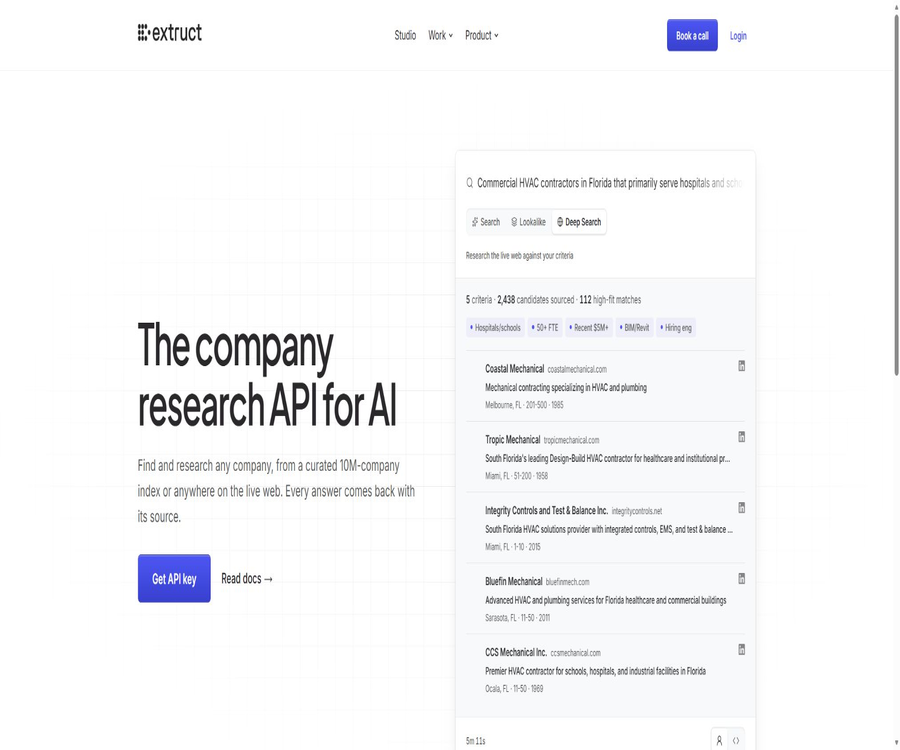
Extruct AI: an intelligent tool focused on AI-based searching.
Tags:AI search engineA one-sentence summary
Extruct AI is an AI platform that focuses on company discovery, corporate research, and data enrichment; it enables the identification of target companies from company indexes and real-time web pages, and generates verifiable research results through semantic search, similar companies, Deep Search, Deep Research, and AI Tables.
Tool Introduction
Extruct AI is operated by the American company Extruct AI, Inc.; its purpose is to provide APIs for use by companies that work with AI applications and business processes. It is not a general-purpose chatbot, but rather it combines functions such as enterprise data retrieval, conditional filtering, web research, contact information completion, and structured output into a single research workflow.
The platform maintains an indexed database of around ten million companies, and it also allows for the search of real-time web pages when needed. Users can interact via the Studio web interface; in addition, they can integrate various capabilities into sales, investment, market research, or automation workflows through REST APIs, MCP, and public skill repositories.
| Product module | Main tasks | Typical output | Suitable scenarios |
|---|---|---|---|
| Semantic Search | Search for companies using natural language and corporate attributes. | Company list and basic fields | Market map, preliminary list |
| Lookalike Search | Identify similar companies based on a seed company. | List of companies sorted by similarity | Customer acquisition, identification of competitors |
| Deep Search | Identify and score within multiple types of data based on qualitative criteria. | Correlation, item-by-item scoring, explanations, and evidence | Complex clue filtering, preliminary investment screening |
| Deep Research | Conduct research focused on a single company, individual, or team. | Reports or structured data with evidence numbers | Due diligence briefs, pre-meeting research |
| AI Tables | Bulk enrichment, research, and evaluation of company lists | Structured tables that can be shared and exported | List cleaning, segmentation, and CRM preparation |
Main functions
Company index and search by individual company
The platform allows for the retrieval of company information using either the company’s domain name or an internal identifier, or through a searchable index of companies. The basic fields are suitable for creating standardized lists, but changes to web pages, as well as relationships between companies with the same name and their sub-brands, still require manual verification.
- Identify companies based on their domain names or corporate identifiers, thereby reducing the ambiguity that arises from searches using only the name.
- It returns available fields such as company profile, industry, location, scale, etc.; the specific fields depend on the API response and account permissions.
- The query results can be passed on to Deep Research or AI Tables without the need to reorganize the targets.
- Company indexes are suitable for quick retrieval, while real-time web research is used to supplement recent information and qualitative evidence.
Semantic Search – Semantic lookup
Semantic Search enables users to describe the company they are looking for in natural language, and they can also specify parameters such as country, city, number of employees, year of establishment, as well as any exclusion criteria. It focuses on generating a wide range of results, which is useful for first creating a list of potential candidates before applying more stringent filtering criteria.
- It is possible to describe the product, target customers, or business model, without needing to know the exact industry classification code in advance.
- The range can be narrowed down by using structured filtering criteria such as region, scale, and year of establishment.
- A single page can return up to 250 entries; the free version allows for reading up to 25 entries at a time, while the paid version enables paginated reading of up to 2000 entries.
- Officials recommend that the new integration use the current company search request method; the old reading method has been marked as deprecated.
Lookalike Search: Search for similar companies
Lookalike Search uses a company’s domain name or internal identifier as a starting point to identify similar companies based on factors such as business content, target customers, corporate characteristics, and website traffic. The more typical the starting point is, the more useful the results will be for acquiring new customers or analyzing competitors.
- It is suitable for starting with existing high-quality customers in order to identify potential leads with similar business characteristics.
- Additional filtering criteria such as country can be added to prevent the list from being too broad.
- The free plan allows for reading up to 25 entries per query, while Starter and Pro versions enable paginated reading of up to 2000 entries.
- Similarity is not a proof of willingness to cooperate or purchasing power; it still needs to be considered in conjunction with Deep Search and human judgment.
Deep Search: In-depth discovery and scoring
Deep Search is suitable for answering qualitative questions that cannot be addressed easily with conventional indexing, such as identifying companies that meet multiple business criteria. The system searches web pages, company databases, maps, and professional networking platforms in an asynchronous manner, and then uses natural language processing to identify, rank, and explain the potential companies.
- The system can infer the scoring criteria, or the user can specify each evaluation condition explicitly.
- The results include correlations, individual ratings, explanations, and evidence, making it easy to understand why a particular company was selected.
- The maximum number of expected results for a single discovery task is 250, and more results can be obtained within the scope of that task.
- Existing tasks and already resolved domain names can be excluded, thereby reducing the likelihood of the same company ending up on the list again.
- The task is executed asynchronously, and the official recommendation is to check its progress every 15 to 30 seconds.
Deep Research in-depth analysis reports
Deep Research generates in-depth briefs on a company, individual, or team. It first plans the tasks ahead of time, then runs research agents in parallel and combines the results; it is suitable for preparation before meetings, due diligence for investments, and research on key clients.
- It supports three levels of research depth: medium, high, and ultra-high, corresponding to up to approximately 5, 15, and 25 research agents respectively.
- It is possible to generate a Markdown report with evidence numbers, or to return results in a data structure defined by the user.
- Structured patterns allow evidence and reasoning to be associated with fields, but the data structure can have up to 5 levels of nesting and 50 attributes.
- The task status provides progress information such as the number of iterations, the number of agents, and the amount of data, as well as indicating the reasons for any degradation in the results.
- This feature requires a Pro plan and sufficient points; in the event of a failed task, the points used for it are returned according to the official rules.
AI Tables: Batch processing of research tables
AI Tables transforms lists of companies into reusable research and scoring workflows. Users can import their own company domain names or receive search results, after which they can add system fields or AI agent columns to supply additional information in bulk.
- Built-in fields are used to supplement the company’s basic information, thereby reducing the need for manual copying and ensuring a consistent format for the fields.
- The proxy column can perform web research, extract facts, evaluate conditions, or generate scores.
- It is possible to check the status of tables and cells, and then read, share, or export the final results.
- The current pricing assigns 1 point per AI cell; the Pro plan includes 2,000 research cells.
Complete email address and phone number
The Pro plan offers the ability to look up contact emails and phone numbers, which can be used to complete the list of targets that have already been identified. Under the current pricing structure, 4 points are required for each email lookup, while 20 points are needed for each phone number lookup; therefore, it is advisable to first filter out companies and job positions, and then add details for those few high-value contacts.
Contact data does not equate to permission for marketing activities. Users must comply with the privacy, anti-harassment, and electronic marketing regulations of the target regions, and they need to implement mechanisms for cancellation of subscriptions, creation of suppression lists, and manual review processes.
Public datasets in the Data Room
The Data Room is used to access the public company data sets that have been compiled by the platform. Free users can view the data in the public Data Room, while Starter and Pro versions offer the ability to export this data, which is useful for quickly obtaining an initial set of companies related to a particular topic.
Studio web workspace
Studio is a web-based workspace that allows for searching and research without the need for custom development. Starter enables sharing of tables and search results, while Team & Enterprise adds features such as shared workspaces, billing based on the number of users, and support for team imports.
How to choose the appropriate research path
The various search methods offered by Extruct address different types of tasks. By first determining whether the goal is to obtain quick results, to find similar companies, to filter based on complex criteria, or to conduct an in-depth analysis of a single target, it is possible to avoid wasting resources.
| Demand | Priority features | Reason for selection | Subsequent actions |
|---|---|---|---|
| Search for companies in batches based on business descriptions | Semantic Search | Fast speed, with support for attribute filtering. | Enrich with AI Tables or re-screen using Deep Search |
| Expand the list of high-quality clients | Lookalike Search | Identify similar companies based on the multi-dimensional characteristics of seed companies. | Check the compatibility between region and buyer. |
| Identify enterprises based on complex qualitative criteria | Deep Search | It allows searching across different data sources and scoring each item individually. | Enter the form after manually reviewing the evidence. |
| Study a key company or individual. | Deep Research | Generate a comprehensive briefing with evidence. | Used for pre-meeting preparations or due diligence |
| Batch completion and scoring of existing lists | AI Tables | The same research logic can be applied repeatedly to each row. | Export and proceed to the CRM process |
Complete workflow
Create a list of target companies
- First, define the ideal customer, the investment theme, or the market scope, and separate the conditions that must be met from those that are used solely for sorting.
- Use Semantic Search to create a broad pool of candidates, or employ Lookalike Search to expand a list of similar companies based on existing high-quality ones.
- Initiate Deep Search for the qualitative criteria related to web-based evidence, and define the scoring conditions as well as the desired number of results.
- Examine the explanations and evidence provided by each company, and eliminate those entries with the same name, those that are no longer in operation, those located in different regions, or those whose business descriptions are outdated.
- Import the reserved list into AI Tables to uniformly add fields, contacts, and ratings, and then export it to the subsequent systems.
Prepare research briefs on key companies
- Verify the correct domain name of the target company, as well as the identities of the individuals or teams involved, in order to avoid confusion regarding the subject of study.
- Select Deep Research, and set the level of depth for the research based on the importance of the question and the available budget in terms of points.
- Define a streamlined data structure when machine processing is required, to avoid exceeding the limits on nesting levels and the number of attributes.
- After the task is started, check its status at the recommended intervals, while also keeping track of the progress, any warnings regarding degradation, or the reasons for failure.
- When reading the final report, open each piece of evidence accordingly, verify the dates, parties involved, and context before using it to make decisions.
Usage tutorial
Getting started with the web version
- Register an account and log in to Studio; first, use the free version to test a well-defined, limited-scale search.
- In semantic search, the target company is described, with filtering criteria such as country, city, size, or year of establishment added.
- Check whether the first 25 results meet the expectations, then adjust the descriptions and exclusion criteria, rather than immediately increasing the number.
- When qualitative evidence is required, upgrade to Deep Search; after review is completed, the data is written into AI Tables in bulk.
- Delete the erroneous entries before exporting or sharing, and record the search criteria and verification time to enable reproduction.
API integration process
- Create access tokens in the account console and store them using server-side key management; do not save them on front-end pages or in public code repositories.
- First, use the company query or Semantic Search to verify the field structure, pagination rules, and free usage quota.
- For Deep Search and Deep Research, after creating an asynchronous task, check its status at the intervals recommended by the developers.
- It handles three states: success, failure, and degradation, and saves the evidence mappings along with the main text of the research.
- In the production environment, retry mechanisms, duplicate removal, quota alerts, and manual inspections are implemented to prevent repeated tasks from consuming a large amount of credits.
Which users are it suitable for
- Sales development team: Identifies companies based on the ideal customer profile, selects a list of targets, and adds additional contacts.
- Market and Growth Team: Create a map of market segments, analyze the competitive landscape, and prepare targeted marketing lists.
- Investment firms and researchers: Identify companies that fit the relevant criteria, and prepare evidence-based research reports on the key targets.
- Consulting and Strategy Team: Organizes company data in bulk, verifies qualitative criteria, and creates reusable research tables.
- Data and automation developers: Integrate the company’s research into agents and internal workflows through APIs, MCP, or open capabilities.
- Founder and Business Leader: Searching for partners, potential clients, or similar companies, and preparing for important meetings.
Typical use cases
- Create a list of segmented market companies based on product capabilities, target customers, region, and scale requirements.
- Using existing high-value customers as a starting point, identify similar companies and verify the suitability of their actual business models.
- Import the list of attendees, recruitment agencies, or industries into AI Tables to uniformly add company information and research findings.
- Before the sales meeting, study the company’s products, team, recent developments, and potential needs, and keep evidence of it.
- Identify potential candidates for investment opportunities, and generate explanations and scores for each investment criterion.
- Using MCP, AI clients that support this protocol can carry out tasks such as company searches, advanced searches, and research.
- Export the enterprise data that has been manually verified to CRM systems, analysis tools, or internal databases.
Product advantages
- The company’s research focus is well-defined: it centers on the discovery, screening, enhancement, and design of enterprises, rather than providing general chat functions.
- Complete search hierarchy: Rapid semantic retrieval, identification of similar companies, qualitative in-depth searching, and targeted in-depth analysis each have their own specific purposes.
- The results highlight the evidence: Deep Search and Deep Research can provide judgments, explanations, as well as the corresponding evidence, which facilitates manual verification.
- Structured batch processing is supported: AI Tables enables the repeated application of consistent analysis logic to existing lists or search results.
- There are various ways to connect: the web interface, REST API, MCP, as well as public skills and n8n community nodes, which cater to users with different levels of technical expertise.
- The free plan includes API access and 25 points per month; developers can first test the fields and workflows before deciding to subscribe.
Usage restrictions and precautions
- Company profiles, contact information, and website evidence may be outdated, point to entities with the same name, or lack context; therefore they cannot be used as definitive proof.
- Semantic Search places emphasis on recall; it does not guarantee that all results meet the implied qualitative criteria, and complex criteria should be referred to Deep Search for further screening.
- Deep Search and Deep Research are asynchronous tasks, and the speed of obtaining results is influenced by the complexity of the tasks as well as the availability of the web pages.
- Multi-agent deep learning in Deep Research consumes a significant amount of credits; it is necessary to confirm the budget and scope of the task before starting.
- Monthly points are reset at the end of the settlement period and are not carried over; any unused quota cannot be transferred to the following month.
- The platform does not guarantee that the information provided is absolutely accurate or complete; important decisions related to sales, investments, and compliance must be reviewed by human beings.
- The terms of service prohibit automatic data extraction via unofficial interfaces, as well as the bulk resale or redistribution of the obtained data.
- It is not permitted to use the services to create or train competitive databases, models, or services; contract permissions must be verified before any commercial reuse.
- The terms indicate that this service is not designed in accordance with industry-specific regulations such as HIPAA or FISMA; workloads subject to such regulations should not be used with it.
- The platform requires users to be at least 18 years old, and it may restrict or terminate access due to violations, misuse, or impacts on the performance of other users.
Prices and packages
The following is the official monthly plan as verified on August 22, 2026. Prices and benefits may change; the final amount, taxes, seating rules, and quotas shall be based on the information available on the purchase page for the account.
| Package | Price | Monthly limit | Primary interests | Suitable for users |
|---|---|---|---|---|
| Free | $ | 25 points | Up to 25 reads per query for semantic and similar search; up to 25 items per read; browsing of public Data Rooms; API and Chrome extensions | Individual testing, interface verification |
| Starter | $ | 500 points | 500 searches for semantic and similar search; up to 2,000 results per search; export to a public Data Room; sharing of tables and searching; APIs and extensions | Small-scale sales and research projects |
| Pro | $ | 2000 points | Deep Search, Deep Research, 2000 AI cells, 500 email inquiries and 100 phone inquiries; API and extensions | Continuous customer acquisition, in-depth research, and batch processing |
| Team & Enterprise | Custom quote | According to the team contract | Shared workspaces, pricing based on seats, team import, CRM integration guidance, dedicated support | Organizations that require collaboration, governance, and customized quotas |
How are points consumed?
| Operation | Current integration cost | Additional explanation |
|---|---|---|
| Semantic Search | 1 point per transaction | Deducted from the monthly shared points pool |
| Lookalike Search | 1 point per transaction | Deducted from the monthly shared points pool |
| Deep Search matching | 2 points per item | Pro plan: billing based on the number of matches identified and scored. |
| AI Table: Unit for studying cells | 1 point per cell | Pro plan: The number of rows and columns should be estimated before running in batch mode. |
| Email inquiry | 4 points per attempt | Pro plan; the results still need to be verified. |
| Phone inquiry | 20 points per attempt | Pro plan; the cost is higher than that of email inquiries. |
| Deep Research agent | 2 points per proxy execution | For medium, high, and ultra-high depths, the scores are approximately 10, 30, and 50 points respectively. |
Subscription and quota rules
- All features share the same monthly point pool; the points are reset at the end of each billing cycle and are not carried over.
- Currently, no separate points for additional purchases are available; when the quota is insufficient, it is necessary to upgrade the plan or contact the team for a solution.
- An upgrade takes effect immediately, with the credit amount adjusted based on the remaining period; a downgrade takes effect in the next billing cycle.
- Subscriptions are automatically renewed by default, but users can cancel them from their account; the cancellation takes effect at the end of the current payment period.
- The commonly used credit cards listed by the authorities are Visa and Mastercard; payments are made in US dollars, and taxes may apply additionally.
- Teams and enterprises can request NET 30 invoices; the specific payment terms need to be confirmed with the sales team.
Supported platforms and integration methods
| Method | Support status | Primary uses | Precautions |
|---|---|---|---|
| Web Studio | Support | Interactive search, tables, and research tasks | Full functionality requires an account and the corresponding plan. |
| REST API | Support | Company inquiries, searches, asynchronous research, and table automation | Uses access tokens and is subject to limits on points and usage. |
| MCP | Support | Allow clients such as Claude, Cursor, VS Code, and Codex to call the research tools. | Through OAuth authorization, the specific capabilities depend on the client. |
| API Skill | Support | Use tokens to execute interface-based workflows in a proxy environment | Suitable for technical users; it is necessary to protect the keys. |
| n8n node | Public warehouse | Calling Extruct within low-code workflows | Check the repository version and license before deployment. |
| Chrome extensions | The package includes | Assisting companies in their research using a browser | The currently available public pricing lists the entitlements; the installation link and store status can be checked within the account. |
| Native mobile apps | Not confirmed | There is currently no reliable official information available regarding the app. | You can use a mobile browser first; avoid installing unofficial programs. |
API, MCP, and open-source status
Extruct provides public API documentation and account tokens, enabling operations such as company searches, Semantic Search, Lookalike Search, Deep Search, Deep Research, and AI Tables. For asynchronous tasks, it is necessary to create tasks, monitor their status, and handle results that are successful, failed, or of reduced quality.
The official MCP server uses OAuth for connections, and it is designed for desktop applications, web interfaces, and development tools that support this protocol. In contrast, the official API Skill relies on account tokens and is closer to the original interface, making it suitable for developers who need precise control over requests and data structures.
Official GitHub content
- The official organization has made available a repository of skills related to market entry, sales outreach, venture capital, and research processes.
- The skills repository makes the Extruct API Skill available, under the MIT license.
- The n8n-nodes-extruct repository provides N8N connection nodes and is licensed under the MIT license.
- linkedin-abm-skills is a publicly available branch repository under the MIT license; it is still necessary to check the rules of the upstream projects and the platform before using it.
- In some workflow repositories, the license information is not clearly indicated on the public pages; therefore, it should not be assumed that the content there can be freely copied or republished.
- The point figures indicated on GitHub’s page may be updated earlier or later than those on the pricing page; the billing should be based on the current official prices.
The Extruct platform itself is a commercial, closed-source service. The fact that the skill sets, connectors, or workflow codes are available in open source format means that those repositories can be used in accordance with the relevant licenses; it does not mean that the company’s indexing systems, research engines, web applications, or service outputs are also open source.
Privacy and data security
The most recent update to the official privacy policy dates from May 8, 2025. The platform processes account contact information, usage records, device and network details, location data, as well as Cookie information; payment details are handled by payment processors such as Stripe.
- User input, output, and related personal information may be processed by AI service providers, and the public policies do not provide a clear enough guarantee of no training of such data.
- The platform states that it does not proactively process sensitive personal information, and users should not submit data that is subject to strict regulations or for which sharing is not permitted, for use in research tasks.
- After the account is terminated, personal information is generally not retained for more than 12 months for its original purpose; thereafter it is deleted, anonymized, or isolated in backups.
- Cross-border processing may involve the use of standard contract clauses and data processing appendices; corporate clients should review these documents prior to making a purchase.
- The platform may use analysis and advertising tracking technologies, and its public policy states that it will not respond to the browser’s do-not-track signals.
- The policy states that personal information will not be sold or shared, and it offers rights to access, correct, and delete such information; however, the specific scope of application depends on the laws in force in the relevant jurisdiction.
- Persons under 18 years of age are not allowed to register for or use the service, and the platform states that it does not intend to collect information from minors.
Safety inspection before the enterprise puts it into use
- First, verify whether there is a legitimate basis for processing the list of companies to be uploaded, the contact information, and the internal notes.
- Review the terms of service, privacy policy, and data processing appendices with the legal or privacy officer.
- Only the necessary API token permissions are granted, and abnormal calls are stored on the server, rotated regularly, and monitored.
- Rules are established for sales and research personnel regarding the fields that may be used, the scope of export, the retention period, and the procedures for deletion.
- Sample verification is conducted on AI conclusions, contacts, and evidence, with manual revisions recorded for audit purposes.
Basic information
| Project | Content |
|---|---|
| Tool name | Extruct AI |
| Development company | Extruct AI, Inc. |
| Tool type | The company focuses on research in API technology, enterprise search, sales intelligence, and data enrichment. |
| Core module | Semantic Search, Lookalike Search, Deep Search, Deep Research, AI Tables |
| Company index scale | Officials say there are around 10 million companies. |
| Price pattern | Free quota, monthly subscription, enterprise customization |
| Free quota | 25 points per month |
| Is registration required? | It is necessary. |
| Chinese support | Natural language queries can use Chinese; the official interface and documentation are primarily in English. |
| API | Provide |
| MCP | Provide |
| Official SDK | The traditional language SDK has not been confirmed; API Skills and public integration repositories are available. |
| Is it open source? | The platform is not open-source; some skill and connector repositories use the MIT license. |
| Main platforms | Integration with Web, REST APIs, MCP, proxy capabilities, and n8n |
| Minimum age | 18 years old |
Recommendation score
Recommendation score: 4.3 / 5. Extruct connects company recalls, similar enterprises, qualitative screening, in-depth analysis of a single objective, and batch table processing into a clear research workflow; it provides evidence-based results and offers various ways for developers to integrate it, making it particularly suitable for B2B businesses.
The main shortcomings are the rapid consumption of points for complex tasks and contact completion, the possibility of errors or outdated information in publicly available data, as well as incomplete details regarding the mobile version, the extension store, and traditional language SDKs. It is better suited to serve as a research accelerator rather than an authoritative corporate database that does not require verification.
Frequently Asked Questions
What does Extruct AI do?
It is used to discover, filter, analyze, and enrich corporate data. Users can create lists of companies, find similar firms, assign scores based on complex criteria, and generate company research reports backed by evidence.
Is Extruct AI free?
There is a free plan that provides 25 points per month, along with limited semantic search, the ability to search for similar companies, access to public data rooms, and API access. Once these credits are used up, one must wait until the next billing cycle or upgrade to a higher plan.
What is the difference between Starter and Pro?
Starter primarily increases the number of basic searches, the number of results that can be retrieved at one time, and the capabilities for sharing and exporting data. Pro adds additional features such as Deep Search, Deep Research, AI Tables, as well as the ability to conduct queries via email and phone.
Do unused points carry over?
No. All features share the same monthly point pool; the points are reset at the end of each billing cycle, and any unused points do not carry over to the following month.
Can I purchase more points separately?
The current official pricing does not allow for the purchase of additional credits separately. If more capacity is needed, it is necessary to upgrade the plan or to consult with team and enterprise sales representatives to create a customized solution.
What is the difference between Deep Search and Semantic Search?
Semantic Search retrieves candidates quickly from the company’s index and allows for structured filtering. Deep Search searches through various types of data to identify and evaluate companies based on qualitative criteria; it is slower and requires more points for each match.
How many points are required for a Deep Research session?
Each research agent run is charged at 2 points. For medium, high, and ultra-high depth levels, up to about 5, 15, and 25 agents can be run respectively; therefore, around 10, 30, and 50 points should be reserved for these cases. The actual charge is calculated based on the number of runs performed.
Are the research results reliable?
The results will include explanations and evidence, which makes it easier to verify them compared to AI responses that lack evidence; however, accuracy and timeliness cannot be guaranteed. Important facts must be checked against the original pages, dates, and the relevant company details.
Is an API provided?
Available. Both free and paid plans include API access; however, advanced features, the number of results that can be retrieved, and the monthly volume of requests are still subject to the limitations set by the plan and the available credits.
Is MCP supported?
Supported. The official remote MCP service can connect to various compatible clients, and OAuth is used for authorization; the availability of specific tools depends on the client and account setup.
Is Extruct AI open source?
The platform itself is not open source. The developers have made some skills, workflows, and N8N nodes available publicly; several of these repositories are licensed under the MIT license, but this does not include the company’s databases and research engines.
Can contact data be used to send marketing emails in bulk?
It should not be used in this direct manner. Even after obtaining an email address or phone number, it is necessary to verify the legitimate basis for using it, the applicable regional regulations, the accuracy of the list, as well as the mechanism for unsubscribing, in order to avoid harassment, unwanted contacts, and compliance risks.
Is search in Chinese supported?
The platform is primarily based on an English interface and documentation; natural language search is possible in Chinese, but the developers have not provided any guarantees regarding a complete Chinese user experience. When researching international companies, it is usually easier to verify them by using their exact English names and descriptions of their business activities.
Where can I install Chrome extensions?
The current pricing page lists Chrome extensions as Free, Starter, and Pro tiers, but there is no clearly visible and reliably accessible store link in the available information. It is recommended to log in to your account and follow the official installation instructions in order to avoid using extensions of unknown origin.
Can the data be resold or used to train competing products?
It is not allowed to do this directly. The terms of service prohibit the bulk resale, re-licensing, publication, or redistribution of the obtained data, as well as the use of the service to create or train competitive databases, models, or services.
Summary
Extruct AI is suitable for teams that need to continuously discover and analyze companies: it starts by creating a list using semantic or similar search methods, then verifies complex conditions through Deep Search, and finally consolidates and scores the information in AI Tables. For a specific target, Deep Research can provide more in-depth reports backed by evidence.
When using it, it is essential to pay close attention to controlling the integration budget, ensuring compliance on the part of contacts, and verifying the accuracy of information. The available skills and connectors enhance automation capabilities, but the product itself remains a commercial, closed-source service; data usage must also comply with the account terms and conditions as well as the rules regarding fair use.
Tools similar to Extruct AI




 Guigong Network Security Registration No. 45132202000164