






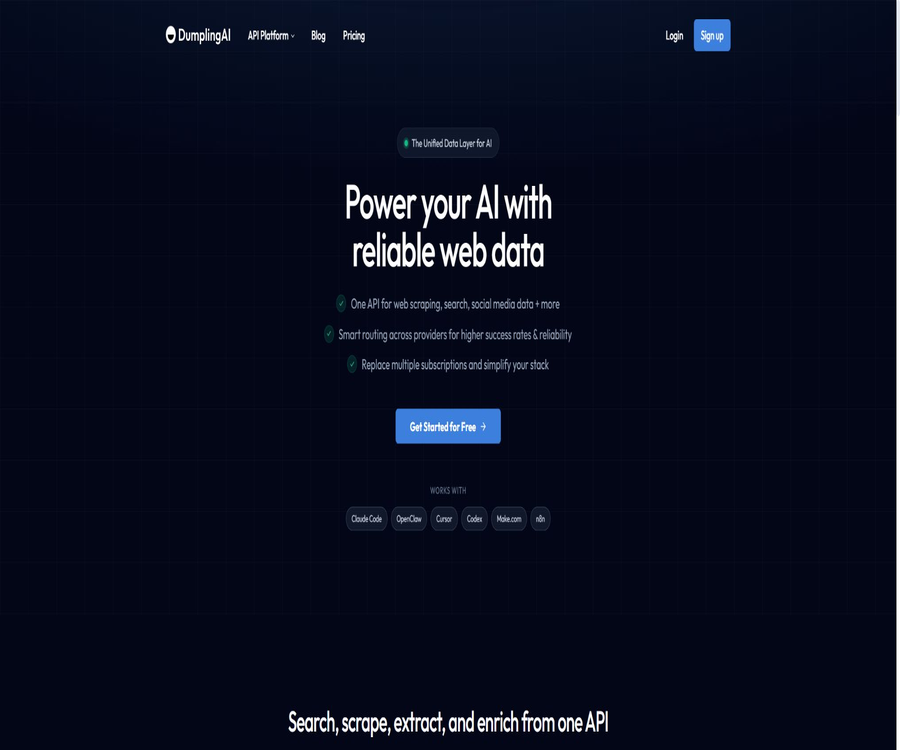
DumplingAI
DumplingAI, an intelligent tool focused on AI search.
Tags:AI search engineA one-sentence summary
DumplingAI is a unified data API platform designed for AI agents, developers, and automation teams; it allows users to access services such as real-time search, web scraping, social media data extraction, document and media processing, image generation, knowledge base access, and cloud-based code execution, all from the same account.
Tool Introduction
DumplingAI integrates the various functions that were previously spread across search, crawlers, YouTube, TikTok, LinkedIn, PDFs, and model services into a single cumulative balance. Users can choose to use direct APIs, code-free automation, MCP, CLI, or a content automation platform.
The official website states that the platform boasts over 50 different data-related capabilities, with 35 API endpoints listed in the current public catalog. The number of capabilities differs from the number of endpoints; one endpoint can support multiple models, channels, or processing parameters.
Access method
| Method | Authentication | Suitable scenarios | Main features |
|---|---|---|---|
| Unified API v2 | Bearer API key | Create new data integration and unified invocation. | It can operate based on capabilities or provider endpoints; officially, it is recommended to use this option for new projects first. |
| Direct API v1 | Bearer API key | Compatible with existing direct endpoints | Maintain the specific request structure and existing automation processes. |
| Remote MCP v2 | OAuth login | Agent clients such as Claude, Codex, Cursor, ChatGPT, etc. | There is no need to paste the API key into the client. |
| Open-source MCP server | DumplingAI API key | Local commands or self-managed MCP processes | Licensed under MIT; can be run via npm or containers |
| CLI | OAuth login | Terminal exploration capability and task execution | Suitable for searching directories, viewing input/output, and conducting quick tests. |
| No-code platforms | API key connection credentials | Make, n8n, Zapier, etc. | Suitable for workflows that do not require a custom backend. |
Key capabilities
Real-time search and discovery
The search capability covers web pages, news, maps, locations, search suggestions, and Google reviews. Web page searches can be filtered by country, location, language, and time range, and it is possible to choose whether to display only the top results.
Web scraping, crawling, and structured data extraction
The platform can capture individual pages, crawl a website recursively, take screenshots of web pages, and extract fields according to the instructions and structural patterns provided by the user. Dynamic page rendering, automatic scrolling, and waiting parameters may increase costs.
YouTube data
It is possible to obtain video subtitles, video details, channel information, videos from the channel, Shorts, comments, and search results. Public data can be used for research and in content workflows, but it is still necessary to comply with the platform’s terms and regulations regarding content rights.
TikTok and LinkedIn data
The directory lists TikTok users, videos, comments, follow relationships, subtitles, and user searches; it also provides the extraction of personal and company information from LinkedIn. The processing of personal data is subject to privacy regulations, restrictions on its use, and local laws, and it should not be collected in bulk without proper consideration.
Document and PDF processing
APIs can convert documents into text or PDF format, merge PDF files, read and write PDF metadata, and extract structured content from documents. Different requests consume credits based on the number of times they are made, the number of pages, or the size of the output files.
Extraction of images, audio, and video
The platform can extract text or objects from images, generate transcripts and perform analyses from audio, and extract subtitles, scenes, or objects from videos. Audio is scored based on its duration, while videos are scored based on the number of seconds; as a result, the cost of longer media files increases rapidly.
Video cropping
Video cropping allows for the creation of segments based on start and end times, with options to set the output quality and frame rate. The billing is calculated based on the number of minutes of the resulting video, rounded up; it is therefore necessary to estimate the cost in advance when processing multiple videos at once.
AI image generation
The image API supports models such as FLUX.1 schnell, dev, pro, 1.1 pro, Kontext pro, and Recraft v3; it allows for the setting of prompts, aspect ratios, quantities, quality levels, as well as model-specific parameters. The cost per image varies depending on the model used.
AI Agents and Knowledge Bases
The platform offers capabilities for Agent Completion, knowledge base searching, and content writing; it allows external data to be provided to the model for responses or to serve as context for searches. The generation of agents is charged based on the total number of tokens in the input and output.
Cloud-based Python and JavaScript execution
Developer tools allow Python or JavaScript to be executed in a controlled cloud environment, and it is possible to specify dependencies, time limits, and output files as needed. External inputs cannot be executed as trusted code; restrictions must be placed on dependencies, timing, and data access rights.
Capability catalog
| Category | Representative capabilities | Common uses |
|---|---|---|
| Websites and data | Crawling, scraping, screenshotting, AI-driven structured extraction | RAG collection, monitoring, and information structuring |
| Search by location | Websites, news, maps, locations, suggestions, reviews | Real-time research, local business insights, and trend identification |
| YouTube | Subtitles, videos, channels, Shorts, comments, and search | Content analysis, reuse, and channel research |
| TikTok | Users, videos, comments, follows, and subtitles | Research on short videos and analysis of public data |
| Personal and corporate data | Abundant corporate research and data available | |
| Documents and PDFs | Text conversion, PDF conversion, merging, metadata, and extraction | Document pipeline and knowledge ingestion |
| Media | Image, audio, and video extraction as well as video cropping | Transcription, visual analysis, and content editing |
| AI | Agents, knowledge bases, and image generation | Smart applications and content generation |
| Code | Running Python and JavaScript in the cloud | Data conversion and custom logic |
Differences between v1, v2, and MCP
| Project | v1 direct endpoint | v2 Unified Platform | MCP v2 |
|---|---|---|---|
| Positioning | Existing endpoint directory | Interfaces with priority for recommending new projects | Allow the AI client to use the tools directly. |
| Path organization | Each function has a direct request structure. | Unified operation entry point and capability identifier | Remote MCP Tool Protocol |
| Authentication | API key | API key | OAuth |
| Suitable for users | Integrated solutions and specific endpoints are already available. | Developers and no-code automation | Users of Claude, Codex, Cursor, and ChatGPT |
| Account relationship | Shares the account and API key with v2 | Shares the account and API key with v1 | Connected to the same DumplingAI service |
v1 and v2 can coexist within the same account; there is no need to migrate all old workflows immediately. For new features and long-term integrations, v2 should be given priority, while existing stable endpoints can be migrated gradually after verifying their equivalence.
Usage tutorial
Perform the first call using the v2 API.
- Register for a DumplingAI account, create an API key in the dashboard, and save it in a secure key management tool.
- Open Workbench, search for the desired capability, and verify the input fields, output structure, and integration cost.
- Use a unified execution entry to specify the capability type, capability identifier, and input parameters.
- Use the Bearer token in the Authorization request header; do not enter the token in the browser’s frontend.
- First, test the return structure using the minimum number of results, short files, or single-page requests.
- Read the usage amount from the successful result, and handle parameter errors, rate limiting, and service errors.
- Upon going live, key rotation, budget limits, backoff retry mechanisms, as well as caching and log data anonymization are implemented.
Connect to remote MCP
- Verify that the AI client being used supports remote MCP and OAuth connections.
- Add the DumplingAI remote MCP service on the client side and initiate authorization.
- Log in using a DumplingAI account, and grant only the access level required for the current task.
- After connecting, check the available tools for searching, scraping, handling documents, managing media, and working with code.
- First, run a low-cost query to verify that the tool’s output and the deduction of points are as expected.
- Set manual approval and invocation boundaries for web scraping, profile access, and code execution.
- Revoke the OAuth connection from the account when it is no longer in use.
Create data workflows in no-code platforms
- Create an API key specific to this workflow in DumplingAI.
- Save the key as connection credentials in Make, n8n, Zapier, or other platforms.
- Choose search, scraping, social data, or document processing as the workflow steps.
- Use sample inputs to check field mapping, pagination, empty results, and error handling.
- Perform deduplication and format validation before writing the results to a table, database, or content system.
- Set the number of pages per run, the file length, and the maximum score budget.
- Monitor the execution history to prevent scheduled tasks from rapidly depleting credits due to repeated or cyclic triggers.
Search and crawling process
A search request can return natural results, selected summaries, related questions and additional searches; it is also possible to choose to retrieve the top-ranked pages. The maximum number of results that can be retrieved is 10, though by default 3 results are fetched if no specification is given.
- The basic cost of searching is calculated based on the number of results displayed; additional points are deducted for fetching more pages.
- The country, location, language, and date range should be consistent with the research objectives.
- For the export format, you can choose Markdown, HTML, or a screenshot, and you can also decide whether to clean up the content.
- Dynamic rendering and latency increase runtime, while screenshots may also add points.
- The ranking results and page content will change; key facts should be recorded over time and verified cross-referentially.
- The terms of access, robots rules, and personal data restrictions of the target site remain in effect.
Document and media processing
| Ability | Basic points | Additional billing |
|---|---|---|
| Convert document to text | 20/per time | Based on the parameters of the current endpoint. |
| Convert to PDF | 50/per 100MB output | Based on the size of the output PDF |
| Merge PDFs | 50/per 100MB output | Based on the size of the output PDF |
| Read PDF metadata | 10/per time | No public additional items. |
| Write PDF metadata | 50/per 100MB output | Based on the size of the output PDF |
| Extract document | 100 per time | An additional 10 is added for each page processed. |
| Extract image | 100 per time | An additional 10 for each image. |
| Extract audio | 100 per time | An additional 20 per minute, rounded up. |
| Extract video | 100 per time | An additional 10 for video per second. |
| Crop video | 200 per output minute | Round up to the nearest minute |
The extraction of long videos is charged on a per-second basis, and the cost can be significantly higher than that for subtitles or search functions. For batch tasks, it is advisable to first use short samples to estimate the cost, and then determine the length, the number of files, and the maximum number of retry attempts in case of failures.
Common data endpoint integration
| Functions | Current integration cost | Explanation |
|---|---|---|
| Web scraping | 10/per time | Dynamic parameters may affect the actual processing. |
| Website crawling | 10 per page | As the number of pages returned increases |
| Web page screenshot | 20/per time | Add 10 for automatic scrolling or non-zero waiting, respectively. |
| AI structured extraction | 250 per time | Process web pages according to structural instructions. |
| YouTube video or channel data | 10/per time | Different endpoints are billed separately. |
| YouTube subtitles | 20/per time | Pricing is based on the current document. |
| Common endpoints for TikTok and LinkedIn | 10/per time | It shall be subject to the specifications of the specific endpoints. |
| Web search | 30 per page | A separate fee will be charged for the retrieval results. |
| Map search | 100 per page | The price varies depending on the location and the type of search. |
| Location or news search | 30 per page | Continuing to turn pages results in further charges. |
| Google reviews | 50 per 10 items | If it is less than or equal to, round up to the nearest multiple of 10; if it is greater, use that value directly. |
| Run Python or JavaScript | 50/per time | External dependencies and resources remain limited. |
AI capability score
| AI capabilities | Integrated cost | Key notes |
|---|---|---|
| Agent Completion | 10 per 1,000 total tokens | Total input and output |
| FLUX.1 schnell | 30 per piece | Fast image generation |
| FLUX.1 dev | 150 per piece | Supports a wide range of parameters. |
| FLUX.1 pro | 300 per piece | Advanced models |
| FLUX.1.1 pro | 500 per piece | The items in the current list have high costs. |
| FLUX.1 Kontext pro | 200 per piece | Reference image editing is supported. |
| Recraft v3 | 200 per piece | Supports various sizes and styles |
| Perplexity search tool | 50 for every 1,000 tokens | Used as an Agent tool |
Prices and packages
As of August 22, 2026, the official website lists three tiers of annual subscription plans. The page shows the average monthly cost after annual payment, with the total amount for the whole year displayed accordingly; the final taxes and settlement amounts are as indicated on the purchase page.
| Package | Monthly average display | Annual payment reference | Annual points | Request rate | Support |
|---|---|---|---|---|---|
| Starter | $ | $ | 1.2 million | 30 times per minute | Basic support |
| Pro | $ | $ | 4.2 million | 60 times per minute | Standard support |
| Business | $ | $ | 9.6 million | 120 times per minute | Priority support |
Points rules
- One balance can be used for over 50 data and AI capabilities available on the platform.
- Different actions and parameters consume one to multiple points each time; it is not possible to estimate based solely on the number of requests.
- Points from subscription plans are not carried over to the next period.
- Points packs purchased separately do not expire and are used once the points from the subscription are used up.
- Failed requests do not deduct points; only successful requests incur a fee.
- Auto Recharge can be enabled to automatically purchase credit packages when the balance falls below a certain threshold.
- For usage levels that remain consistently above those of the standard packages, it is possible to contact the authorities to discuss bulk pricing options.
Change in the criteria for calculating points
On November 19, 2025, the authorities adjusted the value of points; the new points are equivalent to one-tenth of the value of the old points. When checking old records, it is necessary to multiply the historical values by 10 before comparing them with the current figures – the point totals listed in the old records cannot be used directly.
MCP and CLI
| Project | Remote MCP v2 | Official open-source MCP server | CLI |
|---|---|---|---|
| Operation location | Hosted by DumplingAI | User’s local or self-managed environment | Local terminal |
| Authentication | OAuth | API key in environment variables | OAuth |
| Installation | The client adds a remote service. | npm, Smithery, or containers | Run with npx |
| Primary uses | The AI client can directly invoke these capabilities. | Traditional local MCP integration | Search directories, view details, and check capabilities |
| Source code | The hosting service is not open-source. | MIT licensed repository | The status of the complete source code must be confirmed on a project-by-project basis. |
API Authentication and Engineering Practices
- API keys are stored only in the server-side key management system; they are not submitted to Git, logs, or front-end code.
- Separate keys for development, testing, and production environments, and establish processes for key rotation and revocation.
- Read the rate limit response field, using exponential backoff instead of unlimited retries.
- Set hard limits for pagination, media duration, and the number of pages to crawl.
- A successful response should also verify the structure, channels, null values, and usage of points.
- Cache the results of searches and scrapings to avoid repeated requests and strain on data sources.
- When remote MCP is no longer in use, the OAuth authorization is revoked; local MCP, on the other hand, rotates its API keys promptly.
Which users are it suitable for
- AI Agent developers: need unified tools for searching, web browsing, social interactions, document handling, and coding.
- Automation engineer: Combines various data processing steps in Make, n8n, or Zapier.
- Content team: Extracts subtitles from videos, comments, and document content and moves them into the publishing process.
- Research and Monitoring Team: Accesses real-time web pages, news, location data, and public social media data.
- SaaS developers: Use a unified API to reduce the costs associated with maintaining connections to multiple data providers.
- MCP users: Enable Claude, Codex, Cursor, or ChatGPT to directly access external data.
Typical use cases
- Have the research Agent first search for news, then scrape the pages and generate a structured summary.
- Regularly collect YouTube subtitles and comments to build a database of topics and user feedback.
- Extract content from PDFs, images, audio, and video and store it in the knowledge base.
- Capture product information from websites and output it in a table or CRM using a fixed structure.
- Enrich company records based on the information available on public corporate pages, while establishing regulatory limits for personal data.
- Run short Python or JavaScript scripts in the cloud to process API results.
- Through MCP, search, document, and media tools are made available to the AI client for invocation as needed.
Privacy and data processing
According to the privacy policy, users can provide data to DumplingAI to assist in \"training\" the AI; some of this data may be stored in the system to improve the services offered. Before processing sensitive data, customer data, or data protected by contracts, it is necessary to obtain confirmation from the authorities regarding the specific scope of such data, the options available for opting out, and the duration for which it will be retained.
The platform uses PostHog and Google for analyzing web pages and products, Stripe handles payments, and tasks may be processed by model providers such as OpenAI, Anthropic, Perplexity, Groq, etc. The policy states that user data will not be shared publicly, but legal requirements and the need for third-party processing constitute exceptions to this rule.
Privacy and compliance recommendations
- Do not assign API keys, passwords, contents of private repositories, or unmasked customer data to public tasks.
- When handling personal data, record the legitimate purposes, minimum required fields, retention period, and deletion procedures.
- LinkedIn, TikTok, YouTube, and web scraping are also subject to the rules of the target platforms.
- When using cloud-based code execution, it is not allowed to directly incorporate content from untrusted web pages into the code.
- Confirm temporary or permanent storage options for media files and generated assets.
- Users in Europe and other regions can request access to or deletion of their personal information.
- Before making a purchase, enterprises should include data processing agreements, sub-processors, and security control measures.
Content, Copyright, and Data Licensing
- The fact that an API can access public data does not mean that users automatically have the right to copy, republish, or sell it for commercial purposes.
- Search results, social profiles, reviews, subtitles, images, and documents each have different channels regarding rights.
- The temporary viewing permission specified in the website terms cannot be simply equated with an unlimited commercial license for API results.
- Fetching content that is restricted by login requirements, payment needs, or access limitations may violate the rules of the target service.
- AI-generated images still need to have their brands, characters, portraits, and data related to training processes checked for potential risks.
- The datasets made available to the public should include information on the source channel, the time of extraction, the purpose of each field, and the mechanism for deleting them.
APIs, SDKs, and open-source status
| Project | Verification results | Explanation |
|---|---|---|
| Public API | Provide | The v1 direct endpoint coexists with the v2 unified platform. |
| Authentication | Bearer API key | v1 and v2 share the same account and key. |
| Remote MCP | Provide | Version 2 uses OAuth and does not require the API key to be entered. |
| Official CLI | Provide | Run via npx and use OAuth |
| Official MCP repository | Open source | Implemented in JavaScript, under MIT license |
| Official universal SDK | No findings were detected. | You can directly call the API or use MCP with CLI. |
| The platform itself | Not open source | The open-source nature of MCP connectors does not mean that the hosted data services are also open source. |
Product advantages
- One account and its point balance cover searching, scraping, social features, documents, media, AI, and code.
- The v2 unified API reduces the differences in authentication and invocation across various capabilities.
- v1 and v2 coexist, facilitating a gradual migration of existing integrations.
- It supports API, no-code, remote MCP, local MCP, and CLI.
- The credit cost documentation is detailed down to pages, minutes, seconds, images, and models, which facilitates budgeting.
- Failed requests do not deduct points, and additional point packs remain valid, allowing for handling of short-term peaks.
- The official MCP server is licensed under the MIT license, allowing for the inspection and modification of the connector code.
Usage restrictions and precautions
- All public packages are billed on an annual basis; the monthly price shown on the page is merely the annual amount converted into a monthly figure.
- Subscription points are not carried over, and unused balance in months with low usage may be wasted.
- The cost associated with each capability varies; long videos, maps, and structured data extraction can quickly deplete the available points.
- The service aggregates multiple external providers, and its stability, coverage, and data structure may vary depending on the channel used.
- The social and profile interfaces pose risks related to privacy, platform rules, and data accuracy.
- The privacy policy permits certain uses for training or improvement; sensitive data requires additional approval.
- The open-source MCP server acts only as a connector; the actual data processing still relies on paid cloud APIs.
- No official SDK for the common language was found; therefore, the development team must implement retry mechanisms, pagination, and type handling on its own.
Basic information
| Project | Content |
|---|---|
| Tool name | DumplingAI |
| Tool type | Unified data API, automation, and AI Agent tool platform |
| Capacity scale | Over 50 capabilities, with 35 API endpoints listed in the public catalog |
| Main categories | Search, crawling, social networking, documents, media, AI, and code |
| API version | v1 direct endpoint and v2 unified platform |
| MCP | Remote OAuth MCP and official open-source local server |
| CLI | Provide |
| Minimum public package | The annual Starter plan is equivalent to 40 dollars per month. |
| Points rules | Subscription points are not carried over, and the point packages do not expire; a charge is applied only in case of a successful request. |
| Request rate | 30, 60, or 120 times per minute, depending on the package. |
| Official SDK | No universal language SDK was found. |
| Open-source status | The platform is not open-source; the official MCP server is licensed under the MIT license. |
Recommendation score
Recommendation score: 4.5 / 5. DumplingAI offers a wide range of capabilities, provides comprehensive integration methods, and includes detailed cost information; it is also compatible with modern AI Agent workflows through v2, MCP, and CLI.
The main barriers are the requirement for an annual subscription, the complexity of the scoring system, and the need to ensure compliance with various data sources. This approach is suitable for development teams that can manage budgets, caching, data governance, and error handling; it is not appropriate for those who consider scraping and profile interfaces to be sources of data that are available without any restrictions.
Frequently Asked Questions
Is DumplingAI free?
The current pricing page does not list any fixed free plans; the lowest option is the Starter plan, which costs $40 per month when paid annually. Once approved for the Creator Program, users can receive up to 10,000 free credits per month, but this is not a free version available to all users automatically.
How much does a Starter actually cost per year?
The page shows a cost of 40 dollars per month, with billing on an annual basis; the total amount for a full year is 480 dollars, including 1.2 million annual points. Taxes and the final amount will be indicated on the payment page.
Will the points be carried over?
Points from subscription plans are not carried over, while separately purchased point packs do not expire. Point packs are used once the points from the subscription have been used up.
Are failed requests deducted in points?
No fee is charged; the official website states that charging applies only in cases of successful requests. Developers should still limit the number of retries to prevent a large number of successful calls from occurring after errors are resolved.
What is the difference between v1 and v2?
Version v1 retains the existing direct endpoint structure, while version v2 provides unified calls based on capabilities and is recommended for new integrations. Both versions can coexist within the same account and share the same API keys.
Does DumplingAI support MCP?
Support is available; remote MCP v2 uses OAuth, and official open-source MCP servers that require API keys are also provided. Do not confuse these two methods of access.
Can it be used in Codex or ChatGPT?
The official documentation lists MCP clients such as Codex, ChatGPT, Claude, and Cursor. Whether a connection can be established depends on the version of the client, organizational permissions, and connector settings.
Are API SDKs available?
Complete APIs, CLI, and MCP are provided, but no official universal SDK tailored for multiple languages exists; developers can create their own wrappers based on the v2 documentation.
Is DumplingAI open-source?
The hosting platform itself is not open source; the official MCP server is licensed under the MIT license. Open-source connectors still require access to the DumplingAI cloud API and consume account credits.
Will the data be used for training?
The privacy policy states that the data provided by some users may be stored and used to improve AI systems. For sensitive or customer-related data, it is necessary to obtain confirmation from the authorities regarding the details of training, withdrawal, retention, and deletion before such data is submitted.
Can the search and crawling results be used for commercial purposes directly?
It cannot be generalized – the ability to access APIs does not automatically transfer the copyright, database rights, or platform licenses associated with the target content. Each case must be evaluated separately based on the data source, region, and purpose of use.
Summary
DumplingAI integrates external data, document processing, media extraction, AI capabilities, and code execution into a unified infrastructure designed for agents. Versions 2, MCP, CLI, and code-free connections enable users with varying technical skills to access it.
Before formal deployment, it is necessary to establish a budget for the points associated with each capability, as well as guidelines for caching, compliance requirements, and fault handling. Short samples should be used to verify the costs and output structure, after which the number of pages, duration of media content, and frequency of automation can be increased gradually.
Tools similar to DumplingAI




 Guigong Network Security Registration No. 45132202000164