






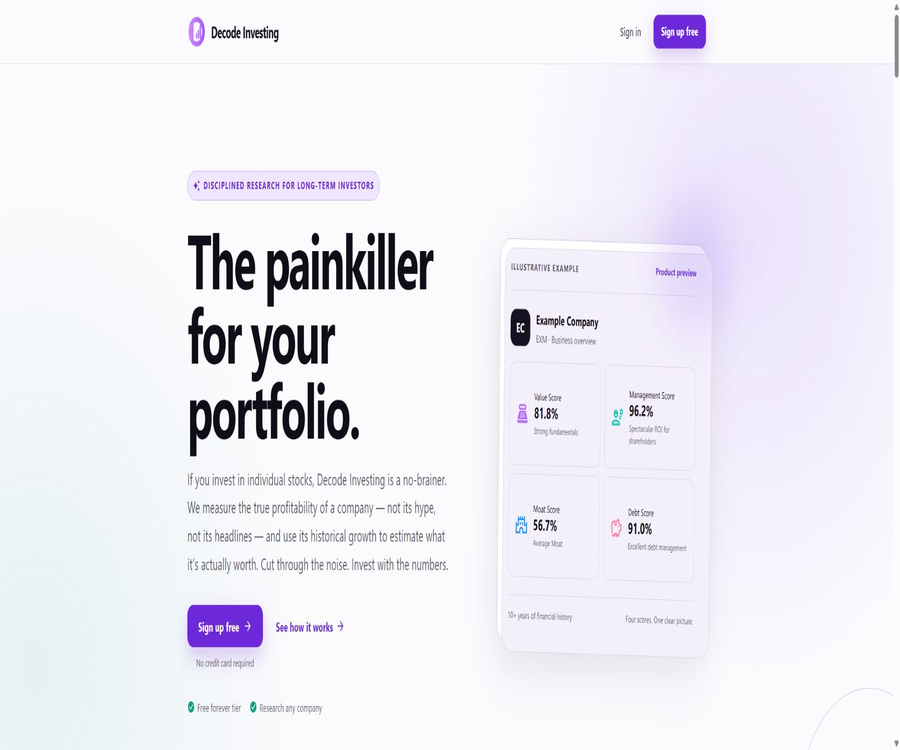
Discover Wonderful Businesses
Discover Wonderful Businesses: an intelligent tool focused on AI-driven searching.
Tags:AI search engineA one-sentence summary
Decode Investing is an AI-powered value investing research platform designed for U.S. listed companies; it can automatically compile fundamental data spanning more than a decade, estimate fair value and safety margins, and use an AI assistant to analyze SEC documents, financial report calls, as well as the risks associated with individual stocks.
Tool Introduction
Decode Investing is operated by Decode Investing Inc., and its goal is to bring together value investment research, company screening, valuation, and document analysis in a single web platform. It provides analytical support based primarily on the public financial and regulatory documents of U.S. listed companies.
The platform provides labels such as Buy, Don’t Buy, Hold, or Sell, but these are merely outputs of algorithms and AI systems and do not constitute investment advice. Users should verify the financial data, assumptions, original documents, and the latest market developments.
Core product components
| module | Main inputs | Main output | Suitable for tasks |
|---|---|---|---|
| Company page | Stock codes and financial data | Value Score, financial health, and valuation | Get to know the company quickly |
| Leaderboard | Market fundamentals as a whole | Daily company ranking | Identify potential companies |
| Stock Screener | Valuation, growth, and financial screening criteria | List of candidate stocks | Batch filter opportunities |
| Valuation tools | Assumptions such as growth rate, EPS, and future PE | Fair value and safety margin price | Establish a reference for the purchase price |
| AI assistant | Issues, earnings call transcripts, or SEC documents | Summary, Answers, and Risk Warnings | Accelerate due diligence |
| Autonomous AI Agent | Research objectives and monitoring tasks | Multi-step reporting and continuous insights | Automated individual stock research |
Main functions
Automatic fundamental analysis
The system compiles the revenue, profits, cash flow, and other key indicators of U.S. listed companies over a period of ten years or more, and calculates their historical growth rates. The data may change due to reclassifications, changes in currency, or updates from the providers; it is necessary to verify important figures by referring to the company’s official documents.
Value Score and rankings
The ranking algorithm is based on the Rule One principles of value investing, and it evaluates a company’s fundamental aspects by taking into account factors such as its competitive advantages and management quality. The list includes only those companies that meet the specified time requirements and scoring criteria; it does not indicate future returns.
Stock filter
Users can filter using criteria such as Value Score, Moat, debt levels, management quality, indices, dividend yield, market capitalization, valuation multiples, profit margins, industry sector, country, and exchange. The paid version allows users to save their filtering settings and create additional filters.
Fair value and safety margin
The platform uses a simplified DCF approach, along with assumptions regarding growth rates, future P/E ratios, and current EPS, to estimate the fair value; it then determines a price that provides a safety margin. The default maximum growth rate is 20%, but reasonable assumptions still need to be adjusted by the user based on the quality of the business and its associated risks.
Payback Time
Payback Time estimates the number of years required to recover the current market value based on the growth of free cash flow; the platform considers a period of ten years to be an ideal timeframe, while five years is regarded as an extremely low-cost scenario. This indicator is influenced by fluctuations in cash flow, the currency used, and the assumptions regarding growth.
Price performance analysis
The new performance charts available in 2026 offer time periods such as 1 day, 5 days, 1 month, 6 months, from the start of the year to date, 1 year, 5 years, 10 years, and since the stock was first listed. Users can switch to view the total return including dividends, and they can also see the return for any specific historical date up to the present.
Lima Stock Research Assistant
Lima is used to answer questions related to individual stocks and market research; the paid versions offer a greater number of queries or an unlimited number of responses. AI-generated answers should be viewed as a starting point for research, and they cannot replace regulatory documents, company announcements, or independent judgment.
Saturday earnings call assistant
Saturday is designed for financial results call sessions, aiming to assist users in asking questions about management’s statements, performance changes, risks, and key points for further observation. Transcriptions may miss certain tones or numbers; therefore, to obtain accurate conclusions it is necessary to listen to the original audio again or refer to the official records.
June SEC Documents Assistant
June can analyze documents such as 10-K, 10-Q, and 8-K; it offers different amounts of query support under both free and paid plans. The platform also provides access to documents like 20-F and 40-F, which are useful for studying the disclosures made by foreign issuers listed in the U.S.
Research on autonomous AI agents
Users can use natural language to create assessments of individual stocks, carry out industry filtering, or set up ongoing monitoring tasks; the Agent will break down these tasks, read relevant files, evaluate competitive advantages and management aspects, determine valuations, and highlight potential risks. Most comprehensive analyses take between 1 and 4 hours to complete.
Complete workflow for stock research
- Create a list of candidates from the rankings or filters, and do not trade based solely on the Buy tag.
- View the company’s revenue, profits, cash flow, debt, and return metrics for over a decade.
- Open a 10-K, 10-Q, 8-K, or 20-F document to review changes in business operations, risks, and accounting practices.
- Use Saturday to review recent earnings call transcripts, identifying management’s commitments and uncertainties.
- Adjust valuation assumptions such as growth rates, future P/E ratios, and safety margins.
- Check stock prices and the total return including dividends to understand the market’s long-term pricing.
- Have Lima or the autonomous agent look for opposing viewpoints, red flags, and omissions.
- Record the final conclusions, hypotheses, evidence, and failure conditions in the observation list.
Stock screening tutorial
- First, determine the scope of investment, such as market value, industry, exchange, and financial history length.
- Use the Value, Moat, Debt, and Management scores to narrow down the candidates.
- Include explanatory factors such as profitability, growth, valuation, and dividends.
- Avoid setting too many filters at once, to prevent overly fitted results.
- Check for abnormal data, one-time gains, and industry-specific accounting differences for each company individually.
- Paid users save their filters and regularly monitor companies that join or leave.
- Use the screening results as a research cohort, rather than an automatic list for purchases.
Tutorial on Creating Autonomous Agents
- Describe the objectives, scope, timeline, and questions that wish to be answered using clear sentences.
- Specify companies, industries, or filtering criteria to avoid merely listing vague ‘best stocks’.
- The Agent is required to list the files used, the valuation assumptions, and the risks on the opposing side.
- Observe the breakdown of tasks and redirect them promptly when an incorrect direction is detected.
- After the report is completed, verify each item in terms of numbers, dates, channels, and calculations.
- Set truly meaningful event and alert conditions for continuous monitoring tasks.
- Check the insight quota and cumulative points every 30 days based on actual usage.
Scoring and valuation framework
| Indicators | Platform usage | Users need to verify. | Main risks |
|---|---|---|---|
| Value Score | Comprehensive fundamental ranking | Composition, historical duration, and industry differences | Scores do not equal future earnings. |
| Moat Score | Assessing competitive advantages | Sustainability of growth and pricing power | Historical growth may not be sustainable. |
| Management Score | Evaluating capital allocation and management | Return rates, changes in debt and equity | Accounting data cannot cover all governance risks. |
| Fair Value | Estimate the fair value | Growth, profit, and future value assumptions | Slight changes in assumptions can significantly affect the results. |
| Margin of Safety | Establish a reference for purchasing at a discount | Risk, cycle, and cost of capital | A discount does not guarantee that prices will not continue to fall. |
| Payback Time | Compare cash flow with market value | Quality of free cash flow and currency | Periodic cash flows can be misleading. |
Which users are it suitable for
- Long-term U.S. stock investors: Assess company quality, valuation, and margin of safety.
- Beginners in value investing: Learn finance, competitive advantages, and management evaluation in a structured manner.
- Researchers in the high-frequency domain: Use AI assistants to reduce the initial time spent on reading documents and attending meetings.
- Users with a longer observation list: are continuously monitored through filters and Agents.
- Study users of U.S. foreign issuers: Review disclosures such as 20-F and 40-F.
- Investment communities and analysts: Candidates are identified first, followed by independent in-depth research.
- Companies and institutions: Custom AI analysts that are selected and analyzed in accordance with their own strategies.
- Investors who place importance on valuation discipline: save custom assumptions and monitor for undervaluation.
Typical use cases
- Select U.S. listed companies with high fundamental scores and low valuations.
- Quickly review the changes in business operations, risks, segments, and capital allocation outlined in the 10-K.
- Compare the commitments made by management during successive financial results call conferences with their actual actions.
- Adjust the DCF assumptions to calculate the individual safety margin price.
- Monitor changes in financial reports, events, and valuations on the watchlist.
- Compare the long-term differences between stock price returns and total returns including dividends.
- Have the Agent examine both the positive and negative aspects of a company to determine whether it is worth proceeding with further due diligence.
- Search for candidate companies that were not previously considered, based on industry and financial conditions.
Product advantages
- Combine screening, fundamentals, valuation, documents, conference calls, and AI research.
- The free version already covers the basic ranking and valuation of U.S. listed companies.
- A financial history of over ten years helps to observe the entire business cycle.
- The three AI assistants are designed for general research, conference calls, and SEC filings respectively.
- Autonomous agents can carry out multi-step research and support continuous monitoring.
- The paid version allows saving personal valuation assumptions, watchlists, and filters.
- The price performance tool takes into account the total return after dividend reinvestment.
- The unused AI and Agent points can continue to be accumulated.
Usage restrictions and risk warnings
- At present, it mainly covers companies listed in the United States; the international market has not yet been fully opened up.
- AI responses, automatic scoring, and buy/sell labels may be incorrect or outdated.
- The content on this platform does not constitute investment, financial, legal, or tax advice.
- The simplified DCF is highly sensitive to assumptions regarding growth, future PE, and the final value.
- Financial figures may be affected by restatements, currency fluctuations, accounting standards, and one-time items.
- The free version comes with limits on company lookups, filtering and previewing, as well as AI-related functions.
- The pricing page, along with the updates for 2026, shows differences in the Agent Insights quota: 40 versus 160, and 100 versus 400.
- “Infinity” Q&A may still be subject to fair use, technical, or anti-abuse restrictions.
- Past performance, rankings, and high scores do not guarantee future returns.
- Before any transaction, it is necessary to independently verify and assess the ability to absorb losses.
Prices and packages
The prices listed below were verified on August 22, 2026. The annual fees are 119.88 dollars per year for the Premium plan and 299.88 dollars per year for the Executive plan; the monthly payment rates are higher. For the Enterprise plan, it is necessary to contact sales.
| Package | Price | Billing cycle | Core limit or benefits | Suitable for users |
|---|---|---|---|---|
| Free | $ | Free | 80 company searches, 50 filter previews, and a limited amount of AI usage | For beginners and light research |
| Premium annual payment | $ | Annual | This amounts to 9.99 dollars per month, with no limits on searches, monitoring of lists, or filtering. | Ongoing research on value investing |
| Premium monthly payment | $ | Monthly | 40 Q&A sessions with category 3 AI assistants every 30 days | Users who wish to cancel flexibly |
| Executive annual plan | $ | Annual | This amounts to 24.99 dollars per month, with unlimited queries to the AI assistant. | High-frequency researchers |
| Executive monthly plan | $ | Monthly | AI assistants are not restricted by higher agent quotas. | Professional individual users |
| Enterprise | Contact sales | Contractual agreement | Custom AI stock analysts based on institutional strategies | Teams and institutions |
Free version quota
| Functions | Free quota | Explanation |
|---|---|---|
| Company inquiry | 80 times | View company analysis and finances |
| Stock screening preview | 50 times | Identify potential stocks |
| Lima | 8 questions or tasks | General stock research |
| Saturday | 8 questions for the financial results conference call | Analyze the phone call |
| June | 4 issues with SEC files | Analyze 10-K, 10-Q, and 8-K filings |
| Autonomous Agent | 8 AI Insights | Execute research projects |
Paid AI and Agent quotas
The current pricing page indicates that Premium provides 40 insights per 30 days, while Executive offers 100 such insights per 30 days. An official update in April 2026 announced that these numbers will increase to 160 and 400 respectively, with any unused quota remaining cumulative. The final figures should be based on those shown on the account usage page.
| Package | Lima | Saturday | June | Latest updates on autonomous agents |
|---|---|---|---|---|
| Premium | 40 times every 30 days | 40 times every 30 days | 40 times every 30 days | 160 per 30 days |
| Executive | No restrictions | No restrictions | No restrictions | 400 per 30 days |
| Enterprise | Contractual agreement | Contractual agreement | Contractual agreement | Customization |
Subscriptions and refunds
The terms state that a paid account can be canceled at any time, but no refund will be given for the payments already made; nor will any credit be provided for partial months, upgrades or downgrades, or unused months. The terms were last revised in 2021, and it is necessary to verify the current billing and account policies before making a purchase.
- The dates for automatic renewal on a monthly or annual basis should be recorded in the account.
- If it is no longer to be used, it should be canceled before the charge is applied in the next cycle.
- The fact that AI points cannot be accumulated does not mean that the subscription fee can be refunded.
- Price changes are usually notified 30 days in advance.
- Taxes and fees may be charged separately from the published dollar price.
- Before deleting the account, export the watchlist, valuation assumptions, and research records first.
Supported platforms and data ranges
| Project | Current status | Explanation |
|---|---|---|
| Web browser | Support | Main research and account entry points |
| U.S. listed companies | Support | Current core markets covered |
| International market | Not fully open. | The official Agent page states that it will be added in the future. |
| SEC documents | Support | 10-K, 10-Q, 8-K, 20-F, and 40-F, etc. |
| Native iOS or Android | Not verified. | There is no entry point to an official app store. |
| Desktop application | Not verified. | It is primarily used via the Web. |
| Price data | Support | Includes five-minute data within the dashboard as well as a long-term historical view. |
Privacy and security considerations
The terms of service refer to the privacy policy, but the current search results do not provide sufficient detail regarding data processing, encryption, sub-processors, and retention policies. Users should not enter their brokerage passwords, ID numbers, tax information, or any confidential internal details in AI conversations.
- Use a strong, unique password and protect your account sessions.
- Enter only the public or authorized materials required to complete the research.
- Do not upload company documents that contain sensitive, confidential information.
- Check the ability to delete AI chats, Agent reports, and watchlists.
- The enterprise version requires specifications for data protocols, sub-processors, and security controls.
- Before using any API, it is necessary to restrict the permissions of the keys and implement usage monitoring.
- Investment records may reveal an individual’s preferences, so the scope of sharing should be controlled.
- Back up the valuation and research evidence that needs to be retained before cancellation.
APIs, SDKs, and open-source status
The terms for 2021 include APIs within the Service definition, while retaining the right to impose quotas and speed limits on their use; however, at present there is no public developer portal, no authentication methods, no information regarding the endpoints, and no official pricing details. Therefore, it cannot be assumed that ordinary users can access these APIs directly.
| Project | Current status | Explanation |
|---|---|---|
| Public API | Not confirmed as open | Mentioned in the terms but not in any public documents |
| Official SDK | No findings were detected. | There are no verifiable language packs available. |
| Webhook | No findings were detected. | Continuous monitoring is carried out by the platform agent. |
| Official GitHub | No findings were detected. | The product’s source code repository could not be located. |
| Is the product open source? | No | Closed-source web services |
| Corporate customization | Support | AI analysts can be customized according to investment strategies. |
Basic information
| Project | Information |
|---|---|
| Tool name | Decode Investing |
| Operating company | Decode Investing Inc. |
| Tool type | AI stock research and value investment analysis platform |
| Main markets | U.S. listed companies |
| Core functions | Fundamentals, screening, valuation, SEC documents, conference calls and agents |
| Main platforms | Web |
| Price pattern | Free version, monthly payment, annual payment, and enterprise quotes |
| Minimum payment amount | $ |
| Is registration required? | The full quota and saving features require an account. |
| Investment advice? | No |
| Public API | The terms state that no public documents were found. |
| Official SDK | No findings were detected. |
| Is it open source? | No |
Recommendation score
The recommendation score is 4.3 out of 5. Decode Investing combines elements such as value investing ratings, valuation analyses, relevant documents, and AI-assisted support for phone calls in a comprehensive way; the free version is sufficient to experience the core research functions.
The main shortcomings are that it focuses only on U.S. stocks, the algorithmic assumptions used may be misleading, the amount of resources allocated to the agent varies between the pricing page and the update logs, and the details regarding the public APIs and privacy protections are not clear enough. It is suitable as a research assistant, but not as a tool to make investment decisions automatically.
Frequently Asked Questions
Is Decode Investing free?
There is a free version that includes 80 company lookups, 50 filtering previews, as well as limited usage of Lima, Saturday, June, and the custom Agent.
Which stocks are supported?
Currently, it primarily supports companies listed in the United States. The international market is listed under the section on autonomous agents as a future development direction; it cannot be considered to be fully available yet.
What is the minimum payment amount?
The premium costs $119.88 per year, which is equivalent to $9.99 per month; the monthly payment amount is $12.99. The final taxes and fees are as indicated on the checkout page.
What is the difference between Lima, Saturday, and June?
Lima is in charge of general stock research, Saturday analyzes financial results presentations, while June focuses on SEC documents such as 10-K, 10-Q, and 8-K.
What can autonomous AI agents do?
It can break down research tasks, read documents, assess companies, establish valuations, identify risks, and provide ongoing monitoring. Completing a project usually requires some time.
Are the buying and selling suggestions reliable?
It cannot be relied on directly. Algorithms and AI may use incorrect data or inappropriate assumptions; therefore, it is necessary to conduct independent verification and take into account one’s own risks before making any transaction.
Will the unused quota be reset to zero?
According to the official pricing and update details, for some AI systems and autonomous agents, points will continue to be accumulated even if they are not used. The specific rules regarding the balance can be checked in the account.
Is a refund available?
The terms and conditions state that payments are generally non-refundable, and no credits can be given for partial periods or unused months. It is necessary to check the current payment policies before making a purchase.
Are APIs provided?
The old terms mentioned APIs and quotas, but no public development documentation or key access points were found; therefore, it is not possible to determine whether they are available to ordinary users.
Is Decode Investing open source?
It is not open-source; no official source code or model repository has been identified. The enterprise-customized AI analysts also constitute commercial services.
Summary
Decode Investing is suitable for value investors who wish to conduct systematic research on U.S. listed companies; it allows them to start with screening, fundamental analysis, and valuation, and then makes use of three AI assistants along with autonomous agents to delve deeper into the relevant documents and assess risks.
It is best used as a tool to accelerate due diligence, rather than as a signal for making transactions. When using it, it is necessary to retain the original documents, personal valuation assumptions, and any evidence against one’s position, and decisions should be made based on the willingness to accept losses.
Tools similar to Discover Wonderful Businesses




 Guigong Network Security Registration No. 45132202000164