






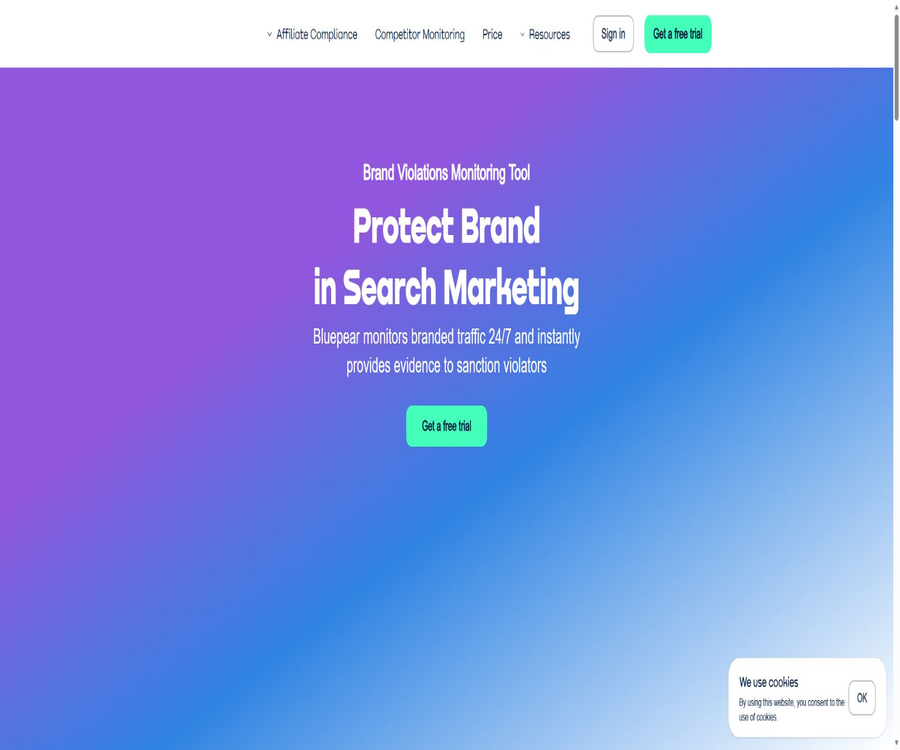
Bluepear
Bluepear, an intelligent tool focused on AI-driven search.
Tags:AI search engineWhat is Bluepear?
Bluepear is an automated monitoring platform designed for ensuring compliance with rules related to brand searches, paid advertising, and affiliate marketing; it is operated by the British company BLUE PEAR MARKETING LTD. This platform continuously checks the search results related to brand keywords, identifying any unauthorized ads, violations by affiliate partners, ad hijacking, and hidden redirects.
Bluepear utilizes automation and AI to detect anomalies, but it is not a chatbot or a content generator. Its main outputs include records of search ads and landing pages, redirect paths, affiliate IDs, screenshots, information on time and location, device details, as well as reports that can be used for internal investigations.
Main functions
Brand term bidding monitoring
The platform examines search ads by taking into account brand terms, spelling variations, countries, and the frequency of scans, in order to determine whether affiliate partners or competitors are running ads using those brand terms. This allows it to identify ads that appear only in specific regions, on certain devices, or during particular time periods.
Ad hijacking detection
Ad hijackers may copy a brand’s title, description, and display address, then use affiliate links to earn commissions that they shouldn’t receive. Bluepear keeps track of similar ads, landing pages, and redirect paths to help the team determine whether there is a violation of affiliate policies or impersonation of a brand.
Identification of hidden pages and navigation links
Some offenders display different pages depending on the IP address, location, device, browser, or time of access, in order to evade detection by brand owners and advertising platforms. Bluepear carries out visits through various simulated environments and tracks the intermediate redirects, in an attempt to determine the final page visited as well as the associated affiliate identifiers.
Screenshots of evidence and records of the incident
Upon detecting suspicious activity, the system can save screenshots of the search results page, advertisements, and destination pages, as well as information regarding keywords, links, time, location, device, browser, and operating system. This evidence can support complaints to affiliate programs and internal audits, but whether it has legal validity must be determined by legal experts.
Violation incident management
Bluepear’s violation management panel allows for the tracking of affiliate partner events in statuses such as New, In Progress, Ignore, and Resolved; it also enables the filtering of ad hackers or specific affiliate networks. Teams can consolidate investigations, warnings, exceptions, and closure records within a single process.
Notifications and summary reports
The official website states that the results of the searches can be notified via Slack, Telegram, or email, and structured summary reports can be generated. Whether the notifications are delivered in real time, which fields can be included in them, and the frequency of sending notifications depending on the chosen plan, all these details need to be checked using a trial account.
Natural search and competitor monitoring
The price comparison table shows the options for Organic Search Monitoring: Lite provides updates on a weekly basis, Business offers daily updates, while Enterprise allows for custom settings. Competitor monitoring enables one to keep an eye on the positions of paid and organic searches, ad copy, call-to-actions, as well as new websites that appear, but it does not constitute a complete SEO suite.
Coupon and brand impersonation monitoring
The platform can examine coupon websites, bridge pages, and search results related to brands in order to identify fake, expired, or unauthorized discount information. The team still needs to cross-check these detection results with the affiliate dashboard, the list of valid coupons, and the terms of the contracts.
What risks does Bluepear monitor?
| Risk type | Common manifestations | Information that Bluepear can record | Subsequent processing |
|---|---|---|---|
| Brand term bidding | Alliances or competitors purchasing brand keywords | Keywords, ads, rankings, regions, devices, and time | Verify the placement permission and contact the partner or advertising platform. |
| Ad hijacking | Copy the official ad and insert affiliate tracking codes. | Ad copy, display address, affiliate ID, and full redirect link | Freeze commissions, demand that the service be taken offline, or initiate a more in-depth investigation |
| Cloaking | Show different pages to reviewers and real users. | Page screenshots and differences in navigation across different environments | Save evidence of multiple reproductions and verify the platform’s policies. |
| Abuse of coupons | Fraudulent, expired, or leaked discount codes are used to manipulate attribution. | Discount pages, brand terminology, links, and screenshots | Check the validity period, affiliate channels, and attribution rules. |
| Domain or brand misappropriation | Domain names with similar spellings, fake login pages, or misleading pages | Search location, landing page, title, and link path | Leave it to the security, legal, or registration department to handle. |
| Competitor ads | Competitors offer stronger discounts on brand-related terms. | Advertising location, copy, region, and time | It is used for PPC and market analysis, and should not be automatically considered illegal. |
It may be permitted for competitors to purchase brand-related keywords under the rules of certain markets and platforms; therefore, being detected in this way does not necessarily mean that a violation has occurred. Bluepear is responsible for ensuring visibility and keeping records, and the matter should ultimately be handled in accordance with the alliance contracts, trademark laws, the policies of the advertising platforms, and local regulations.
The working principle from keywords to evidence
- The brand owner creates the project and provides the brand keywords that need to be protected, along with their common spelling variations.
- Select the countries to be monitored, the search environment, and the scanning frequency appropriate for the package.
- The system automatically performs search checks from various locations, devices, browsers, and at different times.
- Upon detecting an ad, the ad text, the location on the search page, a screenshot, and the destination address are recorded.
- The system accesses pages along the navigation chain, attempting to identify the affiliate ID, hidden pages, and the ultimate target.
- Suspicious events are entered into the panel, and notifications are sent to the team via the designated channels.
- Compliance officers review, mark the status according to the contract rules, and export the evidence.
- The team contacts the alliance network, partners, advertising platforms, or legal services to handle matters, and records the outcomes.
Tutorial on creating monitoring projects
- First, organize the official brand names, product names, domain names, common misspellings, and protected trademarks.
- Include the rules regarding keywords that are allowed and those that are prohibited in the affiliate policy.
- Register for a Bluepear trial account and create a project that represents a brand or business line.
- Add high-value keywords and select countries and regions based on the business scope.
- Set the scanning frequency, the persons to be notified, and the devices or time periods that need to be monitored.
- After waiting for the results of the first round, identify the official advertisements, approved partners, and those on the allowlist.
- Check for false positives and false negatives, and adjust the keyword, exception, and event classification rules.
- Evaluate the actual number of events before the trial ends, and then decide between Lite, Business, or Enterprise.
Investigate brand bidding incidents
- Open a new event and confirm the search keywords, country, device, time, and ad location.
- Compare whether the ad titles, descriptions, and display addresses imitate those of official ads.
- View screenshots of the search results page and the target page to confirm that the issue can be reproduced.
- Check the complete redirection chain to identify the affiliate network, tracking parameters, and the final page.
- Check against the allowed alliance list, regional exceptions, time period policies, and brand term policies.
- Mark the incident as a false alarm, allowed, in processing, or resolved, and record the reason.
- When law enforcement is required, evidence is exported for review by the league manager, legal department staff, or platform complaint handlers.
- Continue monitoring after processing to ensure that ads, redirects, and promotional pages do not reappear.
Establish alliance compliance processes
- The alliance agreement specifies brand terms, misspelled words, display addresses, direct links, coupons, and regional rules.
- Maintain a list of official ads, approved alliances, special events, and valid coupons.
- Define owners and deadlines for the New, In Progress, Ignore, and Resolved statuses.
- Set notification priorities to prevent low-risk events from overwhelming critical alerts related to ad hijacking.
- Save a complete timeline of the first discovery, warnings, recurrences, and final handling.
- Match the Bluepear evidence with the click, conversion, and commission data from the alliance’s backend.
- On a monthly basis, review the most frequently used keywords, regions, partners, and hidden tactics, and update the contracts and scope of monitoring.
Steps for evaluating the effectiveness of a trial version
- Select at least one genuine project that has a certain level of brand searches and an active affiliate program.
- Add the historical violation cases already available in the team to test whether the system can detect similar behaviors.
- Record the valid events and false positives resulting from each keyword, country, and scanning frequency.
- Calculate the time required for manual review, the commissions that can be recovered, and the potential reduction in expenses related to repeated advertising.
- Check whether the screenshots, the link for navigation, as well as the time and location are sufficient to support internal handling.
- Verify whether Slack, Telegram, email, export, and API meet the current process requirements.
- Select a package based on the number of keywords, the number of brands, the country, and the desired scanning frequency.
Which teams are suitable?
- Affiliate Marketing Manager: Identifies partners who violate brand term and direct link rules.
- PPC and paid search teams: Monitor competition for brand-related ads, CPC pressures, and ad hijacking.
- Marketing Compliance Officer: Centrally store screenshots, redirect URLs, affiliate IDs, and handling status.
- Brand Protection and Legal Team: Gather preliminary evidence of search misuse and misleading landing pages.
- E-commerce and subscription brands: Monitor coupon websites, attribution hijacking, and search traffic with high intent.
- Tourism, ticketing, pharmaceutical, beauty, and IT companies: Check for unauthorized deployments across different countries, time periods, and devices.
- Marketing Agents: Manage multiple brand and customer projects in Business or Enterprise.
Typical use cases
- It was found that alliance partners were purchasing search ads for banned brand keywords.
- Identify hidden ads that appear only at night, in specific countries, or on mobile devices.
- Track the links of the official ads that are replicated, to determine whether commissions are being attributed incorrectly.
- Check whether the fake coupon page uses brand searches to secure the final click.
- Observe the advertisers’ positions and promotional messages in brand-related searches.
- Export the screenshots of violations, the landing pages, and the redirect links to the affiliate network for processing.
- Keep a long-term record of the warnings, recurrences, and closure processes for the same partner.
- Before expanding into a new country, understand the local brand search results and potential counterfeits.
Product advantages
- Automate the checking of duplicate searches across different regions, devices, and time periods.
- At the same time, record the search results page, advertisements, landing pages, and the full redirection path.
- It is capable of detecting various types of activities such as brand bidding, ad hijacking, hidden pages, and the misuse of coupons.
- The event panel offers status and filtering features, facilitating collaboration among the alliance, PPC, and compliance teams.
- Notifications are supported via Slack, Telegram, email, and other communication channels.
- Lite and Business disclose keywords, scanning frequency, projects, and country quotas.
- A 7-day trial period without the need for a credit card is available, and the results can be verified using actual keywords.
- It covers paid search, as well as offering natural search monitoring at various frequencies as part of the package.
Usage restrictions and precautions
- The detection of advertisements does not imply a violation of laws or contracts; manual review in accordance with the rules is still required.
- Scanning involves discrete sampling, and it is not possible to prove that there were no illegal ads present during the intervals between two scans.
- Lite delivers 6 times a day, while Business delivers 12 times a day; short-duration or highly targeted campaigns may still result in missed detections.
- Region, device, browser, account status, and personalized searches can affect the consistency of search results.
- The figures regarding cost savings, number of customers, and improvements in testing levels listed on the official website are promotional figures provided by the manufacturer; they do not guarantee the same results for individual customers.
- Automated clicking of ads may be subject to the fees and rules set by advertising platforms; it is necessary to determine in advance how these platforms manage such activities and how they charge for them.
- The price list exposes the API Access field, but the public page does not clearly show the specific allocation of each plan.
- The terms of service prohibit users from accessing the service using robots or scripts, as well as from extracting accounts without permission.
- Evidence from the platform can assist in investigations, but whether legal authorities, alliance networks, or courts will accept it is something that needs to be determined separately.
- In principle, all payments are non-refundable; a 7-day trial period should be fully utilized before opting for an annual payment.
Prices and packages
As of August 20, 2026, Bluepear offers three subscription tiers: Lite, Business, and Enterprise. The official website displays both the monthly price and the average monthly cost when paying annually; annual payment is said to offer up to a 17% discount. The final taxes and total cost will be determined based on the settlement or invoice.
| Package | Monthly price | Average monthly price for annual payment | Core limit | Suitable for users |
|---|---|---|---|---|
| Lite | $ | $ | 20 keywords, 6 scans per day, 1 project, 5 countries, 20 seats, weekly monitoring of organic searches | Teams of a single brand operating in multiple regions |
| Business | $ | $ | 100 keywords, 12 scans per day, 10 projects, all countries, 20 seats, daily monitoring of organic searches | Multi-brand companies and agents |
| Enterprise | Custom quote | Custom quote | Keywords, scanning, projects, and the frequency of natural searches can be customized; global coverage available. | Organizations that require large-scale or specialized scanning settings |
Based on the average monthly price published, the annual cost for Lite is around 2,028 dollars, while the annual cost for Business is around 5,988 dollars. The official website offers a 7-day trial period without the need for a credit card; Enterprise users, on the other hand, need to request a demonstration.
Differences in packages
| Ability | Lite | Business | Enterprise |
|---|---|---|---|
| Brand keywords | 20 | 100 pieces | Custom or unrestricted |
| Paid search scanning frequency | 6 times a day | 12 times a day | Custom or unrestricted |
| Project | 1 | 10 | Custom or unrestricted |
| National coverage | 5 | All countries | Global coverage |
| User seats | The price list shows 20. | The price list shows 20. | The public page does not provide clear information. |
| Natural search monitoring | Weekly | Daily | Customization |
| Notification | The comparison table is listed. | The comparison table is listed. | The comparison table is listed. |
| API access | The allocation is not clearly displayed. | The allocation is not clearly displayed. | Need to confirm with sales. |
| Summary report | The comparison table is listed. | The comparison table is listed. | The comparison table is listed. |
Trial, Payment, and Cancellation
| Matters | Official rules | Precautions |
|---|---|---|
| Free trial | 7 days, no credit card required | Verify false positives and false negatives using real keywords and countries. |
| Bank card | Visa, Mastercard, American Express | Payment information must be accurate and updated in a timely manner. |
| Bank transfer | It can be agreed upon in advance. | Suitable for corporate contract and invoice processes |
| Taxes and fees | The price does not include taxes, bank fees, payment service charges, or exchange fees. | The total cost upon receipt should be taken into account for cross-border purchases. |
| Refund | Payment is final and, in principle, non-refundable. | No refund is usually given either for non-use, early cancellation, or dissatisfaction. |
| Cancel | You can contact the platform at any time to cancel. | It takes effect at the end of the current payment cycle; any unused portion will not be refunded. |
Platforms, search scope, and integration
| Platform or capability | Support status | Explanation |
|---|---|---|
| Web console | Support | Create projects, view events and reports after registration. |
| Search ad monitoring | Support | Scan for brand inquiries across countries, devices, browsers, and time periods |
| Natural search monitoring | Support | The frequency varies depending on the package. |
| Slack notifications | Listed on the official website | The specific configurations and package options need to be confirmed through a trial. |
| Telegram notifications | Listed on the official website | Used to receive discovery results |
| Email notification | Support | Can receive events and reports |
| API | The price comparison table lists API Access. | The scope of the public documents and packages is not clearly defined. |
| Desktop application | No findings were detected. | It is primarily used through the web interface. |
| Mobile apps | No official store version was found. | You can try moving the browser to view notifications and panels. |
| Browser extensions | No findings were detected. | Monitoring is carried out by the platform’s server side. |
Data, Privacy, and Security
The privacy policy states that Bluepear collects names, email addresses, and usage data; it also automatically records IP addresses, browser versions, the pages visited, times of access, device identifiers, and diagnostic information. This information may also come from payment services, certification authorities, and other public or reliable sources.
The operators state that they use TLS encryption for data transmission, static server encryption, access controls, network segmentation, and security monitoring. Personal data may be processed outside the UK, and appropriate compliance mechanisms are employed when such data is transferred to locations outside the European Economic Area.
- The privacy policy permits the sharing of necessary information with group companies, service providers, regulatory authorities, identity verification agencies, and business successors.
- The platform claims it does not sell personal data, but marketing, promotional activities, and the advertising formats shown to users may still involve third parties.
- Users can request access to, correction of, deletion of, restriction of processing, data portability, or objection to certain types of processing.
- The terms of service state that the platform performs regular backups, but users still need to save important reports and records of actions taken on their own.
- By subscribing, the user grants Bluepear permission to display the company name or logo; the user may withdraw this permission in writing five days in advance.
- The contract limits the obligation of confidentiality to the explicitly specified confidential information, and the company should verify whether this complies with its internal policies.
- Do not include any irrelevant personal sensitive data or unauthorized customer information in the project notes.
API, GitHub, and open-source status
The Bluepear price comparison table includes API access, but the official website does not provide information on endpoints, authentication methods, rate limits, SDKs, or developer resources; it also does not clearly show how APIs are allocated among the Lite, Business, and Enterprise versions. When it is necessary to synchronize events with tickets, BI systems, or partnership platforms, one must request the current interface documentation and a testing environment from sales.
A public search did not yield any source code for products certified by Bluepear’s official website, nor any official SDK repository. The terms of service explicitly prohibit copying, reverse engineering, modification, and automated access other than that carried out manually; therefore, Bluepear is a closed-source commercial SaaS product, and it cannot be classified as open source just because it uses AI or provides APIs.
Pre-purchase checklist
- Use historically known violations to test the ability of the system to detect bid manipulation, ad hijacking, and hidden redirects.
- Verify how each keyword is counted, and whether misspellings, language, and matching methods each account for a certain portion of the quota.
- Check the range of search engines, countries, cities, devices, and browsers that scanning supports.
- Ask whether scanning and clicking can generate advertising costs, and how the platform prevents contamination of the analysis data.
- Confirm the retention period and export format for events, screenshots, redirect links, and raw data.
- Verify the actual package assignment for APIs, Slack, Telegram, email, and summary reports.
- Integrate the configuration of exceptions for partners, allowlists, time periods, and geographical locations into the formal compliance process.
- Review of non-refund policies, liability limits, logo usage, UK law, and London arbitration clauses.
- Evaluate the methods for exporting data, deleting accounts, and archiving evidence at the end of the contract.
Basic information
| field | Content |
|---|---|
| Tool name | Bluepear |
| Operating entity | BLUE PEAR MARKETING LTD |
| Place of registration | United Kingdom |
| Tool type | Brand search monitoring, affiliate marketing compliance, and PPC brand protection |
| Primary use | Detect bidding on brand-related terms, ad hijacking, hidden redirects, and coupon abuse. |
| Primary users | PPC, affiliate marketing, marketing compliance, brand protection, and agency team |
| Price pattern | Lite and Business subscriptions, custom quotes for Enterprise |
| Free trial | 7 days, no credit card required |
| Main platforms | Web |
| Notification | Slack, Telegram, and email |
| API | The price list is available, but the public documents and the range of packages are unclear. |
| Official SDK | Not disclosed |
| Official GitHub | No findings were detected. |
| Is it open source? | Not open source |
Recommendation score
The comprehensive recommendation score is 4.4 out of 5 points. Bluepear combines brand terms, advertisements, landing pages, redirects, and affiliate identifiers into investigable elements; it is suitable for teams that already operate affiliate programs or cross-regional brand search advertising campaigns.
The main drawbacks are the high entry price, the possibility that short-term postings may still be missed during scanning, limited information available regarding the API, and the fact that detection results cannot automatically be considered as evidence of violations. It is recommended to make use of the 7-day trial period fully, and to assess the value of this tool by using actual keywords, past incidents, and the team’s procedures for handling such situations.
Frequently Asked Questions
Is Bluepear a generative AI tool?
No. It is a platform for brand search and compliance monitoring in affiliate programs; AI is used to assist in detecting advertisements, redirects, and abnormal behaviors, and it is not designed primarily for generating articles, images, or chats.
What can Bluepear detect?
It primarily detects brand-related keyword bidding, ad hijacking, hidden landing pages, complex redirects, coupon abuse, brand impersonation, and competitors’ ads, while saving relevant evidence.
Can the findings prove a violation of the law or regulations?
It’s not possible. The team also needs to refer to the league’s contract, the policies of the advertising platforms, trademark regulations, and local laws, and verify that the screenshots and redirects can be reproduced.
Is Bluepear free?
There is no permanently free option, but Lite and Business offer a 7-day trial without the need for a credit card. After the trial period, the monthly cost for Lite is $199.
What is the annual price?
The monthly cost for the Lite plan is 169 dollars per year, while the monthly cost for the Business plan is 499 dollars per year; payments are usually made on an annual basis. A customized quote is required for the Enterprise plan.
What are the main differences between the different packages?
The main differences lie in the number of keywords, the number of daily scans, the quantity of items, the range of countries covered, and the frequency of natural searches. Business is suitable for multi-brand operations and global coverage, while Enterprise is intended for customized solutions on a larger scale.
How many countries are supported?
Lite includes 5 countries, Business covers all countries, while Enterprise offers global coverage. The specific combinations of search engines, cities, and devices need to be tested to determine their suitability.
Can it detect Cloaking?
Yes. The platform accesses advertisements and landing pages from various environments, records the redirection paths, and tries to identify ways in which different content can be displayed to different users.
Are APIs provided?
The price comparison table lists API Access, but there are no public interface documents nor clear information regarding the available package options. Customers who wish to integrate with internal systems should first consult the sales team.
Is Bluepear open source?
It is not open source; no official source code or SDK repository has been found, and the terms prohibit reverse engineering as well as unauthorized automated access.
Can I get a refund?
The terms of service state that all payments are non-refundable in principle, and cancellations are only valid at the end of the current payment period. A trial in a real-world scenario must be completed before opting for an annual payment.
Is it suitable for small businesses that don’t have an alliance plan?
If there is little demand for the brand through searches, few affiliate campaigns, and minimal cross-regional advertising efforts, the costs of the product may exceed its revenues. It is more suitable for teams that face competition related to brand terms, issues with affiliate attribution, or risks of search fraud.
Tools similar to Bluepear




 Guigong Network Security Registration No. 45132202000164