






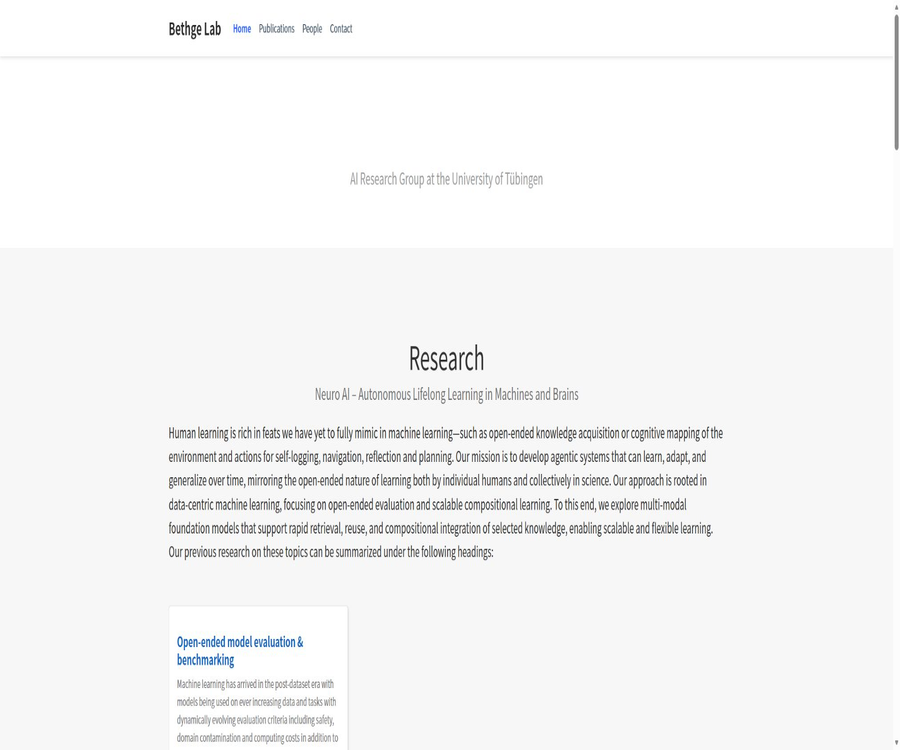
Bethge Lab
Bethge Lab: intelligent tools focused on AI-driven search.
Tags:AI search engineA one-sentence summary
The Bethge Lab is a research team at the University of Tübingen focused on AI and computational neuroscience; its official website presents information on research areas, team members, papers, datasets, and open-source code, but it does not offer online chat or content generation services.
Introduction to the Laboratory
The Bethge Lab, led by Matthias Bethge, conducts research in areas such as machine learning, computational neuroscience, visual science, and autonomous lifelong learning. Its goal is to understand the reasoning and learning mechanisms of the biological brain, as well as to develop machine systems that are capable of continuous adaptation, knowledge integration, and generalization.
Matthias Bethge is a professor of computational neuroscience and machine learning at the University of Tübingen, as well as the head of the Tübingen AI Center. His laboratory maintains collaborations with local universities, Max Planck institutes, ELLIS, and other academic networks.
It is not an ordinary AI tool.
- There is no prompt input field for the public or a general AI chat interface.
- There are no monthly subscription options available for writing, search, or office software.
- The official website is primarily used to learn about research projects, read papers, find team members, and apply for positions.
- The truly actionable resources are usually found in the paper attachments, code repositories, and dataset pages.
- Different research projects have varying dependencies, licenses, maintenance status, and difficulties in replication.
Current main areas of research
Open-model evaluation and benchmarks
The laboratory focuses on the evaluation challenges that arise once models enter the era of datasets, including changing tasks, security issues, data contamination, computational costs, and the democratization of evaluation processes. Relevant research attempts to expand static ranking systems into open evaluation frameworks that are sustainable, composable, and capable of handling sample-level assessments.
Language model agent
Research in this area focuses on language model agents that are capable of reasoning, communicating, and carrying out tasks autonomously. Publicly addressed challenges include theorem proving, the automation of scientific discovery, the retrieval of scientific citations, and the aggregation of information regarding uncertain future events.
Lifelong portfolio and goal-centered learning
The laboratory believes that continuous learning is not only about avoiding catastrophic forgetting, but also about turning past experiences into reusable components for the future. This research combines generalization, goal-centered representation, multimodal pre-training, and scalable lifelong learning.
Neural representations and mechanistic interpretability
The research team used machine learning to analyze neural data, in order to explore how groups of biological neurons carry out reasoning and learning. The work involved digital twins of the retina and visual cortex, comparisons of neural representations, as well as brain region models that could be refined as needed.
Human and machine attention
This research area focuses on salience, saccade paths, and eye movements in images, videos, and virtual reality, while also comparing human attention mechanisms with those of machine vision. One of the goals is to employ attention models that are more in line with human behavior in visual and behavioral studies.
AI science entrepreneurship
The laboratory is also focused on transforming research in machine learning into solutions that hold long-term practical value, and it works in partnership with companies arising from such research. The entrepreneurial and collaboration opportunities listed on the website do not mean that the laboratory is selling standardized commercial products to the public.
Comparison of research directions
| Research directions | Main problems | Typical resources | Suitable for readers |
|---|---|---|---|
| Open evaluation | How to continuously evaluate rapidly changing models | Evaluation frameworks, benchmarks, and datasets | Researchers in model evaluation and governance |
| Language model agent | How to improve reasoning, citation, and task collaboration skills | Papers, benchmarks, and experimental code | Researchers in NLP and agents |
| Lifetime combined learning | How to reuse knowledge and reduce forgetting | Continuous learning and multimodal projects | Machine learning researchers |
| Neural representation | How neural ensembles compute and learn | Neural data models and analysis code | Computational neuroscience researchers |
| Human-computer attention | How can human eye movements be compared with machine attention? | Significance models, eye movement data, and benchmarks | Researchers in visual and cognitive science |
| Scientific entrepreneurship | How to transform research findings into feasible plans | Information on cooperative projects and affiliated companies | Studying entrepreneurs |
Resources available on the official website
- Research Overview: A quick overview of the team’s current mission and key priorities.
- Paper Catalog: Browse papers, preprints, and conference articles by year and publication type.
- Project attachments: Some papers provide PDFs, code, datasets, project pages, videos, or slides.
- Member page: View the person in charge, postdocs, PhD students, master’s students, administrative staff, and alumni.
- Application page: Find out about opportunities for postdoctoral, doctoral, internship, rotation, and thesis work.
- News and Collaboration: View laboratory activities, academic collaborations, and impact projects.
Topics of representative papers
The paper catalog covers visual attention, neural data modeling, continual learning, compositional generalization, multimodal models, and the evaluation of large language models. The status of the papers listed may be either formally published, presented at conferences, or available as preprints; it is necessary to check the version when citing them.
- Evaluation of sample-level models for open capabilities.
- The ability to align scientific claims with literature citations.
- Continuous pre-training and merging of multimodal models.
- Concept frequency and zero-shot performance of visual language models.
- Target-centered learning and combined generalization.
- Adaptation and out-of-distribution generalization during continuous testing.
- Prediction of human visual fixation, salience, and saccade paths.
- Functional modeling of the retina and visual cortex.
GitHub open-source resources
The GitHub organization, which shares the same name as the laboratory and whose homepage points to the official website, currently contains dozens of public repositories that store paper implementations, benchmarks, data processing tools, and experimental code. These repositories are not a single software package; it is necessary to review the instructions and licenses for each one before using them.
Foolbox
Foolbox is a Python toolkit used for creating adversarial examples for neural networks; it can be used in conjunction with PyTorch, TensorFlow, and JAX. It is suitable for research on robustness and model evaluation, but should not be employed to launch unauthorized attacks on real systems.
imagecorruptions
ImageCorruptions offers Python capabilities for applying common types of corruption to images, and can be used to test a model’s stability in the face of noise, blur, weather conditions, and digital distortions. The repository is licensed under Apache 2.0, but the input data and models may have their own separate licenses.
model-vs-human
Model-vs-Human is used to compare models with human behavior on out-of-distribution data. This project is suitable for investigating whether machine vision relies on different cues from those used by humans; the current repository does not explicitly indicate the standard license in the metadata.
CiteME and ONEBench
CiteME focuses on whether language models can identify the papers cited in scientific texts, while ONEBench deals with sample-based benchmarks for openness. Both can be used to evaluate research, but the data, code, and evaluation results need to be interpreted in accordance with the instructions provided in their respective repositories.
Research on warehouses in recent years
The organization has also made available projects such as lifetime model evaluation, multimodal pre-training, reinforcement learning, neural representations, and language benchmarks. The timing of updates to the repository differs from that of paper publications; therefore, recent updates cannot be considered to represent a stable version.
Comparison of open-source projects
| Project | Uses | Primary language | License status | Precautions |
|---|---|---|---|---|
| Foolbox | Adversarial examples and robustness evaluation | Python | MIT | For authorized research and testing only. |
| imagecorruptions | Image erosion and robustness testing | Python | Apache 2.0 | Verify data and model permissions |
| model-vs-human | Comparison of models with human behavior | Python | The warehouse metadata is not specified. | Read the project file before use. |
| CiteME | Evaluation of scientific citation retrieval | Python | Non-standard declarations | Check the data and code provisions separately. |
| ONEBench | Sample-level evaluation of openness capability | Python | MIT | The results depend on the sample and evaluation settings. |
| frequency_determines_performance | Research on multimodal pretraining frequencies | Notebook | MIT | Reproduction may require large amounts of data and computing power. |
How to find the right papers
- First, determine whether the topic falls under evaluation, agents, lifelong learning, neural representations, or attention, based on an overview of the research.
- Go to the paper catalog and narrow down the search by year, conference, or paper type.
- Read the title and abstract to verify that the tasks, data, methods, and evaluation criteria meet the requirements.
- Check whether the paper’s page provides code, datasets, a project page, or slides.
- Give priority to the finally published version, and verify the author, conference, year, and Digital Object Identifier.
- Record the version of the paper, the code submissions, and the data versions to ensure that it can be reproduced later.
How to use the research code
- Find the corresponding repository on the paper’s page, and verify that it is indeed maintained by the author or the laboratory.
- Read the documentation, papers, licenses, dependent versions, and known issues.
- Create an isolated Python environment; do not install it directly on the production system.
- First, run the official minimal example or tests, and then attempt to use full datasets and training tasks.
- Fixed code submission, random seed, data version, and hardware environment.
- Compare your results with the metrics outlined in the paper, and note down any discrepancies that cannot be reproduced.
- When publishing derivative works, cite them in accordance with licensing requirements and academic standards.
Paper replication process
- It is necessary to specify whether what is to be reproduced are training results, evaluation results, charts, or qualitative examples.
- Check whether the original data is public, whether an application is required, and whether its redistribution is permitted.
- Record the software environment, drivers, frameworks, graphics card, and random seed.
- First, verify data reading and loss calculation on a small sample size.
- Check the hyperparameters, preprocessing, data splitting, and evaluation protocol as listed in the paper’s appendix.
- Run it at least several times and report the mean, variance, and failure rates.
- Distinguish between complete replication, approximate replication, and proof of concept; do not overstate the degree of consistency.
Apply to join the laboratory
The official website outlines the procedures for applying as a postdoctoral researcher, a doctoral student, for an internship, for a rotation in a laboratory, or to work on a bachelor’s or master’s thesis. The team emphasizes that given the large number of applications, it is necessary to use the designated application forms rather than sending complete applications directly to regular email addresses.
- Read about the current research directions and select a topic that best matches your personal experience.
- Prepare a resume, a research statement, representative projects, as well as verifiable code or papers.
- Explain the problems that wish to be solved, rather than merely expressing general interest in AI.
- Submit through the channels designated for postdoctoral, doctoral, or student programs.
- Check the application deadline, material requirements, and arrangements for recommendation letters.
- Wait for official notification; do not consider the automatic confirmation as an admission or an interview.
Which users are it suitable for
- Machine learning researchers: seeking work in continuous learning, multimodal approaches, and model evaluation.
- Computational neuroscience researchers: exploring visual systems and neural representation models.
- PhD and master’s students: searching for papers, data, replication projects, and funding opportunities.
- Engineer: Evaluate research tools such as Foolbox and imagecorruptions.
- Model Security Team: Researches adversarial robustness and open evaluation.
- Visual and cognitive scientists: Utilize resources for significance, eye movement, and behavioral comparison.
- Science entrepreneurs: Understanding the transformation of research findings and laboratory-derived projects.
Typical use cases
- Establish a literature foundation for ongoing learning or combinatorial generalization tasks.
- Reproduce the paper and compare the new method with the publicly available baseline from the laboratory.
- Use adversarial example tools to evaluate the robustness of visual models.
- The performance of the image erosion test model under varying distributions.
- Study the scientific citation of language models and the assessment of their openness.
- Compare machine vision predictions with human eye movement or behavior data.
- Search for postdoctoral, doctoral, and undergraduate research opportunities.
Resource advantages
- Place machine learning and computational neuroscience within the same research framework.
- The paper’s table of contents covers a long time period and provides fairly complete information on the authors and the publication details.
- Many paper pages also provide code, data, or project attachments.
- GitHub organizations contain mature tools as well as implementations based on recent papers.
- The research areas include model evaluation, agents, multimodal approaches, vision, and neural data.
- Some warehouses use clear licenses such as MIT or Apache 2.0.
- The official website clearly shows the team, network of partners, and application process.
Usage restrictions and precautions
- The Bethge Lab is a research team, not a SaaS tool that can carry out daily tasks directly.
- The content on the official website is mainly in English, and papers require a background in machine learning or neuroscience.
- Some of the code is intended for reproducing the paper’s results, and it may not possess production-grade stability.
- Different warehouses have different licenses, and some projects do not have a defined standard license.
- Paper code may rely on older frameworks, specialized hardware, or large-scale data.
- Public models and benchmarks may contain data biases, contamination, or evaluation leakage issues.
- Adversarial example projects can only be used for authorized testing, education, and defensive research.
- Preprint and conference versions may differ from the final published version.
- Warehouse star ratings, submission frequency, and paper citations alone cannot prove the reliability of a method.
- The application page and personal information may change; the version available on the official website at the time of submission shall prevail.
Price and usage costs
The Bethge Lab’s official website, the list of its papers, and its public GitHub repository do not require any commercial subscription plans. Reading the web pages is usually free, but accessing the full texts of the papers, data, computing resources for training, and third-party cloud services may incur additional costs.
| Resources | Public price | Possible cost | Explanation |
|---|---|---|---|
| Official laboratory website | Free access | Network and time costs | There is no need to purchase a membership. |
| Table of Contents | Free browsing | Some publications may be subject to access restrictions by journals. | Prioritize searching for the open version. |
| GitHub code | Public access | Computing power, storage, and engineering maintenance | Comply with the licenses for each warehouse |
| Dataset | Varies by project | Application, download, storage, and compliance costs | View the data usage agreement |
| Application project | The service fee is not listed on the official website. | Education, visas, and living costs are additional. | The admission rules are determined by the specific program. |
Platform and access methods
| Platform | Support status | Uses |
|---|---|---|
| Official Web Site | Support | Research overview, papers, members, and application information |
| GitHub | Support | Code, data descriptions, issues, and version history |
| Windows | It depends on the project. | Use it through a browser or a local research environment. |
| macOS | It depends on the project. | Use it through a browser or a local research environment. |
| Linux | Most research codes are given priority. | Training, evaluation, and reproduction |
| Mobile version | Browse web pages | It does not mean providing a separate mobile app. |
API, SDK, and open-source status
The Bethge Lab does not offer a unified commercial API, account control panel, or general SDK. Its open-source resources are available as separate research repositories; users must select the appropriate project based on the relevant papers and abide by the licenses governing those repositories, as well as their data, models, and dependencies.
The laboratory itself is not an open-source product that can be installed as a whole, but a large amount of research code is made available publicly. The open-source status indicated in the catalog should be described as ‘part of the research code is open-source’; it cannot be assumed that all elements are covered by the same licensing agreement.
Safety and research ethics
- Adversarial examples and model attacks can only be used on authorized systems.
- Neural, behavioral, and eye movement data may involve human research and privacy restrictions.
- Before downloading the data, check the ethical approval, scope of consent, and conditions for redistribution.
- When evaluating large models, it is necessary to record the prompt, model version, temperature, and risk of data contamination.
- Research code should be run in an isolated environment, with checks performed on dependencies and file operations.
- The results generated or evaluated cannot replace peer review and independent verification.
Basic information
| field | Content |
|---|---|
| Name | Bethge Lab |
| Properties | University Research Team in Machine Learning and Computational Neuroscience |
| Person in charge | Matthias Bethge |
| Affiliated organization | University of Tübingen |
| Main direction | Lifelong learning, model evaluation, agents, neural representations, and visual attention |
| Price pattern | The official website and the open-source code are available for free, with no commercial subscription required. |
| Is registration required? | There is no need to browse the official website; third-party resources may be required. |
| Unified API | None |
| Unified SDK | None |
| GitHub | There are organizations with the same name as well as dozens of public warehouses. |
| Open-source status | The research code is partially open source; the license varies depending on the repository. |
| Primary language | English |
Recommendation score
The comprehensive recommendation score is 4.4 out of 5 points. For researchers in machine learning, computational neuroscience, and model evaluation, the Bethge Lab offers a list of papers with a coherent thematic structure, as well as a wealth of code resources.
It is not suitable for ordinary users who are looking for one-click AI search, writing, or office-related services. Researchers also have to bear the costs associated with paper selection, environment setup, license verification, and conducting experiments to replicate results.
Frequently Asked Questions
What is the Bethge Lab?
It is a research team at the University of Tübingen dedicated to AI and computational neuroscience, and it is not a commercial AI application.
Can the Bethge Lab be used online directly?
It is possible to view research and papers, but there is no unified online tool for generating content. In practice, it is necessary to access the corresponding code repository and set up the research environment.
Is it necessary to pay to access the official website?
There is no need for a subscription to access the official website and the open-source code; however, publication of papers, cloud computing resources, and certain data may incur additional costs.
What are the main areas of research?
This includes open-model evaluation, language model agents, lifelong combinatorial learning, neural representations, human-computer attention, and AI science entrepreneurship.
Is the Bethge Lab open source?
The entire laboratory cannot be considered an open-source product, but its GitHub repository contains a large amount of research code.
Can all warehouses be used for commercial purposes?
It cannot be generalized; each warehouse, dataset, model, and dependency must have its license and terms of use checked separately.
What is Foolbox suitable for?
It is suitable for generating adversarial examples in an authorized environment and evaluating the robustness of neural networks.
Is a unified API provided?
No, the public resources mainly consist of independent research papers, Python packages, Notebooks, and datasets.
Is Chinese supported?
The official website and most papers are primarily in English; some of the code can be used for multilingual research, but there is no guarantee of a Chinese interface.
How to find the code corresponding to a paper?
Check attachments such as Code, Dataset, and Project in the paper’s table of contents or details page, and verify the repository owner and paper information.
Can I apply to join the laboratory?
Applications can be submitted through the channels for postdoctoral, doctoral, and student programs provided on the official website; the availability of these options and the deadline dates may change.
Is it suitable for beginners?
The official website is useful for learning about research directions, but most papers and replication projects require knowledge of Python, deep learning, statistics, or neuroscience.
Tools similar to those from the Bethge Lab




 Guigong Network Security Registration No. 45132202000164