






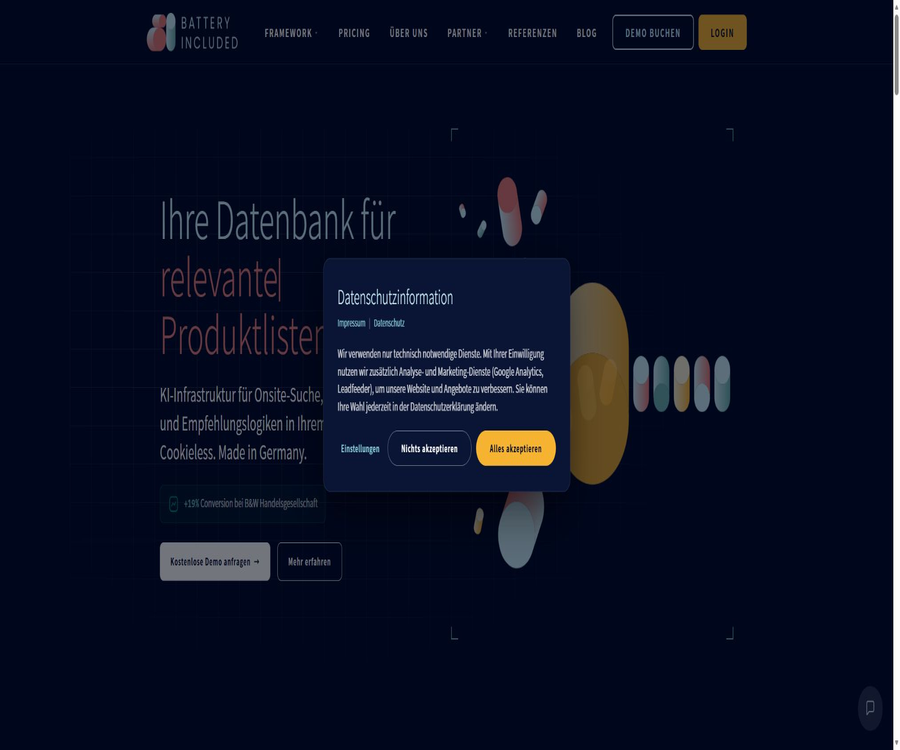
BatteryIncluded
BatteryIncluded: an intelligent tool focused on AI-powered searching.
Tags:AI search engineA one-sentence summary
BatteryIncluded is an AI-based product discovery infrastructure designed for medium to large e-commerce businesses; it integrates product search, search suggestions, cookie-free recommendations with a lower level of personalization, visual marketing tools, and data analysis all within one platform.
Tool Introduction
BatteryIncluded is operated by the German company BatteryIncluded GmbH, and it serves businesses that have large product catalogs, high levels of traffic, or multiple online stores. It connects to the front-end of these stores through an independent search index, thereby reducing the number of pages with no results caused by spelling errors, synonyms, or complex purchasing intentions.
The platform is not a web search box intended for ordinary users; it is rather a corporate service that needs to be integrated into e-commerce systems. Marketing teams can control the sorting of results through the management interface, while development teams carry out the integration using APIs, SDKs, plugins, and data synchronization tools.
What problem does BatteryIncluded solve?
- Identifying spelling errors, spoken expressions, synonyms, and product searches with multiple conditions.
- Ensure that precise searches for brands, SKUs, and technical terms still yield definite results.
- Reduce the occurrence of searches that yield no results and of irrelevant products appearing at the top of the list.
- Establish unified sorting and marketing rules for product lists, category pages, and search pages.
- Generate product recommendations without relying on user profiles or third-party cookies.
- Observe the performance of a product by examining search results, revenue data, and interface performance metrics.
Main functions
Volt Search product search
Volt Search incorporates keyword matching, fault-tolerant searching, automatic suggestions, dynamic filtering, and configurable sorting. It is suitable for creating separate search indexes for catalog fields such as product names, brands, SKUs, attributes, inventory levels, and prices.
- PreSense Suggest can provide search and product suggestions while typing.
- Typos tolerance and the Business Dictionary are used to handle spelling and business terminology.
- The Boost and Bury rules can increase or decrease the ranking of specific products and attributes.
- Query Redirects can direct specified queries to active pages or dedicated topic pages.
- The Similar Search API can be used in scenarios involving similar products and related recommendations.
- Dynamic filtering helps users narrow down large result sets.
Hybrid LLM Search
Hybrid LLM Search combines precise keywords, AISynonyms, and the capabilities of large language models to carry out searches. The precise keyword layer deals with brands and SKUs, the synonyms layer complements the vocabulary available in the catalog, while the large language model layer is used to interpret complex natural language queries that include information such as brands, budgets, product categories, and attributes.
Large models are used to understand queries, and the final products must be verified against the actual catalog structure. This design helps reduce the risk of recommending products that do not exist, but the actual outcome still depends on the quality of the product data, field mapping, and rule settings.
| Search layer | Main function | Suitable for querying | Precautions |
|---|---|---|---|
| Keyword search | Exact matching and fault tolerance | SKU, brand, model, and technical terms | Not good at understanding complex intentions. |
| AISynonyms | Expanded synonyms and business dictionary | Spoken language, synonyms, and searches with no results | It is recommended to confirm this from the management side. |
| LLM reasoning | Break down budget, attributes, and purchase intent | Multi-condition natural language queries | Provided as a paid additional feature |
| Directory verification | Map intents to actual products | Datasets requiring accurate inventory and attribute data | It cannot replace data governance. |
Volt Merch visual marketing
Volt Merch is designed for e-commerce operations and marketing teams; it allows users to control search results and categorized product lists through a drag-and-drop editor. Common functions include setting items as favorites, hiding them, making bulk adjustments, customizing sorting orders, adding promotional banners, and including SEO-related content blocks.
- Pin-to-Top places popular products or key brands in prominent positions at the top.
- Hide Products hides the items that are not suitable for display in the current list.
- Custom Sorting allows sorting by profit, inventory, new products, or a combination of sales strategies.
- The Promotion Banner inserts promotional materials into the product list.
- Category Merchandising assigns separate display rules for different categories.
- AI Picks can generate tags for bestsellers, trends, and recommendations based on data, while also allowing manual adjustments.
AI Recommendations – Product recommendations
AI Recommendations offers suggestions such as items that are often purchased together, similar products, items bought by other users, and predefined sets of products. The provider emphasizes that this recommendation service does not create personal user profiles, and it can be used on product detail pages, within recommendation sliders, and in the shopping cart.
- Frequently Bought Together is used for bundled sales.
- Similar Items is used for finding substitutes and similar products.
- Presets are used for recommending bestsellers, seasonal items, or products from specific categories.
- PDP is recommended for cross-selling on product detail pages.
- The shopping cart is recommended for adding products and enhancing combined purchases.
- Playground allows marketers to exclude, boost, or override automatic results.
AISynonyms automatic synonyms
AISynonyms analyzes query results and product data to propose new synonym candidates. These candidate terms are presented in a management interface for the team’s approval; thus, it functions more like an automatically maintained business dictionary, rather than allowing uncontrolled modifications to queries.
Relevance Stream sorting optimization
Relevance Stream combines the sorting logic defined by the enterprise with data on sales, prices, and aggregate behaviors in order to continuously adjust the order of products by default. The team can still retain control over the process by using rules, tags, and manual adjustments.
Analysis and Monitoring
- Search Insights allows you to view popular queries, terms with no results, and search behavior.
- Revenue Analytics is used to examine the relationship between search metrics and revenue figures.
- Status Updates display the status of service and data synchronization.
- The API Performance Indicator helps in diagnosing interface performance.
- The Turbo package offers specialized analysis for Hybrid LLM Search.
Input data and output results
| Stage | Common content | Output or purpose |
|---|---|---|
| Product catalog | Name, description, SKU, price, inventory, brand, and attributes | Create a searchable index |
| Content data | Categories, blogs, or other document types | Supports discovery of mixed content |
| Query request | Keywords, spoken language, spelling mistakes, and multi-condition requirements | JSON search results and filtering options |
| Aggregated behavior data | Statistics on clicks, shopping carts, purchases, etc. | Optimize sorting and recommendations |
| Marketing rules | Pin, hide, sort, tags, and promotional materials | Control the search page and category page |
Complete workflow
- The business team is responsible for determining the shopping malls, countries, languages, product catalogs, and target metrics that need to be integrated.
- The development team creates search indexes and synchronizes product details, inventory levels, prices, and classification data to the platform.
- In the testing environment, interfaces for search, suggestions, filtering, recommendations, and product lists are integrated.
- The marketing team configures synonyms, sorting, prioritization, hiding, and promotion rules in the management interface.
- Use a real but anonymized query set to test precise searching, complex intents, and the behavior in cases with no results.
- Complete the checks for front-end experience, performance, accessibility, data protection, and fallback strategies.
- After going live, continuous monitoring of searches, revenue, interface performance, and synchronization status is carried out, with the rules being updated accordingly.
Access tutorial
Enterprise trial and solution confirmation
- Schedule a demonstration and prepare information on the number of products, traffic volume, number of e-commerce stores, and the existing technology stack.
- Select Charge, Power, or Turbo, and confirm the required index, account, data source, and AI features.
- Apply for a 30-day trial to test the quality of searches and the operational processes using your own product catalog.
- Sign the contract only after confirming the implementation fees, contract duration, service level, data location, and scope of support.
Development and integration steps
- Obtain public and private integration keys, and manage them separately for development, testing, and production environments.
- Use full synchronization to create the initial directory, and then employ Delta Data Sync to update the fields that have changed.
- Integrate search and suggestions through JSON API, official SDK, or store plugins.
- Integrate filtering, sorting, pagination, recommendation sections, and fallback solutions for no results into the frontend.
- Verify the caching mechanism, timeout handling, retry procedures, key rotation, and the fallback logic in case the interface is unavailable.
- After going live, monitor index freshness, request performance, and search quality.
Getting started with the PHP SDK
The official PHP SDK requires PHP 8.2 or a higher version; it is recommended to install it using Composer. The SDK enables the synchronization of products and content, the addition of custom fields, the execution of search operations, and it allows products and blog posts within the same index to be distinguished based on their type fields.
- First, create separate collections, API keys, and environment configurations.
- Use standard DTO mapping for name, description, order number, price, inventory, and rating.
- Custom fields of the mall should be placed within the namespace of the corresponding document type.
- Full synchronization is used for initialization, while incremental synchronization is used for regular updates.
- Do not expose the private key in the browser or front-end code.
Supported shopping malls and architectures
The official page explicitly mentions Shopware, Magento, OXID, Emporix, as well as custom Headless architectures. The platform utilizes a search infrastructure that is decoupled from the e-commerce store; the availability of specific plugins, version compatibility, and the effort required for implementation need to be determined during project evaluation.
| Access method | Applicable scenarios | Features |
|---|---|---|
| Shop plugin | Supported standard shopping malls | Deployment is fast, but version compatibility needs to be verified. |
| JSON API | Custom front-end and headless e-commerce platform | Flexible control is required; a complete experience needs to be developed. |
| PHP SDK | PHP and Symfony ecosystem projects | Officially open source; PHP 8.2 or higher is required. |
| Go SDK | Go services and data pipelines | The official repository is available; its maturity level needs to be assessed by the project team. |
| Postman API | Interface testing and joint debugging | Suitable for validating endpoints and request parameters. |
Which users are it suitable for
- Mid-to-large e-commerce platforms: they have a large number of products, and it is necessary to improve search functions and product discovery mechanisms.
- Companies with multiple brands and shopping platforms: They require multiple search indexes, data sources, and accounts.
- B2B e-commerce platforms: The attributes of products in their catalogs are complex, and searches often involve model numbers, specifications, and industry-specific terms.
- E-commerce operations team: Wants to have control over the category pages, search pages, and promotional areas.
- Marketing team: Needs bestseller tags, recommendation sliders, banners, and SEO content blocks.
- Development team: To integrate with an independent search service, it is necessary to use APIs, SDKs, or plugins.
- Companies sensitive to privacy: They prefer that search and recommendation functions rely less on cookies and personal profiles.
Typical use cases
- Results showing available items are still returned even when the user spells the brand or product name incorrectly.
- Parse complex requirements such as ‘a certain brand, a specified budget, a certain attribute’ into filtering criteria.
- Reorder the category page by inventory, gross margin, new products, sales volume, and business rules.
- During promotional periods, highlight key products and hide those that are out of stock or not applicable.
- Similar products are displayed on the details page, while complementary products are shown in the shopping cart.
- Analyze zero-result queries and add frequently occurring expressions to the business dictionary.
- Maintain separate indexes for various countries, languages, brands, or sales channels.
- Place products and content articles in the same collection and search by type.
Product advantages
- Integrate search, suggestions, recommendations, marketing controls, and analysis into a unified product system.
- Keyword, synonym, and large-model hierarchical processing to balance accurate numbering with complex intentions.
- The results are verified against the actual product catalog, thereby reducing the risk of creating non-existent products.
- Marketers can drag and drop to adjust the list, without having to wait each time for the developers to make changes.
- The search and recommendation mechanisms reduce reliance on third-party cookies and personal profiles.
- It offers full and incremental data synchronization, JSON APIs, as well as various development resources.
- The package comes with a fixed monthly fee; no additional charges are applied based on extra requests or the amount of content stored.
- It supports multiple popular shopping malls as well as the Headless architecture.
Usage restrictions and precautions
- The product is aimed at enterprise customers, and its initial price as well as implementation costs are significantly higher than those of lightweight search plugins.
- The standard cooperation period is 24 months, and the terms regarding withdrawal, upgrading, and downgrading should be confirmed prior to procurement.
- The authorities charge a fixed implementation fee, the amount of which must be determined on a case-by-case basis for each project.
- Hybrid LLM Search is an additional service that requires extra payment and is not included in the basic package by default.
- The number of indexes, accounts, data sources, dedicated hosting options, and AI features vary depending on the package.
- The quality of search results depends on the quality of the product title, attributes, categories, inventory levels, as well as synonym data.
- The absence of cookies does not mean that companies are exempt from any privacy assessments; data sources such as GA4 still have their own compliance requirements.
- The official customer case data do not indicate that all e-commerce platforms will experience the same increase in conversion rates.
- The release of plugins and SDKs does not mean that the BatteryIncluded core business platform is open-source.
- Integration usually requires development, data mapping, front-end experience testing, and ongoing operation.
Prices and packages
The following are the official prices published on the website as of August 20, 2026. These amounts represent the starting price per month; the actual cost for a company may also include implementation fees, taxes, and customized services, with the final amount being determined according to the terms of the contract.
| Package | Public price | Primary interests | Suitable for users |
|---|---|---|---|
| Charge | €1,500/month starting from | 1 index, search suggestions, fault-tolerant searching, standard marketing, analytics, and email support | Single shopping mall and centralized product catalog |
| Power | €2,500/month | Less than 5 indexes, search guidance, synonyms, enhanced marketing, API, and priority support | Multiple brands or multiple shopping malls |
| Turbo | Contact sales | More than 5 indexes, AISynonyms, AIPicks, AIRecos, SLA, and dedicated hosting | High-traffic enterprise e-commerce |
| Hybrid LLM Search | +€1,500/month | Understanding of complex query intentions and verification of the catalog | As an additional item for any meal set |
| Trial | 30 days free | Try out the features of the selected package without the need for a prior contract or credit card. | Procurement verification and concept testing |
| Implement services | Custom fixed fee | Technical Service Manager and Training After Go-Live | All official projects |
Differences in packages
| Project | Charge | Power | Turbo |
|---|---|---|---|
| Search index | 1 | Less than 5 | 5 or more |
| User account | 1 | Less than 3 | 3 or more |
| Data source | 1 | Multiple | Multiple |
| AISynonyms | Not included | Not included | Includes |
| AIPicks | Not included | Not included | Includes |
| AIRecos | Not included | Not included | Includes |
| Dedicated CVM | Not included | Not included | Includes |
| APIs and SDKs | Includes | Includes | Includes |
Contract and billing details
- The official option is a fixed monthly fee; no additional charges are applied for storing extra products or for server queries.
- The standard cooperation period is 24 months, and the package can be upgraded or downgraded depending on the company’s growth.
- Adding new countries, languages, domain names, or sales channels may require the creation of additional indexes and adjustments to the packages.
- The implementation fee is a fixed price that includes support from technical service personnel as well as training for the marketing team.
Supported platforms
| Platform or channel | Support status | Explanation |
|---|---|---|
| BatteryIncluded management portal | Support | Used for marketing, analysis, synonym, and index management |
| Shopware | Support | Provides ready-made plugins and proprietary APIs for synchronization. |
| Magento | Support | Integration is possible through APIs or integrated projects. |
| OXID | Support | The Hybrid LLM Search page lists them clearly. |
| Emporix | Support | Suitable for enterprise e-commerce and Headless solutions |
| Headless shopping mall | Support | Integration via JSON API or SDK |
| PHP | Official SDK | PHP 8.2 or higher is required. |
| Go | Official warehouse | The version and coverage area should be evaluated before connecting. |
API and data synchronization
All three official packages include the GitHub SDK, Postman API, public and private integration keys, Delta Data Sync, and JSON responses. Developers should keep the private keys on the server side and assign separate credentials for different environments, collections, and services.
- Full synchronization is used for the initial import or reconstruction of the product catalog.
- Incremental synchronization only updates changes such as product prices, inventory, and attributes.
- The Browse interface is used to query, filter, sort, and retrieve the matching results.
- The same collection can hold different types of documents, such as products and blogs.
- Custom fields can expand the directory structure, but it is necessary to maintain consistent types and naming.
GitHub and the open-source status
BatteryIncluded’s core search, recommendation, management portals, and cloud services constitute a commercial platform; its complete source code is not made available publicly. The official GitHub repository provides the PHP SDK, Go SDK, Symfony Bundle, as well as some projects related to integrating with e-commerce platforms, with the PHP SDK and Bundle being distributed under the MIT license.
Open-source repositories are used to integrate with the BatteryIncluded service, but they do not constitute a complete search platform that can be deployed independently. When making a choice, companies should evaluate the commercial service agreements, the maintenance status of the SDKs, and the licenses associated with each repository.
Data privacy and security
The authorities describe search and recommendation functions as Cookieless solutions, stating that no personal user profiles will be created through these features. According to their privacy policy, the GA4 tracking data used for determining relevance is kept internally, is not shared with third parties or AI models, and is stored encrypted on servers in Germany.
- Before connecting, clarify the scope of processing for product data, query logs, aggregated behavior data, and account data.
- Verify the responsibility relationships among GA4, the e-commerce platform, BatteryIncluded, and other service providers.
- Set minimum permissions, environment isolation, rotation, and response procedures for API keys.
- Do not include unnecessary personal data such as customer names, addresses, and order details in the search index.
- Confirm the terms regarding backups, logs, deletion, export, retention periods, and data location.
- Conduct pre-launch reviews for model queries, recommendation logic, and manual rules.
Implementation suggestions
- First, establish a baseline for the current situation regarding high-frequency queries, zero results, conversion rates, and interface latency.
- Select a shopping mall, language, and product catalog to start a 30-day trial.
- Prepare a test set consisting of precise SKUs, spelling errors, synonyms, and complex intents.
- Verify the search quality, filtering, recommendations, marketing rules, and mobile experience separately.
- Confirm data protection, availability objectives, monitoring, rollback, and supplier exit plans.
- After going live, controlled experiments are used to evaluate the results; official customer case figures are not applied directly.
Basic information
| field | Content |
|---|---|
| Tool name | BatteryIncluded |
| Development company | BatteryIncluded GmbH |
| Location of the company | Germany |
| Tool type | AI e-commerce search and product discovery platform |
| Core products | Volt Search, Volt Merch, AI Recommendations, Hybrid LLM Search |
| Price pattern | Monthly enterprise fees, implementation costs, and custom quotes |
| Free trial | 30 days, no credit card required |
| Standard contract period | 24 months |
| API | Provides JSON API and Postman documentation |
| SDK | Provides PHP, Go, and related bundles |
| Is it open source? | The core platform is not open source; some SDKs and connection components are open source. |
| Main markets | Mid-to-large e-commerce companies, B2B businesses, as well as enterprises with multiple brands and shopping malls |
Recommendation score
The comprehensive recommendation score is 4.4 out of 5 points. BatteryIncluded offers comprehensive search, recommendation, and marketing functions, making it particularly suitable for companies with complex product catalogs that require direct control over the results by their marketing team.
Its starting price, implementation fees, and 24-month standard contract period mean that the threshold for adopting it is relatively high. Small shops should first calculate the additional value that using this solution can bring, and decide after trying it out for 30 days.
Frequently Asked Questions
What is BatteryIncluded tool?
It is an AI platform for product search, recommendation, marketing, and analysis tailored for e-commerce companies; it needs to be integrated with the store’s catalog and front-end interface.
Is BatteryIncluded suitable for small online stores?
It is generally more suitable for companies that have 500 or more products, high traffic levels, or a multi-store structure. Small online stores should first compare the implementation costs with the expected benefits.
Can it be used for free?
There is no permanent free plan, but the official provider offers a 30-day free trial, without the need for a prior contract or a credit card.
How much is BatteryIncluded?
The Charge plan starts at 1,500 euros per month, the Power plan at 2,500 euros per month; a quote is required for the Turbo plan. An additional fee of 1,500 euros per month applies to the Hybrid LLM Search option.
Is there still a fee to be paid for implementation?
Yes, according to the official guidelines, a fixed fee is applied for implementation; the specific amount depends on the project.
What is a search index?
An index usually corresponds to a set of product data sources; multiple brands, multiple shopping platforms, as well as different countries or sales channels may require multiple indexes.
Is natural language product search supported?
Yes, Hybrid LLM Search is capable of processing complex requests that include brand, budget, category, and attribute information; however, this functionality comes at an additional cost.
Are cookies required for product recommendations?
The authorities describe AI Recommendations as a recommendation system that does not rely on cookies or personal profiles, but companies still need to examine the compliance requirements related to the analytical data they use.
Which shopping malls are supported?
The official list includes Shopware, Magento, OXID, Emporix, and the Headless architecture; specific plugin and version compatibility must be confirmed prior to implementation.
Are APIs provided?
The official packages include JSON API, integration keys, Postman documentation, and incremental data synchronization.
Is BatteryIncluded open source?
The core business platform is not open-source; however, some official SDKs and connection components are available on GitHub.
What are the requirements for the official PHP SDK?
The official repository currently requires PHP 8.2 or a higher version, and it is recommended to use Composer for installation.
How long does it take to get connected?
Officials state that most integrations can be completed within 2 to 4 weeks; the actual time required depends on the catalog, the front-end interface, the quality of the data, and the extent of customization.
Tools similar to BatteryIncluded




 Guigong Network Security Registration No. 45132202000164