






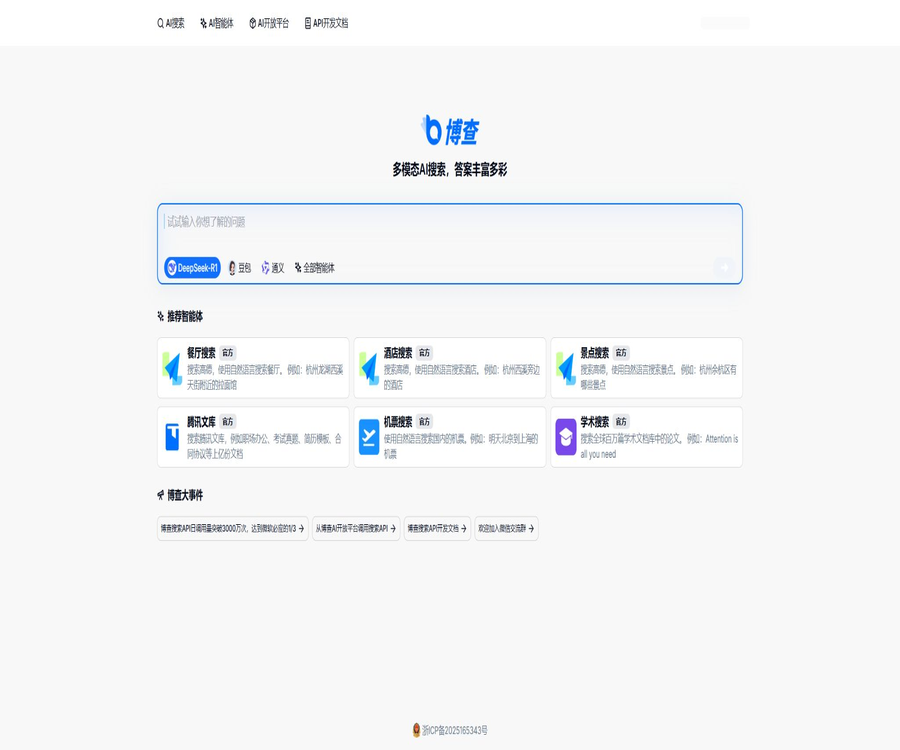
Bocha AI Search
Bocha AI Search – an intelligent tool specialized in AI-based searching.
Tags:AI search engineWhat is Bocha AI search?
Bocha AI Search is a Chinese search engine that serves both ordinary users and AI developers. Ordinary users can search for web pages and specialized content, while developers can use this open platform to add online search capabilities to intelligent agents, chatbots, and RAG applications.
The focus of this product is not merely to return a traditional list of links; rather, it involves understanding natural language queries and combining web summaries, images, videos, and structured cards. Search results and AI-generated summaries may still contain errors, so it is important to check the relevant information on the original pages.
Development companies and product portfolios
Bocha Search is operated by Hangzhou Bocha Search Technology Co., Ltd. Its current product portfolio includes Bocha AI Search for individual users, the Bocha AI Open Platform for developers, as well as features such as Web Search, AI Search, Agent Search, and Semantic Reranker.
The official website presents it as a world-wide knowledge search engine designed for use with AI, covering content such as web pages, news, images, videos, encyclopedias, as well as academic materials. The data sources, the format of the results provided, and the pricing methods vary depending on the search interface used.
Main functions
- Use natural language to search web pages and obtain comprehensive answers.
- It returns fields such as the webpage title, summary, site, publication date, and images.
- Filter by time range to view content from the latest day, week, month, or year.
- Supplement text-based searches with image and video results.
- Use vertical agents for restaurants, hotels, attractions, flight tickets, and more.
- Search for office, exam, resume, and contract-related materials in Tencent Document Library.
- Search for papers and research materials using academic agents.
- Provide Web Search and AI Search interfaces for AI applications.
- Call the specified search agent through Agent Search.
- Reorder the candidate documents using Semantic Reranker.
- Use the official MCP to integrate search capabilities into clients such as Claude and Cursor.
- On the open platform, you can view the number of calls, balance, resource packages, and API keys.
What can regular users search for?
| Search entry | Suitable for querying | Characteristics of the results |
|---|---|---|
| Universal AI search | News, concepts, products, and public information | Combined web search and AI organization |
| Restaurant search | Location, cuisine, budget, and business requirements | Accessing restaurant information based on the map ecosystem |
| Hotel search | Cities, shopping areas, dates, and accommodation preferences | Return structured content related to the hotel |
| Attraction search | Destination, region, and theme of the activity | Assist in discovering and comparing attractions |
| Flight search | Starting point, destination, and date | Natural language queries for domestic flights |
| Tencent Document Library | Workplace templates, exam materials, and contract references | Search the library contents; be mindful of copyright and accuracy when using them. |
| Academic search | Papers, authors, topics, and research directions | Designed for academic information retrieval; it does not replace verification using specialized databases. |
Boca AI Search Usage Guide
- Open the search page and choose either general search or the appropriate vertical agent.
- Use complete sentences to specify the subject, location, time range, and desired outcome.
- View the answers organized by AI, structured cards, and reference pages.
- Open the key source and check the publication date, author, and original context.
- Add more specific conditions to the conflict information and search again.
- Organize the verified information in your own notes or reports.
A way of asking questions that makes it easier to obtain good results
- For news items, indicate the name of the event and the time period as well.
- When querying local services, please specify the city, shopping area, budget, and number of people.
- Add fields such as academic topics, keywords, authors, or paper year.
- The product specifies the model, region, and fields that must be compared.
- When requesting a list of differences, it is necessary to first define the same statistical criteria.
- For conclusions involving high risk, it is required to provide verifiable original sources.
Web Search API
The Web Search API is intended for developers who need the original webpage content. It provides structured data such as page titles, links, summaries, site names, icons, publication dates, and images; up to 50 results can be retrieved per search.
| Parameters or capabilities | Uses | Precautions |
|---|---|---|
| query | Submit keywords or natural language questions | Required; avoid including unnecessary personal information. |
| freshness | Limit the time at which web pages can be published | Supports unlimited, one day, one week, one month, one year, and date ranges. |
| count | Control the number of items returned | The range is from 1 to 50; the more results there are, the higher the processing cost. |
| summary | Request a summary that is more suitable for use with large models. | The abstract is not equivalent to the original text; a link should be kept for verification. |
| Web page results | Build RAG context and reference list | It is necessary to remove duplicates, filter out sources of low quality, and control the length of the prompts. |
| Photos and videos | Supplement multi-modal search results | Check for authorization before downloading, displaying, and using for commercial purposes |
AI Search and Agent Search
AI Search understands the semantics of queries based on web search, and can return structured cards containing information such as weather data, calendar details, and encyclopedia entries. It is suitable for applications that wish to avoid the need to assemble results manually and to obtain more comprehensive search outcomes directly.
Agent Search is used to invoke a specified AI search agent, which provides answers related to a particular field of expertise as well as the possibility to ask follow-up questions. Compared to traditional web searches, the outputs generated by this method go through more processing by various models; as a result, developers need to keep track of relevant evidence, deal with timeout issues, and arrange for manual review.
| Products | Main output | Suitable scenarios |
|---|---|---|
| Web Search API | Websites, images, videos, and summaries | RAG, search box, information discovery, and custom answer generation |
| AI Search API | Web results, AI answers, and structured modal cards | AI for searching products, lifestyle services, and real-time Q&A |
| Agent Search API | Specify the agent’s professional answers and follow-up questions | In-depth research and search in specific domains |
| Semantic Reranker API | Document relevance score and reordering | Optimization of knowledge base retrieval and refinement of search results |
Semantic Reranker semantic sorting
Semantic sorting models are used to determine the degree of relevance between a query and candidate texts, so that the more relevant ones appear at the top. The bocha-semantic-reranker as described by the developers uses a Transformer architecture with around 80 million parameters.
- Improve the semantic matching ability when keywords are not exactly identical.
- Perform a secondary sorting of the candidate documents for vector retrieval or keyword retrieval.
- Reduce the inclusion of low-relevance content in the context of large models.
- Improve the quality of results for customer service, corporate knowledge bases, and document-based queries.
- The sorting score is not an indicator of factual accuracy; source and permission filtering are still required.
API Integration Tutorial
- Register on the open platform and complete the required account verification.
- Receive available trial resource packs or top up your account balance.
- Create an API Key on the key management page and save it securely right away.
- Choose Web Search, AI Search, Agent Search, or Reranker based on your business needs.
- Use the official example to send a minimal request and check the response fields.
- Add timeout, retry, throttling, caching, and error logging.
- Remove duplicates from the search results, apply source filtering, and verify their timeliness.
- Set up balance alerts before going live, and monitor the cost of using each function.
Recommendations for integrating into a production environment
- The API Key should be stored only in backend environment variables or key management services.
- Do not expose keys in web scripts, mobile clients, or public repositories.
- Use different keys for various environments and projects to facilitate revocation and auditing.
- Cache identical queries to avoid repeated payments in a short period of time.
- Set appropriate numbers of results to return and time filters based on the task requirements.
- Retrieval time is maintained for queries related to news, prices, and policies.
- Pass the source domain name, publication time, and original link to the downstream model together.
- Design fallback solutions for 429 errors, timeouts, and empty results.
Official MCP server
Bocha has made bocha-search-mcp available on GitHub; this tool allows Web Search and AI Search to be offered as MCP services to AI clients that support this protocol. The examples in the repository are run using uv, and the Bocha API keys are retrieved through environment variables.
MCP connection steps
- Prepare the Python and uv runtime environments, and obtain the MCP project from the official repository.
- Create a separate API Key for MCP on the Bocha Open Platform.
- Configure the startup command, project directory, and environment variables in client format.
- Use MCP Inspector or the list of client tools to verify that the service has been loaded.
- First, perform a low-cost search to check the query, time range, and number of results to be returned.
- Configure the call budget and monitor errors, delays, and balance consumption.
- If the key is leaked, it should be revoked on the open platform and recreated immediately.
Prices and billing methods
The Bocha AI open platform adopts a model that combines pre-payment, pay-as-you-go charging, and resource packages. The official console offers 1000 free calls to access these resource packages for verification purposes; however, the specific price per product, discounts, validity periods, and free offers may vary depending on the account and the page being used.
| Project | Current billing method | Explanation |
|---|---|---|
| Personal AI search | Basic search can be tried out directly. | Login requirements and feature limits are specified on the product page. |
| Web Search API | Resource package or pay-as-you-go | The console displays the real-time unit price and the validity period of the resource package. |
| AI Search API | Charging in accordance with product rules | The pricing for model processing and structured card capabilities may vary. |
| Agent Search API | Charging by product or agent | The cost of conducting complex research queries is usually higher than that of performing basic web searches. |
| Semantic Reranker | A free period is indicated during verification. | The free status may end; check the console before production. |
| New user resource package | 1000 calls can be obtained. | Whether it can still be obtained and its validity period are specified on the account page. |
| Large-scale use by enterprises | Business inquiry | Related to QPS, number of requests, service requirements, and contractual obligations |
The terms of the service agreement state that the platform may suspend its services when the balance available for top-ups is insufficient. The amounts offered as gifts or as part of top-up discounts cannot be withdrawn, transferred, nor used to issue invoices. Formal purchases must comply with the rules specified in orders, the control panel, and contracts.
How to estimate API costs
- Count the daily active users, the number of searches each user performs per day, and the peak concurrent usage.
- Distinguish between Web Search, AI Search, Agent Search, and sorting requests.
- Measure how many times background searches are actually triggered by a user’s query.
- Consider retrying on failure, exploring multiple rounds of task retrieval, and the resource consumption of the testing environment.
- The monthly base fee is calculated based on the real-time unit price in the console.
- Increase the budget buffer for traffic growth, peak activity levels, and abnormal calls.
- Configure balance alerts and project-level call limits.
What use cases are suitable?
- Ordinary users query Chinese web pages, news, and information on lifestyle services.
- Researchers found papers, reports, and public materials.
- Developers have added real-time online search to chatbots.
- RAG applications supplement the world’s knowledge beyond an enterprise’s knowledge base.
- The AI agent searches for web pages based on tasks and returns the relevant references.
- The customer service system searches for product documentation, policies, and public FAQs.
- The content team keeps an eye on trending topics, competitors, and industry developments.
- Low-code platforms add search tools through plugins.
- Companies purchase search APIs in the domestic service environment.
Tasks that are not suitable for completion directly
- Making medical, legal, or investment decisions without reviewing the original sources.
- Compliance investigations that are required to cover the entire Internet without any omissions.
- It is necessary to obtain access to paywalls, login pages, and the full contents of unauthorized databases.
- Treat the search summary as a direct, citable academic source.
- Use personal accounts to handle large-scale production traffic that is not subject to budget limits or throttling.
- Submitting state secrets or a company’s core confidential information to third-party AI services.
- Evaluations that require completely neutral and permanently unchanged rankings for search results.
Product advantages
- It also provides a search function for consumers as well as an open platform for developers.
- Chinese web pages offer targeted coverage of content related to the domestic ecosystem.
- It supports web pages, images, videos, and various structured modal cards.
- The Web Search results field is suitable for direct integration with large models and RAG.
- Time filtering and a maximum of 50 results help to limit the scope of the search.
- AI Search and Agent Search reduce some of the assembly tasks on the application side.
- Reranker can be used to improve the ranking of knowledge bases and hybrid searches.
- It supports various connection methods such as official APIs, plugins, and MCP.
- Recharging with RMB and utilizing domestic services makes it more convenient for local developers to make purchases.
Usage restrictions and precautions
- Search indexes cannot cover all web pages and closed content.
- AI summaries may misinterpret the original text, omit certain conditions, or confuse times.
- The data freshness and available regions for structured cards vary.
- The web page publication date field may be missing or provided incorrectly by the site.
- Repeated searches, multiple rounds of use of intelligent agents, and attempts to retry after failures will increase the costs.
- Free resource packs, discounted products, and prices may be adjusted at any time.
- The service agreement does not guarantee complete absence of interruptions or errors.
- Photos, videos, and library materials are still subject to copyright laws and platform rules.
- Developers need to review the input and output content provided by end users on their own.
- The search API cannot replace specialized databases and manual fact-checking.
Privacy and data security
The privacy policy of the open platform states that the input data provided during API interactions is collected for the purpose of analyzing and generating search results; the platform also keeps records such as the time of the request, the IP address, and the path and type of the request. Developers should consider search terms as data that is being sent to external services.
- Delete information such as name, phone number, ID number, and internal account before querying.
- Do not use the original customer records or complete confidential documents as search terms.
- Explain to end-users the third-party services and data rules used for online searches.
- Set the minimum required retention period and access permissions for query logs.
- Immediately revoke the API Key once it is leaked, and check for any abnormal usage.
- Companies must complete assessments of personal information, content security, and data export prior to going live.
- Separate privacy policies and procedures for handling user rights are established for downstream applications.
GitHub and the open-source status
The official BochaAI organization has made available the bocha-search-mcp repository, which is used to integrate Bocha search into MCP clients. Upon verification, it was found that no standard open-source license is specified for this repository; therefore, copying, modifying, or redistributing the code cannot be done under permissive licensing terms.
Bocha’s search engine, indexing, sorting models, and open platform are not fully open source. The catalog should indicate that the platform is not open source, and it should be specified separately that the official MCP integration code is available publicly, but its license details are not clear.
Basic information
| field | Content |
|---|---|
| Tool name | Bocha AI Search |
| English name | BochaAI Search |
| Operating company | Hangzhou Bocha Search Technology Co., Ltd. |
| Tool type | AI search engines, search APIs, semantic sorting, and MCP tools |
| Search range | Websites, news, images, videos, encyclopedias, flight information, libraries, and academic content, etc. |
| Developer products | Web Search, AI Search, Agent Search, Semantic Reranker |
| Price pattern | Free trial, resource packs, prepaid pay-as-you-go options, and enterprise quotes |
| Whether API is provided | Yes |
| Is MCP provided? | Yes, the official GitHub repository. |
| Is it open source? | The platform is not open-source, and no standard license is specified for the MCP repository. |
| Is Chinese supported? | Yes |
Recommendation score
4.6 / 5. Bocha offers capabilities such as Chinese-language AI search, specialized intelligent agents, search APIs, semantic sorting, and MCP, making it suitable for domestic AI applications that need access to real-time knowledge; however, price offerings, the accuracy of results, invocation costs, and data compliance still require ongoing monitoring.
Frequently Asked Questions
Is Boccha AI search free?
Regular searches can be tried out right away; when undergoing verification on the open platform, 1000 free calls of the resource package are provided. The amount of free usage, its validity period, and the eligibility to receive it shall be based on the information displayed on the page after logging in.
Can Bocha search for papers?
Academic search agents can be used to find papers and research materials. When citing them formally, it is still necessary to verify the author, version, and publication details in the original journal, database, or paper page.
What is the difference between Web Search and AI Search?
Web Search primarily returns structured results such as web pages and summaries, while AI Search understands semantics and provides sector-specific modal cards. Developers should choose the appropriate interface depending on whether they need to generate answers on their own.
How many results can the Bocha API return at once?
According to the official MCP and interface documentation, the count range for Web Search is from 1 to 50. Returning more results increases the costs associated with deduplication, sorting, and handling the context in large models.
Does Bocha offer MCP?
The official bocha-search-mcp repository is provided, which allows Web Search and AI Search tools to be made available to clients that support MCP. To use it, one’s own Bocha API key is required.
Does Bocha search for open source?
The search platform itself is not open source. The official MCP code is available publicly, but the repository does not specify a standard license for verification; therefore, a publicly available repository cannot be considered to grant open source licensing.
Where should the API Key be placed?
It should be stored in server environment variables or dedicated key management services, and not in browsers, mobile clients, demonstration screenshots, or public code repositories.
Are the search results reliable?
Results and summaries can improve the efficiency of locating information, but they do not guarantee completeness, accuracy, or timeliness. For medical, legal, financial, policy, and academic information, it is necessary to consult the original sources and verify the information cross-referentially.
Tools similar to the Bocha AI search engine




 Guigong Network Security Registration No. 45132202000164