






Nano AI search
The multi-model AI search and super intelligent agent for performing complex tasks introduced by 360
Tags:AI search engineWhat is nano AI search?
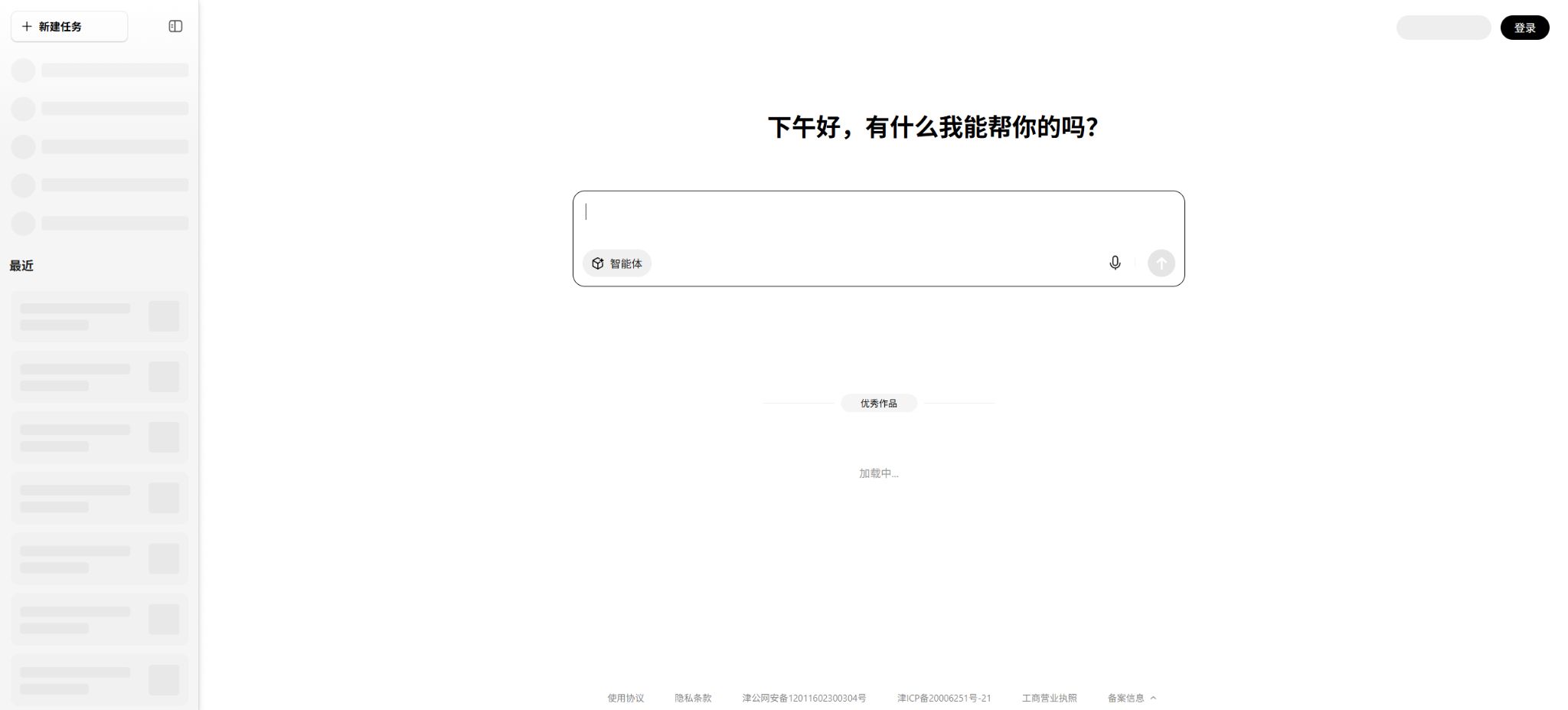
NanAI Search now uses the “NanAI” brand; it is an AI search, content creation, and super-agent platform launched by 360. It has evolved from an initial generative answer engine to a multi-agent task tool: users can not only pose questions over the internet but also assign different expert agents to carry out tasks, utilizing MCP tools, personal knowledge bases, and various large models in order to generate reports, PPTs, images, videos, or digital podcasts.
As of this verification, the official description of this product is “a pioneering multi-agent swarm” capable of generating expert-level videos, reports, and PPTs with just one sentence. The version released in 2026 added features such as super agents, scheduled tasks, nano-level photo editing, nano-level video editing, Digital Human 3.0, video-based PPTs, and a youth mode.
The old name “Nan AI Search” still receives a high number of searches, but the current product is no longer just a search tool.
Core functions
- AI search and answer engine:After searching multiple sources via the internet, an answer is generated directly; it is possible to switch from a concise response to a more in-depth analysis, and outlines or mind maps can be created. When dealing with news, policy, medical, or financial information, it is still necessary to visit the original pages for verification.
- Super Agent:It enables one to understand complex goals, break down tasks, utilize various tools, and consolidate the results – making it suitable for life planning, work research, learning, and content creation. The execution process can be viewed and edited, allowing users to adjust the direction at any stage.
- Multi-agent swarm:Teams are formed from expert Agents from various fields, which carry out automated task division, conduct research in parallel, and integrate the results. This approach is more suitable for complex tasks than using a single model; however, multiple Agents may end up using resources repeatedly or amplify errors among each other.
- Multi-model group chat:According to the official information, it is possible to select members from 16 large-scale models to form a group chat, enabling different models to answer questions, compare results, and work together. The application’s description still lists previous names such as DeepSeek R1/V3, 360 Intelligence Brain, and Tongyi QwQ; the actual models and versions depend on those selected in the current selector.
- MCP Universal Tool Kit:It includes a large number of official MCP tools, and it also allows users to add their own MCP services, enabling the Agent to retrieve data or connect to external capabilities. Third-party MCP services pose risks related to network and data access; therefore, it is necessary to check their origin, permissions, and usage details before installing them.
- Personal knowledge base:After importing PDFs and other documents, it is possible to conduct summaries, extracts, Q&A sessions, and personalized searches; it is suitable for use with learning materials, product manuals, and team knowledge. The processing of scanned images, tables, and very large files may be incomplete.
- Reports and Research:It allows for searching for information related to a specific topic, generating structured analyses and editable reports, and is suitable for use in industry research, competitor analysis, as well as for travel and learning purposes. The citations, figures, and conclusions included in the reports cannot be used as a basis for professional decisions.
- Nano photo editing:Photos can be edited through dialogue; it supports various applications such as portrait photos, conversion of objects into figurines, e-commerce product images, complex Chinese-language posters, comic panels, notebook entries, and GUIs, with the possibility of making adjustments multiple times.
- Nano P Video:It allows for element collaging, partial modifications, style changes, and restoration of damaged video footage; it can also generate motion simulations or photo-dancing content based on reference videos and photos.
- Digital Human 3.0:Use images and voices uploaded by users to create single-person voiceovers, and produce e-commerce promotion or social media videos with different costumes, actions, and settings. To use someone else’s images and voices, explicit permission must be obtained.
- One sentence, a blockbuster:It supports the creation of micro-films with multiple characters and voices, as well as video analyses of news stories and narrative videos. AI can handle the script writing, visual elements, voiceovers, and video synthesis, but human oversight is still required to ensure consistency and accuracy in longer videos.
- AI PPT and video PPT:Enter a topic or upload a file to create presentations in various styles; you can also convert PPTs into videos with narration. It’s possible to quickly draft documents for work reports, teaching materials, research presentations, and marketing analyses.
- Scheduled tasks:After setting a time, the agent is instructed to carry out the plan at that moment; this approach is suitable for gathering information and sending repeated reminders. When it comes to external transmissions, publications, or account operations, human approval is necessary.
What is the difference between nano AI and conventional AI search?
The core of conventional AI search is \"searching and answering questions,\" while nanoAI places more emphasis on \"searching, planning, utilizing tools, generating documents, and carrying out tasks continuously.\" Its distinguishing features include multi-agent swarms, multi-model chat systems, MCP tools, knowledge bases, as well as the creation of images, videos, and digital avatars.
For users who only want to quickly check a fact, these capabilities may seem complicated; for those who need reports, PPTs, or videos as final outputs, the unified workspace helps reduce the need to switch between different tools.
Having multiple models does not automatically mean that the answers will be more accurate. Models may employ different knowledge cutoff dates, networking strategies, and security rules; it is therefore normal for different models to arrive at different conclusions regarding the same question.
The comparison approach is suitable for identifying differences, but ultimately it is necessary to rely on the original data and professional judgment.
Free use, VIP and nano-point prices
| Package or version | Prices, quotas, and core benefits |
|---|---|
| Gear 1 | Monthly VIP subscription: 49 yuan; |
| Gear 2 | 1-month VIP: 59 yuan; |
| Gear 3 | Continuous monthly VIP package: 139 yuan; |
| Gear 4 | 3-month VIP: 168 yuan; |
| Gear 5 | Continuous annual VIP: 499 yuan, promotional annual card: 399 yuan; |
| Gear 6 | 100 nanometers cost 10 yuan, 300 nanometers cost 30 yuan, 1000 nanometers cost 100 yuan, and 5000 nanometers cost 500 yuan. |
Nano AI can be downloaded for free, allowing users to experience basic search functions, dialogue capabilities, and certain creative tools. Advanced agents, image and video generation, digital avatars, watermark-free downloads, or higher usage levels require “Nano” points or a VIP account.
Different tasks, models, levels of clarity, and generation times require varying amounts of resources; moreover, the free quota and any bonuses offered as part of promotions also change.
The main prices currently listed for the App Store in China are:
- Monthly VIP subscription: 49 yuan;
- 1-month VIP: 59 yuan;
- Continuous monthly VIP package: 139 yuan;
- 3-month VIP: 168 yuan;
- Continuous annual VIP: 499 yuan, promotional annual card: 399 yuan;
- 100 nanometers cost 10 yuan, 300 nanometers cost 30 yuan, 1000 nanometers cost 100 yuan, and 5000 nanometers cost 500 yuan.
On the surface, the cost is set at approximately 0.1 yuan per 1 nanometer, but the actual cost of different tasks depends on the pricing rules; it is not possible to estimate the cost of a video or a PPT based solely on the price per nanometer. Whether nanometers are included as a bonus, whether watermarks are removed, as well as options related to fast processing queues and model access, should all be checked on the purchase page.
Subscriptions with a recurring plan are automatically renewed; to cancel them, it is necessary to go through the subscription management section in the Apple account.
Models, MCP, and developer capabilities
NanoAI is a consumer-oriented product; the developers will schedule the use of 360’s own models as well as third-party models based on specific tasks, and users are also allowed to choose models within group chats. The model versions mentioned in the product description may be outdated compared to the latest releases from the respective model manufacturers, so it is not appropriate to describe “integration with DeepSeek” as a fixed version or one that guarantees optimal performance at all times.
The MCP toolkit enables agents to expand their data handling and execution capabilities, but at present, NanoAI does not offer to the public a standard paid inference API similar to those available on general large-model platforms. Developers who wish to use 360 models, search functions, or enterprise agents within their own systems should consult the relevant open platforms or business channels provided by 360 to get further details.
Consumption-side VIPs, nano-points, or custom MCP endpoints cannot be considered as part of the public API quota.
Open-source status
The NanoAI website, mobile apps, multi-agent swarms, search indexes, NanoAI image/video editing tools, and digital human services are proprietary cloud products; no complete source code or model weights are made publicly available by the developers. 360 and its associated teams have other projects related to security, browsers, and AI on GitHub, but these repositories do not indicate that the NanoAI platform is open-source.
Third-party MCPs added by users may be licensed under open-source licenses; it is necessary to examine each project individually. Just because the MCP protocol is open does not mean that the commercial platforms that use it are also open source.
Therefore, the catalog should label nanoAI as “not open source, accessible via third-party MCP tools”.
Supported platforms
NanoAI offers access via Web, Windows, iPhone, iPad, and Android, and it has also been integrated into the AI assistant and reading functions of the 360 Secure Browser. For the Apple version in China, iOS or iPadOS 15.0 or higher is required.
Mac computers with Apple chips can run the corresponding mobile versions, but the App Store indicates that they have not been tested for macOS.
The creation, file management, downloading, and agent functions may vary slightly across different devices.
Tutorial for Using NanoAI Search
Complete a basic task.
- Clarify the issue, time frame, location, source priority, and output format;
- In nanoAI search, upload materials for which you have permission to use or enter search queries;
- First, a framework is established using AI search and answer engines, and then super agents are used to provide additional evidence.
- It is necessary to distinguish between factual information from the source, the author’s opinions, and AI-generated conclusions.
- Check each item for dates, numbers, the original location, and any conflicting evidence;
- The conclusions are manually revised, the verification time is recorded, and then they are published;
Create reusable professional workflows
- Break down complex topics into four categories of questions: background, data, comparison, and conclusions;
- Combining AI search and answer engines, super agents, and multi-agent swarms constitutes fixed research steps;
- Give priority to using the official website, research papers, regulatory documents, and raw data;
- A second person is assigned to review conclusions that are considered high-risk;
- Save queries, evidence, versions, and unresolved issues;
- Re-run after the data changes and update the conclusions;
Which users are it suitable for
- Students and regular users who need to conduct online searches in Chinese, compile information, and create mind maps;
- Professionals in business and operations who need reports, PPTs, research, and comparisons among different models;
- Content creators who produce e-commerce images, posters, photos, and short videos;
- Social media platforms and businesses that need digital voiceovers, short films, or video PPTs;
- Advanced users who wish to use multiple agents, knowledge bases, and MCP to orchestrate complex tasks.
Usage restrictions and safety precautions
- AI search may generate incorrect, outdated, or unsupported content by the original source.
- Professional-looking charts in reports and PPTs can also contain incorrect data;
- Important dates, prices, policies, citations, and financial conclusions should be referred to the original sources;
- Model group chats and swarms only provide different perspectives and do not constitute any guarantee of accuracy.
- Image, video, and digital avatar features involve copyright issues related to portraits, voices, trademarks, music, and other materials;
- It is forbidden to use other people’s photos or voices to create content that is intended for deception, fraud, pornography, or to mislead others.
- Authorization must be obtained before public release, and the AI-generated nature must be indicated as required;
- Teen mode can reduce some risks, but it cannot replace supervision and time management;
- The app’s privacy policy states that it may process phone numbers, browsing history, user identifiers, data related to product interactions, as well as advertising and diagnostic data, and may use identifiers for tracking purposes.
- Before uploading contracts, customer lists, unpublished marketing materials, child-related images, or company documents, it is necessary to remove sensitive information from them first and to verify the data policies in place.
- Recording voice packets requires the use of a microphone and audio data; only one’s own voice or a voice for which permission has been granted should be uploaded.
- Custom MCPs and scheduled agents carry a higher level of risk;
- Minimum permissions, separate test accounts, budget limits, and execution logs should be established; manual confirmation is required for any actions involving deletion, payment, sending messages, posting content, or making changes to the production system.
Frequently Asked Questions
Is nanoAI search free?
The basic functions can be used for free, but advanced tasks such as working with intelligent agents, as well as handling images and videos, are subject to limits related to quotas, VIP status, or Nano points. The monthly VIP subscription costs 49 yuan, while 100 Nano points cost 10 yuan or more.
Can nano AI generate PPTs and videos?
Yes, it can do that. It supports creating PPTs from themes or files, converting presentations into video lectures, and it is also capable of generating micro-movies, digital voiceovers, as well as various other image and video formats.
What is a multi-agent swarm?
It enables agents from various fields to automatically divide tasks, process them in parallel, and combine their efforts to carry out complex tasks; it is suitable for generating reports, planning activities, and creating comprehensive content. The final results still require review by the user.
Which large models are supported by nanoAI?
The officials state that it combines 16 large-scale models and supports group chats; the app’s description lists DeepSeek, 360 Smart Brain, and Tongyi Qianwen, among others. The specific models available may change dynamically, so it is necessary to refer to the current model selector.
Does NanoAI provide APIs?
On the consumer side, it offers features such as search, intelligent agents, a knowledge base, and MCP tool interfaces; the pricing for the standard reasoning API is not publicly available. Companies or developers who wish to integrate these functions must consult 360’s relevant open platform for details.
Is nanoAI open source?
It is not an open-source product. Third-party MCP tools may be open source on their own, but this does not mean that the NanoAI website, apps, search functions, or generation models have their source code and weights made available openly.
Tools similar to nano AI search




 Guigong Network Security Registration No. 45132202000164