






Consensus
Retrieve and synthesize research findings from peer-reviewed papers
Tags:AI search engineWhat is Consensus?
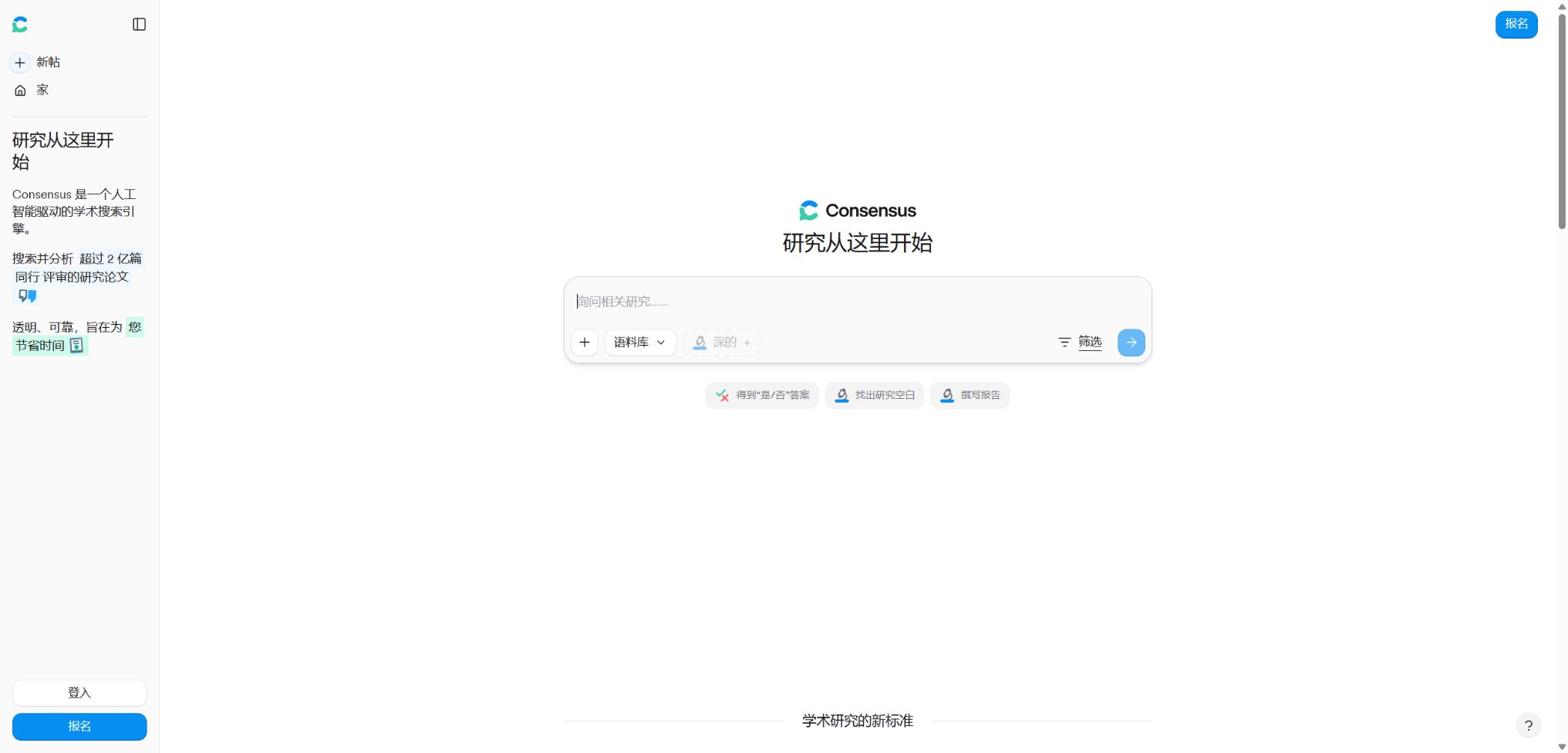
Consensus is an AI-based academic search engine designed for scientific research; it allows users to search through over 220 million papers using natural language or keywords. The system first locates genuine scholarly articles, then rearranges, extracts, and synthesizes the relevant papers, linking the resulting conclusions to the corresponding articles.
It is suitable for quickly understanding the current state of research, identifying key terms, filtering papers, and preparing a preliminary review. Consensus cannot replace a thorough search through databases, reading the full texts of articles, assessing their quality, or following a proper systematic review process.
Main functions of Consensus
- Paper Search combines semantic and keyword-based methods to search for relevant papers;
- Pro Analysis combines up to 20 highly relevant papers from the search results;
- Deep Review allows for the planning of searches and analysis of up to about 50 papers;
- The Research Agent carries out multi-step searches, filtering, and topic organization;
- The Consensus Meter shows the degree of support for a particular issue in the available literature;
- Study Snapshot extracts the research design, sample, methods, and results;
- Ask Paper allows further questions to be posed based on the uploaded or available full text;
- Advanced filtering supports year, type of research, sample, field, and journal quality;
- Library, Collections, Threads, and Zotero facilitate the organization of research;
- The ChatGPT App, Claude MCP, and APIs bring paper searching to other tools.
Paper Search and Pro Analysis
Paper Search provides a quick listing of papers; it does not require the generation of AI-generated summaries, and is suitable for identifying keywords, authors, and research directions. The Pro analysis reorders the 20 most relevant papers to produce comprehensive conclusions along with citations.
The search function supports full questions, phrases, and keywords; it is not necessary to use only academic search expressions. To improve the recall rate, one should try synonyms, abbreviations, as well as different ways of expressing the target population and outcomes.
Deep Review
Deep Review helps to develop search strategies for complex issues, expand key terms, explore citation relationships, and organize the main findings along with evidence from opposing viewpoints. It is capable of analyzing around 50 papers per report, making it suitable for conducting overviews and preliminary research.
It is not a reproducible systematic review, as it is not possible to assume that all databases, grey literature, and studies that were not included have been taken into account. A proper review must still retain the complete search strings, the screening procedures, and the reasons for exclusion.
Research Agent
Research Agent is an upgraded version of Scholar Agent; it allows questions to be broken down into sub-tasks, enables multiple rounds of searching, and automatically applies filters such as year, research type, and journal. It provides more structured research results in both the Pro and Deep search modes.
Consensus Meter
For well-defined research questions related to right and wrong, the Consensus Meter analyzes up to 20 of the most highly ranked papers and assigns a rating of Yes, No, Possibly, or Mixed to each of them. It shows the distribution of conclusions among the selected papers, rather than representing the exact voting results of the entire academic community.
The sample sizes of the studies, the quality of their designs, and the definitions of the outcomes may vary; therefore, percentages should not be interpreted in isolation from the level of evidence provided. Users should examine each study to understand its methods and the population it applies to.
Study Snapshot and Ask Paper
Study Snapshot organizes key elements of a paper such as its methods, sample size, study duration, interventions, and outcomes into structured information. Ask Paper allows questions to be posed regarding the entire text of a paper, helping to identify definitions, results, and limitations.
Automatic extraction may lead to mistakes, with subgroups, correlations, or secondary outcomes being misinterpreted as main conclusions. It is necessary to return to the original text, tables, and supplementary materials before citing a paper.
Filtering, Library, and Zotero
Advanced filtering allows for the narrowing of results based on publication year, research design, studies involving humans or animals, sample size, duration of the study, journal rank, and field of study. Library enables the saving of papers and searching, while Collections allows materials to be organized by project.
Users can import materials using DOI, RIS, BibTeX, and Zotero, and export references or LaTeX files. The management features facilitate organization, but they cannot automatically correct incorrect metadata or missing full texts.
Threads and cross-tool research
Threads preserves the context within the same search, which is useful for gradually narrowing down the scope of the query. Consensus can also serve as a source for the ChatGPT App and Deep Research, as well as a connector for Claude MCP, enabling external AI systems to directly access research indexes.
Comparison of Consensus features
| Functions | Processing range | Main output | Applicable phase |
|---|---|---|---|
| Paper Search | Full database search | List of related papers | Discover literature and keywords |
| Pro analysis | Up to about 20 highly relevant papers | Comprehensive with citations | Quick Evidence Overview |
| Deep Review | Multiple searches, up to about 50 articles | Structured literature review | Range exploration |
| Consensus Meter | Up to 20 relevant papers | Yes, No, Possibly, Mixed | Determine surface consistency |
| Study Snapshot | Single paper | Design, Sample, and Results fields | Preliminary screening |
| Ask Paper | Entire text of a single article or uploaded PDF | Q&A within the text | Speed reading |
Consensus price
Consensus offers versions called Free, Pro, Deep, Teams, and Enterprise. The table below shows the current prices in US dollars as listed on the official website; annual billing involves a one-time payment that results in a lower monthly cost.
| Package | Monthly payment | Annual payment | Main limit |
|---|---|---|---|
| Free | $ | $ | Unlimited Paper Search, 15 Pro messages, 3 Deep Reviews, 10 Snapshots per month |
| Pro | $ | $ | Infinity Pro with Snapshot, 15 Deep Reviews per month |
| Deep | $ | $ | Infinity Pro with Snapshot, 200 Deep Reviews per month |
| Teams | Quotation based on the number of team members | Click on the purchase page | 50 Deep Reviews per user, centralized billing, and account management |
| Enterprise | Custom quote | Contractual agreement | For organizations with 200+ members: batch management, training, and library integration |
Credit limit and plan selection
| Usage requirements | Suggested solution | Reason |
|---|---|---|
| Check papers occasionally | Free | Paper Search offers unlimited access with a limited amount of AI usage. |
| Students and regular research projects | Pro | Pro Comprehensive and Snapshot Unlimited |
| High-frequency reviews and clinical studies | Deep | 200 Deep Reviews per month |
| Laboratory or small department | Teams | Individual login, centralized billing, and management |
| Universities and large institutions | Enterprise | Large-scale seat, training, and library collaboration |
The Deep Review quota is allocated on a monthly basis, and external ChatGPT and Claude connectors are also subject to the same monthly MCP limits. The quota during the testing period may change, so it is necessary to check the current balance in the account.
Consensus usage tutorial
Gain a quick understanding of a research question
- Formulate the question as population, intervention or exposure, control, and outcome;
- First, use Paper Search to look up common terms and representative papers;
- Search separately for synonyms, abbreviations, and opposite hypotheses;
- Filter by year of use, type of study, and population;
- Run Pro Analysis or Consensus Meter to create an overview;
- Open the key papers to check their abstracts, methods, and conclusions;
- Save valuable papers in the project Collection.
Use Deep Review for the preliminary review.
- Define the scope, timeline, design, and exclusion criteria of the study;
- Submit the complete question and check the sub-questions generated by the Agent;
- Check whether any search keywords or filtering criteria have been overlooked;
- Review the key findings, counter-evidence, and research gaps;
- Examine each of the most important papers in detail, along with their full texts;
- Reproducible searches can be added in professional databases;
- Record filtering, quality assessment, and citation before drafting the conclusion.
Compliant citation of Consensus results
- Do not consider AI synthesis itself as an academic source;
- Open the original paper and verify the author, year, journal, and DOI;
- Confirm that the quoted content comes from the main text rather than being inferred by the model;
- Examine the research design, sample, effects, and limitations;
- Priority should be given to citing original studies or authoritative systematic reviews;
- Use RIS, BibTeX, or Zotero to manage references;
- Disclose AI assistance in accordance with school, journal, or institutional policies.
Who is Consensus suitable for?
- Undergraduates and postgraduates: Identifying papers and understanding research designs;
- Researchers: Identify keywords, conduct a literature review, and identify research gaps;
- Clinical staff: Quickly review the existing evidence on a particular issue;
- Teacher: Prepare a list of reading materials for the course along with examples of evidence.
- Policy and Advisory Team: Identifying traceable research evidence;
- R&D and pharmaceutical teams: automated discovery tools and internal research assistants;
- Universities and libraries: they provide access to academic search resources for a large number of users.
The advantages of Consensus
- All AI responses are generated by first searching for genuine papers and then synthesizing the information from them.
- It covers over 220 million research papers and is updated weekly;
- Pro, Deep Review, and Research Agent cover different levels of depth;
- The Consensus Meter visually shows the apparent disagreements in the literature;
- Study Snapshot reduces the time required for designing preliminary studies;
- Advanced filtering, Library, and Zotero support the entire research process;
- It can be connected to ChatGPT, Claude, MCP, and enterprise APIs.
Usage restrictions and precautions
- The database has a wide coverage but does not include all papers, as well as gray literature;
- AI only combines the highly ranked results that are found, which may lead to search biases;
- The Consensus Meter is not a quality-weighted vote across the entire academic community;
- Automatic summaries may confuse relevance, causality, and statistical significance;
- Study Snapshot may extract the wrong subgroups, samples, or outcomes;
- When the full text is not available, the analysis may rely mainly on the title and abstract;
- Medical, legal, and policy decisions cannot rely solely on AI summaries;
- Systematic reviews still require searches across multiple databases, dual screening, and quality assessment.
Data, security, and responsible use
Consensus emphasizes retrieving information first and then synthesizing it, and it uses additional models to check the relevance of the sources to the issues at hand. Even if the citations are genuine, the AI may still provide incorrect interpretations of the papers; therefore, the absence of citation-related illusions does not mean that the conclusions are necessarily correct.
According to the official documentation, the API is used primarily to record anonymized query texts; the data is stored separately from the main database and access to it is restricted. Before uploading unpublished papers, patient information, or trade secrets, it is necessary to check the current contract and institutional policies.
- Do not enter information that can identify patients or subjects in the search box;
- Before uploading a PDF, verify the copyright, confidentiality rules, and permissions regarding sharing.
- All key conclusions are verified against the original text and supplementary materials;
- Distinguish between paper quality, research design, and direction of results;
- Save the search date, filtering criteria, and manually selected records;
- Specify the role of AI in accordance with the requirements of the journal and institution.
API, MCP, GitHub, and open-source information
Consensus offers a Search API designed for organizations and developers, which enables the integration of paper searches, citations, and research data into internal agents, dashboards, and development processes. The ChatGPT App and Claude MCP share the same monthly limit regarding external tools.
The Consensus search index, sorting system, Research Agent, and web-based products are not open-source projects, and their complete model weights are not made public. Numerous GitHub projects with the same name as “AI consensus” have no connection to this academic search product.
Frequently Asked Questions
Is Consensus free?
Free offers unlimited Paper Search, along with 15 Pro messages, 3 Deep Reviews, and 10 Study Snapshots per month.
How much is Consensus Pro?
The cost is $20 per month or $144 per year, which is equivalent to $12 per month; this includes unlimited Pro analysis and Snapshot services, as well as 15 Deep Reviews per month.
Can Consensus replace Google Scholar or PubMed?
It is suitable for natural language discovery and rapid synthesis, but it cannot replace the professional database processes that require reproducible searches, complete coverage, and precise Boolean expressions.
Does Consensus provide APIs?
It allows organizations to integrate paper search and citation functions into their internal tools; it also supports the ChatGPT App and Claude MCP.
Prices and quotas are determined based on the current application and package.
Is Consensus open source?
No, the core search, sorting, and AI research platforms are not open source. GitHub projects with the same name are usually not official Consensus products.
Tools similar to Consensus




 Guigong Network Security Registration No. 45132202000164