






Choosy Chat
Choosy Chat – makes AI conversations more efficient and simpler.
Tags:AI dialogue chatWhat is Choosy Chat?
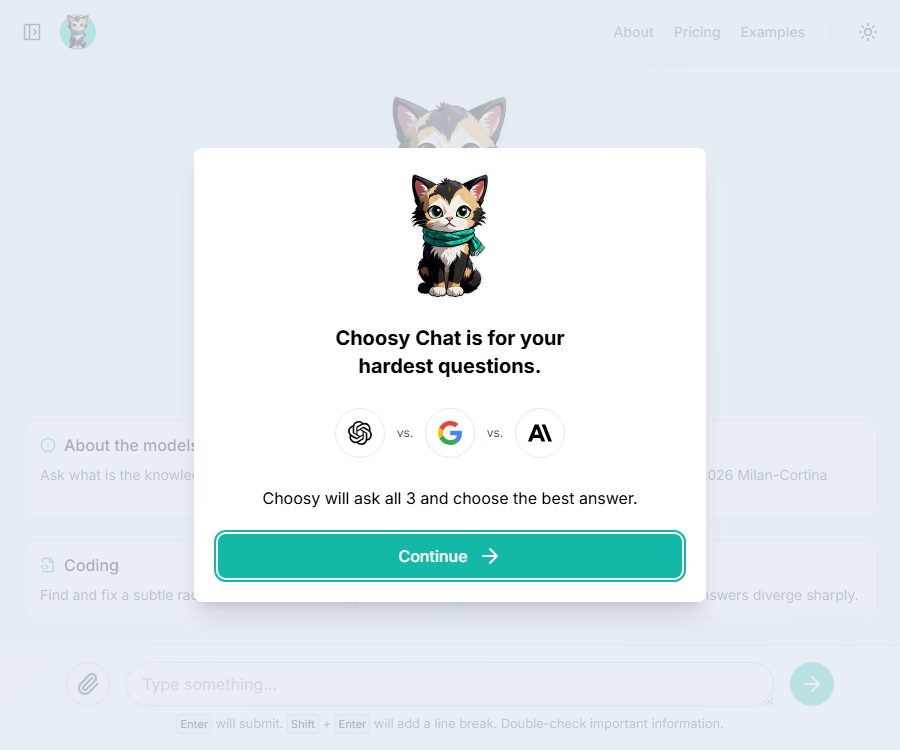
Choosy Chat is a web-based tool for comparing responses from multiple models; it is operated by Gabor Cselle on a personal basis. Users only need to submit a question once, and the platform will then use GPT, Gemini, and Claude to generate responses, which are subsequently evaluated using a proprietary evaluation mechanism.
Its value lies not in simply combining three different chat interfaces, but in allowing comparison of responses generated by the same prompt and within the same context, using different models. On the page, the “Choosy” label indicates the best response, while the “Speedy” label denotes the fastest response.
Main working mechanism
| Phase | System actions | The result shown to the user |
|---|---|---|
| Submit | Receive questions and optional files | A unified input format |
| Parallel invocation | Ask questions to GPT-4o, Claude Sonnet, and Google Gemini | Three separate responses |
| Evaluation | Comparative responses from specialized critics | Best result marker |
| Speed assessment | Compare return speeds | Mark for the fastest result |
| artificial selection | Retain the content of each model for reading. | Users can make their own judgments and are not required to accept the critic’s conclusions. |
\"Best\" and \"fastest\" are two different criteria; a fast response may not be complete, while a detailed response might contain errors. The evaluation made by the critic is also based on the model’s judgments, so it cannot be guaranteed that the choice will always be correct.
Supported models
| Model series | Page name | Current transparency | Precautions |
|---|---|---|---|
| OpenAI | GPT-4o | Provide the series name. | No version date or context quota. |
| Anthropic | Claude Sonnet | Only give the Sonnet name. | No specific generation or snapshot is indicated. |
| Gemini | Only the brand name. | It does not specify Pro, Flash, or the exact version. | |
| Evaluation model | Proprietary critic | Not disclosed | No models, scoring criteria, or confidence levels. |
- The option “Access all models” in the package refers to the ability to use these three models through Choosy Chat; it does not entail obtaining separate memberships or API quotas from each vendor.
- The model providers will keep updating the models; the page does not display a log of model changes, so it is necessary to record the date and the actual interface labels when reproducing the results.
- The About page states that Llama will not be included for the time being, as the product focuses on cutting-edge models that, in their view, have higher performance; no decision has been made regarding whether it will be added in the future.
Three responses along with markers for selecting the best one
- The sharing example shows three model responses for the same question, along with evaluation tags indicating whether the content is brief, detailed, accurate, or inaccurate.
- The Choosy button points to the best result selected by the critic; users can still read the content of other models in order to form their own opinions.
- Speedy merely indicates the fastest response time in a particular call; it does not mean that the information is more accurate, that the reasoning is more sound, or that it is better suited for the task at hand.
- Different models may produce significantly varied results regarding knowledge cutoff, citations, refusals, code style, and risk issues.
- Comparison can reveal differences, but it cannot automatically determine the truth; three models that arrive at the same conclusion may all be relying on incorrect information.
File attachment
- The home page provides the “Attach file” and “Choose File” controls, which allow files to be added to questions; this is suitable for responses that involve comparing different models based on relevant materials.
- The current pricing page categorizes file attachments into Free, Basic, and Pro tiers, but the About page states that only the Pro tier supports attachments; these statements are contradictory to each other.
- The page does not list the file format, maximum size of a single file, number of pages, image recognition capabilities, total storage space, and the number of files that can be attached at each time.
- It is not disclosed whether the files are sent separately to the three model providers, how they are extracted, for how long they are stored, or how they are deleted.
- Before handling contracts, customer data, unpublished research, and internal code, it is necessary to obtain clear instructions regarding data processing.
Suitable types of questions
- Complex knowledge issue: Compare the key points, dates, and uncertainties covered by the three models.
- Code task: Compare implementations, error handling, performance, and readability, then run tests to select the best option.
- Writing and creativity: Access to three structures, tones, and perspectives, allowing for manual combination rather than mechanical adoption of the best options.
- Preparation for academic searches: Compare research topics and keywords, but papers, authors, years, and citations must be verified separately.
- Document understanding: It involves comparing summaries and reasoning based on the same material, provided that the attachment functions and data policies meet the required standards.
- Model selection: Different models are evaluated using a fixed set of problems, but Choosy Chat is not a complete benchmarking platform.
Usage tutorial
- On the home page, enter a well-defined question, specifying the background, objectives, desired output format, and anything that should not be guessed.
- When attachments are required, first test with a small, non-sensitive file to confirm whether the current plan actually supports such attachments and whether the three models can read them.
- After submission, read the full responses from GPT, Gemini, and Claude separately; do not rely only on the Choosy or Speedy labels.
- Break down the conclusions into facts, reasoning, recommendations, and unknown elements, and check where the model is consistent, contradictory, or unable to provide an answer.
- Each model is required to outline the calculation process, assumptions, or evidence available for verification, and key facts are then checked against external authoritative sources.
- Code responses should be tested in an isolated environment, and medical, legal, financial, and security-related issues should be referred to qualified professionals for evaluation.
- When repeated evaluation is required, unified questions and evaluation rules should be saved, along with the date, model label, latency, and manual score.
- Before subscribing, check the remaining quota for this month, the status of any attachments, and the amount due to Stripe; be aware that the number of unused credits will expire at the end of the month.
Free and subscription prices
Choosy Chat charges based on the number of questions; for each question, three models are run simultaneously and evaluated by a critic. There are three subscription tiers available: free, Basic, and Pro, with all prices expressed in dollars.
| Package or version | Price | Billing cycle | Core benefits or quota | Suitable for users |
|---|---|---|---|---|
| Free | 0 dollars | Monthly | All models, Choosy and Speedy, file attachments on the pricing page, 5 questions per month | Experience multi-model comparison |
| Basic | 4.99 dollars | Monthly | All models, Choosy and Speedy, file attachments on the pricing page, 50 questions per month | Low-frequency complex Q&A |
| Pro | 19.99 dollars | Monthly | All models, Choosy and Speedy, file attachments, 200 questions per month | High-frequency comparison and evaluation |
- The allocated amount expires at the end of each month, and any unused portion is not carried over to the following month.
- Stripe handles subscription payments, and the terms specify that no refunds are available for any fees.
- The page does not disclose information on annual billing, team plans, enterprise plans, additional credit limits, premium rates, or pay-as-you-go options.
- Prices may change; before making a purchase, it is necessary to check the taxes, billing cycle, and actual currency on the settlement page.
- There is currently no clear explanation regarding downgrade procedures, the time at which a subscription becomes invalid, reminders for renewal, and how conversations are handled after the account is closed.
How to choose between the free version, Basic, and Pro
| Frequency of use | Suggested gear level | Method of judgment |
|---|---|---|
| Occasional comparison | Free | 5 questions per month are sufficient to identify any differences between the interface and the responses. |
| About ten times a week | Basic | 50 questions suitable for minor research and coding tasks |
| Frequent use on weekdays | Pro | 200 questions enable continuous model comparison |
| Team sharing | It is not clear at the moment. | There are no public seats, collaboration features, administrator rights, or audit capabilities. |
| The quota needs to be retained. | Not suitable | All issues related to the third level that have not been resolved become invalid at the end of the month. |
If the main requirement is merely ordinary chatting, running three models in parallel may result in unnecessary costs and data processing load. Choosy Chat is more suitable for a small number of high-value questions, rather than sending every simple question to all three models.
Operating entity and terms of service
Choosy Chat is operated by Gabor Cselle as a private business; its official address is in San Francisco, California, United States. The terms of service were last updated in May 2024, and they are governed by the laws of California.
- Users are required to provide accurate account information, protect their passwords, and be responsible for their account activities.
- Illicit use, disruption of services, and unauthorized access to the system are prohibited.
- The subscription price can be adjusted; Stripe handles the payments, and no refunds are provided for the fees.
- The service does not guarantee accurate or reliable responses, and it limits liability for indirect losses, data loss, and service interruptions.
- The terms allow the platform to modify the rules and update them via the website; users need to check these updates regularly, rather than relying solely on the version at the time of registration.
Privacy and data security
The terms of service state that use is subject to the privacy policy, but the corresponding link is an empty anchor point; no privacy policy is available for reading. The public page also does not explain how queries, model responses, files, accounts, and shared links are stored and deleted.
- The same issue requires going through the Choosy Chat server and invoking three external models; the specific data paths, locations, and subcontractors are not disclosed.
- It is not specified whether OpenAI, Anthropic, and Google retain the requests, whether they are used to improve the models, or what kind of controls over corporate data are in place.
- The sharing example uses a public link to display user questions and three responses; personal information, company secrets, and confidential materials should be removed before sharing.
- File attachments can increase the extent to which data is exposed, especially hidden metadata, annotations, authors, and revision history within documents.
- There are no public security guidelines regarding account access, data transmission encryption, backup, logging, incident response, and data deletion processes.
- In the absence of a privacy policy, it is not appropriate to upload data related to healthcare, finance, law, customers, employees, or data that is subject to confidentiality agreements.
Accuracy and high-risk use
- The platform examples demonstrate that the model can provide outdated or incorrect answers regarding knowledge cutoffs and current events.
- A critic may prefer answers that are complete or follow a certain style; this does not mean that those answers have been verified item by item for accuracy.
- Issues related to taxation, healthcare, law, and academic citations, even when labeled as optimal, must still be reviewed by authoritative sources or professionals.
- The code must undergo unit testing, security scanning, and license checks; it cannot be simply merged into the production system based on optimal labeling alone.
- When evaluating models, it is necessary to avoid using only platform-specific examples; instead, blind test questions that reflect one’s own business and manual scoring criteria should be employed.
API, SDK, and open-source status
- No public API, SDK, developer documentation, official GitHub repository, or open-source license for Choosy Chat was found.
- The subscription covers only multi-model Q&A on web pages; it does not entail the provision of batch interfaces, embedded components, or rights for commercial use.
- The platform does not make the code used for criticism, the prompts, the evaluation data, or the scoring algorithm available publicly; as a result, the selected best results cannot be reproduced independently.
- There is no official mobile app, desktop client, or browser extension available; it should therefore be considered a web service for now.
Copyright and commercial usage notes
- The public terms do not specify the ownership of intellectual property regarding user inquiries, documents, model responses, and the sharing page.
- The responses from the three models may contain protected expressions, trademarks, code, or fictional citations; rights and factual verification are required prior to any commercial release.
- Accessing models through Choosy Chat does not entail obtaining all commercial licenses or service guarantees from the respective model providers.
- Before uploading third-party files, it is necessary to have the appropriate authorization; when sharing them publicly, it is essential to ensure that no personal information or confidential contractual details are exposed.
Suitable for users
- Product managers, researchers, and developers who need to compare the quality of responses from state-of-the-art models.
- Professional users facing a small number of complex tasks and wishing to reduce manual copying to three different messaging apps.
- Evaluators who need to observe model differences, refusal rates, and knowledge boundaries.
- Creators are hoped to obtain writing or coding solutions from multiple perspectives before making a manual selection.
- It is not suitable for enterprises that require team governance, public APIs, strict privacy compliance, or the ability to process large amounts of transactions in a rolling manner.
Advantages and limitations
| Aspect | Actual judgment |
|---|---|
| Comparative efficiency | When a question receives three responses at once, it reduces the need for replication across different products. |
| Result presentation | Keep all responses, and distinguish between the best and fastest ones. |
| Assessing transparency | The logic behind the critic mechanism is not disclosed, and the optimal labels cannot be reproduced independently. |
| Model information | It covers three models, but the exact versions of Sonnet and Gemini are unknown. |
| Price | The starting price is 4.99 dollars, which is low; however, the credit amount is reset at the end of the month and no refund is provided. |
| file | Attachments are allowed for the interface, but the package specifications are conflicting, and the format, retention settings, and data paths are unclear. |
| Privacy | The lack of a available privacy policy is the main obstacle to the use of sensitive data. |
| Developing openness | No APIs, SDKs, repositories, or open-source critics. |
Summary
Choosy Chat is suitable for submitting a small number of complex questions to GPT, Gemini, and Claude at the same time, allowing one to view the three different approaches on a single page. The Choosy and Speedy tags can reduce the time needed for the initial screening, but the final decision still has to be made by the user.
Its current package is clear in its structure, and it offers 5 free queries per month; however, it is important to be aware of issues such as expired unused quotas, no refund for costs, conflicting instructions regarding attachments, incomplete model versions, and the absence of a privacy policy. It should not be used recklessly for handling sensitive documents, ensuring corporate compliance, or implementing automated integrations.
Tools similar to Choosy Chat




 Guigong Network Security Registration No. 45132202000164