






Chaterimo
Chaterimo: makes AI-driven conversations more efficient and simpler.
Tags:AI dialogue chatWhat is Chaterimo?
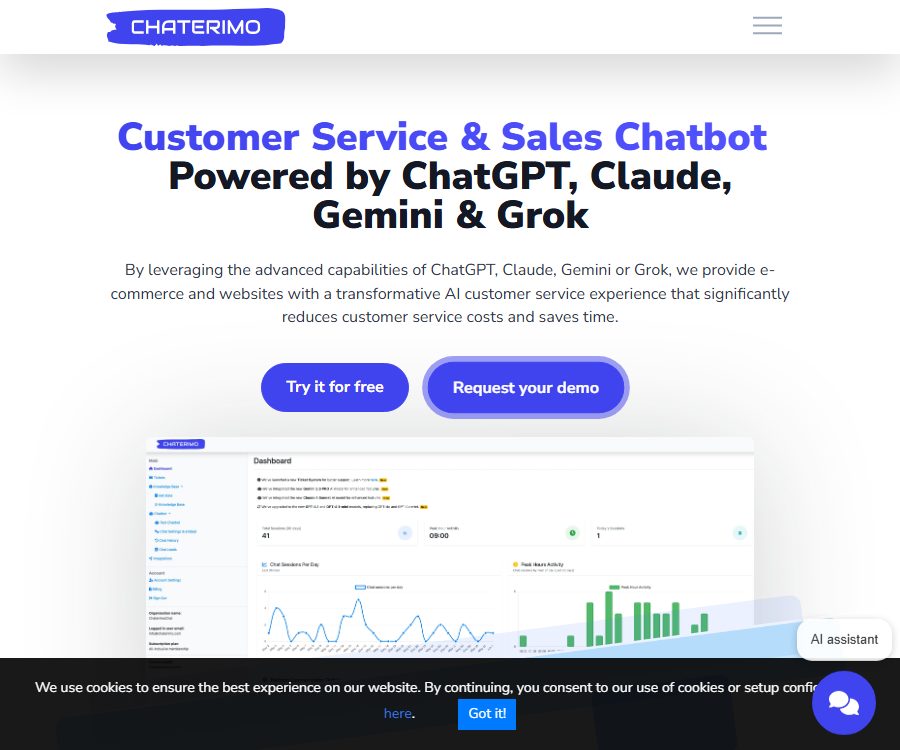
Chaterimo is an AI-based customer service and sales chatbot platform operated by the Czech developer David Langr, intended primarily for e-commerce stores and corporate websites.
It integrates corporate knowledge, product, and order data with GPT, Claude, Gemini, or Grok, enabling visitors to receive automated responses, product recommendations, and assistance regarding order status within the web chat interface.
Main functions
Multi-model customer service and brand roles
- You can choose from the available GPT, Claude, Gemini, and Grok models, and use system prompts to specify the customer service name, tone, response rules, escalation conditions, and sales approach.
- It is possible to set a fixed reply language or to have the system automatically detect the visitor’s language, which is suitable for a store that serves customers in various countries and regions.
- The chat component allows for adjustments to color, position, welcome messages, input prompts, and button text; paid plans enable the creation of multiple components with different appearances and roles.
- The results generated by the model may be inaccurate, incomplete, or not suitable for direct use; therefore, businesses still need to maintain their knowledge bases and review responses with high risk.
Knowledge base and product data training
- You can paste text directly, or extract content from individual web pages, related pages, or site maps to turn common questions, policies, and instructions into searchable material.
- Importing of PDF, Word, Excel, CSV, and plain-text files is supported, with a maximum size of 10MB per file; businesses can also import XML product data.
- After connecting to the e-commerce system, information such as product names, descriptions, prices, and inventory levels can be synchronized, which is used for answering questions about products, as well as for comparing and recommending products.
- Automatic crawling allows for periodic updates of content, but the actual response still depends on the success rate of crawling, the freshness of the data, and the model chosen.
E-commerce customer service and order support
- After being connected to Shopify, Shoptet, WooCommerce, Upgates, Magento, or PrestaShop, the bot can handle common inquiries related to product and order information.
- Visitors can ask about specifications, supply options, delivery timelines, and return procedures; when it comes to order data, businesses should implement necessary identity verification measures and apply the principle of least privilege.
- The system can collect names, email addresses, or phone numbers and create customer service tickets; the team then handles the issues that the robot cannot resolve via email or phone.
- The current service does not involve traditional manual real-time takeover of conversations; customer service agents cannot take over the AI-driven dialogue in the same chat window immediately. This represents an important boundary when evaluating online customer service processes.
Proactive sales and data analysis
- Proactive sales rules can be triggered based on time spent on a page and its location, and they allow for the sending of fixed messages or guidance content generated by AI.
- Each component allows the creation of multiple rules, which can be enabled or disabled separately; the session logic prevents the same prompts from appearing repeatedly during a single access.
- The backend retains conversation history, potential customers, tickets, and chat reports, allowing the team to analyze issue themes, response times, and component performance.
- Sales recommendations and automated call alerts do not constitute a guarantee of a sale; businesses should avoid over-bursting customers with messages and ensure that the promotional claims match the actual conditions of the products.
Input and output
| Type | Acceptable content | Main results | Precautions |
|---|---|---|---|
| Knowledge content | Text, web pages, sitemaps, PDF, Word, Excel, CSV | Searchable customer service knowledge base | A single file should not exceed 10MB. |
| Products and orders | Product catalog, XML product source, e-commerce platform data | Product inquiries, recommendations, order status, and return guidance | It depends on the platform connection and data permissions. |
| Visitor conversation | Natural language questions in web pages or messaging channels | Multilingual AI responses, leads, or tickets | Errors or omissions may occur. |
| Operation instructions | System prompt words, models, temperature, sales trigger rules | Branded customer service behavior and proactive messaging | Changes can immediately affect online components. |
Usage tutorial
- Create an account and an organizational space, and use the free version to test basic Q&A functions; opt for a billing option that provides model keys or a full API set once you need more advanced capabilities.
- Create a new chatbot by entering its name, the brand’s tone, the topics it can answer questions on, the conditions under which it should refuse to answer, and the rules for forwarding requests to other agents; then select an appropriate language model.
- Add corporate text, web pages, and files, or connect to product catalogs; once indexing is complete, test it using actual products as well as issues related to delivery and after-sales service.
- Connect to e-commerce, CRM, email, or messaging platforms, grant only the permissions necessary to complete tasks, and check whether order queries expose personal information.
- Set the appearance of the components, the welcome message, and the rules for proactive sales, and deploy the floating chat window or embedded page on the website.
- Review the conversation history and unresolved tickets, continuously expand knowledge, adjust prompts, and retest incorrect responses.
Platforms and integration
| Platform or method | Uses | Current status |
|---|---|---|
| Web chat component | Access to the corporate website via floating bubbles | Already supported |
| Embedded page | Used for the full customer service page or FAQ page | Already supported |
| Shopify app | Synchronize products and orders and deploy store customer service. | Available now |
| Other e-commerce platforms | Connect to Shoptet, WooCommerce, Upgates, Magento, PrestaShop | According to the specific connection configuration |
| CRM and messaging channels | Integration with Zoho, HubSpot, Pipedrive, Facebook Messenger, and more | Use according to the enabled integrations. |
| Native mobile apps and browser extensions | Independent mobile device or extended management | Not confirmed yet |
Price and quota
The pricing options include a free plan, a plan with lower fees that includes its own model keys, and a all-inclusive plan that provides model calls through Chaterimo. There are differences in the amounts of storage or sales assistant credits displayed on the direct ordering page and on the Shopify channel; the actual amounts shown on the settlement page of the registered account should be taken as the reference.
Built-in model key scheme
| Package or version | Price | Billing cycle | Core benefits or quota | Suitable for users |
|---|---|---|---|---|
| Learner | Free | Monthly | 100 messages, 50,000 characters, Gemini Flash, chat history | Small-scale testing |
| Growth | 9 dollars | Monthly | No limit on AI messages; 5 million characters; 3 components; 2 sales rules | Small shops |
| Evolve | 19 dollars | Monthly | No limit on AI messages; 15 million characters, 10 components, 4 sales rules | Growth-oriented stores |
| Advanced | 24 dollars | Monthly | No limit on AI messages: 50 million characters, 50 components, 6 sales rules | Multi-site team |
| Masterful | 34 dollars | Monthly | No limit on AI messages: 100 million characters, 100 components, 8 sales rules | Large-scale operation |
The “unlimited messages” option with an integrated key scheme means that the Chaterimo platform does not charge based on the number of messages; however, the costs associated with using the models from OpenAI, Anthropic, Google, or xAI still have to be paid by the user to those respective service providers.
All-inclusive API solution
| Package or version | Price | Billing cycle | Core benefits or quota | Suitable for users |
|---|---|---|---|---|
| Growth | 20 dollars | Monthly | 1,000 messages, 5 million characters, 3 components | Small stores that don’t want to configure keys |
| Evolve | 40 dollars | Monthly | 2,000 messages, 15 million characters, 10 components | A customer service team with steady growth |
| Advanced | 50 dollars | Monthly | 4,000 messages, 50 million characters, 50 components | Multi-brand or multi-site teams |
| Masterful | 70 dollars | Monthly | 10,000 messages, 100 million characters, 100 components | Operation with high message volume |
| Enterprise | Contact sales | Customization | The invocation of platforms and models is coordinated uniformly by the service provider. | Customers who require enterprise configuration and support |
The terms state that subscriptions are automatically renewed, and it is possible to cancel them before the next renewal date; once canceled, access remains valid until the end of the current payment period. Any unused portion is generally not refunded on a pro-rata basis, and special refund requests are handled on a case-by-case basis.
Developer APIs and MCP
- The Developer API allows for the creation of separate keys that are used to access account data and to perform automated actions; these keys should be stored in a secure credential management system, rather than being included in public code.
- The native MCP service offers 19 tools; 12 of these are used for reading information related to robots, conversations, products, tickets, leads, and analyses, while 7 allow for modifying prompts, models, languages, the appearance of components, or triggering retraining.
- MCP supports read-only and full permission modes for OAuth connections, and it also allows developers to access via keys; team members should prefer to use read-only permissions.
- The MCP call limit is 5 times per minute and 5 times per day for the free version; 10 times per minute and 100 times per day for the trial version; and 30 times per minute and 1000 times per day for the paid version.
- No public source code repository or open-source license for the product itself has been found; therefore, the MCP interfaces, connectors, and sample functionalities cannot be considered to indicate that the product is open source.
Privacy, security, and data retention
- The platform handles account information, knowledge bases, chat records, leads, tickets, technical logs, as well as the credentials of third-party services to which users connect voluntarily; the merchant is the controller of the data related to end-users, while Chaterimo usually acts as the processor.
- The main hosting and storage take place within the European Economic Area; some service providers may process data outside this area, using the appropriate mechanisms for cross-border data transfer.
- Sensitive credentials are encrypted statically, and encryption is applied during transmission; in addition, organizational-level logical isolation, access control, backup, monitoring, and incident response measures are implemented.
- After the subscription is terminated, service data such as chats, leads, and knowledge base entries are typically removed from the active system within 30 days and from backups within 90 days; billing records may be retained for about 10 years due to tax requirements.
- Businesses should disclose in their privacy policies how data from chat components is processed and obtain the necessary consent; special categories of personal data as defined by GDPR must not be uploaded without written consent.
- The service is not intended for individuals under 16 years of age, and businesses should not use it as a tool for collecting information from children.
Suitable for users and typical use cases
- E-commerce platforms such as Shopify: use product and order data to automatically answer questions regarding specifications, inventory, delivery, and returns.
- Multilingual brands: Enable the same chat component to automatically detect the visitor’s language and respond in accordance with the brand’s rules.
- Small customer service team: Delegate repetitive questions to AI, and handle complex cases through leads and tickets.
- Growth Team: Trigger product recommendations or purchase prompts on pages with high intent, based on the time spent on those pages.
- Operations analysts: Aggregate trends in conversations, tickets, and customer issues through dashboards, Developer API, or read-only MCP.
Advantages and limitations
| Aspect | Actual performance |
|---|---|
| Advantages | Multiple models, BYOK, knowledge base, e-commerce orders, proactive sales, and work orders are all consolidated in one platform. |
| Cost control | You can choose between a model with low platform fees plus additional charges for usage, and a fully bundled message quota. |
| Deployment flexibility | Supports web components, embedded pages, Shopify apps, and various business integrations |
| Boundaries of human collaboration | Tickets can be created, but real-time human assistance via a chat window is not available for now. |
| Response reliability | It is influenced by the quality of knowledge, synchronization status, prompt configuration, and the capabilities of third-party models. |
| Channel differences | The amount limits may vary depending on the purchase channel; it is necessary to check the settlement page before making a purchase. |
Summary
Chaterimo is suitable for teams that wish to set up an e-commerce customer service system quickly using multiple models and enterprise data; it is particularly appropriate for businesses that are willing to adopt the BYOK approach and commit to maintaining their knowledge base.
Before going live officially, it is essential to verify order privacy, error handling, and the ticketing process; moreover, the total cost of using an internal key versus a fully integrated solution should be compared based on the actual volume of messages.
Tools similar to Chaterimo




 Guigong Network Security Registration No. 45132202000164