






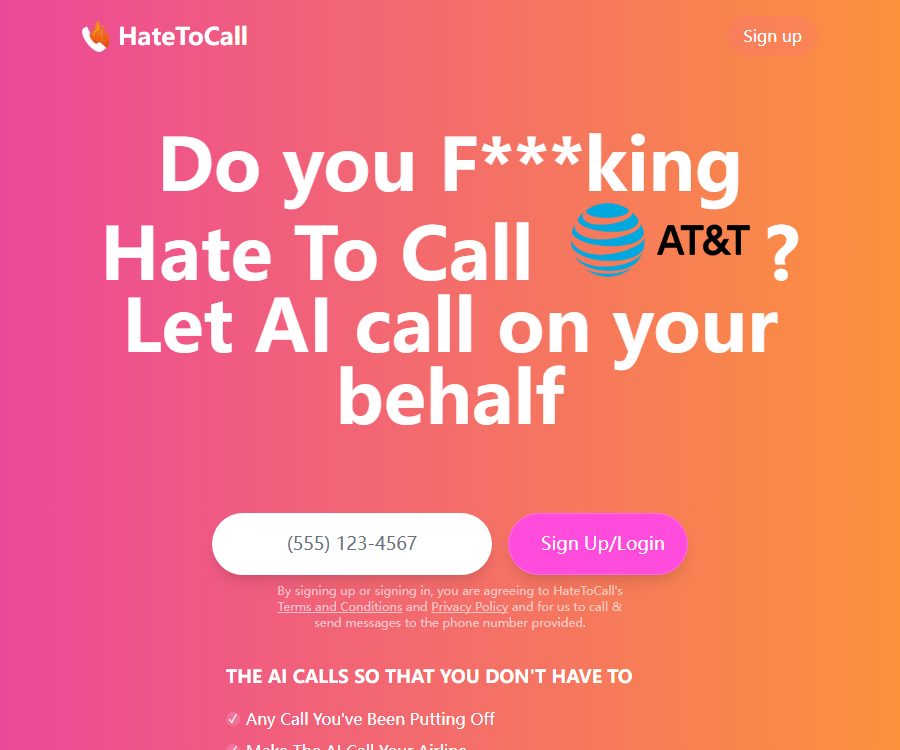
HateToCall.com
HateToCall.com – makes AI-driven conversations more efficient and simpler.
Tags:AI dialogue chatWhat is HateToCall?
HateToCall is an AI-powered call service provided by Mad River LLC, designed to assist users who do not want to wait in long queues or go through repeated transfers when dealing with customer service calls.
After the user enters the phone number and the target, the AI dials the number on behalf of the user; if the other party requests additional information, the system can maintain the call temporarily and call the user back, sending a summary of the results once that is done.
Main functions of HateToCall
1. Initiate a call based on the target.
Users can describe the issue they would like to resolve, such as asking about flights, contacting utility companies, or getting information regarding bills, and then provide the phone number to be dialed. The AI will communicate with the person on the other end regarding the goal in question, but the outcome depends on the validity of the number, the quality of voice recognition, and the degree of cooperation from the other party.
2. Replace user waiting and routing.
The focus of this service is to handle time-consuming tasks such as handling customer queue requests, navigating through menus, and making multiple transfers. It cannot guarantee that a connection will be established, nor can it ensure that customer service representatives will engage in communication through the AI.
3. Call back the user during a conversation
When the recipient requests identification details, confirmation of choices, or information that the AI was not aware of beforehand, the system can maintain the current call and contact the user to obtain such information. Information such as verification codes, passwords, payment details, or complete identity credentials should be disclosed with caution.
4. Summary of the completed call
After a task is completed, AI will send a summary of the call, allowing users to quickly understand the progress made and what steps need to be taken next. This summary may omit details such as dates, amounts, or commitments made by the customer service; important information must be confirmed separately.
Suitable for which scenarios
- Contact the airline to learn about the typical itinerary and the customer service procedures.
- Submit routine inquiries to internet, electricity, or other utility service providers.
- Ask about the items on the bill or try to negotiate the service fees.
- Handle appointments that do not require immediate personal judgment, status inquiries, and basic customer service issues.
- It helps users who suffer from phone anxiety or find it difficult to wait for long periods to conduct low-risk communications.
Which scenarios are not suitable?
- Emergency assistance, medical diagnosis, legal representation, or matters related to personal safety.
- Calls that require the individual to take an oath, provide explicit legal consent, or go through identity verification.
- Bank transfers, securities transactions, insurance claim decisions, and large-value purchases.
- Unauthorized marketing calls, harassment, deception, impersonation, or circumvention of rejection lists.
- In businesses where every word must be recorded accurately and where mistakes can have serious consequences, this is essential.
HateToCall fees
As of August 24, 2026, the official website’s public pages only state that the first AI call is free; they do not provide any information regarding available subscription plans, the price per minute, limits on call duration, or rules for top-ups.
Information regarding whether fees will be charged later, which countries and phone numbers are supported, the cost of SMS messages, and the conditions for refunds can be found on the account page after logging in; the actual payment details shall prevail. Information that is not publicly available should not be referred to as “completely free” as indicated in third-party tool listings.
HateToCall usage guide
- Use your mobile phone number to access the registration or login page, and read the call authorization details, terms of service, and privacy policy.
- Check whether AI-assisted calling is permitted in your area, and determine if it is necessary to obtain the recipient’s consent.
- Enter the full number to be dialed, and check the country code as well as the name of the service provider.
- Describe the goals, acceptable options, and actions that must never be taken in short, clear sentences.
- Keep your phone reachable so that the AI can call back for confirmation when it lacks information.
- After receiving the summary, verify the name, amount, date, order number, and subsequent steps; if necessary, conduct a personal review.
How to write a task description in a more reliable manner
- It defines the boundaries of permissions: for example, only general inquiries are allowed, while changes to accounts are not permitted.
- Write down the goals and priorities; for example, first ask for the reasons, and then explore the available solutions.
- Set a amount limit and a commitment ceiling; any amounts exceeding these limits must be returned to the individual.
- AI is prohibited from providing passwords, verification codes, full identification numbers, and bank card security codes.
- It is required to record the customer service representative’s name, ticket number, key dates, and final conclusion.
Product advantages
- Integrate the dialing target, customer service communication, and result summary into a single process.
- When encountering unknown issues, it is possible to call the user back; there is no need to rely entirely on preset scripts.
- It is suitable for reducing the time costs associated with waiting in lines and repeated transfers.
- The first call can be tried for free, allowing you to test the actual usability first.
Privacy and security considerations
According to the privacy policy, the platform processes email addresses, authentication details, device and usage data, as well as any sensitive information provided by users to carry out telephone tasks. Payment information is handled by payment service providers, while call-related data may also pass through cloud storage services, voice AI technologies, and model providers.
- Submit only the information necessary to complete the task; do not include the full account details in the submission.
- AI must not pretend to be another person or make promises that the user has not authorized.
- The person on the other end of the call may have their own recording policies, identity verification procedures, and automated response systems.
- The platform claims not to sell user data, but still shares information with service providers within the scope necessary to provide its services.
- Deletion requests may be affected by backups, legal obligations, or anti-fraud retention requirements.
Boundaries of law and responsibility
The official terms require users to be responsible for any communications sent by AI on their behalf, and prohibit its use for illegal, fraudulent, harassing, or deceptive purposes. If the consent of the recipient is required, the user remains liable for such actions.
Rules regarding automated outbound calls, disclosure of the identity of robots, recording, and telemarketing vary greatly across different countries and regions. Before using such technologies in business contexts, compliance experts should examine the rules applicable in the target area; ordinary users should also inform the people they are calling about the involvement of AI.
API and open-source status
As of the verification date, the official website did not provide any verifiable public API documentation, developer pricing, or integration guidelines; therefore, HateToCall should not be classified as an open API platform.
At the same time, no official code repository that could prove the open-source nature of its core products was found; therefore, this service should be regarded as a commercial cloud service. The third-party AI phone project has no connection whatsoever with HateToCall.
Frequently Asked Questions
Is HateToCall free?
The official website currently states that the first AI call is free, but it does not disclose the details of subsequent plans or the price per minute. The actual cost must be checked within the account, and it cannot be assumed that all calls will remain free forever.
Can AI handle any calls for me?
No. It is more appropriate to use customer service for general inquiries; high-risk financial matters, medical issues, legal matters, urgent situations, and those that require personal confirmation should not be handled by AI on its own.
What if the other party needs more information?
According to the procedures outlined on the official website, AI can maintain the current call and call back the user to obtain additional information. Users should still refuse to provide passwords, verification codes, or any unnecessary sensitive data.
Who is responsible when AI says something wrong?
The official terms require users to be responsible for the communications they send on their own behalf, and they warn that AI may misinterpret instructions or deliver inaccurate messages. Therefore, the scope of tasks and the limits of authorization must be clearly specified.
Summary
HateToCall is suitable for using AI to handle those customer service calls that involve low risk and require a lot of time; its main features are the ability to make follow-up calls and to generate summaries. Before using it, it is important to check the real-time costs, availability in different regions, the rules regarding consent for calls, and the boundaries regarding sensitive information – important decisions should still be made by humans.
Tools similar to HateToCall.com




 Guigong Network Security Registration No. 45132202000164