






Momntum AI
Momentum AI: an intelligent tool focused on AI-driven conversations
Tags:AI dialogue chatWhat is Momentum AI?
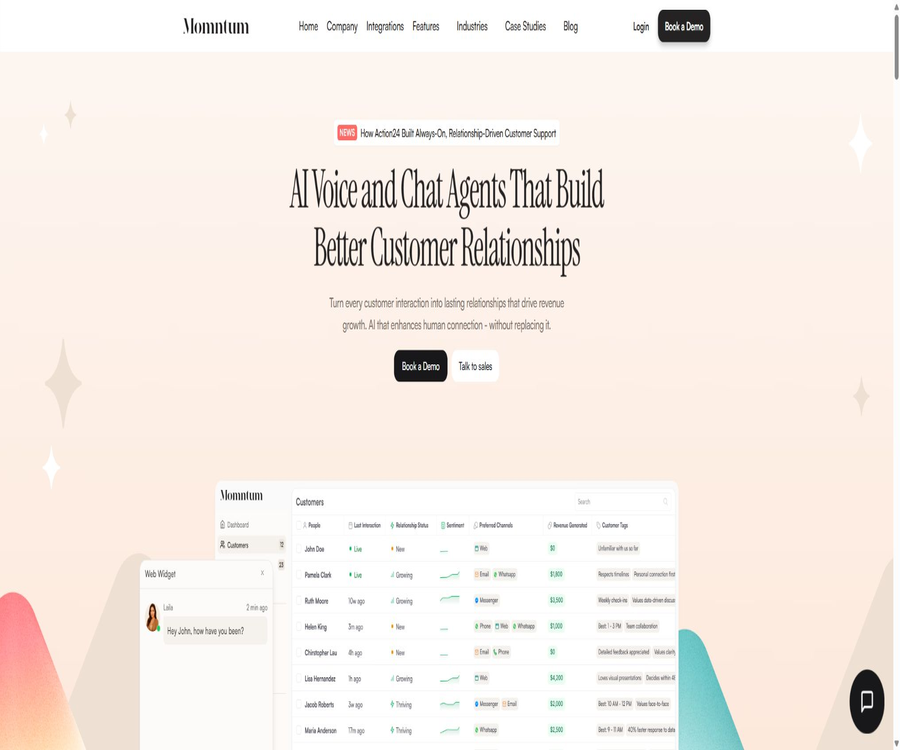
Momntum AI is an enterprise-level customer relationship platform provided by the Irish company Momntum AI Ltd; its core AI agent is named Laila.
It connects voice calls, WhatsApp messages, web chats, emails, and social media messages into a cohesive customer session, which is used for providing answers to inquiries, making appointments, identifying sales opportunities, carrying out proactive follow-ups, and escalating cases to human agents.
This product has no connection with the U.S.-based company of the same name, MomntumAI LLC, nor with its application for reporting urban issues. It should be identified as Momntum AI Ltd, Laila, and a full-channel customer relationship platform.
Main functions
Omni-channel AI voice and chat agents
- Multiple channels for communication: Laila can respond to customers via phone, WhatsApp, web chat, email, Facebook Messenger, and Instagram, among other channels.
- Context continuity: When a customer switches from a web page to phone or WhatsApp, the system carries over their identity, history, intentions, and emotions to the new channel, thereby avoiding the need for repeated explanations.
- Unified inbox: Corporate teams can view conversations and customer profiles from various channels on a single interface, and take over the conversation when AI is unable to handle it.
- Multilingual communication: The product materials claim to support over 700 languages, but the actual performance is affected by dialects, industry-specific terminology, voice quality, and the content of the knowledge base.
- 24/7 concurrent processing: AI is capable of handling a large number of routine inquiries at the same time, but the peak capacity as well as the limitations related to telephone lines and messaging channels need to be specified in the implementation contract.
Booking, sales, and proactive relationship management
- Appointment management: After connecting to a business calendar or appointment system, it is possible to check available slots, make reservations, change dates, confirm appointments, and send reminders.
- Clue extraction: Names, contact information, requirements, and purchase intentions are extracted from the conversations and stored in the company’s CRM or passed on to sales staff for follow-up.
- Proactive outreach: Sending messages based on appointments, reminders, birthdays, service intervals, or unresolved issues; suitable for reminders, follow-ups, and re-marketing.
- Voice to WhatsApp: During a call, it is possible to ask the customer to switch to WhatsApp in order to enter addresses, numbers, photos, or documents; communication can continue via messages even if the connection is lost.
- Cross-channel recovery: The objectives of previous conversations and the information already collected are retained when switching, thereby reducing the need for customers to describe things from scratch or for staff to enter data repeatedly.
Relationship intelligence and human collaboration
- Unified customer profile: Map phone numbers, email addresses, and social media accounts to the same profile, while also recording channel preferences, communication methods, and past interactions.
- Emotion and intent analysis: Identifying dissatisfaction, urgency, purchase signals, and risks; structuring the results and triggering notifications or updates to CRM fields.
- Brand and knowledge management: The implementation team organizes information on services, prices, common questions, procedures, and the appropriate tone of communication into a knowledge base and set of guidelines, ensuring that responses are in line with the company’s rules.
- Manual escalation: When encountering complex, sensitive, urgent issues or those with insufficient confidence levels, the case is forwarded to a staff member along with the context of the conversation to enable further handling.
- Business system actions: Reservations, CRM updates, ticket creation, and follow-up notifications are carried out through customer-specific APIs, Webhooks, and connectors; there are no public self-service developer interfaces available.
Input, processing, and output
| Interaction type | Main inputs | System output | Risks that need to be controlled |
|---|---|---|---|
| Voice call | Voices for incoming or outgoing calls, phone numbers, and call context | Verbal responses, transcriptions, appointments, upgrades, or follow-up messages | Recording consent, identity verification, noise, and emergency situations |
| Text message | WhatsApp, web pages, emails, or social messages | Answers, attachments, forms, reminders, or manual takeover | Channel authorization, cancellation of subscriptions, sending times, and sensitive information |
| Images and documents | Photos, locations, or files uploaded by customers during chats | Information required for business processes or attachments to tickets | Malicious files, privacy, retention period, and access rights |
| Knowledge and customer data | Service details, prices, FAQs, CRM, and past sessions | Personalized responses, fields, signals, and next steps | Content timeliness, minimum permissions, and propagation of erroneous data |
| Business events | Scheduled time, missed calls, recall list, or service nodes | Proactive messages, outbound calls, reminders, and result updates | Legal grounds for marketing, frequency limits, and manual review |
Deployment and usage process
- Schedule a product demonstration, providing details on the industry, number of customers, country, language, distribution channels, existing CRM system, scheduling system, and target business metrics.
- Work with the sales and implementation teams to determine the scenarios that are to be automated, the metrics for measurement, channel costs, service levels, data processing protocols, and the responsibilities related to manual intervention in case of issues.
- The reviewed service descriptions, prices, policies, frequently asked questions, brand tone, and topics that must not be addressed are organized to serve as Laila’s knowledge and guidance settings.
- Connect WhatsApp, phone calls, web components, email, social media channels, as well as CRM or scheduling systems, granting only the permissions necessary to complete the process.
- Design rules for identity verification, sensitive questions, complaints, payments, and escalation in case of medical or security incidents, to determine when the AI must stop providing responses.
- It is run on test numbers and a small group of customers, with individual checks being performed on language quality, accuracy of information, scheduling of actions, CRM synchronization, message unsubscription, and manual intervention.
- After going live, random checks of conversations are carried out to monitor the resolution rate, cases of incorrect appointments, the rate of upgrades, complaints, channel costs, and outdated knowledge; based on these findings, the relevant prompts and procedures are revised.
Price and procurement methods
| Package or version | Price | Billing cycle | Core benefits or quota | Suitable for users |
|---|---|---|---|---|
| Enterprise solutions | Contact sales | Contractual agreement | Configure Laila based on enterprise channels, level of interaction, and scope of integration and implementation. | Organizations that need omnichannel customer service and automation |
| Implementation and integration | Custom quote | As stipulated in the project or contract agreement | Knowledge bases, prompts, APIs, Webhooks, CRM – integration with business systems | Companies with complex data and processes |
| Trial or pilot | Not yet made public | Sales confirmation | The public page only offers options for scheduling demonstrations; no unified rules for free trials are disclosed. | It is hoped to first verify the procurement team for this scenario. |
The product page states that the company will only charge when customers’ questions are answered, but it does not disclose the price per issue resolved, per minute of voice communication, per message, or per seat. Whether there are additional charges for channel fees, numbers, languages, integration, manual implementation, and minimum commitment periods should be confirmed item by item in the quote.
The terms of service state that subscriptions are automatically renewed, and cancellation takes effect at the end of the current payment period; the general terms do not specify a deadline for refunds. Rules regarding payments, settlement in euros, early termination of the contract, and data transfer are subject to the terms of the order contract.
Platforms, integration, and open-source boundaries
| Project | Current situation | Explanation |
|---|---|---|
| Customer touchpoints | Websites, WhatsApp, phone calls, emails, and social media channels | The actual scope of activation depends on the corporate account and the regional channel policies. |
| CRM and business systems | Custom connections are supported. | Examples of materials for open recruitment include Zoho, Keyloop, HubSpot, and Freshdesk. |
| API and Webhook | Used for customer implementation | No public self-service API documentation, SDKs, pricing information, or developer accounts were found. |
| Management interface | Web platform | Used for a unified inbox, customer history, configurations, and manual intervention. |
| Mobile apps | The current status has not been confirmed yet. | The legal text from 2024 mentions the Laila app, but it does not confirm its presence on the current official store page. |
| Open-source product | No | RLM, Laila, and the hosting platform are proprietary products; no official open-source repositories or licenses have been found. |
Suitable for users and scenarios
- Clinics and health service agencies: they handle appointments, reminders, common questions, and follow-up visits after treatments, but medical decisions must be made by qualified professionals.
- Car dealership and service centers: Send recall notices in bulk, address procedural questions, confirm customers’ intentions, and schedule repairs.
- Home and on-site service companies: they receive inquiries, collect addresses and information about faults, arrange home visits for services, and handle missed calls.
- Hotel and hospitality industry: Provide multilingual support for answering questions related to bookings and arrivals, as well as forwarding complex requests to staff.
- Contact Center: Delegate routine conversations to AI, unify historical data across various channels, and allow the human team to focus on handling high-risk and high-value issues.
- Sales and Customer Success Teams: Capture leads, identify emotional states and purchase signals, and carry out proactive follow-ups based on the customer’s journey.
Privacy, Security, and Compliance
- The platform handles names, email addresses, phone numbers, authentication information, devices, networks, locations, usage patterns, customer conversations, as well as business data related to companies.
- The privacy policy states that AI inputs, outputs, and personal data are processed by third-party AI service providers, with OpenAI being specifically mentioned; companies should request a list of the current processors as well as the data processing agreements.
- Personal information is usually retained until the business objectives are achieved or until the account ceases to exist, after which it is deleted or anonymized; backup data may remain in an isolated state pending deletion.
- The legal page states that sensitive personal information is not processed, but the industry pages in question relate to areas such as healthcare, security, and customer relations; there may therefore be differences in the scope of handling such data. Purchasers should request a written confirmation regarding the actual boundaries of data processing.
- The Trust Center is now available, but the public page does not display the full list of certificates and details related to controls. Evidence regarding SOC 2, ISO 27001, HIPAA, the locations where data is stored, encryption methods, backup procedures, and incident response plans can be provided upon request.
- The service is intended for users who are at least 18 years old; when companies provide services to minors, they need additional consent from a guardian, as well as mechanisms for minimizing data processing and implementing upgrades.
- The customer retains ownership of the content they contribute, but must possess the copyrights, rights related to portraits, privacy rights, and any other necessary permissions; separate terms apply regarding the intellectual property rights of feedback and suggestions.
Advantages and limitations
- Maintaining context across voice, chat, and social channels reduces the need for customers to repeat information and helps agents take over more quickly.
- It can not only answer questions but also handle reservations, CRM updates, outbound calls, and proactive follow-ups, making it suitable for end-to-end business processes.
- Performance and price depend heavily on the way in which sales are carried out; there are no publicly available packages, quotas, or standard integration lists, which makes it difficult to compare costs when making purchases.
- The Privacy Policy and Terms of Service were last updated in 2024, prior to the official launch of the Momntum brand in 2025; as a result, some descriptions of applications and products may be outdated.
- AI may make mistakes in assessing emotions, identities, medical or security contexts; therefore, high-risk actions require human verification, defined permission boundaries, and audit records.
- The coverage of over 700 languages is indicated by the product’s capabilities, but it does not mean that the same quality is achieved for every language, dialect, or specialized field; real samples must be used for testing before deployment.
Summary
Momentum AI is suitable for companies that wish to integrate phone calls, WhatsApp, websites, emails, and social media customer service, and to have AI handle tasks such as scheduling appointments, managing leads, and carrying out follow-ups.
The focus of procurement should be on actual channels and integration, consistency in data presentation, manual upgrades, handling of sensitive data, contract prices, and verifiable security controls, rather than merely focusing on the automated features shown in demonstrations.
Tools similar to Momentum AI




 Guigong Network Security Registration No. 45132202000164