






HoldForMe
HoldForMe: an intelligent tool focused on AI-driven conversations
Tags:AI dialogue chatA one-sentence summary
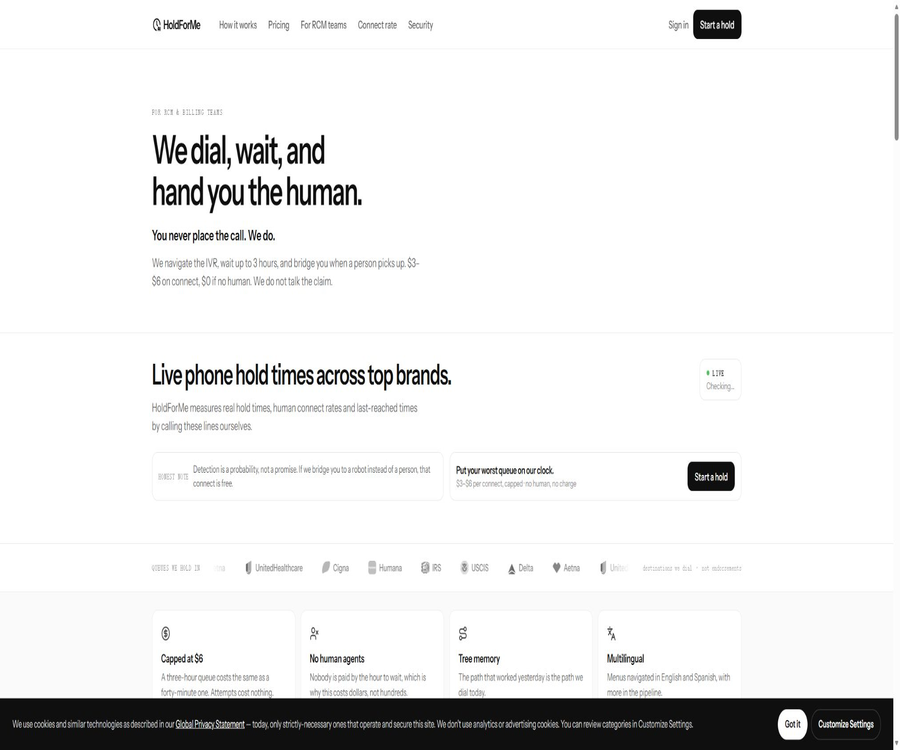
HoldForMe is an AI-based phone queueing service; the automated assistant Reevo dials the numbers on behalf of the user, navigates through the voice menu, and waits for a human agent to be available. Once a human agent is found, the service calls back the user and connects them with the agent.
Tool Introduction
HoldForMe is designed for individuals and business teams who are slowed down by long waiting times in phone queues; it focuses particularly on medical billing, revenue cycle management, taxation, legal matters, banking operations, and insurance services. It handles only the repetitive tasks that need to be carried out before a human agent can get involved, and it does not assist users with discussions regarding claims, complaints, authorizations, bills, or other substantive issues.
The current product is in its early operational and pilot phase; the website is currently recruiting the first team of medical billing specialists. Some tables related to call connection rates are still under evaluation, and the feature related to priority call connections is also marked as part of the pilot program. Users should consider the features that are currently available as an indication of what’s possible, and they should verify the target numbers, regions, available times, and actual call connection rates before making large-scale purchases.
Main functions
Automatic dialing
The user selects an organization from the directory or enters the target number; Reevo then initiates the outbound call from the platform, without requiring the user to make the call themselves. The enterprise version allows the use of outbound phone numbers registered to the organization, which facilitates identification and auditing by the recipient party.
Voice menu navigation
The system can recognize keypress sounds and voice-based menus, and select the path leading to the desired department or to a human customer service representative. For routes that have successfully led to a human agent in the past, the system will prioritize using those routes again and will relearn them once the menu changes.
IVR path memory
When the same organization calls the same insurance company, government agency, or service department repeatedly, the platform saves the valid menu paths to avoid having to search from scratch each time. Caching these paths improves the efficiency of repeated tasks, but changes in the structure of those services, alterations in authentication procedures, or temporary announcements can still render the old paths invalid.
Maximum wait time: 3 hours
Reevo can wait in the queue for up to 3 hours; users can view the timer or close the webpage and continue working. The cost does not increase after 40 minutes, but the platform will continue to wait until the maximum time limit is reached.
Multiple concurrent waits
The business team can place the phone calls from multiple different institutions or payers in a queue at the same time, thereby reducing the need for employees to wait one after another. The actual level of concurrency depends on the account, plan, and available capacity; it cannot be assumed that self-service wallets have the same priority as enterprise solutions.
Live detection
The system uses sound to determine whether there is a human on the other end of the line; once this is confirmed, it immediately dials the user’s callback number. This detection is based on probability, and realistic automated greetings might be mistaken for those made by a human, so the platform does not guarantee success in every attempt.
Call back and phone bridging
Once a real person is detected, the platform asks the customer service representative to wait online while simultaneously calling the user’s phone number; once the user answers, the call is connected to the conversation. A successful connection as per the standard billing rules is only considered to have been established once it is confirmed that it is indeed a real person and the connection lasts for at least 15 seconds.
Wrong connection is free of charge
Voice mail messages, notifications indicating that the employee is no longer at work, dead-end menus, errors in detecting whether it is a real person speaking, interruptions in the connection, or situations where the user does not return the call – all of these should be counted as $0. In case of an accidental charge due to an error, the product instructions will be invalidated automatically, the corresponding amount will be refunded, and the reason for it will be recorded in the logs.
Menus in English and Spanish
Currently, it is possible to navigate through menus in English and Spanish; other languages are still under development. This refers to the language used for automatic menu navigation, and it does not mean translation of live conversations once a connection is established, nor does it imply that Reevo will speak in Spanish on behalf of the user to discuss specific matters.
Call status and queue events
Users can view statuses such as queuing, dialing, navigation, waiting, live verification, callback, and results; relevant information is also displayed when indicating the position in the queue. Not all agencies provide information on the queue position, so some calls only show the waiting time.
Individual audit logs
Each call is logged with information on the caller, phone number, time, menu path, detection process, result, and billing details. All plans include daily logs, and the enterprise plans also offer the option to export usage data, which is useful for checking bills and ensuring compliance.
Real-time latency directory
The platform determines the average waiting time, the rate of successful connections by human operators, and the time it takes to establish a connection for a given line, based on its own tests and actual call statistics. On the initial pages, some of these metrics are not yet filled in; therefore, users should consider the number of samples for that particular line as well as the date of the last update, rather than relying solely on the brand name.
Automatic top-up
When the balance in the self-service wallet falls below $6, it can be automatically topped up by an amount chosen by the user, thereby preventing new requests from being interrupted due to insufficient funds. Users can set a monthly limit, and a receipt is generated for each top-up.
Enterprise reserved capacity
The monthly medical billing plan offers reserved concurrency and a priority queue for payments, so there is no need to share the same capacity as regular self-service traffic. This priority only affects the internal processing order within HoldForMe; it does not mean that one can cut in front of the official phone queues of the target institutions.
Give priority to connecting the pilot projects.
The pilot feature maintains pre-allocated call slots for the commercial insurance routes that the team handles most frequently, with the aim of reducing the time it takes to get a human agent on the line for the next request. It is intended for use only with commercial payers, not with public agencies such as tax authorities; the price still needs to be determined in consultation with the pilot team.
Clarify what will not be done.
| Matters | Whether HoldForMe is executed | Explanation |
|---|---|---|
| Dial the target number | Yes | Initiate outbound calls from the platform side |
| Navigation phone menu | Yes | Use keyboard and voice paths |
| Waiting in the queue | Yes | Up to 3 hours |
| Test artificial customer service | Yes | It is a matter of probabilistic judgment, and errors may occur. |
| Route back and bridge users | Yes | Once the user picks up the call, a live conversation begins. |
| Indicates the identity of the automated assistant | Yes | Reevo will reveal its identity and the purpose of the call. |
| Negotiations, arguments, or complaints | No | The actual communication is still carried out by the users. |
| Make medical or financial decisions | No | It does not mean that the user decides on any matters. |
| Promise to establish a connection. | No | Disconnections, callback-based lines, and menu changes may fail. |
| Continue to act as a messenger after connecting. | No | It is not retained in the actual conversation after bridging. |
Complete workflow
| Phase | System actions | Users need to get ready. | Possible points of failure |
|---|---|---|---|
| Create request | Select the target number or directory to receive calls from. | Correct agency, department, and business hours | Incorrect number or department not supported. |
| Authentication information | Use the reference number explicitly entered by the user. | Only the minimum identification required by the menu is provided. | Incorrect format or the other party requires additional identity verification. |
| Dialing | Make a call using the organization’s registration number. | Confirm that the target allows automatic calls from assistants. | Line rejection or regional restrictions |
| Menu navigation | Replay known route or re-identify | Target department and menu intent | Menu changes, verification codes, or complex voices |
| Wait | The queue can remain active for up to 3 hours. | Keep the callback number accessible. | Hard disconnect, callback queue, or timeout |
| Live detection | Determine whether it is answered by a real person. | Allow the platform to call back immediately. | Automatic greetings are misidentified as being from real people. |
| Bridging | Have the customer service wait and connect to the user. | Answer the call promptly and maintain the connection for at least 15 seconds. | The user missed the call or there were issues with the telecommunications network. |
| Dialogue | Exit the substantive conversation | Users handle the transactions themselves. | Incomplete materials or no authorization. |
| Settlement | The wallet balance is deducted based on the duration of a successful connection. | Check the receipts against the logs. | Incorrect results require appeal or automatic correction. |
Basic usage tutorial
- Confirm that the service is available in the respective regions and on the target routes, and be aware that it is still in the early pilot phase.
- To create an account, first use the first free call to test a non-urgent number with a long waiting time.
- Select an organization from the directory or enter a number, and specify the department you need to reach.
- Only fill in the menu and the reference number that is truly necessary before contacting customer service; do not upload the complete medical records or any unrelated information.
- Set your own call-back number, make sure your phone is not on silent mode, do not block unknown numbers, and avoid using overly strict spam prevention settings.
- After submitting the request, observe the dialing process, menu navigation, and waiting status; you can also close the webpage and continue working.
- Answer the call from Reevo as soon as possible to confirm that it is connected to a live person, rather than to a voicemail or an automated menu.
- Handle claims, bills, tax matters, or other substantive issues directly with customer service, and record the necessary outcomes.
- After the call, check whether the log, waiting time, result label, and charge amount are consistent.
- After confirming the success rate of the target route and the actual time saved, then top up the wallet or evaluate the team’s proposal.
Pay-per-use pricing rules
All plans use the same pricing mechanism based on successful connections; the differences lie mainly in the methods of topping up the wallet, the free credits provided, as well as the corporate features and capacity. The price ranges from $3 to $6, with no charge per seat, and there is no upper limit even if the waiting time reaches three hours.
| Waiting and results | Calculation method | Final cost | Explanation |
|---|---|---|---|
| Connection within the first 10 minutes | Minimum price | 3 dollars | Cover the first 10 minutes |
| 10 minutes later | $ | 3 to 6 dollars | It starts to increase from minute 11. |
| Connected in 27 minutes and 14 seconds. | $ | Example: 4.72 dollars | The receipts should list each item individually. |
| About 40 minutes or more | Reaching the hard upper limit | 6 dollars | Continue waiting without any further price increases |
| Connection will be established within 3 hours at the latest. | Still subject to the upper limit. | 6 dollars | If the platform continues to maintain the connection |
| There are no real people. | No charge | $ | Including line disconnections, dead ends, and shutdown messages |
| Error detection indicates a real person. | Automatically void or reverse. | $ | The log should indicate the reason for the failure. |
| The user did not return the call. | It does not constitute a successful bridge. | $ | The request needs to be created again. |
What constitutes a successful connection?
For billing purposes, it is necessary to confirm that it is a real person and to keep the user on the line for at least 15 seconds. Robots, voice mail messages, messages indicating that business hours have ended, or situations where the user does not answer the call should not be considered as successful connections.
The first call is free.
New users can currently enjoy one free call; there is no need to add a bank card or to speak with a sales representative first. To obtain meaningful test results, it is advisable to choose numbers for which a long wait time is usual, but that do not involve urgent or high-risk situations.
Wallets, monthly commitments, and enterprise solutions
| Plan | Price or top-up | Limits and billing | Core rights and interests | Suitable for users |
|---|---|---|---|---|
| First-time experience | $ | A successful connection once | No bank card is required; the target route can be verified. | First-time user |
| Self-service wallet | The minimum deposit is $15. | $ | No seat fee, no minimum monthly spending required | Individuals and users of low-frequency services |
| RCM Monthly Commitment | $ | The account has been granted a service credit of 345 dollars. | 15% discount, BAA, retention rules, audit export, and priority capacity | Medical Billing and Revenue Cycle Team |
| Group and multiple locations | Custom quote | 20% bonus on top-ups or bulk pricing | Independent numbers, SSO, mandatory MFA, consolidated billing and reporting | Multiple agencies and large organizations |
| Connect with priority | Pilot pricing | Commercial payer warm-up line | Affordable monthly add-ons, not intended for public institutions | Teams that make frequent calls to fixed payees |
Self-service wallet
The minimum amount to top up the wallet is $15, and this amount is usually sufficient for 3 to 5 calls; the first call is free, and subsequent calls can only be made after a top-up is made. There are no fees for using specific services or any fixed monthly charges, making it suitable for users who need to contact agencies related to taxation, immigration, insurance, aviation, and public services from time to time.
RCM Monthly Commitment
By committing to $300 per month, one receives a service quota of $345; this amount is sufficient for approximately 75 to 110 calls, with an average cost of around $3.91 per call. The package also includes a BAA, the ability to configure PHI retention, caching of payer information, daily logging, export of usage data, and reserved capacity.
Group and multiple locations
Multi-location businesses can use a single contract and shared balance, while each location can have its own outbound phone numbers. The solution offers a 20% discount on top-ups, bulk pricing options, SSO or SAML integration, mandatory MFA, combined billing, and priority access to resources; for specific prices, please contact the team.
Free gift with top-up
| Payment amount | Available balance for fund receipt services | Gift ratio | It can roughly cover the number of connections. |
|---|---|---|---|
| 15 dollars | 15 dollars | 0% | About 3 to 5 times |
| 50 dollars | 52.50 dollars | 5% | About 8 to 17 times |
| 100 dollars | 110 dollars | 10% | About 18 to 36 times |
| 300 dollars | 345 dollars | 15% | Approximately 58 to 115 times |
| 500 dollars | 600 dollars | 20% | About 100 to 200 times |
The number of calls covered is estimated to range from 3 to 6 dollars per call, and this does not represent a fixed number of calls that can be made. The shorter the waiting time before a connection is established, the closer the average charge will be to 3 dollars; if the waiting time reaches 40 minutes or more, the charge will be 6 dollars.
Integration deadline and refund
The credit available in the wallet service constitutes non-transferable service points, not cash; it also has a specific expiration date. The current public page does not indicate the exact deadline, only stating that it will be specified in the terms and conditions, so it is necessary to check the date on the settlement page before making a top-up.
The page also states that service points cannot be refunded to the bank card, and this does not conflict with automatic correction of incorrect charges: the former prevents users from voluntarily returning unused credits, while the latter corrects any balance that should not be charged. It is necessary to keep track of the expiration dates and refund conditions before making large deposits.
Which users are it suitable for
- Medical billing and revenue cycle team: Monitors denial cases, status of appeals, and progress of preauthorizations.
- Tax consultants and accounting firms: Contact the dedicated lines for tax authority staff or the local tax authorities.
- Immigration and other law firms: Waiting for immigration authorities, court clerks, and record offices.
- Loan and banking operations team: responsible for verification, settlement, as well as the departments related to card management and service upgrades.
- Insurance agents and brokers: Handle policy forms, certificates, underwriting, and claims processing.
- Individuals who frequently contact customer service teams for airlines, public utilities, and insurance.
- There are lines with duplicate payers, as well as business teams that wish to have their requests queued in parallel.
- Organizations that require audit logs, BAA, SSO, and centralized billing for compliance purposes.
Typical use cases
- Medical billers wait simultaneously for the rejection or appeal status updates from multiple payers.
- The clinic tracks pre-authorizations, but reserves clinical discussions for employees with the appropriate permissions.
- Tax consultants can contact the tax authorities’ dedicated lines during the filing season, avoiding delays caused by waiting for human assistance.
- Immigration attorney assistants wait for an update on the case status or for a live representative at the office to pick up the call.
- Loan officers contact the settlement and identity verification departments to resolve the problematic documents.
- Insurance brokers handle policies and certificates among various underwriting agencies.
- Individuals occasionally get in touch with airlines, insurance companies, or customer service agencies for public utilities.
- The team compares the actual connection performance of different institutions and time periods through logs.
Medical bills and HIPAA scenarios
HoldForMe focuses on minimizing medical information; to initiate a wait, only the target number, reference number, and any identification details required by the other party before the call is connected are needed, rather than complete medical records, diagnoses, or clinical data. Even so, the reference number, the institution, the time of the call, and the outcome can still be considered protected information.
| Control | Self-service wallet | RCM Monthly Commitment | Group solution |
|---|---|---|---|
| Individual audit logs | Yes | It exists and can be derived. | Reports are provided in a consolidated format. |
| Default setting for recordings | Off by default | It can be configured by organization. | It can be configured according to the contract. |
| BAA | Not included | Signable | Confirmed per contract |
| Metadata retention | By account settings | Optional: 7, 30, or 90 days | Configure according to the contract |
| SSO or SAML | Not listed | Certain corporate capabilities | Provide |
| MFA enforcement | Not listed | Confirmation is required. | Provide |
| Reserved capacity | Standard capacity | Paid priority lane | Priority capacity |
BAA does not equate to automatic compliance.
Medical teams must sign the appropriate Business Associate Agreement before engaging in any business calls that involve access to protected health information, and they must ensure that the protocols, sub-processors, and retention settings are suitable for the actual purposes at hand. Just seeing a BAA mentioned on a page does not mean that self-service wallets or all calls are automatically in compliance with HIPAA.
Metadata retention
Under the regulated schemes, it is possible to store call metadata for 7, 30, or 90 days, with immediate deletion available upon request. Companies must also address any conflicts between audit requirements, billing disputes, and legal retention obligations, in order to avoid deleting business records that are required by law to be kept.
Recording and transcription
The privacy policy states that Reevo will indicate that it is an automated assistant on the recording line; when it is clear from the call process that recording is taking place, the platform may collect the recordings and their transcriptions for users to review and to improve the quality of calls. The default setting of disabling recordings does not conflict with the possibility of enabling them in certain processes, as this depends on the account and organization settings.
Different states, countries, and the organizations being contacted have varying requirements regarding automated calls, consent for recording, disclosure of identity, and the handling of sensitive information. Users should not rely solely on the suggestions provided by the platform; instead, they must consult their own legal or compliance officers to determine which numbers can be used, what methods of communication are allowed, and for how long such information should be stored.
Privacy and data processing
Account registration requires the collection of name and email address; when a request is submitted, the target number, callback number, menu path, time, queue events, results, as well as the authentication identifier provided by the user are collected. The server also records the IP address and browser identifier for security and operational purposes.
| Data category | Current disclosures | Primary uses | Control recommendations |
|---|---|---|---|
| Waiting list | Email address submitted by the user | Enable notifications | Apply for deletion when it is no longer needed. |
| Account | Name and email address | Login, notifications, and management | Use organizational identities and review them regularly. |
| Phone number | Target number and callback number | Dialing and bridging | Avoid using unauthorized numbers. |
| Call metadata | Path, time, queue events, and results | Services, troubleshooting, auditing, and billing | Set retention periods of 7, 30, or 90 days, etc. |
| Authentication identifier | The reference number explicitly entered by the user | By accessing the previous menu | Only the minimum necessary fields are provided. |
| Recording and transcription | Collected during the process of disclosing the recordings | Reviewing and improving quality | It is disabled by default; enable it according to the organization’s requirements. |
| Server logs | IP and browser identifiers | Safety and operations | Understand cross-border processing and retention |
| Third-party processing | Telecom, voice, AI, identity, and email service providers | Complete calls and account services | Request the latest list of sub-processors |
Not for use in advertising or sales
The platform states that it does not sell personal information nor shares data for targeted advertising across different contexts; the website currently does not use analysis or advertising cookies. Essential cookies are used for security purposes, and local storage is used only to remember the user’s own preferences.
Third-party model training
The product’s safety guidelines state that the collected data will not be sold, shared, or used to train third-party models. The privacy policy also specifies that the AI inference providers will process the data to support Reevo’s call inference functions; companies should ensure that such processing is subject to appropriate retention measures, isolation protocols, and contractual restrictions.
International data transmission
HoldForMe operates in the United States; the data of users located outside the country is transmitted to the U.S. for processing, and safeguards are put in place through agreements with service providers. Companies based in the European Union, the UK, or other regions need to determine the applicable cross-border mechanisms as well as any local industry regulations.
Data rights
Users who meet the criteria can request access to, correction of, deletion of, restriction on processing, a portable copy of their data, or express objections; the platform may verify their identity before carrying out such requests. The specific retention periods and a list of sub-processors can be obtained from the privacy team.
Safety control
- All solutions offer transmission protection, static encryption, and detailed audit logs.
- Call recording is disabled by default; organizations can choose to enable it in accordance with their plans and business processes.
- Under the regulated scheme, a BAA can be signed and metadata retention periods of 7, 30, or 90 days can be established.
- The group solution offers organizational roles, a history of seat assignments, SSO or SAML, and mandatory MFA.
- The platform can provide a list of telecommunications and other sub-processors upon request.
- The delete interface is used to immediately remove specified data, but no developer documentation is available.
- The page does not display any fixed third-party security certification badges; the audit status must be queried directly.
- Users still need to control the target number, reference number, recording settings, and the security of the calling device.
Reliability and failure modes
| Failure modes | Reason for occurrence | Is it charged? | Suggested action |
|---|---|---|---|
| Only queues that support callback are supported. | The other party does not allow continuous online waiting. | $ | Use the other party’s official callback or manual handling. |
| Hard disconnect of the circuit | Queue timeout, or the operator/organization hangs up the call. | $ | Retry at a different time and check the logs. |
| Changes in menu path | The other party has updated the IVR. | No charge for unanswered calls | Let the system re-identify it and provide feedback. |
| Robots resemble real humans. | False triggers for automatic greetings | It should be automatically invalidated. | Mark the error and check for correction. |
| User misses the callback call | Mute, block, or busy line | $ | Add contacts and stay reachable. |
| The target has left work. | The business hours are incorrect. | $ | Check the time zone and the working hours of the department. |
| Complex authentication is required. | The menu requires inputs that the platform does not have. | No charge for unanswered calls | Reduce automation or require user intervention in advance |
| Over 3 hours | The queue has remained unattended for a long time. | $ | Change the time slot or use other service channels. |
Pilot evaluation method
- Identify the five payment providers, government agencies, or service departments that the team calls most frequently, and record their correct numbers as well as their business hours.
- Start with non-urgent, low-value matters; do not use the first batch of pilots to handle cases with approaching deadlines.
- Submit calls on different working days and at various times to see whether they reach the correct department.
- Statistically track the successful connection rate, the error rate in detecting real humans, the average waiting time, and the rate of missed calls by users.
- Compare the cost of $3 to $6 per transaction with employee waiting time, wages, and the value of the task.
- Check whether the logs, receipts, error corrections, and balance expiration alerts are clear.
- The medical team must complete the BAA and retention settings before uploading any protected information.
- Automatic top-up or monthly subscription plans can be enabled only after the success rate of the target route and the time saved meet the internal standards.
Difference from Google Pixel’s Hold for Me
| Comparison items | HoldForMe service | Pixel Hold for Me |
|---|---|---|
| Initiation method | The platform dials the number on behalf of the user. | The user first dials the number from their phone. |
| Menu navigation | Automatic operation via buttons and voice menu | It mainly starts from the moment entry into the waiting phase. |
| Hardware limitations | Based on hosted web pages and phone bridging | Depends on supported Pixel phones, regions, and carriers. |
| Concurrent business queue | The team can initiate multiple tasks with different goals to be handled. | For individual phone calls |
| Corporate capabilities | BAA, auditing, SSO, and centralized billing solutions | It’s not the medical billing team workspace. |
| Price | A connection can be established successfully for 3 to 6 dollars. | It belongs to the supported phone features. |
Although their names are similar, they are not the same product, and there is no confirmed connection in terms of development or commercial aspects. When making a choice, users should first determine whether what they need is just assistance during phone calls, or a complete service that covers everything from dialing and menu navigation to connecting with a live operator.
Platform support and integration
| Platform or capability | Current status | Explanation |
|---|---|---|
| Web page services | Support | Create an account, submit for processing, check status and logs |
| Call back | Support | After real-person verification, the user’s number is dialed and the call is routed through a bridge. |
| English IVR | Support | Menu navigation |
| Spanish IVR | Support | Menu navigation |
| Other languages | In planning | There is no complete schedule. |
| Native iOS apps | No findings were detected. | It primarily uses web pages and regular phone callbacks. |
| Native Android apps | No findings were detected. | It is not the same product as the functions of the Pixel system. |
| Public developer API | No findings were detected. | Only the capability to delete interfaces is mentioned. |
| SSO or SAML | Enterprise solutions | Group and multi-location scenarios |
| Export by quantity | RCM and higher plans | Used for billing and auditing |
API, GitHub, and open-source status
The product’s safety instructions state that data can be removed immediately by deleting the relevant interface, but no public API documentation, SDKs, authentication methods, or rate limits are available for external developers. If a company wishes to initiate batch requests through the RCM system, it must first confirm with the team the scope of integration required.
No verifiable official HoldForMe GitHub repository, open-source Reevo models, phone menu engines, or self-hosted versions have been found. It is currently a closed-source hosted service, and the AI inference providers mentioned in the privacy policies do not imply that the underlying models or platform code are made available publicly.
Product advantages
- Processing starts as soon as a call is made; there is no need for the user to first enter a waiting queue.
- It can handle both keyboard inputs and voice menus, while also remembering the commonly used paths.
- The maximum waiting time is 3 hours, and the cost stops increasing after 40 minutes.
- A charge is applied only when a real person is connected and the bridging is successful; there is no charge in cases of no connection or incorrect detection, with the amount set at $0.
- A fee of 3 to 6 dollars is charged for each successful connection; the price ceiling is clear and there are no sudden price increases.
- Self-service wallets have no seat fee or fixed minimum monthly spending requirement.
- The top-up amounts, monthly commitments, and group plans cater to different levels of usage.
- Medical teams can benefit from BAA, configurable retention, and audit trails on a per-transaction basis.
- The page proactively indicates that real-person detection will fail, and it plans to publish the line connectivity rate.
- The English and Spanish menu navigation covers common U.S. phone lines.
Usage restrictions and precautions
- The product is still in the early pilot phase, and some connection rates as well as the results of third-party audits have not yet been made public.
- Live detection is a probabilistic assessment, and automatic greetings may lead to incorrect bridging.
- Fallback queues, hard disconnections, complex validations, and menu changes may not be handled.
- The maximum waiting time for a service is 3 hours, and it cannot be guaranteed that someone will eventually answer the call.
- Reevo does not negotiate, file complaints, or engage in substantive discussions on behalf of users.
- Users must keep the callback number reachable; otherwise, the request will not be successfully routed.
- English and Spanish are only available for menu navigation; other languages are not yet available.
- The minimum deposit for a wallet is $15; service points have an expiration date and cannot be refunded to a bank card.
- The specific deadline for earning points is not indicated in the public price details; it is necessary to check the terms before making a top-up.
- BAA and regulated retention capabilities are not default features of self-service wallets.
- Recording, automatic outbound calls, and the disclosure of identity are subject to regional laws and the rules of the recipient organizations.
- Priority connection is still in the pilot phase; it is available only for commercial payers and not for public institutions.
- There are no public developer APIs, official SDKs, open-source code, or self-hosted solutions available.
- No native mobile applications were found; reliance is mainly on web pages and phone callbacks.
Basic information
| Project | Content |
|---|---|
| Tool name | HoldForMe |
| Name of the AI assistant | Reevo |
| Country where the company is located | United States |
| Tool type | AI-based call queuing and human connection service |
| Core competencies | Dialing, IVR navigation, waiting, live verification, callback, and bridging |
| Maximum waiting time | 3 hours |
| Billing | A connection can be established successfully for 3 to 6 dollars. |
| Minimum top-up amount | 15 dollars |
| Free trial | The first successful connection was free of charge. |
| Menu language | English and Spanish |
| Key industries | Medical billing and revenue cycle management |
| Medical agreement | The RCM commitment plan allows for the signing of a BAA. |
| Platform | Web and phone callback |
| Public API | No findings were detected. |
| Is it open source? | No |
Frequently Asked Questions
Is HoldForMe free?
The first successful connection is free; thereafter, a charge of 3 to 6 dollars is applied for each successful connection. There should be no charge if there is no human operator involved, if no errors are detected, or if the user does not answer or the connection is interrupted.
Why is the price between 3 and 6 dollars?
The cost is $3 for the first 10 minutes; thereafter, it increases by $0.10 per minute, with the additional charge calculated on a per-second basis. After about 40 minutes, the cost reaches a maximum of $6. Even if you wait for another 3 hours, the cost will not exceed $6.
Is there a charge if no real person is connected?
No. The billing requirement is that a real person must be confirmed, and the call must be connected to the user for at least 15 seconds; voicemails, messages indicating that the recipient is not available, dead-end menus, misidentifications, and missed callbacks are not subject to billing.
Will it talk to the customer service on my behalf?
No. Reevo only states that it is an automated assistant designed to confirm that the correct person has arrived and to connect the user with them; it does not handle matters related to claims, complaints, bills, or any other substantive issues.
How long can one wait at most?
The waiting time per session is limited to 3 hours. The cost starts to increase after 40 minutes of waiting, and if no human agent is available within those 3 hours, the platform does not guarantee that the connection will remain active.
Which languages are supported?
At present, phone menu navigation in English and Spanish is available; more languages are still under development. The actual conversation with a live person takes place after the call is connected, and no automatic translation service is provided.
Does the balance in the wallet expire?
Yes. Service points are non-transferable, have a specific expiration date, and cannot be returned to the bank card; however, no specific deadline is indicated in the public price list, so it is necessary to check the settlement terms before making a top-up.
Can I turn off automatic top-up?
Automatic top-up is a feature of the wallet; it is activated when the balance falls below $6. Users can choose the amount to top up and set a monthly limit. Whether this feature is completely disabled and what the default setting is should be checked in the account settings.
Is it suitable for use in medical institutions?
It can be aimed at medical billing and revenue cycle teams, but when dealing with protected health information, a regulated approach that includes a BAA must be used, along with mechanisms for retention, recording, access control, and oversight by sub-processors.
Is there a guarantee for connection success?
No, the platform makes it clear that neither live verification nor a successful connection of the line can be guaranteed; currently, the data related to some target lines is still under assessment. No fee is charged in case of no connection, but the task itself may be delayed.
Is HoldForMe the same as Pixel’s Hold for Me?
They are different. HoldForMe handles the dialing and navigation menu on behalf of the user from the platform side, while the Pixel feature starts to function during the waiting phase after the user has already dialed; there is no established commercial relationship between the two.
Is there a mobile app?
No separate iOS or Android clients were found. The current process involves creating a request via a web page, and then receiving a callback over a regular phone call to complete the bridging.
Are APIs provided?
No public developer APIs or SDKs were found. The page mentions functions for deleting interfaces and exporting data related to enterprise usage, but external system integration requires confirmation from the team.
Is HoldForMe open source?
It is not open source; no official open-source code repository, model weights, phone engine, or self-hostable version has been found.
Summary
HoldForMe reduces the most mechanical aspects of phone calls to four steps: dialing by the platform, navigation menu, waiting for a live operator, and callback routing. The cost is between 3 and 6 dollars per call; there is no charge if the call is not connected, and a maximum fee of 6 dollars applies, which makes it easy to calculate the costs for both occasional personal use and frequent business use.
What truly needs to be verified are the connection rate of the target lines, the accuracy of detecting fake calls, the reliability of callback functions, and the maturity of the pilot programs. Medical and corporate teams must also complete the necessary procedures such as BAA agreements, consent for recording calls, arrangements regarding data retention, definition of permissions, selection of sub-processors, and assessment of the expiration dates related to points, before going live; compliance standards cannot be lowered by relying solely on automatic waiting functions.
Tools similar to HoldForMe




 Guigong Network Security Registration No. 45132202000164