






Fresho
Fresho, an intelligent tool focused on AI-driven conversations
Tags:AI dialogue chatWhat is Fresho?
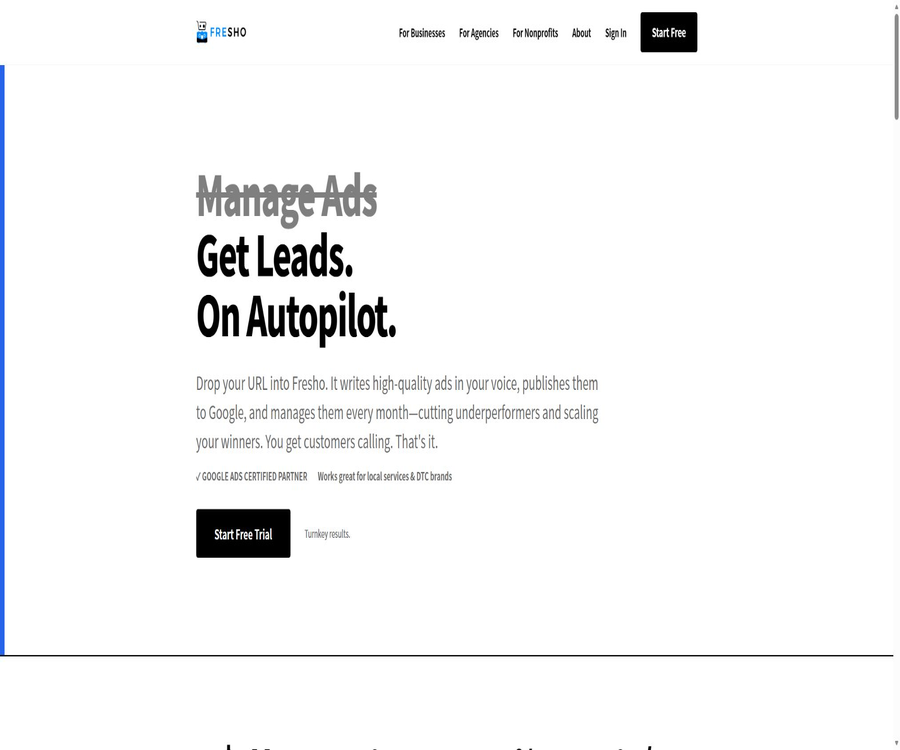
Fresho is a platform for Google Ads that enables automatic creation and management of ads, designed for businesses and advertising agencies. After a user submits their website, the system analyzes the business and its pages to generate ad copy, keywords, and ad groups, which are then uploaded to the client’s own Google Ads account.
This page introduces Fresho.dev’s advertising automation product; it is not the same as the software for handling wholesale orders and managing inventory of fresh foods that shares the same name. The websites, companies behind these products, and their prices are all different.
A one-sentence summary
Fresho can automatically convert corporate websites into a format suitable for Google Ads, removing ineffective ads over time and replicating the most effective versions, thereby helping local services and DTC brands attract customers with high intent to purchase.
Product positioning
| User type | Main requirements | The methods offered by Fresho | Suitable solution |
|---|---|---|---|
| Single enterprise | Obtain phone numbers, leads, or sales through Google searches | Automatically create and continuously optimize an account | Starter |
| Multi-brand companies | Centralized management of multiple advertising accounts | Up to 5 accounts with priority support | Growth |
| Advertising agency | Increase the number of customers without adding more staff. | White-label reports, built-in ads within MCC | Growth or Enterprise |
| Large institutions | 6 or more accounts and system integration | Custom onboarding, training, and dedicated manager | Enterprise |
| Non-profit organizations | Increase the utilization rate of Google Ad Grant | Specialized automatic optimization for grants | Custom price for non-profits |
Generate ads automatically from the website
After the user hands over the website to Fresho, the system learns about the services, products, pages, and brand identity, and then generates ad copy, keywords, and account structures. Different ad groups are mapped to corresponding landing pages.
What does a website need to provide?
- Pages that clearly describe the product or service.
- Target area, service scope, and contact information.
- Actual prices, qualifications, restrictions, and differences.
- A landing page capable of fulfilling the objectives of advertising campaigns.
- Valid phone numbers, forms, or purchase paths.
- Privacy policy and information on necessary cookies and conversions.
Keyword and ad group creation
Fresho automates keyword research, ad copy creation, and ad group structure, thereby reducing the time required to set everything up starting from an empty account. Ads are organized around specific pages and search intents, rather than all being directed to the home page.
Contents that still require manual confirmation
- Brand terms, competitive terms, and prohibited terms.
- Areas where services are provided and areas where orders are not accepted.
- Prices, discounts, eligibility, and legal statements.
- Restrictions on advertising policies in sensitive industries.
- Definition of transformation, value, and attribution window.
- Budget limits and unacceptable customer acquisition costs.
Advertising placement
Once generation is complete, Fresho can publish the campaign directly to the Google Ads account. The official website states that businesses do not need to create each element individually within a complex control panel, but account owners should still retain the ability to review and suspend campaigns.
Continuous automatic optimization
The platform continuously monitors the performance of each ad, removes those that are less effective, and creates new variations and enhancements based on the most successful ads. This cycle repeats on a monthly basis to ensure that ads remain up to date over time.
How to deal with successful and inefficient ads
- Ads with good performance serve as a model for new variants.
- Inefficient ads are removed before they continue to consume the budget.
- The new version replaces the underperforming ads.
- The system continuously updates keywords, copy, and the structure of campaigns.
- The results should be assessed in conjunction with the quality of the clues and the actual income.
Attracting customers through local services
Fresho is designed specifically for local service sectors such as housekeeping, repairs, and plumbing; it uses Google searches to identify users who are actively looking for such services. The leads are directed to the company’s website or phone number, rather than being sold to a shared list available to multiple companies.
Key points of local service configuration
- It only covers the cities and areas within a certain radius that can actually be served.
- Distinguish intentions based on emergency, scheduled, and regular consultations.
- Set different answering methods for business hours and off-hours.
- Record calls, forms, and clients who have made purchases.
- Exclude recruitment, tutorials, free, and irrelevant queries.
DTC and Shopify stores
Fresho offers connectors in the Shopify App Store that allow for the import of product, inventory, order, and customer data; these connectors can be used to create and manage ads based on Google’s data regarding audience interests, location, and advertising metrics.
The app store also states that Google Ads and Meta Ads are compatible, but the official website focuses primarily on the automatic management features of Google Ads. Companies should not assume that Meta Ads offers exactly the same level of automation and package benefits.
Shopify data scope
| Data type | Uses of connectors | Suggestions on privacy and permissions |
|---|---|---|
| Product information | Generate product ad and landing page mappings | Only the fields required for deployment are read. |
| Inventory data | Avoid promoting unsellable products. | Confirm the synchronization frequency and stock-out rules. |
| Order history | Analyze purchase and advertising effectiveness | Restrict access to personal information in orders |
| Customer information | Audience and Effect Analysis | Obtain a legal basis and restrict exports. |
| Google Audience and Regions | Match ad intent and location | Comply with the platform’s advertising policies. |
White-label advertising agencies
Growth and Enterprise are intended for agencies; ads, campaigns, and reports can use the agency’s brand. Fresho operates within the client’s Google Ads account as well as within the agency’s MCC, so clients are not forced to switch to a closed account.
Responsibilities retained by the agent
- Customer objectives, budget, and overall marketing strategy.
- Optimization of landing pages, quotes, and sales processes.
- Advertising policies, brand, and legal reviews.
- Customer communication, explanation, and relationship management.
- Review of clue quality, revenue, and attribution.
Can existing manual campaigns coexist?
The agent’s information page states that Fresho only manages the campaigns that it creates and tags; other campaigns created manually can continue to run within the same account. This approach is suitable for testing purposes using one account or a portion of the budget.
Non-profit organization Google Ad Grant
Fresho originated from the need of nonprofit organizations to manage Google Ad Grants, aiming to help eligible organizations make use of their monthly advertising quotas. A discounted rate is applied to nonprofits, with a separate quote provided based on the specific circumstances of each organization.
Fresho cannot obtain grant eligibility on behalf of an organization, nor can it replace Google’s project rules. The organization still needs to meet the requirements regarding eligibility, conversion quality, website content, and policy guidelines.
Tutorial on creating a corporate advertising account
- Confirm that the website, landing page, phone number, and forms are available.
- Register for Fresho and choose the 14-day Starter trial.
- A Google Ads account with the necessary permissions for connection.
- Submit the website and verify the business, region, and services identified by the system.
- Set the budget, conversion rates, content to be excluded from campaigns, and the target cost per customer acquisition.
- Review the mapping of keywords, copy, ad groups, and landing pages.
- After launching with a small budget, check the search terms, the quality of leads, and the sales results.
Agent pilot tutorial
- Start with customer accounts that have low profits, are difficult to optimize, or are at risk of being lost.
- The minimum permissions required for completing the deployment are granted through MCC.
- Establish criteria for customer branding, region, budget, and conversion acceptance.
- Have Fresho create a test campaign with independent tags.
- Keep the existing manual campaign unchanged and set a comparable range.
- Compare clue cost, quality, conversion rate, and manual time.
- After the pilot phase, more accounts will be migrated and white-label reporting will be enabled.
Shopify connection tutorial
- Check the products, inventory, and privacy settings in the Shopify store.
- Install the Fresho app and read the data permissions requested.
- Connect Fresho, Google Ads, and the necessary analytics accounts.
- Confirm the product, order, and customer fields to be imported.
- Set rules for products that cannot be promoted, target regions, and minimum inventory levels.
- Review AI-generated product descriptions, images, and videos.
- After going live, focus on orders and profits rather than just clicking to assess performance.
Guide to Using Google Ad Grant
- First, ensure that the organization meets the requirements for Google for Nonprofits and Ad Grant.
- Clean up website content, mission, projects, and conversion pages.
- Contact Fresho to obtain nonprofit discounts and applicable packages.
- Connect to the Grant account and set conversion goals that comply with the rules.
- Check whether the keywords, ads, and landing pages are in line with the charitable mission.
- Continuously monitor Grant usage, conversion rates, and policy notifications.
- For projects with poor results, adjust the page and target audience instead of simply adding more keywords.
Which users are it suitable for
- Local service companies: Direct phone numbers and contact forms can be obtained through searches.
- DTC brand: Continuously generates ads based on products and purchasing intentions.
- Shopify merchants: Use products, inventory, and orders for automated advertising.
- Multi-brand companies: Managing multiple advertising accounts within a single solution.
- Small agencies: Use white-label automation to increase the number of customers they can serve.
- Large agents: Deploy in bulk within MCC and require customized integration.
- Non-profit organizations: Improving the use of Google Ad Grant and ensuring effective access to it.
- Business owners without advertising specialists: reduced workload related to keyword selection and copy writing.
Typical use cases
- Acquire local search clients for services such as housekeeping, plumbing, and repairs.
- Create a new Google Ads account quickly from the website.
- Map different service pages to separate keywords and ad groups.
- Continuously eliminate inefficient ads and generate superior variants.
- Allow an account manager for agents to manage more clients.
- Deliver white-label reports for the agency’s branded products to customers.
- Create e-commerce ads based on Shopify products and inventory.
- Help non-profit organizations make use of their monthly Ad Grant allocation.
Product advantages
- A website is all that’s needed to generate keywords, ad copy, and account structure.
- The ad is directed to the customer’s own Google Ads account.
- Continuous optimization, rather than remaining unchanged for a long time after it is created once.
- The campaigns created with Fresho can run in parallel with manual campaigns.
- Both Starter and Growth include an unlimited number of campaigns.
- Growth offers 5 accounts, white-label reports, and priority support.
- The Shopify connector can use product, inventory, and order data.
- Special programs are available for the Google Ad Grant nonprofit organization.
- Starter offers a 14-day trial period to test the actual leads first.
Usage restrictions and precautions
- In addition to the $249 per month fee, a separate budget is required for advertising.
- The 14-day trial is available only for the Starter plan; it does not mean that ad clicks are free.
- Automatic optimization cannot fix poor landing pages, quotes, or sales follow-ups.
- The performance figures on the official website are based on specific accounts and cases, and it cannot be guaranteed that they will be the same for other companies.
- Ad copy, keywords, and targeting may still violate industry or platform policies.
- The system focuses on the English-language official website and services in the United States; details for Chinese-speaking markets and other regions are pending confirmation.
- The Shopify connector accesses product, order, and customer information, and requires only the minimum level of permissions.
- Non-profit organizations must maintain their eligibility for Google Ad Grant and comply with the relevant requirements on their own.
- The public terms are brief; they do not specify a fixed data retention period nor detailed SLAs.
- There are no public API or SDK documents available for customers; custom integration is available only for Enterprise users.
- The product platform is not open source; the separate libraries available on GitHub are not the source code of the advertising system.
Prices and packages
| Plan | Price | Billing cycle | Account limit | Core rights and interests | Suitable for users |
|---|---|---|---|---|---|
| Starter | 249 dollars | Monthly | 1 account | No restrictions on campaigns, 24/7 optimization, 14-day trial period | Single enterprise or pilot project |
| Growth | 889 dollars | Monthly | Up to 5 accounts | White-label reports, priority support, unlimited campaigns | Agents and multi-brand companies |
| Enterprise | Custom quote | Contractual agreement | No account restrictions | Custom integration, training, and dedicated account managers | 6 or more accounts, or large institutions |
| Nonprofit | Discounted custom price | In accordance with the institutional agreements | As required | Automatic management by Google Ad Grant | Eligible non-profit organizations |
The price verification date is August 22, 2026. The package cost does not include expenses related to Google Ads advertising budgets, taxes, third-party landing pages, or sales systems; the final amount will be determined based on the contract and the settlement process.
How to calculate the cost of a package
| Cost items | Included in the Fresho package? | Budget recommendations |
|---|---|---|
| Fresho software and automatic management | Includes | Select a plan based on the number of accounts. |
| Google Ads clicks and impressions | Not included | Set separate daily budgets and monthly limits. |
| Landing page design and hosting | It is not specified what is included. | Optimize separately based on the conversion rate |
| Phone tracking and CRM | It is not specified what is included. | Confirm integration of existing tools |
| Shopify platform fees | Not included | Charged separately by Shopify |
| Artificial strategies and customer relationships | To be borne by the company or agent. | Manual review and explanation will be retained. |
| Custom integration for Enterprise | In accordance with the contract | Clear costs for implementation, maintenance, and support |
Why does the Shopify app appear to be free?
The Shopify App Store lists the Fresho connector as free, meaning that no fixed fees are associated with installing this app. The automatic management of Fresho ads is still billed according to the Starter, Growth, or Enterprise plans available on the official website.
Trial and cancellation
Starter offers a 14-day free trial, with the official website stating that cancellation can be done at any time. The public version of the terms does not provide details regarding automatic transition to a paid subscription upon the end of the trial, the deadline for refunds, or any rules regarding prior notification; it is therefore necessary to check the payment page again when registering.
Platform support and integration
| Platform or integration | Support status | Primary uses |
|---|---|---|
| Web console | Support | Register, connect, and manage accounts |
| Google Ads | Core support | Create, publish, and optimize ads |
| Google Ads MCC | Agent support | Manage multiple customer accounts |
| Shopify apps | Support | Import product, inventory, order, and customer data |
| Meta Ads | The Shopify listing indicates compatibility. | The specific scope of automation needs to be determined. |
| White-label report | Growth and above | Delivery of branded products on behalf of others |
| Custom integration | Enterprise | Connecting to large institutional systems |
| Native desktop applications | No findings were detected. | It is primarily used via the Web. |
| iOS or Android app | No findings were detected. | There are no official instructions for the mobile app. |
Data, conversion, and evaluation metrics
| Indicators | Questions that can be answered | Areas prone to misjudgment |
|---|---|---|
| Click-through rate | Do ads attract users who are searching? | A high number of clicks does not equate to high-quality leads. |
| Cost per click | One-time cost of purchasing data traffic | Low cost may stem from words with weak intent. |
| Conversion rate | Percentage of visitors who achieve the goal | An incorrect definition of transformation can contaminate the optimization process. |
| Cost per clue | Cost of obtaining a phone number or form | Invalid clues may also be counted. |
| Conversion rate | The proportion of leads that become customers | CRM or manual feedback is required. |
| Customer acquisition cost | Total cost of acquiring paid customers | It should include platform fees and labor costs. |
| Return on advertising spending | Revenue efficiency generated by advertising | Income is not equal to profit. |
Privacy and data collection
The privacy policy outlines the personal information such as names, email addresses, and company details that users provide voluntarily, as well as usage data like advertising preferences and campaign settings. The platform uses first-party cookies to enable product functions and conduct analysis; it does not employ third-party cookies for personalized advertising.
Service providers may process information under confidentiality agreements, and the platform may disclose it when required by law or to protect rights. The policy only mentions the use of industry-standard measures such as encryption, without providing detailed information on security certifications.
Data responsibilities of Google and Shopify
Fresho commits to complying with the Google API Services User Data Policy and the requirements regarding limited use when dealing with Google API data. The Shopify connector may import product, order, inventory, and customer information; merchants should review the associated permissions and provide their own privacy notices.
- Only connect the ads and store accounts required for launching the campaign.
- Avoid importing unnecessary customer fields into the advertising system.
- Restrict the account permissions of agents, employees, and external personnel.
- Revoke the Google and Shopify tokens when leaving the store or terminating the service.
- Confirm the processes for data export, retention, deletion, and backup.
- Do not include sensitive customer data in ad copy or keywords.
Data retention and user rights
Users can request access to, correction of, or deletion of their personal information, and they can also deactivate their accounts at any time. The public policy does not specify a fixed retention period for accounts, ads, reports, logs, and Shopify data.
Advertising content and intellectual property rights
Users retain the rights to the advertising content, while granting Fresho permission to use such content for the provision of services. The customer is responsible for ensuring that the advertisements are legal, accurate, and compliant with relevant regulations; AI-generated content cannot be used as an excuse to avoid compliance obligations.
API, GitHub, and open-source status
Fresho makes use of the Google Ads API and connects to stores through the Shopify app; however, the official website does not provide any public APIs or SDKs for customers. For Custom Integrations in the Enterprise version, it is necessary to contact sales.
The mancha project made available under the Fresho-dev name is an independent HTML template along with a responsive library, distributed under the MIT license. This repository does not indicate that it constitutes the code for Fresho’s advertising platform; therefore, it cannot be used as evidence to classify Fresho’s products as open source.
| Project | Public status | Conclusion |
|---|---|---|
| Fresho advertising platform | Managed business services | The product itself is not open source. |
| Customer API | Not disclosed | There are no documentation documents for the self-service interface. |
| Official SDK | No findings were detected. | No list of languages and licenses available |
| Integration with Google Ads API | For use within the platform | It does not mean making the API available to customers. |
| Shopify apps | Public installation | Used to authorize access to store data |
| Mancha warehouse | Source code is open, MIT | An independent front-end library; it is not the source code of an advertising platform. |
| Enterprise integration | Custom offerings available | Scope and costs are as specified in the contract. |
Basic information
| Project | Content |
|---|---|
| Tool name | Fresho |
| Product type | Google Ads: a platform for automatically creating, publishing, and optimizing ads |
| Founder | Scott Glasgow, Oscar Wahltinez |
| Primary users | Local businesses, DTC brands, agents, and nonprofit organizations |
| Price pattern | Monthly subscription, 14-day trial, and enterprise customization |
| Entry price | Starter: $249 per month |
| Is registration required? | It is necessary. |
| Main platforms | Web, Google Ads, MCC, and Shopify |
| Primary language | The official website and Shopify app are listed in English. |
| Chinese support | Not specified |
| Public API | No findings were detected. |
| Official SDK | No findings were detected. |
| Is the product open source? | Not open source |
| Relevant public warehouses | Mancha, MIT license, non-product source code |
| Price verification date | August 22, 2026 |
Recommendation score
Recommendation score: 4.1 / 5. Fresho is suitable for local businesses that do not want to handle the details of Google Ads on their own, as well as small agencies that need to expand their services by using a white-label solution; the fact that the ads remain in the client’s account and a 14-day trial period is available also reduces the risk of switching to another service.
The main drawbacks are the high minimum cost for software, the need for additional advertising funds, the rather brief privacy and terms of service, as well as the lack of customer APIs. The effectiveness of this solution depends heavily on the website, industry, region, budget, and efforts put into sales follow-up.
Frequently Asked Questions
What does Fresho do?
It analyzes corporate websites, automatically generates keywords, ad copy, ad groups, and landing page mappings, publishes them to Google Ads, and continuously optimizes them.
Is Fresho free?
It is not a permanently free service. Starter offers a 14-day free trial, after which the cost is 249 dollars per month; additional fees apply for advertising budget.
What is included in the Starter?
It includes 1 Google Ads account, an unlimited number of campaigns, and automatic optimization throughout the day; it is suitable for pilot use by individual companies or agencies.
How many accounts are included in Growth?
Up to 5 accounts are allowed; the price is $889 per month, and it includes white-label reports as well as priority support.
How much is Enterprise?
There is no fixed public price; it is necessary to contact the sales team. It is intended for those who need customized integration, tailored training, and a dedicated account manager.
Is the advertising budget included in the subscription?
It is not included. The Fresho subscription covers the software and related administrative costs, while the costs associated with clicks on Google Ads are paid separately from the customer’s advertising account.
Is it necessary to know Google Ads?
It is not necessary to carry out all manual settings, but users should still understand budgets, conversions, policies, and lead quality; important campaigns must be reviewed manually.
Can Fresho manage manually created ads?
The agent page states that it only manages campaigns created and marked by Fresho; other campaigns created manually can continue to operate simultaneously.
Will the ads disappear after use is stopped?
It will not be retained by the platform; the ads, keywords, and campaigns are all in the customer’s own Google Ads account. It is still necessary to check the automatic rules and permissions before terminating them.
Does it support white-labeling for agents?
Supported. Versions Growth and above allow for the generation of reports on proxy product brands; the platform operates within the customer’s MCC account.
Does it support Shopify?
Yes, it is possible to import product, inventory, order, and customer data using Shopify apps. The fact that the installation page indicates a free option does not mean that the Fresho ad management subscription is also free.
Is Google Ad Grant supported?
It supports the management of grants for eligible non-profit organizations; prices are discounted based on the specifics of each organization, and a separate quote is provided.
Is Chinese supported?
The official website and the Shopify app are primarily in English; there is no explicit commitment to a Chinese interface or optimization for Chinese-language advertising. Testing and obtaining quotes are required before entering the Chinese market.
Are APIs provided?
No public customer APIs or SDKs have been found. Enterprise offers customized integration, but the specific systems, interfaces, and costs require further discussion.
Is Fresho open source?
It is not open source. The public Mancha repository is an independent front-end library licensed under the MIT license; it cannot be used as the source code for the Fresho advertising system.
Are third-party cookies used to personalize advertising?
The privacy policy states that first-party cookies are used to enable product functions and conduct analysis, while third-party cookies are not employed for personalized advertising.
How long are the data stored?
The public policy does not specify a fixed retention period; it is necessary to determine the procedures for deleting Google data, Shopify data, reports, logs, and customer data before they are put into official use.
Summary
Fresho integrates website understanding, keyword research, ad copy creation, account setup, and continuous optimization into a Google Ads automation management service, focusing on local customer acquisition, DTC businesses, agencies, and nonprofit organizations.
It is recommended to start with the 14-day trial version of Starter to establish a baseline in one account, and to evaluate performance based on actual sales and profits rather than just the number of clicks. Before signing a contract, it is necessary to clarify the media budget, renewal terms, data retention policies, ad approval processes, Shopify permissions, and the scope of Enterprise integration.
Tools similar to Fresho




 Guigong Network Security Registration No. 45132202000164