






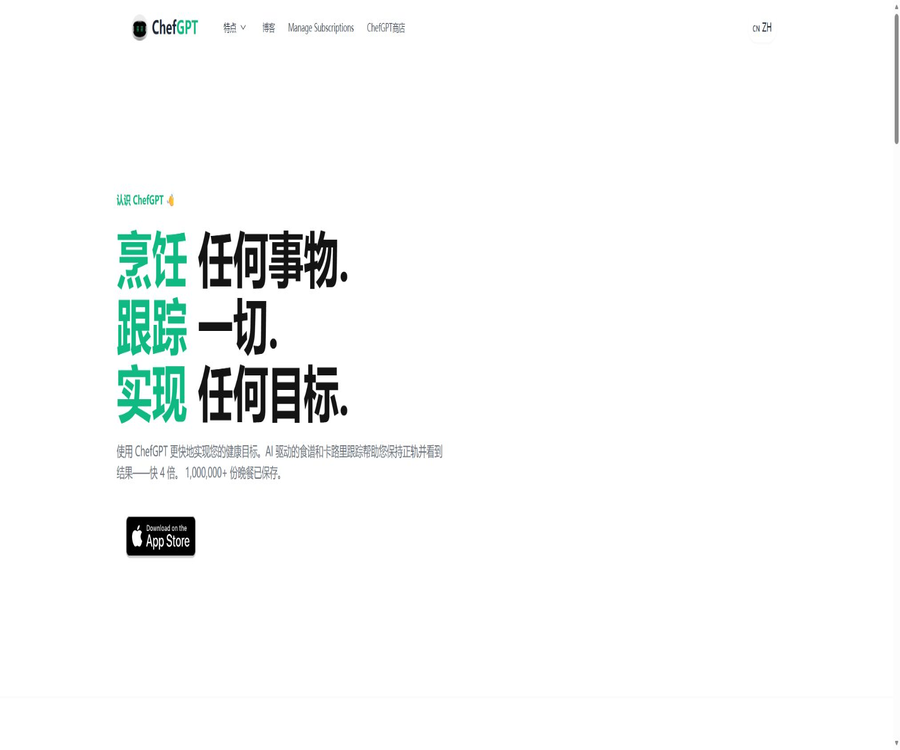
ChefGPT
ChefGPT: an intelligent tool focused on AI-driven conversations
Tags:AI dialogue chatWhat is ChefGPT?
ChefGPT is a kitchen assistant that combines AI-driven recipe generation, meal planning, and daily food tracking. Users can enter existing ingredients, the dishes they want to prepare, any dietary restrictions or nutritional goals; they can also take photos of their meals to estimate the nutrition content and record the calorie count.
The product is operated by MIU Digital Limited and is available through a web interface as well as apps for iPhone, iPad, and Android. ChefGPT also offers a separate developer API; the pricing plans, usage restrictions, and subscription options for consumer applications need to be checked separately.
A one-sentence summary
ChefGPT assists home users in managing their diet through a complete set of processes that include inventorying ingredients, creating personalized recipes, tracking nutrition, planning meals for the entire week, and generating shopping lists. It also allows developers to incorporate recipes and meal plans into their own products using APIs.
Main functions
1. PantryChef generates recipes from existing ingredients.
PantryChef generates actionable recipes based on the ingredients already available in the kitchen, making it suitable for using up leftover food in the fridge or for preparing meals on short notice. Users can choose the meal type, cooking time, and skill level, after which the system combines these elements to create a recipe.
- Recipes are created starting from ingredients selected manually or identified through photo recognition.
- Narrow down the results by meal time, such as breakfast, lunch, snacks, or dinner.
- Adjust the recommendations based on cooking time, skills, and dietary requirements.
- Reduce repeated purchases and prioritize using up existing ingredients first.
2. MasterChef is generated based on dish names and preferences.
MasterChef is suitable for users who already know what they want to eat; it allows them to search for and create recipes based on dish names, style, or dietary preferences. Once a recipe is created, it’s possible to modify the ingredients, quantities, and cooking methods.
3. MacrosChef nutrition-targeted formulas
MacrosChef enables users to specify targets for proteins, carbohydrates, fats, etc., and it then generates recipes that are closer to the required amounts of macronutrients. It is suitable for daily planning in the context of fitness and weight management, but it should not replace the advice of doctors or registered dietitians.
4. MealPlanChef – Diet planning tool
MealPlanChef creates meal plans for one week or longer, based on lifestyle, goals, dietary needs, and preferences. The plans can be automatically converted into shopping lists, thereby reducing the need to search for ingredients and organize them manually for each meal.
- Plan daily meals according to individual goals and dietary restrictions.
- Combine the ingredients from multiple recipes into a shopping list.
- Integrate with the calendar to view and implement meal plans.
- The maximum duration of the plan for the paid version may be longer than that of the free version.
5. Photo recognition and calorie tracking
Users can take photos of their meals; the AI then identifies the possible ingredients and estimates the nutritional value, which is recorded in a daily log. Photos cannot determine hidden ingredients, weights, or the amount of oil used in cooking, so the results are better suited for tracking trends rather than providing accurate medical measurements.
6. Storage room and shopping list
The pantry function is used to keep track of the ingredients available at home, with updates made as shopping or cooking takes place. The system suggests recipes based on the current inventory, helping to reduce waste and replenish any missing ingredients.
7. Recipe adjustments and Recipe Remix
Recipe Remix allows for modifications to existing recipes – such as making them spicier, replacing ingredients, changing the serving size, or altering the cooking method. Users still need to check the ingredient proportions, any allergens, and cooking safety; they should not simply follow the steps suggested by the AI.
8. Health and habit tracking
Recent updates to the mobile version have added features such as weight history, macronutrient analysis, hydration tracking, fasting windows, and integration with Apple Health. The specific features available may vary depending on the operating system, region, and app version; therefore, the functions on Android and iOS are not necessarily identical.
9. Recipe API and embedded components
The ChefGPT API offers various endpoints based on ingredients, macronutrients, dish variations, meal combinations, dietary plans, and recipe images. The paid plans also include embeddable components that are suitable for displaying results in diet-related products aimed at real users.
Complete workflow
- Answer basic questions such as lifestyle, dietary preferences, goals, and allergens to create a personalized profile.
- Choose from existing ingredients, specific dishes, macronutrient goals, or a weekly plan as the starting point.
- Set the portion size, cooking time, dietary restrictions, and ingredients to be avoided.
- After generating the recipe, check the quantity of ingredients, cooking temperature, allergy risks, and nutritional estimates.
- Add the materials that need to be purchased to the shopping list, and update the inventory in the storage room accordingly.
- Take photos or keep a manual record after cooking or eating, to monitor daily calorie and macronutrient trends.
- Adjust preferences based on actual results, rather than treating a single AI recommendation as a fixed diet plan for the long term.
Usage tutorial
Prepare dinner using the ingredients already in the fridge.
- Open PantryChef and select or take a picture of the ingredients that are actually available at the moment.
- Select dinner, estimated cooking time, skill level, and number of servings.
- Additional allergens, foods to avoid, dietary patterns, and materials that must be used first.
- Generate recipes and check whether any essential ingredients that are not available in stock have been included.
- Check the doneness of the meat, its storage conditions, and the risk of cross-contamination before starting to cook.
- Use substitutes or Recipe Remix for inappropriate ingredients, rather than simply skipping the step.
Connect to the ChefGPT API
- Register for a developer organization and choose a trial plan or a paid plan suitable for your volume of requests.
- Create an API key in the account; each organization can have only one valid key at a time.
- Select the endpoints for ingredients, macronutrients, meal planning, dietary plans, or recipe images.
- Store the keys on the server side; do not expose them in website or mobile client code.
- Real human end-users are used to initiate requests, with the number of calls being controlled based on the minutes allocated and the monthly quota specified in the plan.
- Return data is displayed to the user only in accordance with the permissions granted; no bulk collection, extraction, or saving of such data is permitted without authorization.
Which users are it suitable for
- Home cooks: Get quick ideas and recipes for dinner based on the ingredients they already have.
- People who work out: Plan their meals based on goals related to protein, carbohydrates, and fats.
- Users focused on fat loss and weight management: track meals, calories, and weight trends.
- Busy families: Generate a weekly menu and a combined shopping list in one go.
- Users who need to reduce food waste: Arrange the dishes based on the inventory available in the storage area.
- Food application developers: Provide recipes to end-users through APIs and embedded components.
Typical use cases
- Before leaving work, prepare a dinner that can be made within a set time limit, using the ingredients available in the fridge.
- Find a more suitable combination of dishes based on the macronutrient goals for the training period.
- Create a plan for breakfast, lunch, and dinner for the week and make all the purchases at once.
- Take photos of meals eaten outside to quickly estimate the amount consumed that day and to observe long-term trends.
- Adjust online or personal recipes to different serving sizes, preparation methods, or dietary restrictions.
- Add a recipe generation feature for real users to health, grocery, or food service applications.
Product advantages
- It offers multiple clear entry points, including ingredients, dish names, nutritional goals, and meal plans.
- Recipe generation forms a closed loop with shopping lists, pantry management, and calorie tracking.
- Taking photos helps reduce the time spent searching for items one by one and manually entering information.
- It supports the substitution of ingredients, adjustment of portions, and changes in cooking methods, thereby improving the feasibility of following recipes.
- It is available for iOS and Android devices, and is suitable for use in shopping and kitchen scenarios.
- The developer API offers various subscription plans based on endpoints and the number of requests, along with embedded components.
Usage restrictions and precautions
- AI may generate recipes with incorrect proportions, missing steps, or dish names that do not match the final product.
- Photos can only provide an estimate of the type and amount of food; hidden fats, sauces, and the actual weight can lead to significant errors.
- For allergies, diabetes, kidney disease, pregnancy, and other medical dietary needs, one cannot rely solely on the generated results.
- Raw meat, seafood, eggs, and leftovers must be handled in accordance with reliable food safety standards.
- Consumer subscriptions may have different prices in various regions, on different platforms, and through different promotional channels.
- The iOS instructions state that these features require a valid paid subscription, while the Android instructions list only some of the advanced features as requiring payment; as a result, the experience may differ.
- The prices on the old version of the website do not reflect the current settlement prices for the mobile app.
- The API allows requests to be made only by real human end-users; automatic calls intended for bulk data collection or scraping of results are prohibited.
- In principle, the data returned by the API cannot be saved, unless explicit permission is granted by ChefGPT.
- The terms of service limit consumer services to personal use; commercial use requires prior written consent.
- The terms of service also state that the content created belongs to ChefGPT, and authorization must be obtained before any recipes are published or distributed.
Consumer application price
The prices listed below were verified on August 21, 2026, from the App Store in the United States. The app can be downloaded for free, but the in-app purchase list contains several entries with identical names and prices; aside from weekly subscriptions and one-time discounts, the page does not clearly indicate the duration or benefits associated with each amount.
| Project | Public price | Billing instructions | Precautions |
|---|---|---|---|
| App download | Free | Download and install | It doesn’t mean that the main functions will remain free forever. |
| ChefGPT PRO weekly subscription | 4.99 dollars | Weekly | It will renew automatically; the rules for cancellation are subject to those of the app store. |
| One-time discount for ChefGPT Pro | 59.99 dollars | One-time discount indicator | It is necessary to confirm on the settlement page whether the benefits will be provided on a long-term basis and covered. |
| Other in-app purchases for ChefGPT Pro | $ | The cycles are not listed individually in the public list. | It may correspond to monthly fees, annual fees, region, or promotional tiers. |
| Android apps | Includes ads and in-app purchases | Subscriptions to some advanced features | The amount is determined by the region of the Google Play account and the payment page. |
The official details for 2023 indicated a price of $2.99 per month, $29.99 per year, as well as a 7-day trial period; however, these were early figures and cannot be considered as the current standard pricing. Before subscribing, it is necessary to check on the final payment page the date when the trial period ends, the amount required for renewal, and the procedures for cancellation.
ChefGPT API pricing
The API is available as a separate monthly subscription plan; the prices listed below were verified on August 21, 2026, and are in US dollars. The provider also offers a trial program to test the endpoints, but it is clear that there is no regular free trial for the paid subscription plans.
| Package | Monthly fee | Monthly request volume | Requests per minute | Endpoints and components |
|---|---|---|---|---|
| Essential | 19.99 dollars | 1,000 times | 50 times | Generate recipes based on ingredients, 1 embedded component |
| Grow | 49.99 dollars | 2,500 times | 100 times | Add five components: macronutrients, recipe variations, and image endpoints. |
| Pro | 99.99 dollars | 10,000 times | 200 times | Add endpoints for meal planning and dietary plans, 20 components |
| Enterprise | Contact sales | The page is marked as unrestricted. | The page is marked as unrestricted. | All endpoints and unlimited components; the actual fair use conditions need to be confirmed. |
The monthly API quota is calculated based on UTC time and is reset at midnight on the first day of each month. Plans can be upgraded, downgraded, or canceled at any time; payment methods include major credit cards and PayPal.
Supported platforms
| Platform | Support status | Explanation |
|---|---|---|
| Web | Support | You can log in to manage products and subscriptions. |
| iPhone | Support | iOS 15.1 or later is required. |
| iPad | Support | iPadOS 15.1 or later is required. |
| Android phones and tablets | Support | Google Play offers official apps. |
| Mac with Apple chip | The compatibility list includes | macOS 12 or a later version is required, but the page specifications have not been tested for macOS. |
| Apple Vision | The compatibility list includes | VisionOS 1.0 or a higher version is required. |
| Native Windows and Linux applications | No findings were detected. | Available via the Web |
| Developer API | Support | Separate accounts, keys, and monthly subscription plans |
| Embedded components | Support | The quantity varies depending on the API package. |
Privacy and data security
The latest version of ChefGPT’s privacy policy, updated in January 2023, is rather brief. It states that information such as registration details, order data, subscription information, survey responses, form submissions, usage patterns, and preferences are collected for the purposes of personalization, processing transactions, improving services, and sending promotional emails.
The policy states that personal identity information will not be sold, but it can be shared with trusted third parties who assist in operating and providing services; it may also be disclosed for legal or security reasons. The policy does not provide detailed specifications regarding the fields involved or the retention periods for new food photos, nutritional information, weight data, fasting details, or health-related functions.
- The identifiers and usage data disclosed by the App Store may be used for tracking across apps or websites.
- Data associated with an identity may include contact information, identifiers, and product usage details.
- Google Play reveals that it may collect personal information and device identifiers.
- Google Play also states that data transmission is encrypted, that the data is not shared with third parties, and that deletion requests are supported.
- Different stores do not always follow the same guidelines for disclosure; photos related to health and food should be treated as sensitive information.
- Remove irrelevant people, locations, and recognizable backgrounds before uploading the photo.
- Do not include medical records, identification documents, or any other unnecessary personal information in the notes accompanying the recipe.
API, GitHub, and open-source status
ChefGPT provides an official recipe API, API keys, development documentation, and embedding components. Only one valid key can exist per organization at any given time; creating a new key will invalidate the old one, which means that updates are necessary in production environments when there is a change.
No official open-source repository or open-source license that corresponds to the reliability of the commercial ChefGPT product was found. The various GitHub projects with the same name that were identified are maintained by third parties; therefore, the ChefGPT website, mobile applications, or API cannot be considered open source.
Basic information
| field | Content |
|---|---|
| Tool name | ChefGPT |
| Development company | MIU Digital Limited |
| Tool type | AI-powered recipe generation, meal planning, and diet tracking |
| Core pattern | PantryChef, MasterChef, MacrosChef and MealPlanChef |
| Main inputs | Ingredients, dish names, dietary preferences, macro goals, and meal photos |
| Main output | Recipes, nutritional estimates, meal plans, and shopping lists |
| Price pattern | Monthly subscriptions within consumer apps and standalone API subscriptions |
| Is registration required? | The main personalization, recording, and subscription features are required. |
| Chinese support | The official website offers a Chinese version; the language used in the application and the quality of the generated content depend on the specific platform. |
| Whether API is provided | Yes |
| Official SDK | No findings were detected. |
| Is it open source? | No |
| Main platforms | Web, iOS, Android, and developer APIs |
Recommendation score
Its rating is 4.1 out of 5 points. ChefGPT connects recipes, inventory, shopping, meal planning, and photo records, making it useful for home users who wish to reduce the need for impulsive decisions and manual recording.
The shortcomings include a lack of uniformity in the way consumer prices are displayed, the fact that nutritional estimates cannot replace professional advice, and the fact that privacy policies have not kept up with the requirements of health-related functions. Developers also need to pay special attention to the restrictions imposed by APIs, which prohibit automatic bulk data extraction and defaultly forbid saving the data returned.
Frequently Asked Questions
Is ChefGPT free?
The app can be downloaded for free, but the iOS version indicates that the main features require a paid subscription, while the Android version states that certain advanced functions need a subscription. The scope of what is available free of charge and any trial offers vary depending on the platform and region, so it is necessary to check these details on the current payment page.
How much does ChefGPT Pro cost?
The App Store in the United States currently lists a price of 4.99 dollars per week, along with a one-time discount of 59.99 dollars and several price options for unspecified subscription periods. It is not correct to assume that the current price is 2.99 dollars per month or 29.99 dollars per year, based on the older website versions.
Can ChefGPT prepare meals using the ingredients in the fridge?
Yes, PantryChef will create recipes based on the ingredients that have been selected or photographed. After the recipes are generated, it is still necessary to check for any missing ingredients, the correct portion sizes, potential allergens, and the steps required to ensure food safety.
Is it accurate to calculate calories using a photo?
It can only be used as an estimate. Photos generally cannot reveal hidden ingredients, the weight of ingredients, the amount of oil, or the seasoning used; for medical diets or preparation for competitive events, reliable weighing devices and professional tools are necessary.
Does ChefGPT support Chinese?
The official website offers a Chinese version, and it is usually possible to enter instructions for recipes using Chinese in that site. The language options listed on the App Store currently only include English; therefore, a full Chinese interface on mobile devices needs to be verified depending on the specific device used.
Does ChefGPT provide an API?
Independent APIs are provided, covering functions such as searching by ingredients, macronutrients, meal planning, dietary plans, and images. Packages start at $19.99 per month, and are subject to restrictions regarding the number of requests per month, the rate per minute, and data usage rules.
Can APIs generate and save a recipe database in bulk?
By default, this is not allowed. The official pricing rules permit requests to be made only by real human users; automatic calls intended for data collection or scraping are prohibited, and the retrieved data cannot be saved unless explicit permission is granted.
Can the recipes generated by ChefGPT be used for commercial purposes?
The current terms of service restrict the use of this service to personal purposes only, and assert that the generated content belongs to ChefGPT. Written permission must be obtained before such content is used for commercial purposes, redistributed, or incorporated into paid products.
Is ChefGPT open source?
It is not open source, and no official source code repository corresponding to any commercial product has been found. Third-party projects with similar names are not linked in any reliable official manner to the ChefGPT commercial service.
Can personal data be deleted?
According to Google Play’s data security policies, it is possible to request the deletion of data. The specific process for making such a request, the time required for processing it, and which types of data – such as photos or health records – can be deleted should be checked in the account settings or by contacting the support team.
Can ChefGPT replace a nutritionist?
No. It is suitable for keeping track of daily inspiration, plans, and trends, but disease management, allergies, pregnancy, and special medical nutrition still require guidance from qualified professionals.
Summary
The value of ChefGPT lies not only in the ability to create recipes, but also in its capacity to connect ingredient inventory, recipes, shopping lists, and dietary records. It can significantly reduce the time required for planning, whether it’s for home cooking or general health management.
When using it, the AI-generated results should be regarded as suggestions only; it is necessary to carefully check matters related to nutrition, allergies, and food safety. Subscribers and API users should also verify the current prices, renewal terms, content licensing, and data usage restrictions before making a payment.
Tools similar to ChefGPT




 Guigong Network Security Registration No. 45132202000164