






ccMonet
ccMonet: an intelligent tool focused on AI-driven conversations
Tags:AI dialogue chatWhat is ccMonet?
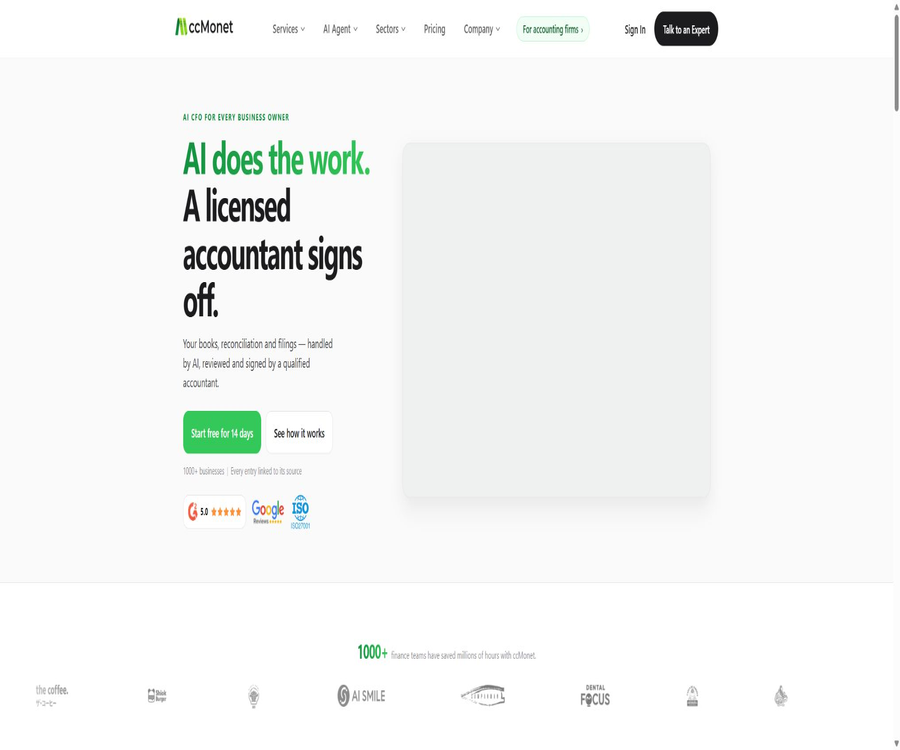
ccMonet is an AI-based financial platform designed for small and medium-sized enterprises as well as accounting firms; it is operated by the Singaporean company 2nd Brain Pte Ltd. It integrates functions such as invoice processing, bookkeeping, bank reconciliation, expense reimbursement, management reporting, and tax services into a single workflow.
The product does not rely solely on automated model generation of accounts; instead, it employs a approach that combines AI-based preprocessing with review by professional accountants. Companies can submit documents and view reports via the web or mobile platforms, while accounting, tax, and customer success teams handle the matters that require judgment.
A one-sentence summary
ccMonet enables businesses to handle their daily financial tasks by taking photos, uploading files, or connecting to business data; thereafter, AI and accounting teams work together to create traceable accounts, compliant reporting documents, and insights into business performance.
Main functions
AI-based bill reading and automatic bookkeeping
Users can submit invoices, receipts, bank statements, and expense proofs; the system identifies the date, supplier, currency, tax amount, and line items. It supports multiple languages and currencies as well as some handwritten documents, but images with low resolution still require manual verification.
Bank reconciliation and anomaly alerts
The system matches the ledger entries with bank transactions, and flags those that are duplicated, have incorrect amounts, lack supporting documents, or cannot be classified. The official website also lists the banks in Singapore that can be connected to the system; it is necessary to confirm which accounts can be accessed before activation.
Expense reimbursement and approval
Employees can take photos of receipts and upload them; the AI then generates a reimbursement request which is processed in accordance with the company’s rules. Managers can approve requests from their mobile devices, and the system sends reminders; once approved, the transaction is recorded in the accounts.
Real-time financial statements and AI Q&A
The platform provides income statements, balance sheets, cash flow statements, and operational dashboards, and allows users to ask questions about profits, costs, and cash positions using natural language. Whether the reports are truly real-time depends on whether the data from banks, POS systems, invoices, and accounting reviews has been synchronized.
Tax and corporate compliance services
The services provided for Singaporean companies include GST, ECI, corporate income tax filings, annual reports, and certain matters related to ACRA. Different packages cover different aspects such as Form C or Form C-S, GST filings, and XBRL; therefore, not all compliance services can be considered to be included in the basic price.
Work space in an accounting firm
The version intended for accounting firms offers multi-client dashboards, role-based permissions, a client collaboration portal, a document repository, audit trails, customized reports, and tax export functions. It also supports a white-label or co-branded approach, allowing the firms to retain control over their client relationships.
How should AI and accountants divide the work between them?
| Stage | Main tasks of AI | Main tasks of humans | The user needs to confirm. |
|---|---|---|---|
| Data reception | Read images, PDFs, streams, and structured files | Check for missing pages, abnormal vouchers, and business context. | Are the documents complete and does one have the authority to submit them? |
| Bookkeeping processing | Extract fields, suggest categorization, match transactions | Confirm the account type, tax nature, and special transactions. | Are the important categories and amounts correct? |
| Bank reconciliation | Automatically match and mark differences. | Handle unmatched, duplicate, and cross-period items | Is the account period consistent with the ending balance? |
| Reports and Insights | Generate reports, dashboards, and answer questions | Explain significant fluctuations and provide professional advice. | Whether the data cutoff date and definition are applicable |
| Taxation and Compliance | Organize drafts, calendars, and to-do lists | To be reviewed or submitted by qualified professionals. | Corporate facts, authorizations, and final declaration contents |
The official website describes the working process by stating that \"AI handles most of the preprocessing, while humans are responsible for verification,\" which is a summary provided by the supplier of its own processes. The quality of invoices, historical accounts, and the complexity of transactions vary from one company to another, and these factors significantly affect the amount of work that needs to be done manually.
Complete workflow
- Schedule a demonstration or register an account, providing information on the company’s location, industry, annual revenue, volume of transactions, currency used, and existing accounting system.
- The implementation team is responsible for determining the scope of services, reporting requirements, migration of historical data, connections to banking or business systems, and the required packages.
- Upload invoices, receipts, bank statements, reimbursement documents, and other financial files, or enable available data connections.
- AI reads the fields, generates accounting suggestions, automatically matches bank transactions, and places any abnormal items in a queue for further processing.
- Company staff complete the missing documents, specify the purpose of the transaction, and provide approval details; the accounting team then reviews the accounts, tax aspects, and balances.
- The platform generates ledgers, management reports, and cash flow insights, allowing users to view deadlines and data integrity.
- In cases involving taxes or statutory filings, authorized personnel verify the entity responsible for the filing, the relevant period, and the final figures before submitting the documents.
- Regularly check account permissions, integrations, document retention, and service scope; re-evaluate quotes when there are changes in business volume.
Tutorial for new users
- First, organize the company’s registration documents, recent bank statements, invoices, expense receipts, as well as the employee records and existing account books.
- Select the modules you wish to learn about in the consultation form, and schedule a one-on-one demonstration or trial.
- Have the implementation team assess whether historical records need to be added, and determine how data from Xero, QuickBooks, ERP systems, or spreadsheets should be transferred.
- Different roles are assigned to managers, finance staff, employees, and external accountants; the administrator account is not shared.
- Conduct a trial run using one month’s actual data, and conduct random checks on AI recognition, account types, tax rates, currencies, and bank matching.
- After confirming the accuracy, support responsiveness, and scope of services, move all entities, stores, or employees in.
Process for reimbursement of expenses
- Employees should take a photo of the complete receipt using their smartphones, making sure that the merchant name, date, amount, tax amount, and currency are clearly visible.
- Check the cost categories, descriptions, and associated items generated by AI, and add information regarding the business purpose or the customer’s name.
- The system sends the requests to the appropriate approvers based on amount, department, or project, and reminds users of pending tasks.
- The approver approves, rejects, or requests further clarification based on the documents and relevant policies.
- Once approved, the associated costs are recorded in the accounts and included in the payment process; thereafter, finance staff check for any duplicate requests, as well as the status of tax handling and settlement.
Which users are it suitable for
- Small and medium-sized enterprises in Singapore: They wish to delegate tasks such as daily bookkeeping, GST handling, ECI matters, corporate tax payments, and the preparation of annual reports to the same service team.
- Food service, retail, and multi-location businesses: need to integrate POS systems, supplier invoices, employee reimbursement processes, and data related to operations in multiple locations.
- Professional services and medical institutions: There is a desire to reduce manual data entry, while still maintaining reports at the level of projects, departments, or clinics.
- Cross-border enterprises: They need to handle multiple currencies, various entities, and consolidated financial statements, and obtain review from local professionals.
- Startups without a full-fledged finance team: they need basic compliance measures, an overview of cash flows, and services that can scale as the business grows.
- Accounting and bookkeeping firms: They wish to manage clients on a bulk basis, automate the processing of data, and maintain their own brand using a white-label approach.
Typical use cases
- Convert invoices and receipts from emails, photos, and PDFs into ledger entries, and close them back to the original documents.
- Automatically match bank transaction records with accounting entries, and handle missing information and discrepancies in a centralized manner.
- Have employees submit the expenses, carry out approval processes by department and amount, and then generate reimbursement and payment records.
- View profits, costs, cash flow, and store performance, and ask the AI about any unusual changes.
- Prepare GST, ECI, Form C-S or Form C, annual reports, and XBRL-related documents.
- An accounting firm manages multiple clients, documents, permissions, reports, and audit records from a backend system.
Product advantages
- It connects AI automation, accounting review, and tax services, thereby reducing the need for companies to transfer data between various tools and service providers.
- A traceable relationship is maintained among invoices, transactions, and accounts, allowing it to be possible to revert to the original documents for verification when issues arise.
- It covers invoices, banks, fees, reports, and compliance requirements, and is suitable for use ranging from daily record-keeping to annual reporting.
- It supports multiple languages, currencies, and various business scenarios, as well as providing a multi-client workspace for accounting firms.
- Both the web version and the iPhone app can handle daily tasks, allowing employees to take photos directly to submit expenses.
- Professional accountants are available to provide assistance; companies are not required to leave all judgment-based tax matters entirely to AI.
Usage restrictions and precautions
- AI-based recognition, classification, and response generation may be inaccurate; the official figures regarding accuracy and efficiency are provided by the suppliers, and they cannot replace testing using actual company samples.
- Review by professionals can reduce risks, but users remain responsible for the factual details of the business, authorization, the integrity of credentials, and the content of the final submission.
- The public pricing is primarily intended for small and medium-sized enterprises in Singapore; tax regulations, service providers, and pricing in other countries need to be confirmed separately.
- The fees vary depending on annual revenue, volume of transactions, package level, and additional services; the default slider values on the pricing page do not represent fixed prices for all companies.
- GST, Form C, XBRL, retroactive accounting, payroll, and consolidated financial statements may require additional fees.
- Financial documents contain highly sensitive information; companies should restrict access, verify third-party integrations, and establish procedures for exporting and deleting such documents.
- The privacy page indicates that there is no option for exporting all data in bulk at the moment; it is necessary to plan for retrieving the data in advance before migrating or terminating the service.
- The App Store page indicates that the app can be downloaded and installed for free, but this does not mean that accounting and tax services can be used freely on a long-term basis.
Prices and packages
As of August 21, 2026, the pricing page in Singapore uses dynamic calculations based on revenue and volume of business. By default, it shows that the monthly fee starts at S$
| Plan | Reference price on the page | Billing method | Main content | Suitable for users |
|---|---|---|---|---|
| Monthly accounting | The default plan starts at 120 Singapore dollars per month. | Monthly service; price varies depending on scale | Monthly bookkeeping, multiple currencies and languages, annual reports, corporate taxation, and dedicated accounting; advanced features available depending on the plan level | Companies that require ongoing account monitoring and monthly support |
| Annual accounting | The default plan starts at 90 Singapore dollars per month. | Annual plan: the page displays the total annual cost as well. | Basic bookkeeping, annual reports, corporate taxation, and specialized accounting services; certain benefits are available only at specific tiers. | Small businesses that primarily need annual compliance. |
| Accounting firm proposal | Contact sales | Customized according to the scope of cooperation | Multiple clients, permissions, portals, audit trails, white labeling, migration, and integration with external interfaces | Accounting and bookkeeping firm |
| Additional services | Charged by project, number of times, employee, or hours | Charged based on actual service usage | GST, XBRL, retrospective accounting, salaries, personal taxes, consolidation, scanning, and payment preparation, etc. | Companies with complex matters beyond the basic package |
Monthly and annual accounting do not have just one unified level of functionality; the pages displayed vary depending on the size of the company. Before signing a contract, it is necessary to obtain a written outline of the volume of transactions, the number of entities involved, the types of declarations required, the frequency of services, the response time, as well as the arrangements for migration and termination.
Reference for common additional services
| Services | Reference price on the official website | Billing unit | Precautions |
|---|---|---|---|
| GST filing | 400 Singapore dollars | Quarterly | Whether it is included depends on the plan and tier. |
| Upgrade to Form C | 100 Singapore dollars | Per transaction or based on the declared scope | Complex reports may incur additional fees. |
| Expert support and optimization | 300 Singapore dollars | Every hour | The premium monthly plan may include 1 hour per month. |
| Historical adjustments | 3,800 Singapore dollars | Every year | The quality of the data and the scope of adjustments may affect the final quote. |
| GST review | 400 Singapore dollars | Quarterly | It is necessary to confirm whether it should be combined with the formal declaration. |
| Mandatory GST registration | 400 Singapore dollars | One-time use | The prices listed on the voluntary registration page vary. |
| Simplify XBRL | 300 Singapore dollars | By project | The reference price for a complete XBRL page is 500 Singapore dollars. |
| Salary and CPF reports | 30 Singapore dollars per employee per month | By employee, on a monthly basis | Other employees’ tax forms may be calculated separately. |
| Scanning of paper documents | 1 New Dollar per page | By page | A large amount of historical materials requires an initial estimate of the number of pages. |
The prices listed on the current public page represent only a portion of the costs; they do not include all additional services nor do they equal the total amount specified in the final contract. Taxes, location, events, the complexity of the project, and the specific scope of delivery can all affect the overall cost.
Free trial and cancellation
The official website offers a 14-day free trial, with no credit card required; the mobile app can also be downloaded for free. The free trial is intended for trying out the product, but it does not mean that professional bookkeeping, tax filing, or dedicated team services are free of charge.
The pricing page indicates that monthly or annual plans are not subject to long-term locking, and cancellation is allowed with prior notice. The actual refund process, data retrieval, any pending submissions, and the handling of annual contracts shall be in accordance with the ordering page and the agreement between the two parties.
Supported platforms
| Platform or method | Support status | Explanation |
|---|---|---|
| Web page version | Support | The main entry points for accounts, invoices, reconciliation, reports, approvals, and team management |
| iPhone | Support | The official app allows for taking photos to record expenses, processing reimbursement requests, viewing reports, and using AI-based Q&A; it requires iOS 15.1 or a higher version. |
| iPad | No indication of native adaptation. | The store page indicates that the current version is designed only for iPhone. |
| Android | Support | An official Google Play version is available; regional availability and system requirements are as specified in the store. |
| Windows, macOS, Linux | It can be used through a browser. | No separate desktop clients for these systems were found. |
| Accounting firm portal | Support | Multiple clients, role permissions, collaboration, documents, and audit trails |
Integration and data import
| System or data | Support methods | Primary uses | Confirmation is needed. |
|---|---|---|---|
| Xero, QuickBooks | Officials state that it can be synchronized or integrated. | Migrate accounts and integrate with existing accounting processes | Synchronization direction, fields, historical range, and conflict handling |
| Main ERP | Enterprise connection | Import business and financial data | Specific products, interfaces, implementation costs, and maintenance responsibilities |
| Excel, CSV | File import or migration | Receive existing tables and historical data | Encoding, currency, date, and account mapping |
| Bank data | Bank connection or transaction import | Automatically synchronize transactions and reconcile them. | List of banks, authorization methods, refresh frequency, and regions |
| POS and sales channels | Integrated by industry and project | Summarize sales from physical stores or e-commerce platforms | Channel support, refund policies, and fee structures |
| Open interface | Customized for firms or enterprises | Connect CRM to internal systems | There are no public self-service documents available for applications, authentication, fields, and fees. |
APIs, SDKs, and open-source status
The website’s FAQ mentions API options as well as the possibility of connecting CRM systems or internal systems via open interfaces; however, at the time of verification, no public developer console, API reference materials, process for obtaining keys, or official SDK documentation was available. As a result, it represents more of an enterprise integration solution driven by sales and implementation efforts, rather than a public API that can be used independently right away.
No official GitHub organization, open-source repository, or open-source license linked from the official website was found. The ccMonet product should be considered a closed-source commercial platform; the fact that it supports Excel, CSV, or open interfaces does not mean that the product itself is open source.
Data security and privacy
The ccMonet official website indicates that it holds an ISO/IEC 27001:2022 certification, and explains that it uses encryption, two-factor authentication, as well as measures in line with GDPR and PDPA. However, such certifications and security statements cannot replace a company’s own evaluation of its suppliers, especially in situations involving cross-border data transfers, connections to banking institutions, and handling of customer data by accounting firms.
The privacy policy states that user data is considered private by default; the platform handles account information, device and location data, documents, images, file metadata, as well as data provided by third-party APIs. Service providers and integration partners may also be involved in processing this data, so administrators should grant only the minimum permissions necessary to carry out their tasks.
Data training, export, and deletion
The FAQ states that customer data will not be used for AI training without consent. The privacy policy also mentions that it is possible to export each piece of data individually, but there is currently no option to export all the data at once.
The terms used in different official documents to describe deletion, suspension, and termination are not exactly the same; the provisions also state that data may be retained for up to 30 days after a request for termination, and for an even longer period in backups. Companies should specify in the contract the procedures for deleting primary data, backups, shared copies, and data that is required to be retained by law.
Safe Use Checklist
- Create separate accounts for employees, approvers, accountants, and administrators, and enable two-factor authentication.
- Only upload materials related to accounting and reporting, and conceal any irrelevant personal information as well as complete proof documents.
- Regularly check the authorization levels for connections to banks, ERP systems, accounting software, and sales channels.
- Access should be revoked immediately when an employee leaves, the firm changes, or a project is completed, and the necessary records should be exported.
- Before signing, confirm the data location, sub-processors, cross-border data transfer, notifications in case of security incidents, as well as the provisions regarding backups and deletion.
- Do not submit tax returns based solely on AI-generated responses; significant decisions should be verified by qualified professionals and authorized representatives of the company.
Basic information
| Project | Information |
|---|---|
| Tool name | ccMonet |
| Operating company | 2nd Brain Pte Ltd |
| Company registration address | Singapore |
| Tool type | AI accounting, bank reconciliation, expense reimbursement, financial reporting, and tax service platforms |
| Primary users | Small and medium-sized enterprises, cross-border companies, accounting and bookkeeping firms |
| Price pattern | 14-day trial, monthly or annual plans, additional services and corporate customization |
| Main platforms | Web, iPhone, Android, office portal |
| Primary interface language | English |
| Public API | API options are mentioned, but no public self-service documentation is available. |
| Official SDK | No findings were detected. |
| Official GitHub | No findings were detected. |
| Is it open source? | No |
| Security information | The official website shows the ISO/IEC 27001:2022 certification. |
| Key compliance areas | In Singapore, the scope of services in other areas needs to be confirmed. |
Recommendation score
The recommendation score is 4.3 out of 5. ccMonet is suitable for small and medium-sized enterprises that wish to integrate AI-based accounting, bank reconciliation, expense reporting, financial statements, and compliance services specific to Singapore into a single workflow; it is also appropriate for accounting firms that need multiple client backends and the ability to offer customized solutions.
Its shortcomings lie in the fact that pricing depends on dynamic tiers and additional services; moreover, the API documentation is not transparent enough, nor is the capability for exporting large amounts of data available in a clear manner. Companies should first verify the quality of identification and support using actual data, and then confirm the terms of service, the data involved, as well as the responsibilities related to termination through written agreements.
Frequently Asked Questions
Is ccMonet free?
The mobile app can be downloaded and installed for free; the official website also offers a 14-day free trial without the need for a credit card. Continuous bookkeeping, accounting reviews, tax filings, and dedicated support are paid services.
Which countries’ companies are suitable for ccMonet?
The platform is intended for small and medium-sized enterprises around the world and supports multiple currencies; however, the most detailed information regarding prices and compliance requirements is available for Singapore at present. In other countries, it is necessary to first verify the local tax regulations, as well as the qualifications of the service providers and professionals involved.
Will it replace accountants?
The role of this product is not to completely replace accountants. AI is responsible for reading, classifying, matching data and generating preliminary reports, while accountants are in charge of reviewing these reports, identifying any abnormalities and handling the related reporting tasks.
Is it compatible with Xero and QuickBooks?
The official website’s FAQ outlines the integration with Xero, QuickBooks, and major ERP systems; it also supports migration from Excel and CSV files. Before implementation, it is still necessary to determine the specific direction of data synchronization, the fields involved, and the range of historical data.
Is an API provided?
The official website mentions API options and connections via open interfaces, but no public self-service API documentation or key management console is available. Companies or organizations that need such interfaces should contact sales to discuss the available solutions, authentication procedures, costs, and responsibilities for support.
Is ccMonet open source?
No. No official product source code, SDK repositories, or open-source licenses have been found; it should therefore be considered a closed-source commercial platform.
Will the data be used to train AI?
The official FAQ states that the data will not be used for AI training without consent. Companies should still verify the purposes of data processing, the sub-processors involved, as well as the arrangements regarding cross-border data transfer and deletion, by referring to the contracts, privacy policies, and the actual integration process.
Can I cancel my subscription?
The pricing page indicates that monthly or annual plans can be canceled with prior notice, without any long-term commitment. The rules regarding refunds, work already carried out, and the settlement of annual services are specified on the purchase page and in the service agreement signed.
Why isn’t the price a fixed figure?
The platform adjusts prices based on annual revenue, volume of transactions, frequency of use, and level of compliance; additional services may incur separate charges. The default slider values on the price page are intended only as a starting point for reference.
Can accounts generated by AI be submitted directly?
It is not recommended to submit a declaration without first conducting a review. Users should verify the original documents, the nature of the business, the tax rates, the time period involved, and the entity involved; significant matters should then be reviewed by qualified accountants or tax professionals.
Summary
ccMonet combines daily financial automation with professional accounting services, covering the entire range of tasks from handling invoices, bank transactions and expenses to preparing management reports and ensuring tax compliance. It is more suitable for companies that do not have a full-fledged financial team than standalone OCR or bookkeeping tools.
When making a choice, what matters most is not just the accuracy of the individual promotional claims, but rather whether one’s data can be processed reliably, what exactly is included in the package, and how data and responsibilities are specified in the contract. It is a safer approach to first conduct a trial run and then confirm the details in writing.
Tools similar to ccMonet




 Guigong Network Security Registration No. 45132202000164