






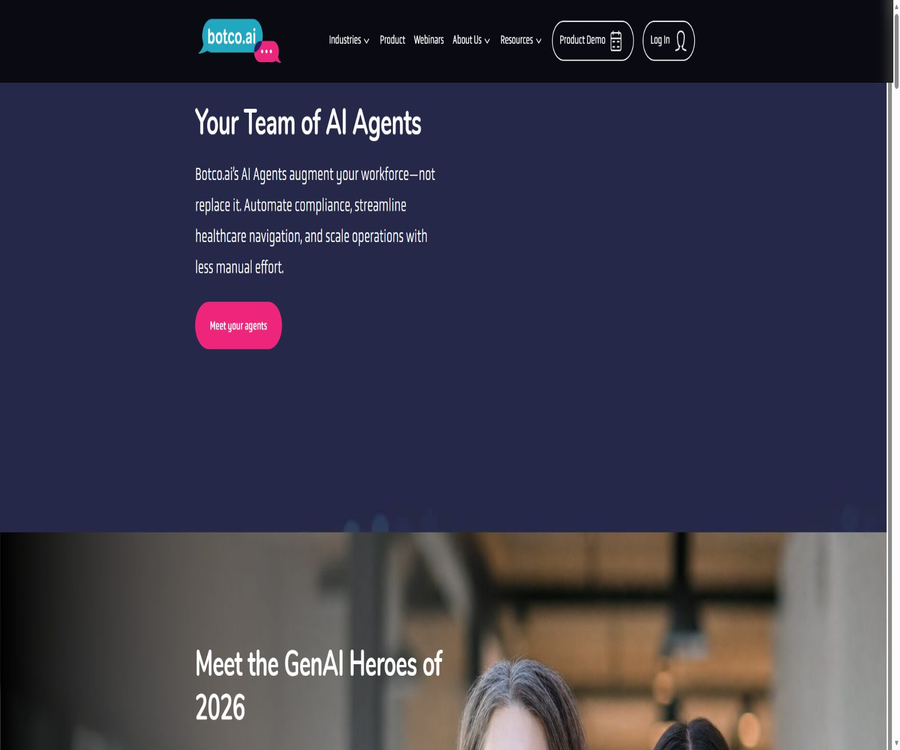
Botco.ai
Botco.ai: an intelligent tool focused on AI-driven conversations
Tags:AI dialogue chatA one-sentence summary
Botco.ai is an enterprise AI agent platform designed for the healthcare, pharmaceutical, behavioral health, and public sector; it enables the creation of intelligent assistants that can utilize organizational data to provide RAG-based knowledge answering, multi-channel dialogue, business process management, human handoff, and analysis capabilities.
Tool Introduction
Botco.ai is provided by the American company Botco.ai, Inc. Initially, it focused on conversation-based marketing and intelligent chatbots; today its official website offers task-oriented AI agents for regulated industries. This product enables teams to deploy conversation services intended for patients, customers, the general public, or internal staff, through a no-code environment, integration with industry-specific data, and enterprise integration.
The platform emphasizes that AI agents are intended to enhance existing teams rather than replace human staff entirely. In cases involving clinical matters, drug safety, insurance, public services, or other high-risk issues, it is still necessary to limit the powers of these agents and provide pathways for human intervention.
Current product positioning
| Dimension | Current location | Primary value | necessary boundary |
|---|---|---|---|
| Target industry | Healthcare, pharmaceuticals, behavioral health, and the public sector | Handling frequent inquiries and providing process guidance | It cannot replace professional diagnosis, prescriptions, or legal decisions. |
| Product format | Task-oriented AI agent network | Configure proxies based on positions or business tasks. | The scope of the task and the responsible person must be clear. |
| Knowledge approach | RAG and models optimized for organizational data | Let the answer be based on the specified knowledge and system records. | A search result that turns up does not necessarily mean that the information is correct. |
| Interaction method | Web, mobile, social, SMS, voice, images, and videos | Provide unified services through multiple channels | Various channels are subject to regional, platform-specific, and privacy regulations. |
| Delivery method | Scheduled demonstrations and enterprise implementation | Integrate with the existing system design workflow | The public page does not show the prices of self-service packages. |
Main functions
Code-free AI agent creation
Enterprise teams can create and manage AI chatbots or task agents in a code-free environment, and deploy them through centralized permission and governance controls. The older version of the documentation still includes script-based dialogue components such as Block, Card, Intent, and Entity; the current deployment should follow the latest editor available within the account.
RAG knowledge Q&A
Botco.ai makes use of a retrieval-enhanced generation framework, which allows agents to find relevant context in websites, files, knowledge bases, CRM systems, CMS platforms, EHR systems, or other authorized systems in order to provide answers. For sensitive information, it is necessary to establish versions, expiration dates, reviewers, and rules for refusing to answer questions; one cannot rely solely on the manufacturer’s claims of eliminating hallucinations.
Task-based agent
The platform can assign different agents to tasks such as clinical support, nursing visits, patient referrals, scheduling, trial screening, government services, or CRM processes. Each agent should be granted only the data and permissions necessary to carry out that specific task.
Multi-channel and multi-modal interaction
The current product page lists options for desktop and mobile Web chatting, social media channels, SMS, Voice AI, image and video interactions, as well as multilingual conversations. Authentication requirements, consent procedures, costs, and available regions for each channel need to be verified one by one during the implementation phase.
Appointment scheduling and structured data collection
AI agents can guide users through processes such as making appointments, registering, directing inquiries to the appropriate departments, and collecting structured information, sending the results to the relevant business systems. When it comes to health, insurance, or identity-related information, it is necessary to clarify the purpose of using such data, minimize the number of fields required, and verify the receiving system.
Manual transfer
The platform allows conversations that require manual handling to be forwarded to customer service agents or specialists, along with the relevant context; it is suitable for sensitive situations, high-risk scenarios, or those in which the model’s confidence level is low. The transfer mechanism must include trigger conditions, waiting instructions, service hours, and alternative channels for emergency situations.
Emotion and dialogue analysis
The Integrated Analytics Dashboard allows users to view conversation-level reports, channel performance, sentiment trends, and other operational metrics. Sentiment analysis is merely a probabilistic assessment and should not be used for automatically rejecting requests, making clinical judgments, or taking decisions that have a significant impact on individuals.
Contextual call to action
The platform can adjust the call-to-actions based on the user’s journey, the channels used, or their historical behavior, with these actions ranging from making reservations, seeking information, downloading materials, to being directed to sales representatives. The personalized rules must comply with requirements related to marketing consent, medical privacy, and anti-discrimination laws.
Enterprise system integration
The current product page lists CRM, CMS, EHR, scheduling systems, as well as various databases, data warehouses, and SaaS connections. The platform also offers API cards or custom interfaces for exchanging leads, records, and results from conversations with external systems.
Playground testing
Botco.ai Playground is used to simulate conversations in a secure testing environment, to adjust the agents and evaluate their performance, before deciding whether to deploy them in production. The test set should include normal queries, typos, multiple languages, malicious inputs, urgent requests, and requests that exceed authorized limits.
Typical working principle
- Identify the specific tasks that the agent needs to carry out, the target audience, the success metrics, and the high-risk issues that must not be addressed.
- Connect to authorized websites, files, knowledge bases, or business systems, and assign an owner and update schedule for each piece of content.
- Configure RAG retrieval, system prompts, Intent, Entity, workflows, channels, and actionable operations.
- Set up authentication, field-level permissions, sensitive information masking, manual transfer, and emergency alerts.
- In Playground, representative questions and aggressive test sets are used to verify the responses, the sources cited, and the failure paths.
- It is first released to a small group of users, and continuous optimization is carried out through dashboards, sample reviews, and manual feedback, before expanding the channels and tasks.
Getting started with deployment
- Schedule a product demonstration and inform the supplier about the industry, country, distribution channels, estimated volume of conversations, and types of data that need to be processed.
- It is required to provide security reports, compliance certificates, data processing agreements, BAA agreements, and a list of sub-processors that correspond to the actual plan.
- Choose a single, low-risk scenario for piloting, such as public information queries or basic navigation before making reservations.
- Work together with business units, compliance teams, privacy officers, security staff, and front-line employees to establish knowledge scopes, rules for refusing requests, and criteria for manual escalation.
- Connect the testing system and use masked data to verify field mapping, authentication, permissions, error handling, and logging.
- After the acceptance criteria are signed, the system is rolled out in phases, with regular retesting of the model, the knowledge base, and any changes in third-party integrations.
Establish a reliable knowledge base
- It provides an overview of the policies allowed for use by agents, service information, drug-related data, organizational pages, forms, and frequently asked questions.
- Remove duplicate, expired, or conflicting content, and record the date of publication, version, and responsible person for each document.
- Split large files into reasonable sections based on theme and semantics, while retaining metadata such as titles, applicable regions, target audience, and expiration dates.
- Standard answers are established for common questions, while strategies for declining to answer or forwarding such questions that are uncertain, high-risk, or outside the scope of coverage are defined.
- A test set is constructed using real historical cases, including error-prone examples such as numbers, dates, negative sentences, and similar diseases.
- Continuously monitor missing hits and manual modifications; after updating the knowledge base, re-index it and carry out regression tests.
Which users are it suitable for
- Medical service providers: offer patient navigation, scheduling, referrals, and answers to non-diagnostic questions.
- Behavioral health and addiction service agencies: Handle service introductions, eligibility guidance, and manual connections within safe boundaries.
- Pharmaceutical and life sciences team: Provides support for product information, patient programs, trial screening, and procedures related to adverse events.
- Local and state governments: distribute service information and guidelines, as well as handle the large number of inquiries from the public.
- Corporate customer service team: Automatically handles standard inquiries via Web, SMS, voice, or social media channels.
- Operations and Data Team: Connects the results of conversations to CRM, CMS, EHR, scheduling, and analysis systems.
- Compliance and Security Team: Regulated AI projects that require a BAA, permissions, auditing, and manual controls.
Typical use cases
- Patient Service Navigation: Answers questions regarding institutions, departments, times, and procedures, and assists in connecting patients with the appropriate personnel.
- Reservation and preliminary registration: Collect the necessary fields, determine the appropriate time slot, and enter the details into the scheduling system.
- Pre-screening for clinical trials: Users are guided to fill in information based on established standards, after which it is submitted to a qualified team for formal evaluation.
- Adverse event entry: Potential reports are identified and promptly forwarded to trained personnel; the AI does not make decisions on closing the case on its own.
- Redirecting resources for behavioral health: Providing institution-approved information and activating emergency procedures when crisis-related language is detected.
- Government services Q&A: Provides explanations regarding the documents required, operating hours, and contact methods, without issuing any legal decisions.
- Criteria for evaluating leads: Collect the requirements and sync them to CRM, after which the sales or service team takes over.
- Internal knowledge assistant: Helps employees find policies, procedures, and system information, while respecting departmental permissions.
Product advantages
- The product is specifically designed for regulated industries, and its functional features include manual handoff, role-based access controls, and mechanisms for ensuring compliance.
- The combination of RAG, task-oriented agents, and enterprise data connections enables responses to be based on an organization’s own knowledge and processes.
- It supports interaction through various channels such as the Web, SMS, voice, social media, as well as images and videos.
- Code-free environments and Playgrounds lower the barriers for business teams to get involved in development and testing.
- The analysis dashboard covers conversation, channel, and sentiment trends, making it easy to identify knowledge gaps and operational issues.
- It can be connected to CRM, CMS, EHR, databases, data warehouses, and scheduling systems, thereby reducing the need for repetitive data entry.
- The authorities provide a process for deleting conversation data, allowing end-users to submit requests without having a platform account.
Usage restrictions and risks
- Botco.ai is a product designed for enterprise use; it does not have publicly available pricing information, and its procurement process as well as integration costs may be higher than those of conventional chat tools.
- The official website uses absolute marketing claims such as “no illusions,” but RAG and fine-tuning cannot technically eliminate all errors.
- Issues related to healthcare, medicines, insurance, and public services can have real-world consequences; therefore, manual review processes and emergency pathways must be in place.
- Multilingual output may still mistranslate technical terms, dosages, times, and qualification requirements, and requires evaluation by native-speaking experts.
- Emotion analysis can be influenced by culture, language, disabilities, and ways of expression; it should not be used in high-stakes decisions where transparency is important.
- Connecting EHRs, CRMs, and third-party platforms expands the scope of data flow, and permission or mapping errors can lead to the exposure of sensitive information.
- The publicly available help materials include information on the older script editor as well as the current AI agent; account features may vary depending on the contract and version.
- The terms allow the supplier to adjust services and fees; specific SLAs, data retention policies, model details, and exit procedures must be outlined in the contract.
- The platform does not disclose unified limits regarding the volume of messages, concurrent connections, languages, as well as limits on Voice AI or API usage; these details must be confirmed during the quotation stage.
Price and procurement methods
As of August 20, 2026, Botco.ai’s official website does not disclose any fixed pricing for its packages; the main options available are to request a demo or to get in touch with sales representatives. Any historical quotes from third parties should not be presented as the current official prices.
| Project | Public status | Billing information | It should be confirmed at the time of purchase. |
|---|---|---|---|
| Product demonstration | Application is possible. | Fees not indicated | Industry, use case, channels, integration, and time to go live |
| Enterprise AI agent platform | Officially available | Custom quote | Number of agents, amount of knowledge, volume of conversations, languages, and administrators |
| System integration and implementation | Provided by project | The price is not disclosed. | One-time implementation fees, maintenance, changes, and third-party costs |
| Free trial | The terms state that it may be provided at the discretion of the relevant party. | The deadline and requirements are not publicly available. | Whether to require a payment method, deferred payment upon expiration, and data deletion |
| Subscription period | The clause specifies annual prepayment with automatic renewal. | The specific amount shall be as stipulated in the contract. | Cancelation windows, renewal notices, and non-refund policies |
Previous interviews mentioned a fixed monthly fee and a one-time integration fee, but these are not the bases for the current public quotes. Companies should request that the order details separate out the costs related to platform subscription, implementation, channels, SMS or voice services, models, storage, support, any excess usage, and third-party services.
The terms state that paid subscriptions are usually prepaid on an annual basis with automatic renewal, and the fees cannot be refunded unless required by law. Before signing the contract, it is necessary to check whether it includes this provision, as well as the rules regarding cancellation, data export, and the retention period after termination.
Channel and platform support
| Channel or platform | Support status | Primary uses | Precautions |
|---|---|---|---|
| Web Chat | Support | Consulting for desktop and mobile websites | It is necessary to configure cookies, privacy notices, and authentication. |
| Social media channels | Support | Reply in the social messaging environment | Subject to the policies of third-party platforms and data access restrictions. |
| SMS | Support | Reminders, Q&A, and workflow guidance | It is necessary to handle matters related to number approval, cancellation of subscriptions, as well as regional and carrier fees. |
| Voice AI | Listed on the product page | Voice interaction and navigation | The language, recording, transcription, fees, and coverage area need to be confirmed. |
| Images and videos | Supports interaction | Sending materials, virtual tours, or supplementary content | The content of the file and its copyright need to be reviewed. |
| Multilingual | Supports multiple languages | Serving audiences in different languages | The accuracy of professional translation needs to be assessed separately. |
| Mobile apps | Can be integrated into mobile experiences | Provide a proxy in the customer’s application. | No separate Botco.ai app store products designed for ordinary users were found. |
Integration capability
| Integrated categories | Current example | What can it be used for? | Key points for verification |
|---|---|---|---|
| CRM and marketing | Zoho CRM, Pipedrive, Pardot, Eloqua, and others | Synchronization of leads, customers, and events | Fields, consent, deduplication, and update direction |
| Databases and warehouses | MySQL, PostgreSQL, BigQuery, Redshift, Azure SQL, and others | Query or write structured data | Network, read-only permissions, auditing, and query restrictions |
| Business and Finance | NetSuite, QuickBooks, Xero, Sage Intacct, etc. | Integration of business processes and records | Financial data should not be altered arbitrarily by chat agents. |
| Documents and forms | Imported Files, Google Sheets, Excel, and SFTP | Import knowledge or structured records | Version, access scope, and sensitive fields |
| Scheduling and medical systems | Scheduling, EHR, and EMR categories | Appointments, patient workflows, and service records | BAA, minimum requirements, identity verification, and professional responsibility |
| Custom interface | API Card and project integration | Call external endpoints or create custom interactions | Authentication, timeout, errors, retries, and data minimization |
APIs and developer capabilities
According to the public information available on Botco.ai, its platform is driven by APIs, and it is possible to access enterprise endpoints through API cards; previous versions of the product also used interfaces to transmit leads, conversation records, and business data. It functions more like a tool for project-level integration, rather than a public API service that any developer can register to use.
As of this verification, no public API references, unified authentication guidelines, rate limits, SDK packages, or developer pricing could be found. Teams that need to integrate the service programmatically should request in the contract a list of interfaces, details regarding the environment and version used, error codes, information on concurrency limits, SLA requirements, and notifications for any changes.
Safety and compliance
The current product page lists information regarding HIPAA validation, SOC 2 Level 2 compliance, field-level encryption, as well as compliance with GDPR and CCPA regulations. Purchasers should inquire about the audit period, the scope of the reports, any exceptions, the actual environment in which the data is stored, and the parties involved in the contract; they should not rely solely on website badges to determine that their business is compliant.
The privacy policy states that the handling of PHI is based on a BAA, and it outlines administrative, physical, and technical protection measures. It also explains that information provided voluntarily during conversations may be processed by third parties such as Syncari, Paubox, and Twilio; therefore, the sub-processors and the specific data flow paths need to be determined prior to deployment.
- Medical clients sign a BAA before transmitting PHI, and verify that all models, integrations, and channels are included in the agreement.
- Apply the principle of least privilege to agents, administrators, APIs, and databases, and separate credentials according to environment and purpose.
- Field-level masking cannot replace data minimization; the chat interface collects only the information that is truly necessary to complete a task.
- Save consent, knowledge version, model version, responses, tool calls, manual takeover, and audit of data changes.
- Establish security tests for prompt injection, unauthorized queries, echoing of sensitive data, identity theft, and bulk data export.
- Confirm cross-border transfer, processing in the United States, backup, retention, deletion, portability rights, and notification of security incidents.
Data deletion and retention
End-users can request the deletion of conversations hosted on Botco.ai via Web, Facebook, Instagram, or SMS, without needing to have an account on the platform. Removing a social media app only stops future sharing; it does not necessarily delete the conversations that have already been saved.
The privacy policy specifies the retention period based on the purposes of data processing and legal requirements; data used for profiling can be retained for up to ten years. Companies must outline in their privacy notices the roles involved, the channels through which requests are made, any exceptions, the methods of verification, and the division of responsibilities regarding data processing with Botco.ai.
Is it open source?
Botco.ai is a closed-source commercial SaaS product, and its terms of service prohibit decompilation, reverse engineering, or any attempts to obtain the source code. There is no publicly available repository containing the source code of this product, as verified by its official website.
API integration, documentation, or third-party connections do not indicate that the platform is open source; moreover, no official open-source SDK license was found. The open-source status of items in the catalog should be clearly marked as non-open source.
Basic information
| field | Content |
|---|---|
| Tool name | Botco.ai |
| Development company | Botco.ai, Inc. |
| Tool type | Enterprise AI agents, RAG Q&A, and multi-channel dialogue platforms |
| Key industries | Healthcare, pharmaceuticals, behavioral health, and the public sector |
| Core competencies | Code-free building, RAG, workflows, manual handoff, analytics, and system integration |
| Primary channels | Web, social media, SMS, Voice AI, mobile, images, and videos |
| Price pattern | Book a demonstration and get a customized quote for businesses |
| Free version | No public permanently free version was found. |
| Free trial | The terms state that it may be provided; current eligibility and deadline are not disclosed. |
| API | Project-level interfaces and API Cards are provided; no public developer APIs were found. |
| Official SDK | No findings were detected. |
| Official GitHub | No certified product warehouses were found. |
| Is it open source? | Not open source |
| Chinese support | Multi-language dialogue is supported, but no complete official instructions in Chinese for the management interface are available. |
| Compliant wording | The official website lists HIPAA, SOC 2, GDPR, and CCPA; the scope thereof requires verification through a contract. |
Recommendation score
The recommendation score is 4.0 out of 5 points. Botco.ai offers RAG, task automation, multi-channel communication, human handoff, system integration, and analysis services for regulated industries; it is suitable for organizations that need to implement compliance-related solutions.
The deductions are mainly due to issues such as public pricing, API specifications, usage limits, and insufficient technical details; furthermore, the statement on the official website claiming \"no illusions\" is too absolute. Buyers should rely on formal evaluations and contracts to verify accuracy, security levels, and operational responsibilities, rather than relying solely on demonstrations.
Frequently Asked Questions
What is Botco.ai? What tool is it?
It is an AI agent platform for enterprises in regulated industries, capable of providing multi-channel Q&A services, business process management, and human handover based on organizational knowledge and system data.
Is Botco.ai still in operation?
It is still in operation. The official website continues to display products, provide login options, offer demonstrations, present industry solutions, and include a page for data deletion; its function has evolved from that of a marketing chat tool in the early stages to that of a task-oriented AI agent.
Is Botco.ai suitable for medical diagnosis?
It should not be used as an independent diagnostic tool. It is more suitable for helping patients navigate, schedule appointments, get answers to their questions, and follow the appropriate procedures; clinical judgments, treatment decisions, and handling of emergencies must be left to qualified professionals.
Does the platform really have no illusions?
No absolute guarantee can be provided. RAG, fine-tuning, proprietary knowledge, and testing can help reduce errors, but retrieval failures, outdated information, prompt attacks, and model reasoning can still lead to inaccurate responses.
Is Botco.ai free?
There is no publicly available permanent free version or fixed price. The official website requires an appointment for a demonstration; the terms state that the supplier may offer a limited-time trial at its discretion, with the specific conditions to be confirmed by the sales team.
How is the pricing?
Currently, custom quotes tailored for businesses are used. The terms specify annual prepayment and automatic renewal; the actual costs may include subscription fees, implementation costs, integration costs, channel-related expenses, model-related costs, usage-based charges, and support services.
Which channels are supported?
The product page lists Web chatting, social media channels, SMS, Voice AI, mobile experience, image and video interactions, as well as multilingual conversations. The scope of availability depends on the contract and third-party platforms.
Can it be connected to EHR and CRM?
CRM, CMS, EHR, scheduling tools, databases, and other enterprise systems can be connected as needed. When dealing with PHI, a BAA must be signed, and permissions, sub-processors, and data pathways must be verified.
Is it possible to have human customer service take over?
It supports configurable manual transfer, and allows the conversation context to be passed on to a human operator. This process should be used prioritarily for high-risk, low-confidence cases, complaints, and urgent issues.
Does Botco.ai offer a public API?
Public information indicates the presence of API-driven integration and API Cards, but no complete set of public developer APIs, SDKs, rate limits, or options for generating keys are available. Companies must obtain the necessary specifications through their sales and implementation teams.
Is Botco.ai open source?
It is not open source. No official repository containing the source code has been found, and the terms of service explicitly prohibit decompilation and access to the source code.
Are customer data used to train public models?
The official website states that corporate data remains private and that no public models are trained, but companies should still specify in the contract all model providers, as well as the rules regarding logging, data retention, fine-tuning, and human access. The promotional material on the website cannot replace the terms related to data processing.
Can conversation data be deleted?
A deletion request can be submitted, and end-users do not need to have an account on Botco.ai. Removing an application from a social platform does not necessarily mean that existing conversations are deleted; usually, a separate request must be made following the platform’s official deletion procedures.
What should be assessed thoroughly before going live?
It is necessary to evaluate knowledge accuracy, factual correctness, privilege escalation, privacy issues, multilingual support, manual transfers, emergency situations, system writing capabilities, and peak load. For each high-risk failure scenario, there should be a defined default security response.
Tools similar to Botco.ai




 Guigong Network Security Registration No. 45132202000164