






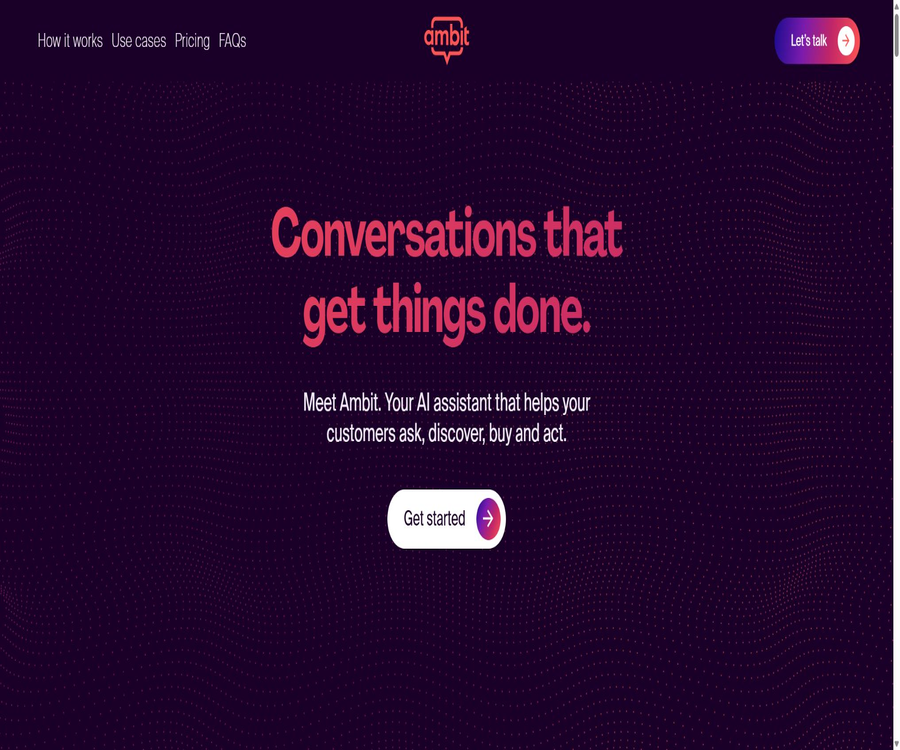
Ambit AI
Ambit AI: an intelligent tool focused on AI-driven conversations
Tags:AI dialogue chatAmbit AI is an AI agent platform designed for enterprise customer service, sales assistance, and internal knowledge queries. It converts brand content into conversational responses, and uses scripted processes to guide users through booking appointments, making purchases, submitting tasks, or being connected to human customer service representatives.
What is Ambit AI?
Ambit was developed by the New Zealand-based company Ambit AI Powered Limited, and it began operating in 2017. This platform integrates scripted natural language processing, retrieval-enhanced generation, and generative AI, and it is designed to serve organizations that need a consistent brand voice as well as controlled business processes.
Main functions
- Read web pages, PDFs, documents, videos, and approval links.
- Build RAG knowledge answers based on corporate data.
- Create a brand name, image, and tone of voice.
- Configure action workflows for scheduling, recommendations, submission, and querying.
- Deploy AI agents on websites and other communication channels.
- Handle common sales and service issues around the clock.
- Transfer to the human team with the context when necessary.
- Track user emotions, feedback, and NPS.
- Connects CRM, customer service, collaboration, and industry systems.
- Understand popular topics and usage by analyzing the pages.
RAG knowledge base
AI agents retrieve content from web pages, PDFs, videos, and documents approved by the enterprise in order to provide answers, rather than relying solely on the memory of general models. RAG helps reduce the occurrence of unfounded responses, but errors can still occur if the information is outdated, the retrieval is incorrect, or the question falls outside the scope of the available knowledge.
Scripted dialogue flow
Companies can establish call-to-action workflows that guide users at appropriate points in the conversation to schedule appointments, find solutions, complete tasks, or take further action. While these script-based workflows offer a degree of control, complex scenarios still require ongoing testing and maintenance by business professionals.
Branded AI agents
The agent’s name, character profile, interface, and tone can be customized to match the brand, and they can be deployed on websites or other platforms. Branding helps ensure consistency, but it should not lead users to believe that the AI is a real person; clear disclosure is necessary when important decisions need to be made.
24/7 customer service
The platform can answer common questions, assist with making appointments, guide customers through purchasing processes, and provide relevant information outside of business hours. It is suitable for dealing with frequent, standard inquiries, while complaints, exceptions, and high-risk transactions should still be handled by human staff.
Transfer to live customer service
Plans starting with Full Suite and higher support the redirection of users to live chat or customer support teams, along with the transmission of the collected context information. When deploying such systems, it is necessary to define the trigger conditions, waiting times, assignment of tickets, and backup procedures in case of failures.
Emotions, feedback, and NPS
The platform can collect customer feedback, analyze emotions, and support the NPS loop, which helps to identify issues with the user experience as well as popular needs. Emotional assessments are based on probabilistic results, and therefore cannot be used alone for rejecting services, evaluating employees, or making high-risk decisions.
Sales and purchase guidance
AI agents can compare products, explain the differences between options, recommend next steps, and collect information on potential customers. When it comes to prices, inventory levels, eligibility criteria, and contracts, it is necessary to connect to authoritative business systems and display the date of data update.
Internal knowledge and employee services
In addition to external customer service, Ambit can also be used for HR tasks, internal communication, intranets, and providing knowledge queries for member organizations. In employee-related scenarios, it is necessary to isolate permissions by role in order to prevent access to information that should not be made available across different departments.
Supported integrations
- CRM systems such as HubSpot.
- Customer service tools such as Salesforce.
- PMS and industry business systems.
- Internal collaboration tools such as Slack and Microsoft Teams.
- Companies develop their own systems and databases.
- Custom APIs developed to meet specific requirements.
Which users are it suitable for
- Companies that have a large number of customer inquiries and relevant content materials.
- Teams that wish to offer round-the-clock services on their website.
- Retail and e-commerce companies that need branded sales assistants.
- Governments and public agencies that provide complex policy information.
- Organizations that require member Q&A and service processes.
- Large and medium-sized enterprises that wish to connect their CRM systems with customer service systems.
- Companies that need internal HR or knowledge assistants.
Typical use cases
- Answer common questions about products, policies, and services.
- Help customers compare packages and benefits.
- Guide reservations, registrations, and lead capture.
- Providing product recommendations on e-commerce websites.
- Handle inquiries related to travel, insurance, and membership information.
- Explain HR policies and reimbursement procedures to employees.
- Collect feedback, sentiment, and NPS data.
- In case of complex issues, connect with a human customer service representative.
It’s not very suitable for which situations
- A personal website with only a small number of visits and very few issues.
- Users who wish to use a permanently free chatbot.
- Technical teams that require a completely offline, open-source deployment.
- There are no organizations that compile authoritative knowledge materials.
- Companies that are unable to arrange for manual handling of upgrade issues.
- Scenarios in which AI is used directly for medical diagnosis or legal decisions.
- The budget is not sufficient to cover the monthly subscriptions for the early-stage projects.
Apply for a demonstration tutorial
- Identify the areas of services, sales, or internal knowledge that you wish to improve.
- Statistically analyze monthly chat volumes, channels, and frequently asked questions.
- Organize the web pages, documents, and systems that need to be integrated.
- Schedule a product discovery meeting of about 20 minutes.
- A demonstration of RAG-based responses, the action workflow, and manual handover is required.
- Confirm the package, implementation timeline, and any additional costs.
- Create a sandbox using your own data and then reassess the procurement.
Tutorial on Building Knowledge Agents
- Choose a business topic with clear boundaries.
- Remove duplicate, expired, and conflicting information.
- Upload or connect approved web pages and documents.
- Define the proxy tone, refusal scope, and escalation rules.
- Testing is carried out using real questions and adversarial questions.
- Have business experts verify the answers and the sources cited.
- After going live, the content is continuously updated based on the failed conversations.
Tutorial on designing action workflows
- Clarify the business action that needs to be completed as a result of the conversation.
- List the minimum necessary fields for collecting information.
- Design normal paths, abnormal paths, and cancellation paths.
- Configure buttons, questions, and system calls.
- Set high-risk steps that require manual confirmation.
- Verify the system’s write results in the testing environment.
- Monitor completion rates, abandonment rates, and reasons for errors.
Manual transfer tutorial
- Define trigger conditions such as complaints, payments, identity, and low confidence.
- Connect to real-time chat or customer support systems.
- Decide which queue and skill group to assign it to.
- Pass the conversation summary and collected information to a human.
- Shows the waiting time and optional alternative channels.
- Test the fallback mechanisms in the event of unattended operation and system failures.
- Review the transferred conversations and update the knowledge base.
Price packages
| Package | Monthly fee | Dialogue and workflow quotas | Accounts and Support |
|---|---|---|---|
| Core | 1250 dollars | 5 action workflows, up to 50 generative themes, around 3,000 to 5,000 conversations per month | Up to 3 slots for the portal, basic analysis |
| Full Suite | 2500 dollars | Up to 20 action flows, 100 topics, and 10,000 chats per month | Up to 5 seats for the portal, platform configuration, customer success manager |
| Enterprise | Contact sales | Up to 50 action workflows, 20,000 chats per month | Unlimited seats, customized analysis, and high-level customer success support |
Core solution
- Targeted at medium-sized enterprises, startups, and internal business units.
- Deploy self-service AI agents on the website.
- 5 action processes are provided.
- Up to 50 generative dialogue topics are supported.
- There are around 3,000 to 5,000 conversations per month.
- Up to 3 portal seats are provided.
- Basic analysis retains data for 1 year.
- It includes features for feedback, emotions, and NPS.
Full Suite solution
- Supports unified management across multiple channels.
- Up to 20 action workflows can be provided.
- Up to 100 generative themes are supported.
- Each month includes 10,000 chats.
- It is possible to route to real-time chat or the customer support team.
- Includes core integrations for CRM and customer service.
- Provides enhanced analytics and customer success managers.
- Optional Uneeq digital human capabilities.
Enterprise plan
- Includes all the capabilities of the Full Suite.
- Up to 50 action workflows can be provided.
- Each month includes 20,000 chats.
- Custom integration of industry software and similar applications is supported.
- There are no limits on the number of real-time chat sessions with AWS on this platform.
- Customized analysis dashboards retain data for 2 years.
- It offers white-glove hosting and high-level customer success support.
Additional usage and total cost
Core explicitly states that additional chat credits can be purchased, and it should also be confirmed that extra usage is charged for other packages. The total cost may also include costs related to knowledge organization, custom integration, digital avatars, channel fees, implementation services, and internal operational staff.
Demonstrations and sandbox environments
The official website offers the possibility to schedule demonstrations, and it states that sandboxes can be created allowing potential customers to upload certain links in order to converse with their AI agents. Sandboxes are suitable for testing the quality of responses, but sensitive or restricted materials should not be uploaded.
Implementation cycle
According to the official FAQ, a standard platform is usually ready for use within 2 to 4 weeks; however, complex APIs and integrations can extend this timeline. A proper plan should also include content cleanup, testing, compliance checks, training, and a monitoring period after deployment.
Data analysis
| Analytical ability | Core | Full Suite | Enterprise |
|---|---|---|---|
| Use topics that are popular. | Foundation | Platform and Google Analytics | Customized dashboard |
| Feedback, emotions, and NPS | Foundation | Enhance | Customizable |
| Data retention | 1 year | 1 year | 2 years |
| Configure access | Portal | Portals and platforms | No limit on seats |
APIs and developer capabilities
Ambit can be connected to existing CRM, customer service, collaboration, and industry-specific systems; for tools that do not have pre-built support, custom APIs can be developed. The public interface lacks complete endpoints, rate limits, and separate API pricing documentation, so these details need to be determined as part of the project scope.
GitHub and the open-source status
Ambit AI has an official organization on GitHub, and it has made components such as the Bot Framework location selector and emotion analysis tools available to the public. However, the core Ambit platform, the RAG system, the administration interface, and the business model remain undisclosed; as a result, the entire product is still a closed-source service.
Safety and privacy
Customer conversations may contain information related to identity, accounts, and business activities; therefore, companies must determine the location where such data will be stored, the retention period, encryption methods, access rights, sub-processors involved, and the procedures for deleting this data. For high-risk operations, authentication is necessary, and human approval must be obtained.
Content maintenance
The accuracy of RAG agents depends on the quality of the data; after new policies are introduced, the knowledge base should be updated accordingly and older versions removed. The team needs to assign responsible persons for managing the content and establish regular review cycles, rather than leaving it unattended for a long time after it is put into use.
Product advantages
- Combining script workflows, RAG, and generative dialogue.
- The answer is derived from the documents approved by the company.
- Supports customization of brand names, tone, and interface.
- The conversation can be directed toward actual business actions.
- It supports seamless handover to human customer service.
- It covers customer service, sales, and internal knowledge.
- Provides emotional insights, feedback, and NPS analysis.
- It supports enterprise system integration and hosting services.
Usage restrictions
- The starting price is $1,250 per month.
- Both Core and Full Suite have limits on the number of chats and processes.
- Complex integration may take more than 2 to 4 weeks.
- RAG may still retrieve incorrect information or produce inaccurate answers.
- Emotion analysis cannot replace human judgment.
- The public API technical documentation is limited.
- Sensitive operations require strict permissions and manual approval.
- The core platform is not open source.
Basic information
| Project | Content |
|---|---|
| Tool name | Ambit AI |
| Development company | Ambit AI Powered Limited |
| Date of establishment | 2017 |
| Location | New Zealand |
| Tool type | Enterprise AI customer service and dialogue agents |
| Core technology | Script NLP, RAG, and generative AI |
| Primary channels | Websites, social media, and corporate communication channels |
| Price pattern | Monthly subscriptions and enterprise quotes |
| Whether API is provided | Supports integration and customized APIs |
| Is it open source? | The platform is not open-source; the developers provide only a small number of open-source components. |
Recommendation score
The comprehensive recommendation score is 4.1 out of 5 points. Ambit is suitable for companies that have a large amount of knowledge-based content and require branded services as well as system integration; however, small and medium-sized teams should first test its value in a sandbox environment and consider the costs associated with excessive messaging and ongoing content maintenance.
Frequently Asked Questions
What is Ambit AI?
It is a platform for enterprise AI customer service and dialogue agents, capable of answering questions and carrying out guided processes based on internal data.
What is the difference between Ambit and ordinary chatbots?
It combines script-based NLP, RAG, and generative AI, with an emphasis on branding, action workflows, and enterprise integration.
What types of files can be uploaded?
Web pages, PDFs, documents, videos, and approved links can be used as sources of knowledge.
Can I be connected to a human customer service representative?
Full Suite and Enterprise support manual routing, as well as the transfer of the collected conversation context.
How much is Ambit AI?
Core costs $1,250 per month, Full Suite costs $2,500 per month, and for Enterprise, you need to contact sales for a quote.
Is there a limit on the number of chats per month?
Yes: Core version requires around 3,000 to 5,000 executions, the Full Suite version needs 10,000 executions, and the Enterprise version requires 20,000 executions; additional usage amounts need to be confirmed.
How long before it can go live?
Standard projects usually take 2 to 4 weeks, while complex integrations and APIs will prolong the timeline.
Are APIs provided?
It supports integration with CRM, customer service, and collaboration systems; custom APIs can also be developed for specific projects.
Is Ambit AI open source?
The core platform is not open source; only some of the individual components are made available on the official GitHub repository.
Tools similar to Ambit AI




 Guigong Network Security Registration No. 45132202000164