






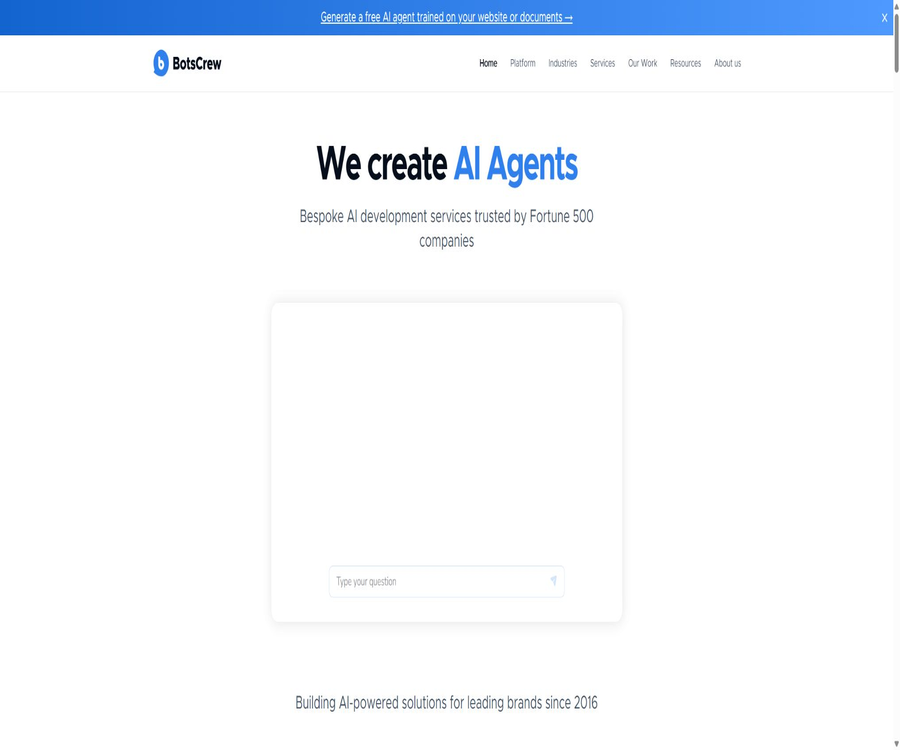
#1 Chatbot Development Company
#1 Chatbot Development Company, specializing in intelligent tools for AI-driven conversations
Tags:AI dialogue chatWhat is BotsCrew?
BotsCrew is a company specializing in the development of enterprise-level conversational AI and generative AI technologies. Founded in 2016, it offers a comprehensive range of services that cover everything from identifying requirements and providing strategic advice to creating prototypes, deploying solutions in production, and ensuring ongoing optimization. Its main focus is on developing AI agents, voice assistants, and chatbots tailored to the needs of businesses.
BotsCrew also offers an enterprise AI Agent platform that enables teams to train, orchestrate, and manage different types of agents. It does not simply sell a fixed template; instead, it combines a platform, engineering teams, integration capabilities, and ongoing support into a complete solution for projects.
Products and Services Composition
| Products or services | Main function | Appropriate stage |
|---|---|---|
| AI strategic consulting | Identify opportunities, assess readiness, and plan a roadmap. | Before project initiation |
| Discovery phase | Verification use cases, data, architecture, costs, and metrics | From concept to prototype |
| Development of custom AI Agents | Create intelligent agents that are in line with the company’s processes. | Development and production |
| Enterprise AI Agent Platform | Train, orchestrate, deploy, and manage multiple agents | Launch and operation |
| Voice agent | Handling phone calls, voice interactions, and IVR-based alternatives | Customer service and marketing |
| Classic chatbot | Process high-frequency standard tasks using a controlled workflow. | FAQs, forms, and compliance scenarios |
| Ongoing optimization and support | Monitor performance, resolve issues, and expand capabilities | Production and operations |
Core functions
- Train AI Agents through web pages, documents, or knowledge bases.
- Use visual workflow orchestration to manage conversations and business logic.
- Create generative AI agents, voice agents, and traditional chatbots.
- RAG ensures that responses are based on knowledge approved by the enterprise.
- Connects CRM, help desk, calendar, payment, and internal systems.
- It can be deployed via websites, WhatsApp, Facebook, text messages, Slack, and other channels.
- Create different agents for employees, customers, sales, or data analysis.
- Configure manual routing, permissions, approval processes, and exception handling.
- Update the content via the backend and continuously monitor its performance.
- It addresses complex requirements beyond custom-developed processing platforms.
Three types of dialogue products
| Type | Features | Typical tasks |
|---|---|---|
| AI Agent | Capable of understanding context, using tools, and handling complex tasks. | Internal assistant, sales, support, and data querying |
| Voice agent | Communicate through natural speech and handle interruptions. | Replacement for telephone customer service, marketing campaigns, and IVR systems |
| Classic chatbot | Following the established process ensures more predictable results. | FAQs, qualification collection, forms, and regulated processes |
Enterprise AI Agent Platform
The BotsCrew platform is used to create and manage different AI Agents within a single interface. Companies can have their business staff update knowledge and processes, while the development team can connect more complex systems and operations.
- Visualize the creation of branches, conditions, and automated actions.
- Upload materials or scrape content from specific companies to create a knowledge source.
- Create isolated agents for different departments.
- Unified management of web pages and messaging channel deployment.
- Maintain a hybrid approach that combines classic processes with generative responses.
- Complex configurations and expansions are handled through manual support.
- Use feedback to iteratively refine prompts, knowledge, and tools.
AI strategic consulting
Consulting services do not merely produce conceptual reports; instead, they identify practical use cases by taking into account business objectives, data, technology, skills, and compliance readiness. The official process also includes ROI analysis, prioritization, architecture definition, an implementation roadmap, and rapid pilot projects.
- Interview management and frontline teams to identify the real business issues.
- Evaluate the readiness of data, systems, processes, skills, and policies.
- Compare the value, risks, and implementation difficulty of multiple AI use cases.
- Establish benchmarks and key metrics for candidate use cases.
- Design roadmaps for three months, six months, or twelve months.
- Estimate development time, team requirements, and overall costs.
- Use small-scale pilots to verify data and user acceptance.
- Establish a feedback and continuous improvement mechanism for promotion across the entire company.
Discovery phase and prototype
The discovery phase is used to verify issues, data, and technical approaches prior to large-scale development. For enterprise AI, this step enables the identification of hidden problems such as document inconsistencies, system permissions, answer accuracy, and integration costs.
- Define the target users, business tasks, and success criteria.
- Check the completeness and searchability of the knowledge documents.
- Determine whether to use generative AI, rule-based processes, or a hybrid architecture.
- Design dialogue, tool invocation, and manual takeover processes.
- Create prototypes or proof of concepts and have real users test them.
- Estimate the production architecture, usage, and maintenance costs.
- Define the scope of development, timeline, and risk list.
Knowledge base and RAG
Companies can have agents answer questions by referring to websites, documents, and knowledge bases, rather than relying solely on the model’s memory. For production deployment, it is still necessary to handle tasks such as content segmentation, permissions, versions, citations, updates, and strategies for dealing with unanswered questions.
- Only materials approved by the business manager are included.
- Set access boundaries for different customers, regions, and positions.
- Retain the content version, update time, and responsible person.
- Mandatory verification is imposed on numbers, policies, and product specifications.
- Set to reject requests or transfer them to a human agent when there is not enough evidence.
- The quality of recall and responses is continuously tested using real-world problem sets.
Voice agent
Voice agents are suitable for phone support, interactive events, and scenarios where a screen is not required; they can understand the context and handle interruptions from users. Before being put into use on a large scale, issues such as voice latency, accents, noise, audio notifications, phone numbers, and manual transfers need to be addressed.
- Automatically answers common inquiries and collects the necessary information.
- Route complex or sensitive calls to a human agent.
- Provide a branded voice experience in marketing campaigns.
- It replaces some of the traditional IVR menus with complex hierarchies.
- Generate a call summary and update the business system.
- The test covers accents, silence, talking over others, and background noise.
Classic chatbot
Classic robots carry out tasks by following fixed procedures and rules, making them suitable for scenarios where a stable output, clear steps, or strict control is required. Although they lack the flexibility of generative agents, it is easier with them to test all possible scenarios and meet approval requirements.
- Frequently asked questions and policy inquiries.
- Judgment of clue eligibility and form collection.
- Booking, reminders, and status checks.
- Conduct customer communications in accordance with the approved script.
- It is necessary to determine the process for fields and fixed results.
- A fallback option when generating a response fails.
Channel and system integration
The official website’s platform page lists the various deployment methods such as web pages, WhatsApp, Facebook, SMS, and Slack, and emphasizes the possibility of connecting to third-party systems. The actual channels, regions, template approvals, and message costs need to be checked separately as part of the plan.
- Web chat components and brand pages.
- Corporate messaging and social platforms.
- SMS and mobile messaging scenarios.
- Internal collaboration tools such as Slack.
- CRM, help desk, and customer database systems.
- Calendar, scheduling, payment, and order services.
- Internal data warehouses, documents, and business interfaces.
How to launch the BotsCrew project
- Choose a use case with a clear business objective and measurable outcomes.
- Prepare the existing processes, conversation records, knowledge materials, and system inventory.
- Conduct requirement interviews and AI readiness assessments with BotsCrew.
- Identify the target audience, channels, language, compliance requirements, and requirements for manual intervention.
- Complete the discovery phase and identify knowledge, models, architectures, and integrations.
- Build a proof of concept using limited knowledge and a user base.
- Use real-world problems to test accuracy, security, and completion rate.
- Based on the results, determine the production scope, budget, and launch plan.
- Publish at a low volume and maintain manual monitoring.
- Continuous improvement based on logs, feedback, and business metrics.
Online acceptance process
- Create test sets for standard problems, boundary problems, and adversarial problems.
- Check whether each key response can be traced back to the approved knowledge.
- Verify login, identity, roles, and data permissions.
- Test the failures, retries, and repeated operations of each external system.
- Check the message format, buttons, and session status across various channels.
- Verify model rejection, manual transfer, and emergency escalation.
- Conduct load, latency, monitoring, and disaster recovery tests.
- Verify the privacy notification, consent, retention, and deletion processes.
- Have the business, legal, security, and customer service teams sign off on the approval.
- After going live, continuous random checks are carried out to record the versions of the models and knowledge.
Pricing and Budgeting
The BotsCrew official website does not list any standardized package options or pricing for projects; formal cooperation requires consultation. The figures provided in the official price guide serve as reference values for the industry and various projects, and they are not fixed prices for individual customers.
| Development approach or project | Reference ranges in official content | Explanation |
|---|---|---|
| Simple GPT prototype | It is available starting from around $2,000. | It usually does not involve complex integration or production support. |
| Low-budget concept demonstration | A limited prototype can be created for around 5,000 dollars. | It is not equivalent to a secure and scalable enterprise system. |
| Common customization projects | Many projects start at a cost of between 10,000 and 49,000 dollars. | The range comes from market projects cited in official articles. |
| Traditional custom chatbots | Historically, it ranges from about 5,000 to 200,000 dollars. | There are significant differences in complexity, channels, and integration. |
| AI for complex enterprises | It could be over 500,000 dollars. | Involves multiple systems, compliance, scalability, and long-term support |
| Official quote from BotsCrew | Request a quote as needed | A more reliable budget can be established only after the discovery phase. |
What determines the cost?
- Number of use cases and complexity of business processes.
- The quality, format, and permissions of knowledge data.
- Number of systems and channels that need to be connected.
- Voice, text, multilingual, and multimodal capabilities.
- Generative models, hosting, and usage costs.
- Security, privacy, HIPAA, or other compliance requirements.
- Goals for simultaneous online users, response time, and availability.
- Management backend, analysis, manual intervention, and auditing capabilities.
- Discovery, design, development, testing, and deployment support.
- Maintenance, monitoring, and continuous optimization after going live.
The costs should be listed separately when providing a quote.
| Cost layer | Possible content | Check the key points |
|---|---|---|
| Discovery and Consultation | Interviews, audits, use cases, roadmaps, and prototypes | Deliverables and intellectual property rights |
| The platform might allow it. | Admin dashboard, proxy, and channel capabilities | Number of users, number of environments, and usage volume |
| Custom development | Dialogue, tools, business logic, and interface | Range changes and acceptance criteria |
| Third-party services | Models, messages, calls, cloud, and data tools | Whether to resell and what the price increase will be |
| Security and compliance | Testing, documentation, auditing, and data isolation | Authentication does not mean that all deployments will automatically meet the compliance requirements. |
| Ongoing support | Monitoring, repair, knowledge, and model optimization | Service level, response time, and monthly working hours |
Which users are it suitable for
- Large and medium-sized enterprises that need customized customer service agents.
- Teams that wish to integrate AI with CRM and internal processes.
- Organizations with clear requirements regarding security, compliance, and service levels.
- Customer experience teams that need a unified solution for text and voice.
- A management team that prefers to consult and conduct pilot projects first before expanding gradually.
- Healthcare, tourism, retail, and other industries involving high levels of customer interaction.
- Digital agencies that require a white-label solution or that deliver robots to clients.
Typical use cases
- Automatically answer customer questions and transfer them to a human agent when necessary.
- Help employees search for processes in the internal knowledge base.
- Collect sales leads and synchronize them with CRM.
- Schedule appointments, set reminders, and check status.
- Use voice agents to handle calls or marketing interactions.
- Let the data analysis agent answer questions related to controlled operations.
- Provide educational, administrative, and diversion support in medical settings.
- Manage white-label bots for multiple brands or customers.
Product advantages
- It offers comprehensive services ranging from strategy and discovery to production and optimization.
- It also supports generative Agents, voice-based robots, and traditional process robots.
- The platform is combined with custom engineering, allowing complex requirements to go beyond the limitations of templates.
- Supports multi-channel and third-party system integration.
- Agents can be trained using corporate websites, documents, and knowledge bases.
- Emphasize validating projects using business metrics and ROI.
- The official website shows corporate clients and the results of actual projects.
- It offers SLAs, white-labeling services, confidentiality agreements, and capabilities for compliance-related tasks.
- It is suitable for gradual expansion from small-scale pilots to enterprise deployment.
- Experience with long-term conversational AI projects.
Usage restrictions and precautions
- There is no publicly available standard package, so it is not possible to determine the exact total cost at this early stage.
- Custom projects require longer cycles for discovery, development, and acceptance.
- The price ranges mentioned in the article are not fixed quotes from BotsCrew.
- Third-party models and messaging channels incur ongoing usage fees.
- A poor quality knowledge base directly reduces the accuracy of responses.
- Complex integration increases costs related to security, testing, and maintenance.
- Generative agents may produce hallucinations and perform actions beyond their authorized scope.
- In high-risk scenarios such as healthcare, robots cannot be regarded as professionals.
- Multi-channel launch is also affected by the policies of various platforms and regional restrictions.
- Compliance capability must be achieved in conjunction with the customer’s configuration and the contract.
- The long-term effectiveness depends on continuous monitoring, content maintenance, and employee cooperation.
- The publicly available GitHub projects are outdated and do not reflect the source code of current commercial platforms.
Safety and privacy
The official website claims to offer confidentiality agreements, service level guarantees, as well as compliance with HIPAA and GDPR regulations. Companies still need to evaluate the actual implementation, as a supplier’s experience or the claims made on its website do not guarantee that each robot will meet all relevant regulations.
- Clarify the data processing roles of the customer and BotsCrew respectively.
- Confirm the data region, sub-processor, and cross-border transmission.
- Restrict access to knowledge, conversations, and tools.
- Implement masking, encryption, and control for sensitive fields.
- Record the model, prompt, knowledge, and tool version.
- Establish security incident, deletion request, and audit processes.
- In high-risk industries, professional personnel are assigned to make the final decision.
GitHub and the open-source status
On GitHub, there is an organization named BotsCrew-projects belonging to BotsCrew; its homepage points to its official website, and it has made available code related to chatbot frameworks. The most recent activity in its main repositories dates back to some time ago, so they cannot be considered as complete source code for current enterprise AI Agent platforms.
| Project | Open state | Explanation |
|---|---|---|
| botscrew-projects organization | Public | It can be confirmed that it is associated with the BotsCrew official website. |
| Historical Robot Framework | Partial open source | Early projects that included modules such as the core and Messenger. |
| Current enterprise platform | Open source not indicated | Delivered through commercial services and platforms |
| Customer-customized code | In accordance with the contract | Ownership and usage rights must be specified in the agreement. |
| Self-hosting | Price needs to be confirmed by inquiry. | The official website does not offer any standardized, publicly available deployment packages. |
Basic information
| field | Content |
|---|---|
| Tool name | BotsCrew |
| Date of establishment | 2016 |
| Tool type | Enterprise AI Agent platforms and custom development services |
| Key capabilities | Generative AI, RAG, voice agents, and traditional chatbots |
| Service phase | Strategy, discovery, development, deployment, and continuous optimization |
| Public self-service trial | An interface for generating AI Agents is provided; the enterprise platform is primarily used for demonstration purposes. |
| Public fixed package | Not provided |
| Official price | Request a quote by project |
| Is white-labeling supported? | The official website indicates support. |
| Is it open source? | Commercial platforms are not open-source; there are some early open-source projects. |
| Suitable for | Companies that require customization and integration, along with digital agencies |
Recommendation score
4.4 / 5. BotsCrew is suitable for organizations that need consulting services, custom development, enterprise platforms, and integrated ongoing support – especially for complex dialogue and voice-related projects. If a small team only requires affordable self-service robots, it is better to consider standardized SaaS solutions first.
Frequently Asked Questions
Is BotsCrew a platform or a development company?
Both. It offers a corporate AI Agent platform, and professional teams are responsible for providing consulting services, carrying out analysis, custom development, system integration, and ongoing optimization.
What AI products can BotsCrew create?
It is possible to create generative AI agents, voice agents, traditional chatbots, internal knowledge assistants, customer service agents, sales agents, and data analysis agents, among others.
Which channels are supported?
The official website’s platform page lists channels such as web pages, WhatsApp, Facebook, text messages, and Slack; the specific regions where these services are available, the associated costs, and any account requirements must be confirmed on a case-by-case basis.
How much is BotsCrew?
There is no unified public pricing. Official articles indicate that the simple GPT prototype can cost around $2,000, while complex corporate projects can cost hundreds of thousands of dollars; the actual price depends on the scope of the project.
Are the price ranges mentioned in the article for the official packages?
No. They are used to explain the costs and budget factors associated with industry projects, and they cannot replace the formal quotes provided by BotsCrew for specific requirements.
Does it support the healthcare industry?
It supports medical dialogue projects and promotes the capabilities related to HIPAA, but each project still requires an independent compliance assessment based on the data, intended use, deployment method, and contract terms.
Can it be connected to an enterprise’s existing systems?
Third-party integration is possible; common systems include CRM, help desks, calendars, payment systems, knowledge bases, and internal systems. The specific interfaces and permissions need to be determined during the discovery phase.
Is it necessary to go through a discovery phase first?
Complex projects are necessary. During the discovery phase, it is possible to verify data, accuracy, architecture, integration, costs, and various metrics in advance, thereby reducing the risks associated with a full-scale development effort.
Is BotsCrew open source?
The current commercial platform is not labeled as open source. The official GitHub organization contains some older code related to robot frameworks, but this does not represent the entire source code of the platform in use today.
Is it suitable for small businesses?
If customization and integration are required, consultation is available; for simple FAQs with a limited budget, standardized chatbots are usually faster and their costs are easier to predict.
Tools similar to those of #1 Chatbot Development Company



 Guigong Network Security Registration No. 45132202000164