






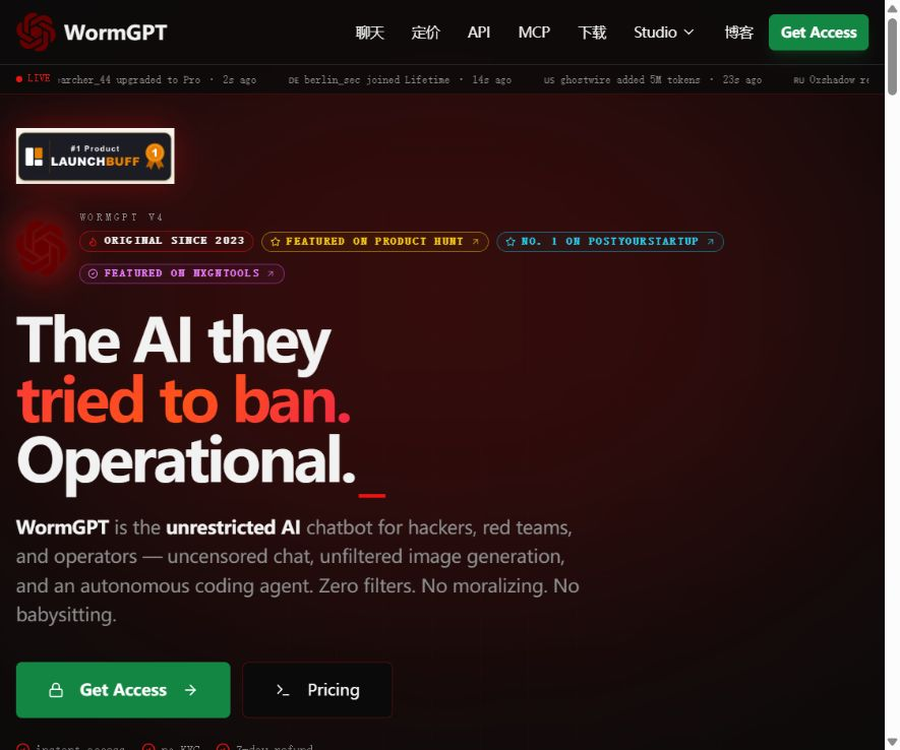
WormGPT
WormGPT, an intelligent tool focused on AI-driven conversations
Tags:AI dialogue chatWhat is WormGPT?
WormGPT was initially a type of malicious generative AI tool promoted on underground forums in 2023; its purpose was to bypass the security restrictions of common AI models. Security researchers discovered that it could be used to create phishing emails, fraudulent messages for commercial purposes, and other malicious content.
According to public security studies, the original project ceased operations in 2023. Since then, numerous websites, messaging tools, prompt-based projects, and model packages with the same name have appeared on the internet; it is not possible to assume that they were created by the original developers just because of their similar names.
Why is it necessary to be cautious?
- The history of this brand is closely linked to cybercrime and phishing activities.
- The original identity of the project, the entity responsible for its operation, and the subsequent inheritance relationships are unclear.
- Currently, there are multiple unrelated domain names and services with the same name.
- Some websites only accept irreversible cryptocurrency payments.
- The marketing material emphasizes no censorship, no logging, and anonymous use.
- Downloading programs may contain malware, spyware, or remote control capabilities.
- The so-called lifetime license may become invalid when the domain name is shut down.
- The account names, codes, and information entered by users may be collected by the operators.
- Using such tools may violate laws, contracts, and platform rules.
The original WormGPT and the current website with the same name
| Dimension | Original WormGPT in 2023 | Current websites and projects with the same name |
|---|---|---|
| Distribution channels | Underground forums and security research reports | Public domain names, social platforms, and GitHub projects |
| Known location | Black-hat generative AI and its use to assist in criminal activities | Everything from so-called security research to unrestricted chatting is available. |
| Technical terms | It was once described as being fine-tuned based on GPT-J 6B. | It is often used for packaging third-party models or as a prompt interface. |
| Operational continuity | Public studies indicate it was shut down in 2023. | The relationship with the original developer is usually impossible to prove. |
| Credibility | It can only be understood based on historical research materials. | Verification must be carried out site by site; the brand identity cannot be inherited automatically. |
The current domain name is being promoted publicly.
As of August 20, 2026, the domain names listed in the database identify themselves as WormGPT V4, and they claim to offer unlimited chatting, self-programming agents, deep web research, OSINT capabilities, as well as API and MCP access. The site also states that it maintains no logs, does not require real-name verification or phone verification, and only accepts cryptocurrency.
- Unrestricted conversation and so-called zero-refusal responses.
- An autonomous agent for code tasks.
- Deep web research, OSINT, and file identification.
- External access in the form of APIs and MCPs.
- No KYC or phone number verification is required.
- Multiple cryptocurrency payments are supported.
These details are merely promotional material provided by the website; they do not indicate that the service has passed independent testing. When performing real-time verification, the prices, download options, API information, as well as the policies related to privacy and terms all lead to the same marketing page. No verifiable interface documentation, actual terms of service, or details regarding privacy handling could be found.
Prices and payment methods
The current page shows a monthly fee of 99 dollars or a one-time fee of 199 dollars for lifetime access, and only cryptocurrency is accepted as payment method. These prices do not guarantee that the service will be available on a continuous basis or that it is related to the original WormGPT; moreover, there are no verifiable mechanisms for refunds or dispute resolution before making a payment.
| Plan | Page pricing | Payment characteristics | Main risks |
|---|---|---|---|
| Monthly payment | $ | Cryptocurrencies | The rules regarding automatic renewal, credit limits, and refunds are not clear. |
| for life | $ | Cryptocurrencies | It is difficult to recover costs once a domain name or service is shut down. |
| Trial | The page does not provide clear instructions. | No complete rules were found. | Registration, top-up, or download may be required first. |
| API and MCP | Not made publicly available separately | No official billing documents were found. | The interfaces, limits, and service availability cannot be verified. |
Risks of cryptocurrency payments
- Transfers are usually irreversible and lack credit card charge-back protection.
- The billing address does not provide direct proof of the true identity of a company.
- Lifetime plans lack a guarantee regarding the duration of service.
- Anonymous customer service staff are unable to handle refunds and account disputes.
- Payment addresses may be associated with risks of fraud, money laundering, or sanctions.
- Corporate payments can also violate financial and compliance regulations.
Results of privacy and terms verification
Although the page lists links to the privacy policy and terms of service, upon verification these links do not lead to separate policy documents; instead, they display only the marketing content from the home page. The claim of having no logging is not supported by any technical white papers, audit reports, data retention records, or a verifiable mechanism for data deletion.
- No clear legal company name or registered address could be found.
- No list of personal information collection, use, and sharing is available.
- No retention period for conversations, files, and logs is specified.
- No process for account cancellation or data deletion was seen.
- No model suppliers or data processing partners were seen.
- No details regarding refunds, dispute resolution, or service termination are provided.
- No independent security audit or proof of zero logs was found.
Downloads and account risks
Installation packages, scripts, browser extensions, and mobile apps labeled as WormGPT may originate from completely different publishers. Unknown programs are particularly likely to steal browser cookies, cryptocurrency wallets, API keys, the clipboard, and credentials related to development environments.
- Do not run installation packages of unknown origin on your main computer.
- Do not turn off antivirus software or system security features.
- Do not import browser passwords, Cookies, or wallet seed phrases.
- Do not enter the cloud platform and code repository keys in the script.
- Do not grant administrator, accessibility, or full access rights.
- Do not assume a file is secure just because it has passed one scan.
- Corporate equipment should be isolated and analyzed by a security team.
Description of the GitHub project with the same name
There are multiple repositories on GitHub using the name WormGPT, containing prompts, command-line chat clients, wrappers for third-party APIs, and so-called research projects. No unified official source code repository that can be reliably identified through the current domain name has been found.
- Warehouses with the same name do not represent the original WormGPT source code.
- The number of stars and forks does not indicate the security of the code.
- A disclaimer cannot eliminate malicious functions and legal risks.
- Clients that invoke services such as OpenRouter are not models that are trained independently.
- The prompt jailbreak project is not equivalent to a complete AI platform.
- Archiving, deleting, and renaming can affect long-term availability.
- Before downloading, it is still necessary to review the dependencies and installation scripts for each file individually.
Common characteristics of counterfeits and scams
- It claims to be the only official version, but it cannot prove its connection to the developers from 2023.
- Copy the same brand, logo, and hacker-style marketing copy.
- It claims to have no limitations and to be able to complete all tasks.
- Anonymous email addresses and payment in cryptocurrency are required.
- Use a countdown and a limited-time lifetime price to urge immediate purchase.
- There are no real companies, teams, addresses, or legal documents.
- It is required to turn off security software or run commands with high permissions before downloading.
- Send the payment address and installation package privately in the chat group.
- Build trust by using fake user reviews or counterfeit media logos.
Steps for verifying website credibility
- Verify the domain registration date, historical page changes, and owner changes.
- Find verifiable company entities, teams, and contact addresses.
- Compare privacy policies, terms, refunds, and payment methods.
- Check the signature, hash, and distribution source of the downloaded file.
- Check the reputation of domain names and files on multi-engine security platforms.
- Look for technical analyses from independent security agencies, rather than promotional articles from alliances.
- Check whether the GitHub repository is linked to the official website in both directions.
- Do not send irreversible funds to unknown recipient addresses.
- Registration, payment, and downloading should be halted if any critical evidence is missing.
The attack risks posed by WormGPT
Such models, lacking any security restrictions, can lower the barriers to creating social engineering content and enable attackers to modify multi-language decoys on a large scale. They may not possess highly advanced technical skills, but they can increase the quantity of fraudulent content as well as its level of personalization.
- Generate more natural phrasing for phishing and business email fraud scams.
- Batch rewrite of lures for different languages, positions, and industries.
- Assist in gathering public information and creating impersonation scenarios.
- Quickly create fake customer service, recruitment, and payment notifications.
- Explain public attack concepts to low-skilled attackers.
- Increase the frequency of testing for malicious content and the speed of iteration.
How can companies protect themselves from AI-based phishing attacks?
- Payment, account changes, and changes to payment details require secondary verification.
- Use known phone numbers or internal systems to verify high-risk requests.
- Deploy email authentication, anti-phishing, and malicious link detection.
- Train employees not to judge the authenticity of emails based on grammatical errors.
- Set up alerts for new domain names, abnormal logins, and bulk outbound transmissions.
- Restrict the execution of macros, scripts, and unknown attachments in the terminal.
- Enable multi-factor authentication for finance, email, and cloud platforms.
- Regularly conduct drills for responding to business email fraud and account takeover attempts.
Steps to take after receiving a suspicious email
- Do not click on links, download attachments, or reply directly.
- Contact the alleged sender independently through the internal address book.
- Submit the email as an attachment to the security team for analysis.
- Check the sender’s domain name, the reply address, and the result of email verification.
- Check the reputation of links and attachments in an isolated environment.
- Change the password immediately once it has been entered and terminate the session.
- Inform the finance department, the bank, and management when payments are involved.
- Retain email headers, timelines, and relevant evidence.
- Assess the impact and scope of notification in accordance with the incident response process.
The reasonable boundaries of security research
Researchers can analyze publicly available information, domain infrastructure, marketing strategies, and the impact of defensive measures, but they must not create or deploy actual malicious content in the name of research. Any testing must be carried out with written permission and in an isolated environment.
- Study the detection features for AI-generated phishing content.
- Analyze counterfeit domain names, payment methods, and fraud infrastructure.
- Design employee training and defensive email templates.
- Evaluate the security classifier on synthetic data.
- Test the internal email verification and incident response processes.
- Report clues about malicious services to the platform or law enforcement agencies.
Scenarios where it should not be used
- Generating or sending phishing emails and fraudulent messages.
- Creating malware, ransomware, or tools for stealing information.
- Scanning, invading, or taking control of others’ systems without authorization.
- Collect credentials, wallets, personal identification, or payment information.
- Bypassing security controls, verification codes, and access permissions.
- Automated harassment, spam, or fake accounts.
- Use real companies, employees, or customers as targets for testing.
How should we view the so-called advantages of a product?
- Low-barrier responses may expand the scope of security research, but they also increase the risk of abuse.
- Anonymous and cryptocurrency payments reduce the barriers to registration, but they also diminish mechanisms for holding people accountable and providing refund protection.
- APIs and MCPs are promoted as being easy to integrate, but currently there is a lack of verifiable documentation.
- Programming agents can automate the execution of tasks, but they can also amplify errors and malicious activities.
- The promise of zero logging seems to safeguard privacy, but the absence of audits cannot be considered proof of that.
- The lifetime price may seem cheap, but the provider and the continuity of the service are uncertain.
Usage restrictions and significant risks
- The relationship between the current site and the original WormGPT cannot be verified.
- Multiple sites with the same name compete with each other for the so-called official status.
- The privacy, terms, API, and download pages lack separate text sections.
- Cryptocurrency payments are irreversible and offer limited refund protection.
- Unknown download programs can directly harm devices and accounts.
- The so-called lack of logs means there is no independent audit or technical proof.
- The model may generate incorrect, dangerous, or illegal content.
- Using it may result in criminal, civil, and contractual liabilities.
- Enterprise security software may block relevant domain names and programs.
- A repository with the same name on GitHub does not indicate that it is official or secure.
- The service may be shut down at any time, have its domain name changed, or become inaccessible.
- It is not suitable for being recommended to users as a regular AI tool.
Basic information
| field | Verification results |
|---|---|
| Name | WormGPT |
| Historical positioning | Related to the risks of malicious generative AI and cybercrime. |
| Original project status | Public security research indicates it was shut down in 2023 |
| Current domain name promotion | The so-called V4 unlimited chatting and programming proxy |
| Current price | $ |
| Payment methods | The page claims to support only cryptocurrencies. |
| Operating entity | No legal entity that can be properly verified was found. |
| Privacy and Terms | The entrance does not display a separate, complete text. |
| Whether API is provided | The page claims to offer it, but no official documentation is available. |
| Is it open source? | Not confirmed; warehouses with the same name do not equate to the official source code. |
| Risk level | High risk; registration, payment, or downloading is not recommended. |
Recommendation score
0.5 / 5. WormGPT has a clear history of being an malicious AI, and the current website bearing the same name lacks verifiable information regarding its operators, as well as policies and technical details; moreover, it requires payment in irreversible cryptocurrency. Ordinary users and businesses should not use it as a reliable AI tool.
Frequently Asked Questions
Is WormGPT a legitimate AI tool?
The name itself does not determine legality; the original project was known for being used to facilitate phishing and malicious activities. Whether its use is legal depends on the specific actions taken, any relevant permissions, and local laws – malicious uses are clearly unacceptable.
Is the current website the original WormGPT official site?
It cannot be confirmed with certainty. The original project was reported to have been shut down in 2023, and currently several unrelated domain names claim to offer WormGPT.
How much is WormGPT?
The domain names listed in the database are currently priced at $99 per month or $199 for a lifetime, with only cryptocurrency accepted as payment method. This pricing does not indicate that the service is reliable or that the payment process is secure.
Is it possible to try it for free?
The current page does not display the complete details of the available free trial terms. Do not download unknown programs, provide your wallet information, or turn off your security software just for the sake of a trial.
Are you really not going to save the logs?
It cannot be confirmed. The page only contains statements regarding log-free marketing; there is no separate text detailing privacy policies, technical specifications, or audit reports.
Is WormGPT on GitHub the official website?
It is usually not possible to make such a judgment. There are multiple prompt and client projects with the same name on GitHub, and there is no consistent evidence indicating that they belong to the original developer or to the current domain name.
Can security researchers use it?
It is preferable to use models that have been approved by the organization and are auditable, as well as isolated testing environments. Research must be conducted with proper authorization, and it is not allowed to create, deploy, or spread actual malicious content.
What to do if a suspicious WormGPT website is found?
Do not make any payments or downloads; keep evidence of the domain name, pages, and payment addresses, and report the issue to your browser’s security service, hosting provider, corporate security team, or local law enforcement authorities.
Tools similar to WormGPT




 Guigong Network Security Registration No. 45132202000164