






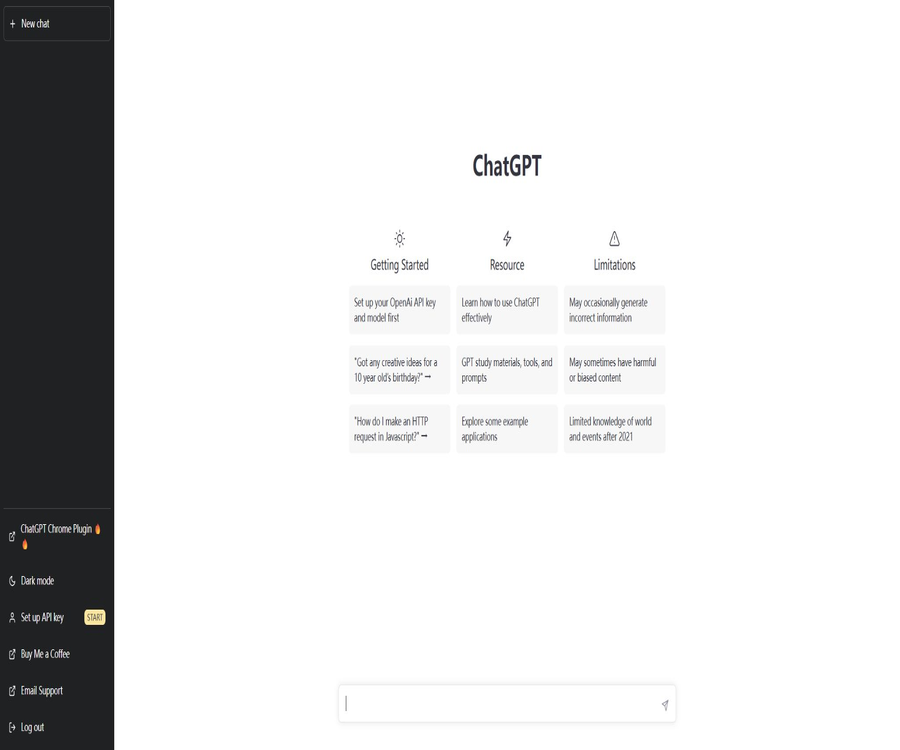
Freegpt
Freegpt, an intelligent tool focused on AI-driven conversations
Tags:AI dialogue chatWhat is FreeGPT?
FreeGPT is a third-party web interface that imitates the interaction style of ChatGPT; it requires users to enter their own OpenAI API Key. It provides a chat interface and options for selecting models, but the actual access rights, usage limits, and costs related to the models are determined by the user’s OpenAI API account.
What is described here is the website with the domain name freegpt.cc; it is not the official free version of ChatGPT provided by OpenAI, nor should it be confused with the numerous FreeGPT projects available on GitHub. Before using it, it is necessary to understand the key-based authentication mechanism and its security limitations.
Current verifiable product formats
The current title of the official website is ChatGPT Playground, and a pop-up window guides users on how to create an OpenAI project key. After entering the key on the page, users can select the GPT and inference models listed there and start a conversation.
The page does not display options for registration, membership, points, or the amount of model credits provided by FreeGPT; it also lacks a complete help center, terms of service, and a separate pricing page. It is more like a visual client for third-party APIs rather than a subscription platform that offers its own model services.
Core functions
Includes an OpenAI API key.
Users need to create a project key on the OpenAI platform and then paste it onto the FreeGPT page. The project key is recognized by the page, and calling the models consumes the API quota associated with that OpenAI project.
Multi-model selection
The current drop-down list shows the GPT-5 series, GPT-4.1 series, GPT-4o series, older versions of models, and the o-series inference models. This list is merely a set of candidate options; whether a particular model can be used actually depends on account permissions, whether the model is available, and the current rules of the API.
Dialog-based web interface
The website offers a messaging interface similar to that of popular chatbots, along with the ability for continuous conversations, making it suitable for users who do not want to write their own API requests. However, the convenience of the interface cannot replace a thorough security review of request paths, logs, and data processing.
The browser saves the keys and models.
The pop-up on the page claims that the API Key is stored only in the browser, and the save button writes the key along with the model name to the browser’s local storage. These settings may be lost if the site data is cleared or if a different browser is used.
System message function
The system_message feature is enabled in the data of this page; it can be used to define roles, tasks, and output guidelines for conversations. The system warnings do not guarantee that the model will always follow them, nor can they replace the permissions and content controls at the application level.
Dark and light themes
The interface will use the system’s theme; it is also possible to save preferences for light or dark themes in the browser. This feature only affects the display, without altering the models, costs, or privacy handling practices.
List of main functions
- Use the user’s own OpenAI API Key through the web interface.
- Switch between various GPT and inference models in the dropdown list.
- Use continuous conversations to complete writing, Q&A, translation, and coding tasks.
- Set roles, objectives, and output format through system messages.
- Write the key and default model to the current browser’s local storage.
- Switch between dark and light themes based on system or user preferences.
- There is no need to purchase a separate subscription for the FreeGPT interface.
- The cost of making the call is borne by the OpenAI project to which the key belongs.
What use cases are suitable?
- Technical users who have their own independent OpenAI API account and are familiar with pay-as-you-go pricing.
- Temporarily test the basic performance of different texts with reasoning models.
- Users who do not want to write request code but need a visual chat interface.
- Experiments that use test keys with low permissions, a limited budget, and the possibility of being revoked at any time.
- Experience system prompts and multi-turn conversations on non-sensitive content.
- Used for research and development aimed at comparing third-party front-end interaction designs.
Scenarios in which it is not recommended to be used
- Use an organization production key, administrator key, or high-limit project key.
- Processing customer data, medical information, source code, and trade secrets.
- Do not save the API Key on public computers, internet cafes, or someone else’s browser.
- Users who wish to obtain official OpenAI customer support, data control, and product guarantees.
- Beginners who are unable to monitor API usage or who will not revoke compromised keys.
- Corporate compliance, education of minors, and official implementation in regulated industries.
- In the website name, “Free” refers to a scenario in which model calls are completely free of charge.
Steps to get started
- Make sure you have an OpenAI account and a project that allow the use of APIs.
- Create a new project dedicated to testing in the OpenAI official console.
- Set a lower budget for the project, set reminders for usage levels, and define the necessary permissions.
- Create a new project key; do not reuse the key from the production environment.
- Go to the FreeGPT page and open the API Key settings popup.
- Paste the test key and select the models actually supported by the account.
- First, send a short request without sensitive information to verify the functionality.
- Return to the OpenAI console to check whether there is corresponding API usage.
- After the test is completed, delete the browser’s site data and revoke the key.
Steps for using API Keys safely
- Create separate projects for third-party testing; the budget of the main project is not shared.
- Set the monthly budget and alert thresholds as low as possible.
- Only short-term keys are created, with their creation time and purpose being recorded.
- Do not share keys through chats, screenshots, documents, or code repositories.
- Check the request target and request headers in the browser’s developer tools.
- During testing, monitor the usage changes in the OpenAI console in real time.
- After completion, clear the local storage from the FreeGPT page.
- Immediately revoke the test key that has been pasted in the OpenAI console.
- If abnormal usage is detected, suspend the project and replace all relevant credentials.
Fees and billing methods
As of this verification, the FreeGPT page does not offer any membership plans or paid subscriptions; no charging information is displayed on the interface itself. Users must provide their own OpenAI API Key, and therefore the cost of text generation is calculated based on the current pricing of OpenAI’s API.
The API of OpenAI and the ChatGPT subscription are billed separately; purchasing a ChatGPT individual subscription does not necessarily grant access to the API. The prices of the models and their availability can change, and the costs related to inputs, cached inputs, outputs, and tools should be based on the real-time pricing displayed in the OpenAI console.
| Project | FreeGPT has fees | Actual cost sources |
|---|---|---|
| Web frontend | No fees are displayed at the moment. | The website provides a chat interface. |
| OpenAI API Key | FreeGPT is not available. | Created by users in the OpenAI project |
| Text and inference model invocation | No commitment to a free quota. | Charged at the real-time price of the OpenAI API. |
| ChatGPT individual subscription | It has nothing to do with that website. | API call fees are generally not deducted. |
| Networks and browsers | No separate charging | The user is responsible for the costs related to the network and equipment. |
| Abnormal or abusive requests | The website does not provide any information regarding compensation. | It may consume the user’s API quota. |
Model categories listed on the page
The table below shows the categories displayed on the FreeGPT page during this verification; it does not represent OpenAI’s official commitments regarding the model’s lifecycle or the maximum length of context allowed. In case of request failures, it is necessary to first check the official OpenAI model documentation and project settings.
| Page classification | Examples of models listed | Usage tips |
|---|---|---|
| GPT-5 series | GPT-5.4, 5.4 mini, 5.4 nano, and earlier 5 series | Check account permissions and real-time prices |
| GPT-4.1 series | GPT-4.1, 4.1 mini, 4.1 nano | Suitable for regular text and long-context tasks |
| GPT-4o series | GPT-4o, GPT-4o mini | Old models may enter a phase of being phased out. |
| Legacy | GPT-4 Turbo, GPT-3.5 Turbo | It should be based on the status of the official model. |
| O-series reasoning | o4-mini, o3, o3-pro, o3-mini, o1 series | The parameters of inference models and the associated costs may vary. |
Where exactly are the keys stored?
The page code uses the browser’s local storage to save the API Key and model name, as indicated in the fields for input. Browser local storage is not an encrypted vault; malicious extensions, scripts on the same device, or vulnerabilities in other users’ or sites can still lead to the retrieval of sensitive data.
More importantly, when a message is sent, the page code includes the local key in the Authorization request header and sends it to FreeGPT’s own backend session interface. In other words, although the key is stored in the browser, it passes through the request pathway controlled by that website during use.
Privacy and request path risks
- The page does not provide a complete and easily verifiable separate privacy policy.
- The API Key is sent along with the chat request to the backend interface under the FreeGPT domain.
- Users cannot rely on the wording “saved locally” to be certain that the server will not record request headers.
- Chat messages may pass through both the FreeGPT service and the OpenAI API.
- The page contains third-party tracking scripts and network infrastructure services.
- Insufficient website operators, logging policies, retention periods, and security audit information.
- Browser extensions and shared devices can also increase the exposure of keys.
- Sensitive tasks should be handled using OpenAI’s official interface or a trusted client hosted by oneself.
Differences between FreeGPT and the official version of ChatGPT
| Project | FreeGPT third-party frontend | OpenAI’s official ChatGPT or API |
|---|---|---|
| Operating entity | Third-party websites | Official OpenAI services |
| Login method | Currently, the built-in API Key is mainly used. | Official accounts and organizational structure |
| Model cost | Handled by the user’s OpenAI API service. | ChatGPT is available on a subscription basis or via pay-per-use API pricing. |
| Key processing | Send to third-party backend interface | Use the official console and APIs directly. |
| Help & Terms | There is little public information available. | Provides official documentation, privacy protections, and support services. |
| Feature updates | The list of front-end models is maintained by a third party. | OpenAI updates products and models. |
| Relationship of responsibility | There is no official affiliation with OpenAI. | Official products |
How to control API costs
- Set a low budget and multiple usage alerts for testing projects.
- Priority should be given to small models that are inexpensive and capable of completing the task.
- Reduce system prompts, historical messages, and unnecessary context.
- Limit the length of each output and avoid endless retries.
- Regularly check the usage of models in the OpenAI console.
- If an abnormal call is detected, the key is immediately revoked and the project is suspended.
- Do not allow multiple people to share the same project key.
- After completing third-party testing, delete the project or completely rotate the credentials.
Product advantages
- It is possible to use a personal API key for chatting without having to write any code.
- The interface displays a variety of GPT and inference model options in one place.
- Tasks and output methods can be customized through system messages.
- The front end does not currently display any information regarding membership or subscription fees.
- Suitable for interface testing with low risk, short duration, and a limited budget.
- The model and key settings are saved in the current browser, allowing for straightforward operations.
Usage restrictions and precautions
- Calling the model is not free; it consumes the user’s own OpenAI API balance.
- ChatGPT subscriptions and OpenAI APIs generally have two separate billing systems.
- When an API Key is used, it is sent to the FreeGPT backend, which poses a risk related to third-party trust.
- The website does not disclose the complete prices, support options, privacy policies, or service guarantees.
- The list of page models may be ahead of or behind OpenAI’s actual status.
- The so-called context length must be based on the official model documentation.
- There is no evidence indicating that this website is an official product of OpenAI or a portal for collaboration with them.
- It is not suitable for storing long-term keys or handling any sensitive data.
- The browser’s local storage can be affected by cache clearing, extensions, and shared devices.
- There is no commitment regarding site updates, interface availability, or long-term maintenance.
GitHub and the open-source status
The real-time search did not yield any GitHub repository containing source code that could be verified through the freegpt.cc domain name, the website’s footer, or official materials. The items listed in the search results such as gpt4free, FreeGPT-4, chatbots, and various proxy projects belong to other developers.
Therefore, this website should be labeled as not being open source. The front-end scripts of the pages can be viewed in the browser, but this does not mean that the project is released under an open source license; it also does not imply that the back-end request processing logic can be audited or deployed.
Basic information
| field | Content |
|---|---|
| Tool name | FreeGPT |
| Corresponding website | freegpt.cc |
| Tool type | Third-party OpenAI API chat frontend |
| Core pattern | Users provide their own OpenAI API Key. |
| Front-end price | No fees are displayed at the moment. |
| Model cost | Billed on a pay-as-you-go basis by the OpenAI API service. |
| Is it from OpenAI official sources? | No |
| Is registration required? | FreeGPT does not require separate registration at the moment, but an OpenAI API account is needed. |
| Whether an independent API is provided | No findings were detected. |
| Is it open source? | No |
| Recommended uses | Only for low-risk short-term testing |
Recommendation score
2.8 / 5. FreeGPT reduces the barriers to using personal API keys, but these keys pass through third-party servers, and there is insufficient information available regarding their policies and maintenance; it is not recommended to use keys with high quotas or to enter sensitive data.
Frequently Asked Questions
Is FreeGPT truly completely free?
The pricing is not displayed on the web interface at the moment, but when the model is invoked using the user’s own OpenAI API Key, fees will be charged according to the current price of the OpenAI API.
Can ChatGPT Plus be used directly with FreeGPT?
Generally, it’s not possible. The ChatGPT subscription and the API pay-as-you-go service are separate products; FreeGPT requires an OpenAI platform project key.
Is the API Key stored only in the browser?
The page stores the key in the browser’s local storage, but when sending a message, it also includes this key in the request headers and sends it to the FreeGPT backend interface.
Can I use the API Key from the production environment?
It is not recommended. If testing is necessary, a separate short-term key with a low budget, limited permissions, and the ability to be revoked immediately should be created.
Is FreeGPT the official website of OpenAI?
No. It is a third-party website; the use of OpenAI’s model names on its pages does not imply any official affiliation or endorsement between the two parties.
Does FreeGPT have an official GitHub repository?
No official repository that can be verified through the domain name and product details was found; projects with the same name on GitHub cannot be considered as the source code for this website.
Is it suitable for entering work-related documents?
It is not suitable. Requests may pass through third-party services, and there is insufficient information regarding the processing of data; organizational-approved tools should be used for work-related materials and sensitive personal information.
Tools similar to Freegpt




 Guigong Network Security Registration No. 45132202000164