






Discuss SenseChat
The knowledge Q&A and creation assistant launched by SenseTime.
Tags:AI dialogue chatDiscuss what SenseChat is.
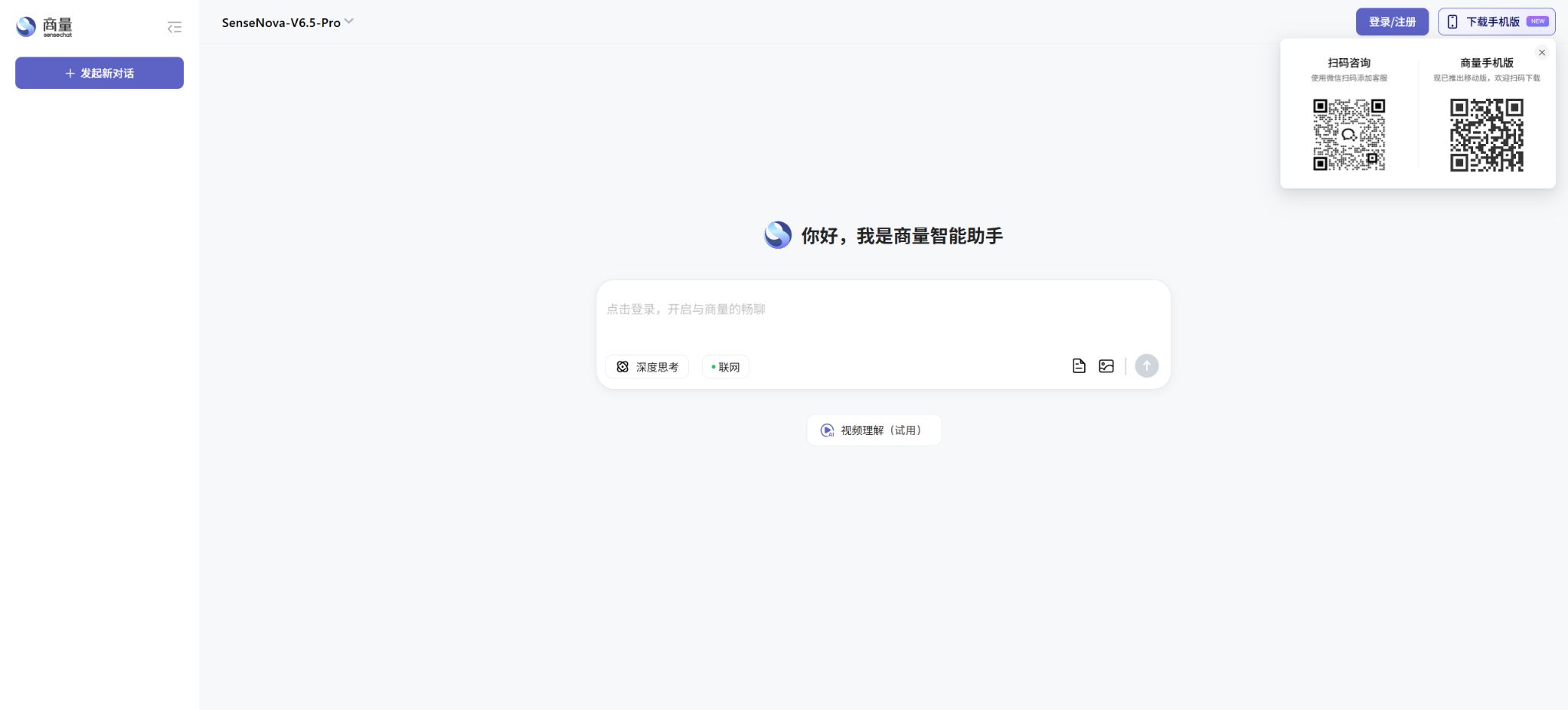
SenseChat is a multi-modal AI chat and lifestyle assistant developed by SenseTime; it relies on the \"RiRiXin\" SenseNova large model framework as well as the SenseCore AI infrastructure. It is capable of handling text, images, and documents, and it can perform tasks such as answering questions, writing, summarizing, translating, providing learning assistance, conducting online searches, and understanding images.
Shangliao is a product designed for individual users; when it is necessary to integrate the model into websites, apps, or enterprise systems, the Ririxin Open Platform should be used.
The accounts, credit limits, service agreements, and prices of the two cannot be conflated.
Main functions
1. Multiple rounds of dialogue and content creation
Discussions can take place around a common theme, enabling the exchange of ideas, as well as the creation of explanations, articles, emails, marketing texts, the conduct of brainstorming sessions, and learning of codes and languages. The current website displays models such as SenseNova V6.5 Pro, and it is possible to use reasoning functions or various tools depending on the task at hand.
The model generates content that appears fluent but is inaccurate. Professional knowledge, statistical figures, code, and references must be verified again; the naturalness of the language should not be taken as an indication of factual accuracy.
2. Online search
Users can enable online access, allowing the model to search recent web pages in order to formulate answers. It is useful for obtaining information on news background, product updates, and real-time data; however, the scope of the searches, the order in which sources are listed, and the dates of the web pages may not be complete.
When dealing with topics related to policy, prices, healthcare, law, and finance, it is necessary to go to the original page to verify the information.
3. File Q&A
Discuss examples of materials such as PDFs that can be displayed on the homepage; it is possible to create summaries, answer questions, and extract information from reports, papers, and learning materials. Question-and-answer functions for files help save time when reading, but scanned documents, complex tables, footnotes, and cross-page relationships may be interpreted incorrectly.
Before uploading confidential documents, it is necessary to verify the organizational authorization and privacy policies.
4. Image Understanding
Multimodal models support the uploading of images for recognition, description, chart analysis, OCR assistance, and visual question answering. They can be used for study materials, product information, and everyday photos, but they cannot replace medical imaging diagnosis, identity verification, or security checks.
5. Conversations in English and Cantonese
Options such as finding a partner for English conversations in order to practice are available. The Hong Kong version of SenseChat provides support for Cantonese spoken language, slang, and multi-modal communication, and it also offers mobile applications specific to the Hong Kong region.
Regional versions, login methods, and app store availability may vary.
6. Deep thinking
SenseNova Reasoner and the V6.5 series can be used for mathematics, logic, coding, and complex analysis. A longer thought process does not necessarily mean that the answer is correct;
Complex reasoning should involve the examination of assumptions, calculations, and final conclusions, in order to prevent the model from continuing to operate on incorrect premises.
Supported platforms
Users in the Chinese mainland can use the web version, and an official mobile app is also available. For the Hong Kong market, iOS and Android versions are provided, with a focus on providing a Cantonese-friendly experience.
The version for mobile devices, system requirements, and availability in various regions shall be based on the information provided on the app store’s live page.
Logging in, accessing history, and uploading files usually require an account. Before sharing conversations publicly, names, contact information, customer data, and internal documents should be removed.
Price and version comparison
| Package or version | Prices, quotas, and core benefits |
|---|---|
| Personal version price | The official website allows individual users to register and try out its main functions, but it does not display any fixed pricing for individual membership subscriptions or a list of permanent free usage quotas. The options related to model selection, the number of connections allowed, file size limits, and traffic restrictions during peak times may change depending on operational decisions. Therefore, such tools should be labeled as “free trial” rather than being described as offering permanent free access or unlimited use. If pages mention membership options, points, or promotional packages, those details should reflect the actual purchase page after logging in. |
| API price | The following are the current pricing rates in RMB as displayed on the official price page: SenseNova V6 Pro – for text and image input/output, the cost is 3 yuan per million tokens for input and 9 yuan per million tokens for output; SenseNova V6 Turbo – for lightweight multi-modal processing, the cost is 1.5 yuan per million tokens for input and 4.5 yuan per million tokens for output; SenseNova V6 Reasoner – for complex, slow-paced reasoning as well as text and image analysis, the cost is 8 yuan per million tokens for input and 32 yuan per million tokens for output; SenseNova V6.5 Omni – for real-time audio/video or pure audio interactions, the cost is 0.08 yuan per minute; licenses for the entire device’s lifecycle require an in-person discussion. For text-to-image generation, the basic version costs 0.03 yuan per image, with a yearly package of 100,000 images costing 2,700 yuan; the advanced version offers functions such as image deletion, expansion, styling, and partial redrawing, at a cost of 0.1 yuan per image, with a yearly package of 100,000 images costing 9,000 yuan. The default concurrent processing capacity for text-to-image generation is 1; to increase the number of QPS, it is necessary to purchase additional concurrent processing resources, and the cost increases with each additional QPS in the basic version. |
Personal version price
The official website allows individual users to register and try out its main functions, but it does not disclose any fixed pricing for individual membership subscriptions or a list of permanent free usage quotas. The options related to model selection, the number of connections allowed, the file size limits, and peak usage restrictions may change depending on operational decisions.
Therefore, the tool catalog should be labeled as a “free trial”; it should not be described as permanently free or available for unlimited use. If the page mentions memberships, points, or promotional packages, the information shown on the actual purchase page after logging in shall prevail.
RiRiXin Open Platform
The SenseNova open platform offers enterprises and developers APIs for dialogue, multimodal processing, reasoning, real-time audio and video, avatar creation, and text-to-image generation. The basic dialogue interface supports HTTP requests and SSE streaming responses, and can be used for customer service, content creation, data analysis, character-based conversations, and various industry applications.
API Keys should be stored only on the server side or in a key management system; they must not be included in the frontend, app installation packages, or in publicly available code. Production services also require mechanisms for rate limiting, timeout handling, retry operations, budget controls, data anonymization in logs, and content security.
API price
The following are the pay-as-you-go prices in RMB as displayed on the official pricing page:
- SenseNova V6 Pro:For text and image input as well as text output, the cost is 3 yuan per million tokens for input, and 9 yuan per million tokens for output;
- SenseNova V6 Turbo:Lightweight multi-modal: 1.5 yuan per million tokens for input, and 4.5 yuan per million tokens for output;
- SenseNova V6 Reasoner:Complex slow thinking and graphic reasoning: 8 yuan per million tokens for input, and 32 yuan per million tokens for output;
- SenseNova V6.5 Omni:Real-time audio and video or pure audio interaction: 0.08 yuan per minute; a face-to-face meeting is required for device lifetime licensing.
- Text-to-Image Basic Version:0.03 yuan per sheet; a yearly package of 100,000 sheets costs 2,700 yuan.
- Advanced Text-to-Image Version:Erasure, image enlargement, stylization, and partial redrawing: 0.1 yuan per image; a yearly package of 100,000 images costs 9,000 yuan.
The default concurrency level for text-to-image generation is 1; to increase the QPS, it is necessary to purchase additional concurrency resources. The basic version costs 24,000 yuan per month for each additional QPS, while the premium version costs 200,000 yuan per month.
Enterprise contracts, bulk packages, regions, and new models may be subject to changes; official purchases should be based on the quotation sheets and the control panel.
Real-time audio and video interaction
V6.5 Omni enables low-latency audio and video streaming interactions over RTC networks; it can understand user speech, images, and context to provide real-time responses, and is suitable for digital avatars, customer service, education, automotive applications, and smart devices.
Real-time systems continuously process data from microphones and cameras; it is necessary to inform users clearly, obtain their permission, and set a deadline for storing the recorded audio and video. Network fluctuations, accents, multiple people speaking at once, and noisy environments can affect recognition accuracy and cause delays.
Dialogue between anthropomorphized characters
The open platform offers interfaces for character dialogue; it allows for the setting of character backgrounds, tones of voice, and memory of previous conversations. These features are useful for game NPCs, virtual companions, and brand characters. Personification can lead users to overestimate the understanding capabilities of such models, and scenarios involving children, mental health, and emotional dependence require more stringent safety measures, exit mechanisms, and human support.
GitHub and the open-source ecosystem
SenseTime’s official OpenSenseNova GitHub repository is connected to the Nichin Shin open platform, and it makes various models, datasets, and Agent tools available to the public. The current key projects include:
- SenseNova-U1:A unified multimodal understanding and generation model, with code and training processes based on Apache 2.0;
- SenseNova-Vision:Detection, segmentation, OCR, geometric prediction, and image generation are unified into a multi-modal generation task; the project is based on Apache 2.0.
- SenseNova-SI:Spatial intelligence models, training data, and evaluation – licensed under Apache 2.0;
- SenseNova-MARS:Research on multimodal Agent reasoning and search;
- SenseNova-Skills:PPT, Excel, skills for in-depth research and image processing that can be used for the operation of agents such as OpenClaw; licensed under the MIT license.
- MemSense:A long-term memory project for agents, licensed under the MIT license.
Different projects may have different licenses applied to their code, weights, data, and third-party components; it is necessary to read the LICENSE and NOTICE files in the repository before using them for commercial purposes. The SenseChat website, account system, V6.5 business model, and the backend of the open platform are not all open-source.
Data and Privacy
The discussion forum deals with text, images, files, and feedback provided by users, in order to offer generation and retrieval services. Before uploading corporate documents, unpublished works, personal information, and content subject to confidentiality agreements, it is necessary to confirm the procedures for data retention, use in training purposes, assignment to sub-processors, and deletion.
When using the Hong Kong version or cross-regional services, it is also necessary to take into account the data location and local privacy requirements. Real-time audio and video, as well as voice and facial data, are highly sensitive information that should not be stored indefinitely by default.
Discuss the tutorial for using SenseChat
Complete a basic task.
- Clarify the issue, time frame, location, source priority, and output format;
- Discussing the materials that can be uploaded to SenseChat for use, or entering search queries;
- First, establish a framework through multiple rounds of dialogue and content creation, then supplement it with evidence obtained via online searches.
- It is necessary to distinguish between factual information from the source, the author’s opinions, and AI-generated conclusions.
- Check each item for dates, numbers, the original location, and any conflicting evidence;
- The conclusions are manually revised, the verification time is recorded, and then they are published;
Create reusable professional workflows
- Break down complex topics into four categories of questions: background, data, comparison, and conclusions;
- A fixed set of research steps is established by combining multiple rounds of dialogue with content creation, as well as online searching and question-answering regarding documents.
- Give priority to using the official website, research papers, regulatory documents, and raw data;
- A second person is assigned to review conclusions that are considered high-risk;
- Save queries, evidence, versions, and unresolved issues;
- Re-run after the data changes and update the conclusions;
Which users is it suitable for?
- Individual users who need multiple rounds of Chinese-language Q&A, writing, and summarization of information;
- Learners who practice communicating in English or Cantonese;
- Students and knowledge workers who read PDFs, reports, and charts;
- Content creators who gather up-to-date information through online searches;
- Developers who integrate multimodal, reasoning, and real-time audio/video APIs;
- A technical team that focuses on research in unified multimodal technologies, spatial intelligence, and Agent Skills.
Advantages
- Chinese, Cantonese, and multimodal interaction are among the product’s features;
- Both personal chats and enterprise APIs are supported by the same Nichin Shin system.
- It covers text, images, files, real-time audio and video, as well as text-to-image generation.
- V6 Pro, Turbo, and Reasoner can be chosen based on performance and cost;
- The authorities are expanding the ecosystem of open models, data, and Agent Skills.
Restrictions and Precautions
- Neither connectivity, nor file handling capabilities, nor visual abilities can eliminate hallucinations.
- When short questions lack context, the model may add information that is not actually present.
- Document parsing may miss tables and footnotes;
- Image recognition may misinterpret details;
- Conclusions indicating high risk should be reviewed by a human;
- The official benchmarks, product examples, and computing power figures are presented for promotional or statistical purposes under specific conditions, and they do not mean that every user will experience the same speed and accuracy levels.
- Before purchasing the API, test it using your own language, documentation, images, as well as considering your requirements regarding concurrency and latency.
Frequently Asked Questions
Discuss whether SenseChat is free?
The personal web version is available for registration and trial use at the moment; the official website does not disclose fixed membership prices or permanent quota details. Traffic limits and functional quotas during peak times are indicated on the page after logging in.
What is the relationship between consultation and continuous improvement?
Shangliao is a personal AI assistant, while Ri Ri Xin SenseNova represents the underlying model and developer platform. Companies should make use of the API available on this open platform in order to integrate it into their systems.
Is Cantonese supported?
Supported. The Hong Kong version of SenseChat focuses on providing capabilities for Cantonese spoken language and slang, along with local mobile applications.
Can PDFs be uploaded?
File reading and Q&A are possible, but complex tables, scanned pages, and footnotes still require manual verification; sensitive files should be uploaded with caution.
How much is the API?
V6 Turbo costs 1.5 yuan for input and 4.5 yuan per million tokens for output; V6 Pro costs 3 yuan and 9 yuan respectively.
The Reasoner costs 8 yuan or 32 yuan. Real-time interaction and image generation are charged separately.
Discuss making SenseChat open source?
The full version of the application is not open source. The official OpenSenseNova team has made some components such as U1, Vision, SI, MARS, and Skills available under an open license; it is necessary to check each repository individually for the relevant licensing terms.
A tool similar to one used for discussing SenseChat




 Guigong Network Security Registration No. 45132202000164