






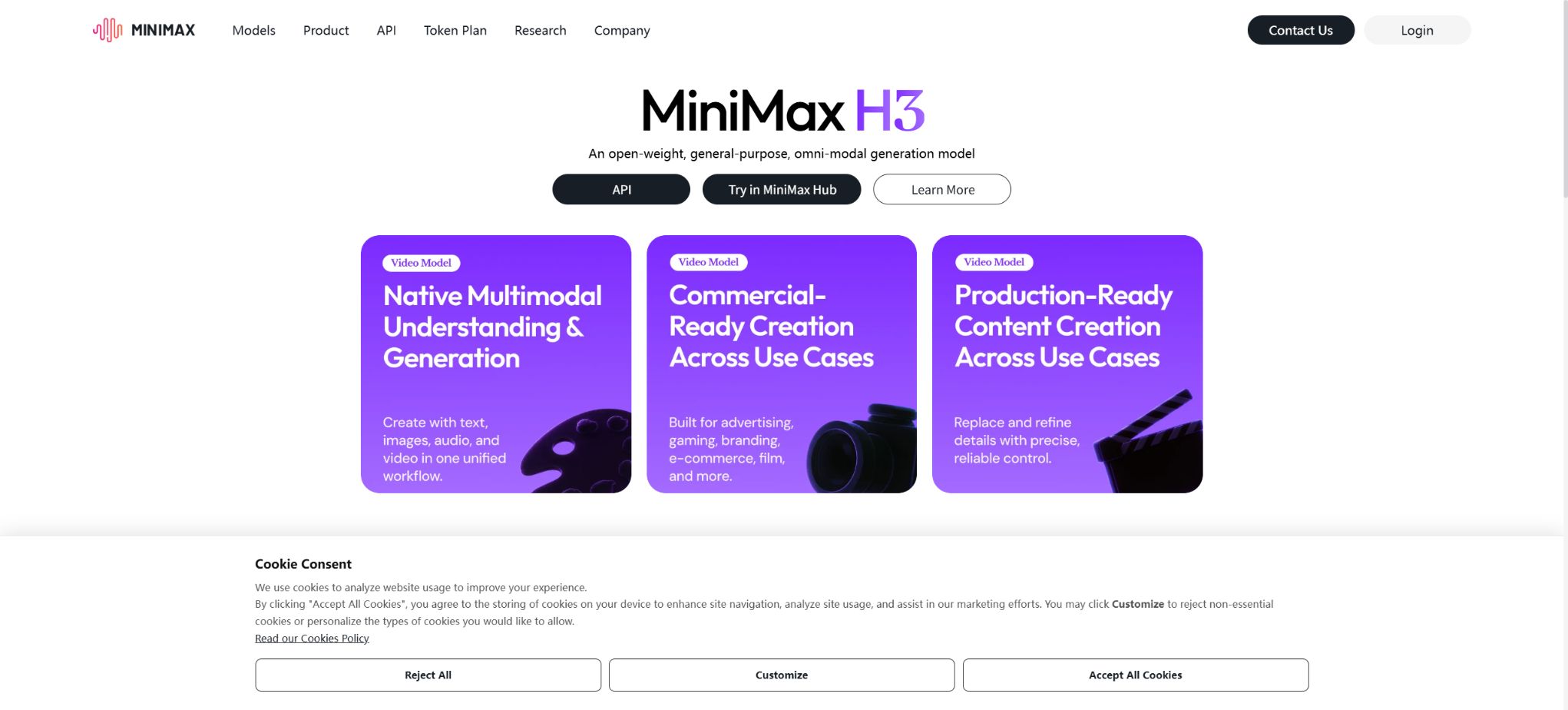
MiniMax
A universal AI platform that supports text, voice, and multimodal interactions
Tags:AI dialogue chatWhat is MiniMax?
MiniMax is a general artificial intelligence company founded in 2022; its Chinese name is Xiyu Technology. It is not a single chatbot, but rather consists of multimodal foundation models, AI products designed for ordinary users, and an open platform for developers.
The official models can handle text, code, images, videos, speech, and music; the main products include MiniMax Agent, MiniMax Code, Hailuo Video, MiniMax Audio, Talkie, as well as domestic and international open platforms.
Users should first determine the appropriate entry point for a given task: use Agent for complex daily tasks, Code for programming, Hailuo for video processing, and Audio for voice-related tasks; if it is necessary to integrate these functions into one’s own application, then the open platform API should be used.
The accounts, credit limits, membership benefits, and regional prices may vary for different products; it is not possible to consider the Conch Membership, Agent points, and API Token Plan as part of the same package.
Model and product matrix
1. MiniMax M3 and M2 series
The MiniMax M3, M2.7 and their Highspeed versions are designed for text, code, and Agent tasks; they support long contexts, tool calls, and the execution of complex tasks. The Highspeed version offers a higher generation speed, but the cost per API call is also higher.
M2-her focuses on multiple characters, long-term interactions, and immersive dialogue.
The name of the model is updated continuously, and the \"automatic selection\" feature in chat applications does not guarantee that a specific version will always be used. For production systems that require stable output, it is necessary to lock down the model within the API, keep track of the version used, and conduct regression tests.
2. MiniMax Agent
The MiniMax Agent is a general-purpose intelligent agent that can first plan a task and then utilize search tools, browsers, coding capabilities, APIs, and MCP to carry out complex procedures. The main functions listed in the official user guide include in-depth research, creating PPTs, developing full-stack websites, analyzing long documents, processing images and audio/video files, as well as generating images, audio, and video content.
The agent supports uploading PDF, PPTX, images, audio, video, and compressed files. It can utilize pre-defined MCPs, as well as create new external tools through MCP Builder. After a task is completed, it is possible to download the research documents, code, and reports.
When creating a website, the deployment results are also provided.
Agents are capable of interacting with external services and keys; users should provide only the minimum necessary credentials, and test databases as well as separate projects should be used. Even for websites that are generated automatically, it is still necessary to check aspects such as authentication, payment processes, database permissions, potential vulnerabilities, compatibility with mobile devices, and rollback procedures.
3. MiniMax Code
MiniMax Code is the official programming agent, available for desktop and web use; it allows direct utilization of the Token Plan without the need to manually configure API keys. Developers can also integrate Token Plan keys with OpenClaw, Claude Code, Cline, and other compatible tools for code understanding, generation, modification, and Agent workflows.
Code models may generate non-existent interfaces, outdated dependencies, or unsafe implementations. It is necessary to examine the differences before merging, and to run compilation checks, static analysis, unit tests, integration tests, and security scans.
4. Conch AI Video
Hailuo AI is MiniMax’s video creation product; Hailuo 2.3 and the Fast series support text-to-video and image-to-video generation, as well as videos in various resolutions and lengths. Subject Reference allows the use of reference images to maintain the characteristics of the main subject, while Video Agent combines scripts, camera angles, and generation steps to create a more complete video workflow.
Video generation can still suffer from issues related to limbs, text, physical movements, camera continuity, and character consistency. Authorization must be obtained before using real people, trademarks, fictional characters, or copyrighted materials; synthetic content intended for public release must also comply with the platform’s guidelines regarding identifiers.
5. MiniMax Audio
MiniMax Audio offers synchronous and asynchronous text-to-speech conversion, streaming output, synthesis of very long texts, tone design, and rapid sound replication. Speech HD places emphasis on audio quality, while Turbo focuses on speed and cost; it can be used for audiobooks, podcasts, customer service, game characters, educational purposes, and digital avatars.
To replicate a voice, explicit permission from the owner of that voice is required; it cannot be used for impersonation, fraud, or to bypass authentication processes. Long texts should be checked segment by segment with regard to pronunciation, pauses, numbers, proper nouns, and characters with multiple pronunciations.
6. Images and music
The open platform enables the creation of images from the image-01 series, as well as songs, lyrics, and instrumental music from the Music series. The official CLI also allows for the unified handling of text, images, videos, voice, and music in the terminal.
The commercial use of the generated results, issues related to facial similarity, controversies surrounding the training data, and platform policies must be verified by the publisher themselves.
7. Talkie
Talkie is an AI-powered character and interactive entertainment product designed for users around the world, with a focus on character development, long-term conversations, and immersive interactions. It is not the same product as general office agents or open platforms; its subscription model and content ecosystem are also independent of those of other products.
Open platform API
The MiniMax domestic platform offers interfaces for text generation, tool invocation, image understanding, speech synthesis, timbre design and replication, as well as video, image, music, and file management. Pay-as-you-go API keys can be used to access various model types.
The Token Plan uses separate keys and subscription quotas; these two types of keys as well as their respective balances cannot be used interchangeably.
The official platform offers methods for integration that are compatible with mainstream interface standards, as well as stream-based responses, caching for billing purposes, and tools for making calls. Developers should set up mechanisms for handling timeouts, retries, ensuring idempotency, restricting concurrency, performing content filtering, and generating alerts regarding costs; they must not store keys in the frontend or in public repositories.
Domestic Token Plan prices
The Token Plan is intended for individual developers and for use in coding tasks as well as everyday routine activities; the allocation is managed on a 5-hour basis with a weekly limit. The following are the official prices as stated in the domestic documentation for 2026:
| Package or version | Prices, quotas, and core benefits |
|---|---|
| Starter | 29 yuan per month or 290 yuan per year; M2.7: 600 requests every 5 hours; |
| Plus | 49 yuan per month or 490 yuan per year; 1,500 requests every 5 hours, plus 4,000 characters of text for voice messages and 50 images per day. |
| Max | 119 yuan per month or 1190 yuan per year; 4,500 requests every 5 hours, including 11,000 characters of text for voice messages, 120 images, and a limited amount of video content. |
| Plus Extreme Edition | 98 yuan per month or 980 yuan per year, with M2.7-highspeed; 1,500 requests every 5 hours. |
| Max Extreme Edition | 199 yuan per month or 1990 yuan per year, 4,500 high-speed requests every 5 hours, along with higher multi-modal quotas; |
The limit of 100 songs per day for Music as mentioned in the document is considered a free service; it should not be viewed as a permanent commitment. The quotas for videos, images, and audio are updated on a daily basis, and the number of requests is subject to a 5-hour time limit as well as a weekly total limit.
A single request may also be subject to limits regarding the length of the token, and cannot correspond to a fixed number of characters.
Domestic API pay-as-you-go pricing
Pay-as-you-go is suitable for enterprise systems and those with variable usage levels. The current core prices are as follows:
- MiniMax-M2.7:The cost for input is 2.1 yuan per million tokens, the cost for output is 8.4 yuan per million tokens; the cost for reading from cache is 0.42 yuan per million tokens, and the cost for writing to cache is 2.625 yuan per million tokens.
- M2.7-highspeed:The cost is 4.2 yuan per million tokens for input, 16.8 yuan per million tokens for output, and 0.42 yuan per million tokens for cached reads.
- Speech 2.8 HD:3.5 yuan per 10,000 characters; Turbo is 2 yuan per 10,000 characters;
- Timbre design and rapid replication:9.9 yuan per sound color, usually charged when it is used for synthesis for the first time;
- image-01:0.025 yuan per sheet;
- Hailuo 2.3:For 768P, the cost is 2 yuan for 6 seconds and 4 yuan for 10 seconds; for 1080P, it is 3.5 yuan for 6 seconds. The Fast version costs as little as 1.35 yuan per clip.
- Music:The cost for different versions ranges from about 0.25 to 1 yuan per piece, with some models available at no cost.
There is no one-to-one correspondence between Chinese characters and tokens; officials estimate that about 1600 Chinese characters require 1000 tokens. In voice billing, each Chinese character is counted as 2 characters, while letters, punctuation marks, spaces, and line breaks are counted as 1 character each.
The charging rules for failed tasks, security audits, caching, and retries are subject to the billing information in the console.
Price differences on international platforms
The international version is priced in dollars, and the models and packages may be updated earlier or later than those on the Chinese version. For example, the pricing page for the international service shows the cost in dollars per million tokens, per video, and per 10,000 characters.
Chinese developers should select a location based on the entity, data region, payment method, and target audience; they cannot simply convert international prices into domestic contract prices.
GitHub and the open-source status
MiniMax has an official GitHub organization linked to its website, where the model weights, CLI tools, MCP servers, agent examples, and research projects are made available. The official CLI is licensed under the MIT license and enables unified handling of text, images, videos, speech, and music;
MiniMax-MCP is also licensed under the MIT license.
The licensing for each model must be checked individually: MiniMax-M1 uses the Apache 2.0 license, while the MiniMax-M2 repository is licensed under MIT; although M2.7 makes its weights and code available publicly, its license allows for personal, research, and non-commercial use only. Commercial use requires prior written permission from MiniMax, in addition to compliance with the requirements regarding attribution and prohibited uses.
An open weight does not mean that Agent, Conch, Audio, Talkie, and the backend of the open platform are all open-source.
MiniMax Usage Guide
Complete a basic task.
- Identify the audience, platform, format, duration, and the information that needs to be conveyed;
- In MiniMax, prepare scripts, shots, or reference materials that can be used;
- Select the model and product matrix to create a low-cost preview;
- Use the core functions to adjust the visuals, rhythm, subtitles, and audio;
- Check each frame for characters, text, logos, lip movements, and factual accuracy;
- Export in the desired format after confirming the licensing for music, portraits, and materials;
Create reusable professional workflows
- Create scripts, shot lists, brand assets, and a list of elements that are prohibited from use;
- Set unified parameters for saving the model, product matrix, core functions, and outputs;
- First, use representative shots to test the model and the quota;
- Transfer the failed shots to manual editing or regenerate them;
- Uniformize subtitles, volume, colors, and end credits;
- Record the version and reviewer before publishing in batches;
Data security and usage restrictions
- To use cloud-based services, it is necessary to upload prompts, files, or media; companies should therefore review the privacy policies, data retention rules, mechanisms for exiting training programs, and information related to sub-processors in their respective regions.
- Source code, customer information, unreleased materials, and audio samples should first be classified and anonymized;
- AI outputs may contain factual errors, fabricated citations, incorrect codes, and inappropriate content;
- For in-depth research, it is necessary to consult the original sources for verification;
- Financial, medical, legal, and policy recommendations cannot be used directly for decision-making;
- To create audio and video content, it is necessary to handle aspects related to portraits, voices, copyrights, and identifiers for synthetic content.
Which users is it suitable for?
- Individual users who need Chinese and multimodal Q&A, research, and document processing;
- Knowledge workers who wish to have agents generate PPTs, websites, and research reports;
- Developers who use code agents and very long contexts;
- Creators who produce short videos, voiceovers, audiobooks, music, and character-related content;
- Companies that need a unified API for text, voice, video, images, and music;
- Technical teams that wish to download the open-weight model for research or non-commercial use.
Frequently Asked Questions
Is MiniMax free?
Some products designed for users offer a free trial version, and open platforms may also provide a trial quota; however, frequent use, membership benefits, the Token Plan, and API calls on a pay-as-you-go basis require payment.
What is the relationship between MiniMax and Conch AI?
Hailuo AI is a video generation product under MiniMax, which makes use of the Hailuo video model; MiniMax also includes Agent, Code, Audio, Talkie, as well as an open platform.
How much is the Token Plan?
The domestic standard versions are priced at 29 yuan per month for Starter, 49 yuan per month for Plus, and 119 yuan per month for Max; the high-speed version starts at 98 yuan per month.
The quota is limited to 5 hours and per week.
Does MiniMax provide an API?
It offers support for text, code, voice, video, images, music, and files; payment can be done on a pay-as-you-go basis or via a Token Plan.
Is MiniMax open source?
Some models and tools are open source or have open weights, but not all full commercial products are open source. The licensing terms for different models vary greatly; in particular, using M2.7 for commercial purposes requires additional authorization.
Can it be deployed privately?
The open-weight model can be deployed on its own within the limits permitted by the license; for enterprise-level proprietary deployment, commercial licensing, and cloud service integration, it is necessary to contact the official authorities.
Upon deployment, it does not automatically gain all the capabilities of the Conch, Audio, or Agent platforms.
Tools similar to MiniMax


 Guigong Network Security Registration No. 45132202000164