






Monica
A one-stop personal AI assistant that integrates multiple popular models and creative functions.
Tags:AI dialogue chatWhat is Monica?
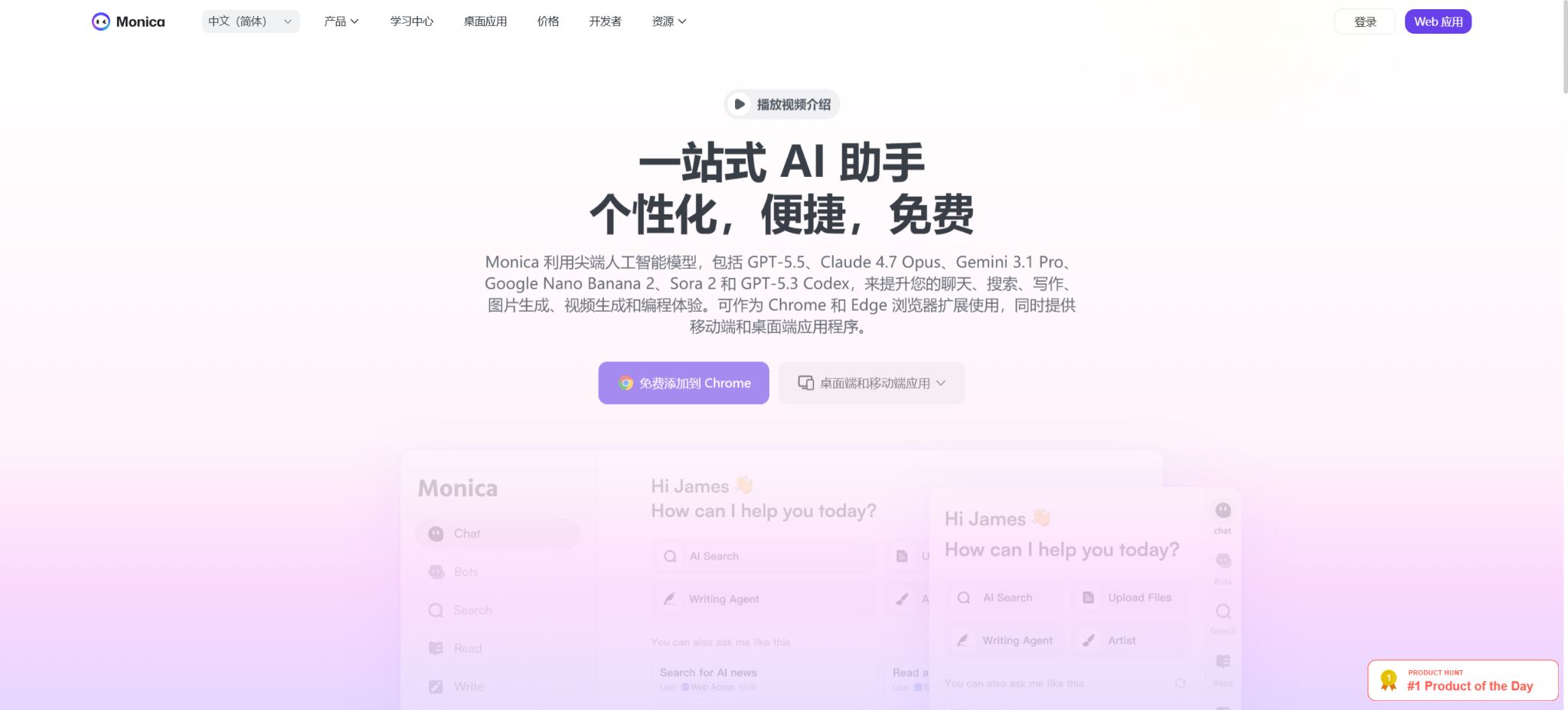
Monica is a versatile cross-platform AI assistant operated by the Singaporean company BUTTERFLY EFFECT PTE. LTD. It first gained attention as a tool for use in browser sidebars and for highlighting text; users could ask questions, rewrite content, translate text, summarize information, and draft email replies without leaving the webpage they were viewing.
Today, Monica has been expanded to include web applications, desktop versions for Windows and macOS, iOS, iPadOS, Android, as well as browser extensions; it also offers multi-model chatting, AI search, in-depth research, document Q&A, image and video generation, custom bots, and automated browser operations.
Monica is not a chatbot designed to connect to just one single model; rather, it brings together various language, image, and video models in a unified interface, while also providing browser capabilities and productivity tools. Users can work with current web pages, selected text, PDFs, images, YouTube videos, and conduct regular conversations all within the same account. They can also organize their research findings into reports or slides.
Core functions
- Multi-model chat:Use and compare models from OpenAI, Anthropic, Google, xAI, and other providers within a unified interface. The specific names of the models as well as their version updates change frequently; it is therefore necessary to refer to the list of models available in one’s account.
- Browser sidebar:Open a chat window next to the current page and ask questions by directly referencing the content on that page, eliminating the need to copy text repeatedly or switch between tabs.
- Word selection toolbar:Once text is selected, it can be subjected to operations such as explanation, translation, rewriting, expansion, abbreviation, polishing, summarization, grammar checking, and custom actions.
- Summary of web pages and YouTube:Extract the key points from long articles, search results, emails, and public videos to generate outlines, timelines, or Q&A sections.
- AI search:Search web pages and organize answers along with their sources; quick searches or in-depth research can be used to deal with topics of varying complexity.
- Document processing:Upload PDF, Word, or other supported files for summarization, Q&A, translation, and citation tracking; multiple sources can also be used for intelligent document generation.
- AI writing:It provides templates for blogs, ads, social media, product descriptions, emails, reports, and video scripts, and it also allows users to save their own prompts and toolbar actions.
- Images and videos:It aggregates various generation models and offers tools for background removal, object removal, restoration, enhancement, and video generation; different models are charged based on a premium pricing system.
- Custom Bot:Roles, prompts, knowledge bases, built-in skills, and custom API skills can be configured without any programming, after which they can be published using a private link or a shared link.
Monica Agent
Monica 9.0 includes the Monica Agent, designed for handling complex tasks; its core is composed of three components: Deep Research, Browser Operator, and Create Slides. It integrates the processes of researching information, performing web operations, and organizing presentation results into a single workflow, making it suitable for industry research, competitor analysis, data collection, and preparation of reports.
- Deep Research:Automatically break down sub-problems based on the research objectives, search multiple web sources, compare different viewpoints, and generate a structured analysis;
- Browser Operator:Navigate web pages like a user, search, switch pages, extract content, and complete certain forms or repeatable processes;
- Create Slides:Organize the research findings, documents, or raw materials into a well-structured presentation with clear sections and key points.
According to the official guidelines regarding advanced points, the average amount of points required is as follows: about 138 points for each in-depth study, about 187 points for creating slides, and about 150 points for browser operations. The actual amount of points needed varies depending on the complexity of the task. Using the browser to carry out certain actions may result in submitting forms, logging into accounts, or triggering specific business processes; in cases involving purchases, publications, deletions, transmissions, or handling of sensitive accounts, it is necessary to conduct a manual check before carrying out such actions.
Web reading, summarization, and writing
After installing Chrome or Edge extensions, Monica can access the context of the current webpage. Users can ask for a summary of the article’s main points, have terms explained, have data extracted, and have the page content rewritten in the form of an email, post, or report.
The smart toolbar allows you to adjust the order of buttons freely, so that commonly used functions such as translation, editing, replying, and custom prompts can be placed in a position visible right after the selected text.
Web page summaries are useful for quick filtering of information, but they do not mean that the original text has been fully read. After logging in, it may be impossible to access all content such as pages, dynamic tables, collapsible sections, comments, and scripts.
Important studies should examine the original webpage’s publication date, author, footnotes, and the full context.
When creating written content, it is also necessary to verify facts, trademarks, copyrights, and citations.
Websites, PDFs, and multi-engine translation
Monica supports translation between more than 30 major languages. Extensions allow the translated text to be embedded in web pages alongside the original text, thereby reducing the need to switch back and forth between translation sites and the original pages.
PDF translation displays the original text alongside the translated version, and it is also possible to ask further questions regarding the document.
On the web interface, it is possible to compare the results provided by Google Translate, Microsoft Translate, and various AI models at the same time. A glossary can also be maintained to ensure consistency in product names, technical terms, and corporate terminology. Different translation engines do not always manage tables, footnotes, formulas, and formatting correctly; therefore, contracts, patents, medical texts, and technical standards still require review by professionals.
ChatPDF and file Q&A
Monica’s ChatPDF allows users to upload PDF files or import them from links; it can generate summaries, intelligent Q&A responses, mind maps, citation locations, and full-text translations. The official website states that the maximum size for a single PDF file is 50MB, while the normal limit is 100K tokens, which is roughly equivalent to 70,000 English words or characters.
The files are synchronized across Web, extensions, Windows, Mac, iOS, and Android devices until the user deletes them.
The advanced scoring rules also provide a full-text reading mode, which allows the model to access the complete original text during conversations; the chat context can exceed 100,000 characters. However, advanced points are deducted based on the length of the context and the model used. Just because a document is long does not mean that the model will cover every page accurately – when numbers, tables, conclusions, or limitations are involved, it is necessary to click on the references to check the original text.
Intelligent document generation
Smart Document Generation allows PDF, Word, current web pages, and other online sources to be combined into a structured document. It provides templates for academic papers, literature reviews, FAQs, and competitor analyses, and it can generate citation formats as well as organized chapters.
The basic mode uses models with lower costs, while the advanced mode allows switching to more powerful models for handling complex writing tasks.
Automatic citation tools can only serve as a help for organizing information. Before publishing a paper, report, or any other material, it is necessary to verify that the sources cited are indeed reliable, that the authors and dates are correct, and that the formatting follows the appropriate standards such as APA or MLA.
The model may mistake web page titles, organization names, or secondary citations for formal publications.
Custom Monica Bot
Monica Bots is a platform for creating code-free bots. Users can configure the bot’s name, role, response logic, initial questions, and the scope of sharing, and they can also add built-in capabilities such as web access, image retrieval, document reading, and drawing.
Custom skills can connect to external APIs via parameters, enabling the Bot to carry out operations either within the company or with third parties.
The knowledge base supports PDF, DOCX, TXT, and Markdown formats. According to the official documentation, a knowledge base can hold up to 20 files; each file may be no larger than 50 MB, and it can contain up to 1000K tokens.
The bot breaks down the content and performs vector-based searches; it is suitable for FAQs, course materials, collections of papers, and internal rules. Confidential files should be removed before sharing them publicly, and the permissions and keys for custom APIs should be restricted.
Memory and Memo
Monica can use Memory to keep track of users’ preferences and long-term information, and it can be used to save chats or other data via Memo. Memory is disabled by default; once it is enabled, it is possible to view, update, or request the deletion of the stored information.
It should be noted that turning off Memory only stops further learning; it does not automatically delete the memories that have been saved. Deleting chat records also does not remove these separate memories, which must be deleted manually within Memory.
Supported AI models
Monica aggregates language models such as GPT, Claude, Gemini, Grok, and Llama, as well as image or video generation tools like DALL·E, Stable Diffusion, Flux, Recraft, Ideogram, Imagen, Veo, Kling, and Sora. The list of available models on the official website and in app stores is updated regularly; the models that are available may vary depending on the platform, region, configuration, and time period.
The advantage of aggregate services is that they reduce the cost associated with registering on multiple platforms separately and facilitate comparison across different platforms; however, the limitations are that the context handling, tool calls, file handling capabilities, output speed, and content policies may differ from those of the models offered by their original manufacturers.
Subscribing to Monica does not grant separate accounts or API quotas from the various model manufacturers.
Free, Pro, Max, and Ultra
Starting from January 2, 2026, Monica will use a quota system that includes \"basic queries\", \"advanced queries\", and \"advanced points\" all at the same time. The free plan allows 40 basic queries per day; there are no advanced queries or advanced points available in this plan.
The paid plan provides a fixed amount per month, and the advanced points are reset on the first day of each month.
- Free:40 basic queries per day, 0 advanced queries, 0 advanced points; limited trial access to some image-related functions may be available.
- Pro:5,000 basic queries per month, 200 advanced queries, and 1,500 advanced points;
- Max:The plan includes unlimited basic and advanced searches, as well as 4,500 advanced points per month.
- Ultra:The plan includes unlimited basic and advanced searches, as well as 20,000 advanced points per month.
The authorities also stated that Max and Ultra include 1,600 unrestricted queries to advanced models and 12,000 unrestricted basic queries per month; once these quotas are used up, the frequency is reduced to 100 queries per day in order to maintain service quality.
Therefore, “infinity” is still subject to constraints such as fair use, frequency, and system policies; it is not an unrestricted means for automated invocation.
If the amount of advanced points is insufficient, they can be purchased additionally: 4000 points for $10, 12000 points for $30, and 40000 points for $100. Points do not correspond to a fixed number of messages; for example, tasks such as Deep Research, video generation, and handling long contexts can consume dozens to thousands of points each time.
Before subscribing, an estimation should be made based on the commonly used models and tasks, rather than relying solely on the number of queries.
Subscription price
| Package or version | Prices, quotas, and core benefits |
|---|---|
| Unlimited | The Unlimited plan costs 29.99 euros per month or 229 euros per year; there is also a version with the same price under the Pro+ name. |
| Pro | The reference in-app purchases listed on the official App Store for the European region include: Pro at 5.99 euros per week, 9.99 euros per month, and 99 euros per year; |
Monica’s official website displays real-time prices based on region, currency, event, and payment cycle. The reference in-app purchases listed on the official App Store for the European region are as follows: Pro at 5.99 euros per week, 9.99 euros per month, and 99 euros per year.
The Unlimited plan costs 29.99 euros per month or 229 euros per year; there is also a version with the same price under the Pro+ name.
The names of the plans available in the mobile store may not correspond exactly to Pro, Max, and Ultra versions on the official website; therefore, it is not possible to determine the data limits based solely on those names.
The final price, taxes, auto-renewal schedule, and specific benefits are subject to those stated on the actual purchase page. The website, iOS, Android, and promotional channels may vary.
Before making a purchase, it is necessary to determine whether the payment is on a monthly, annual, or weekly basis, and to check the actual limits for advanced points, model queries, Agent tasks, as well as images and videos.
How to spend advanced points
With the default Smart Trimming option, the system automatically truncates the context based on the conversation, and applies basic or advanced charging according to the selected model. Paid users can choose Custom Limit to retain the full text or specify a particular length for the context; in this case, advanced charges are applied per 1000 tokens of context.
The higher the cost of the model, the more context is typically consumed per unit.
In AI translation, OpenAI, Claude, and Gemini require approximately 0.5 credits per 1000 tokens of text, while DeepL needs around 0.1 credit. Google and Bing’s translation services are listed as free in the pricing table. For image generation, the cost ranges from 3 credits per use with low-cost models to several dozen credits with high-cost models.
Video generation earns approximately 25 to 1600 points per time.
The actual rules may change; it is advisable to check the score indications before running large tasks.
Supported platforms
Monica offers a web interface, as well as extensions for Chrome and Edge; it also provides applications for Windows, macOS, iPhone, iPad, and Android, in addition to a messaging app portal. A single account allows for the synchronization of chats, preferences, and uploaded files.
Browser extensions are best for reading the current page, desktop versions are suitable for making calls between different applications, while mobile versions are ideal for voice functions, taking photos, and conducting queries at any time.
The timing of feature releases may vary across different platforms. If a certain model, Agent, or tool cannot be found, it is necessary to update the application and its extensions first;
Officials state that extensions prior to 6.2.0 are unable to display the new advanced point consumption accurately.
API and open-source status
Monica allows external APIs to be configured as skills within custom bots, but at present there is no unified public reasoning API with defined pricing, nor a complete self-deployment solution available for ordinary developers to use as an alternative to the Monica client. Integrating an external API into a bot does not equate to having access to Monica’s own model aggregation API.
Monica’s client, model routing, Agent, search functionality, and cloud platform are proprietary products; there is no official, fully open-source repository for self-deployment. The Monica project available on GitHub might be a personal assistant, a customer service system, or some other software, and it has nothing to do with Monica AI as operated by BUTTERFLY EFFECT.
Monica’s tutorial
Complete a basic task.
- Clarify the issue, time frame, location, source priority, and output format;
- Upload materials for which you have permission to use in Monica, or enter search queries;
- First, establish a framework using multi-model chat, and then add evidence through the browser sidebar.
- It is necessary to distinguish between factual information from the source, the author’s opinions, and AI-generated conclusions.
- Check each item for dates, numbers, the original location, and any conflicting evidence;
- The conclusions are manually revised, the verification time is recorded, and then they are published;
Create reusable professional workflows
- Break down complex topics into four categories of questions: background, data, comparison, and conclusions;
- A fixed set of research steps is formed by combining multi-model chatting, the browser sidebar, and the word-highlighting toolbar.
- Give priority to using the official website, research papers, regulatory documents, and raw data;
- A second person is assigned to review conclusions that are considered high-risk;
- Save queries, evidence, versions, and unresolved issues;
- Re-run after the data changes and update the conclusions;
Which users are it suitable for
- Users who frequently browse foreign language websites and need word-by-word translation, summaries, and writing assistance;
- Individual users who wish to compare multiple mainstream models on a single interface, without having to switch between different services.
- Students and researchers who need to summarize papers, PDFs, web pages, and YouTube videos;
- Operational and content teams that are needed to create emails, marketing copy, reports, and social media content;
- Business professionals who need to conduct in-depth research, gather information on competitors, work with web pages, and prepare a preliminary draft of a presentation;
- Individuals or small teams who wish to create sharing-oriented AI bots using knowledge bases and custom skills;
- Users who need to synchronize AI workflows across Windows, Mac, browsers, and mobile devices.
Usage restrictions and precautions
- Monica aggregates multiple models, but the accuracy of the output still depends on the models, the context, and the tool used for invocation;
- Searching for answers, summarizing web pages, and conducting in-depth research may result in the omission of sources or misinterpretation of the web pages;
- PDF Q&A may miss footnotes, tables, and scanned text;
- Images and videos consume a large amount of points, and they may pose issues related to copyright, consistency of the individuals depicted, and compliance with content regulations.
- BrowserOperator can click on web pages and fill out forms; before taking action, it is necessary to check the target, fields, and desired action.
- Do not allow it to purchase items, publish content, send messages, delete data, or modify important accounts without confirmation.
- On the login page and in the customer system as well, it is necessary to avoid including passwords, verification codes, payment information, and personal data in the prompts.
- Installing a browser extension means that the tool can read webpage content within the scope of the user’s authorization;
- Before handling the company’s internal network, email accounts, cloud documents, and customer data, it is necessary to verify the extended permissions and organizational policies.
- Once Memory is enabled, turning off this function does not delete the stored content; sensitive information must be removed separately.
Frequently Asked Questions
Is Monica free?
There is a free version available, which allows 40 basic queries per day; advanced queries and premium points are not included. Features such as advanced models, in-depth research, browser operations, long contexts, as well as support for images and videos require a paid subscription or a limited trial period.
Which platforms does Monica support?
It supports Web, Chrome, and Edge extensions, as well as Windows, macOS, iPhone, iPad, and Android; chats and files can be synchronized via account.
Can Monica summarize web pages and YouTube?
Yes. The extension can summarize the current webpage, emails, and public videos, and it is also possible to ask further questions related to that page.
Dynamic or restricted content may not be able to be read in its entirety.
Can Monica translate PDFs?
Yes, it supports displaying the original PDF text alongside its translation, and further Q&A is possible. The maximum size for a single file on a regular page is 50 MB; the advanced full-text mode requires additional credits.
What can Monica Agent do?
It includes three types of tasks: in-depth research, browser automation, and slide generation, covering everything from data search to structured output.
How much is Monica?
The official website applies dynamic pricing based on region. In Europe, the reference prices for the official iOS version are 9.99 euros per month or 99 euros per year for the Pro plan, while the Unlimited plan costs 29.99 euros per month or 229 euros per year.
The final version shall be based on the settlement page.
Is Monica open-source software?
No. The official client, model aggregation tools, Agents, and cloud services do not come with a fully open-source, self-deployable version; GitHub repositories with the same name should not be considered official repositories.
Tools similar to Monica




 Guigong Network Security Registration No. 45132202000164