






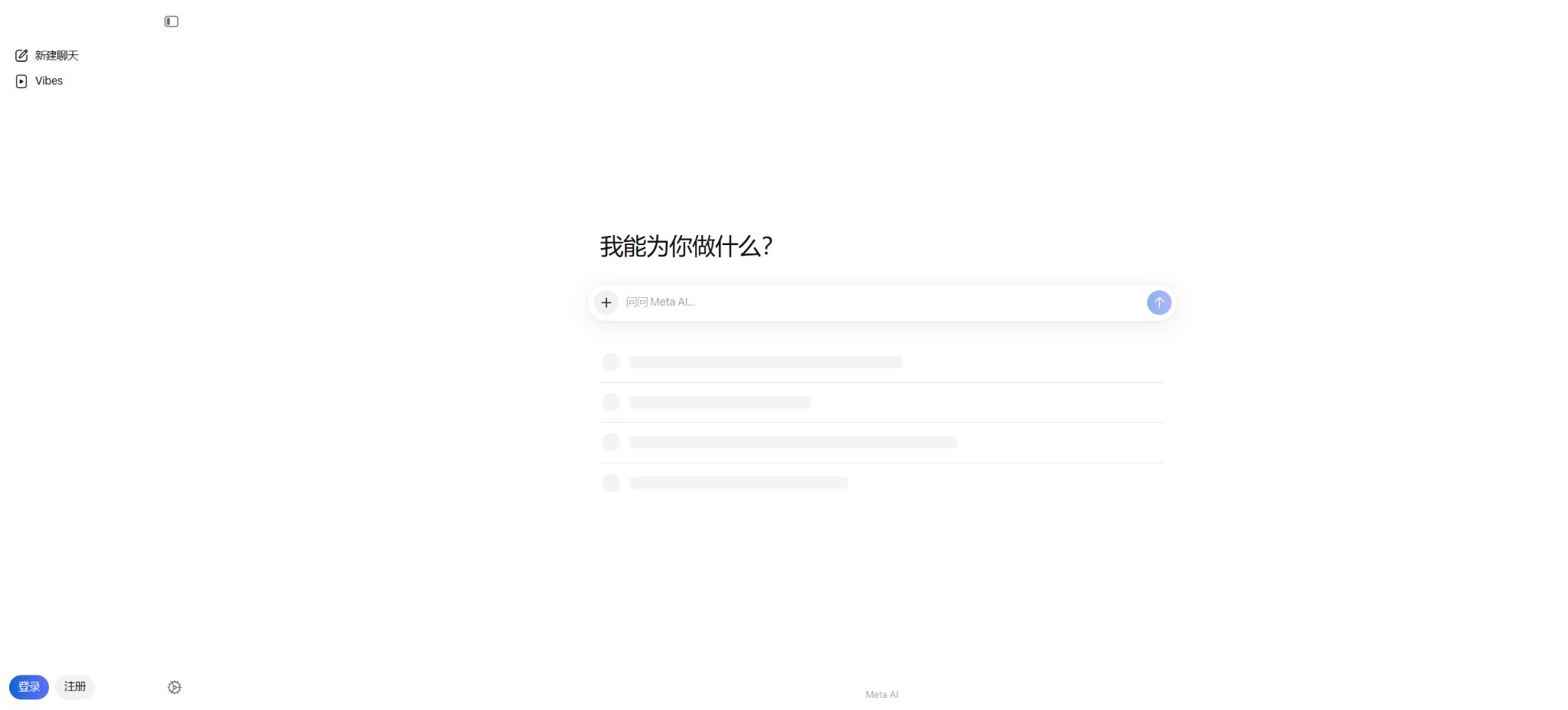
Meta AI
A free AI assistant that is fully integrated into the ecosystems of WhatsApp, Instagram, and Facebook.
Tags:AI dialogue chatWhat is Meta AI?
Meta AI is a personal AI assistant launched by Meta; it can be used through a dedicated Meta AI app and website, and it is also being gradually integrated into WhatsApp, Instagram, Facebook, Messenger, Threads, as well as Meta AI glasses.
It not only answers questions, but it can also search for public content on the internet and on Meta platforms, understand images and videos, engage in voice conversations, generate or edit images; moreover, with appropriate authorization, it can connect to services such as email and calendars to carry out multi-step tasks.
As of this verification, the latest inference capabilities of Meta AI’s websites and applications are as follows:Muse Spark 1.1Driver. Muse Spark 1.1 is a multimodal reasoning model released by Meta Superintelligence Labs in July 2026; it focuses on enhancing capabilities related to agents, tool invocation, computer operations, programming, and multimodal understanding.
Old materials often refer to Meta AI as a “Llama-based assistant”; this description is significant from the perspective of its early versions, but it no longer accurately reflects the current product. Llama remains an important family of open-weight models developed by Meta, while Muse Spark is the new generation of products offered by Meta AI – the two should be understood as separate entities.
Core functions
- Instant and Thinking modes:Instant is suitable for everyday questions and answers, rewriting, translation, organizing information, and providing quick suggestions; Thinking allocates more computational resources to handling planning, analysis, coding, and complex problems. The names of patterns, their occurrence frequency, and the level of availability may vary depending on the region and account used.
- Online searching and in-depth research:It is possible to search for web pages, research papers, as well as public posts on platforms such as Facebook and Instagram, Reels, content created by creators, and community content; these elements can then be used to generate a comprehensive report. During the research process, it is possible to request changes to the focus, tone, or certain sections at any time, and the system will adjust accordingly without the need to wait for the entire report to be completed.
- Agent task execution:In the supported markets, Meta AI enables users to create plans, link emails with calendars, check schedules, create slides, and take subsequent actions to achieve their goals. Users can also set up recurring tasks such as daily summaries, weekly meal plans, or alerts about product updates or trends; these tasks run automatically according to the scheduled timeline once they are configured.
- Documents and multimodal understanding:Muse Spark 1.1 is capable of understanding images, videos, audio, and PDF files; it can identify objects in visual content, extract details, compare products, and assist in analyzing documents. The developer model released by Meta supports a context size of up to 1 million tokens, but the actual size of files that can be uploaded, the number of such files, and the length of conversations are still limited by the settings in the account interface.
- Voice and real-time camera:Standalone applications support natural voice conversations; users can interrupt responses, change topics, or switch languages. Live AI allows the camera to be directed at the real world so that further questions can be posed, such as identifying landmarks, comparing products, or obtaining instructions for operating household devices.
- Meta AI glasses:Meta AI is being integrated into devices such as Ray-Ban Meta, Oakley Meta, and Meta Ray-Ban Display; these devices, together with cameras, microphones, and voice recognition technologies, enable hands-free question answering, environment understanding, and various daily assistance functions. The price of these hardware devices varies depending on the country, language, and specific features they offer, and it differs from that of chat services.
- Assistant within social apps:On WhatsApp, Instagram, Facebook, and Messenger, users can directly use Meta AI to get answers to questions, create content, or receive recommendations. Facebook’s AI Mode also generates answers by taking into account public opinions posted in Groups and Reels; features such as those related to Threads and side-by-side Q&A in group chats may still be in the testing phase or available on a gradual basis.
- Shopping and local recommendations:The shopping feature allows users to compare second-hand items available on Facebook Marketplace with new products listed on the website, and to filter them by price, style, and distance. It also enables users to find suggestions regarding outfits, brands, locations, and communities by leveraging content created by public creators.
Muse Image: Image creation and editing
Muse Image is an image generation model developed by Meta Superintelligence Labs, and it is now part of Meta AI. Users can generate images starting from text, or they can upload existing photos and modify them.
It allows combining multiple reference images to create posters or infographics with readable text, restoring old photos, changing hairstyles or styles, removing bystanders, and generating renovation visuals based on room photos that include references to actual products.
Image generation provides preset prompts; it also allows users to select, draw on, or mark the areas that need to be modified directly on the image. The conversation maintains its context, enabling users to continuously change the style, add elements, or adjust the layout.
The generated results can be downloaded, or shared via chat, quick photos, or information streams. Muse Image is currently available on Meta AI apps and websites, as well as in Instagram Stories and WhatsApp in certain countries; it will gradually become available on Facebook, Messenger, and in more regions as well.
Meta labels everyday image creation as free to use; when a higher volume of generation is needed, a Meta subscription plan may be required, though the official pricing is not specified uniformly for all countries.
The early version of Vibes was a content stream within the Meta AI application used for discovering, creating, and editing short AI videos; the new Muse Video is still in the development stage, so it should not be mistaken for a fully available professional video tool – Muse Video – and neither should Muse Image or the current Meta AI services be considered such tools.
Plans, slides, and personal workspace
The new version of Meta AI allows research reports, training plans, slides, mood boards, and other outputs to be stored in one place, making it easy to reopen them, make further modifications to them, and share them. For example, users can use it to study kitchen renovations based on their budget, find furniture on the Marketplace, and create visual mood boards.
It can also be used to read the calendar in order to create a training schedule for half-marathons, with the plan being sent automatically on a weekly basis.
Such agents require the ability to connect to external accounts and have appropriate permissions granted. Viewing the calendar, sending messages on behalf of a user, creating events, and making purchases represent different levels of risk.
When it comes to external writing, payments, public release, or deletion of data, it is necessary to verify the target, content, and permissions; models should not be allowed to operate on important accounts without human oversight.
Privacy and personalization
Regular Meta AI conversations can be personalized by taking into account the user’s data, interactions, and connected services within Meta products. Meta also uses information about offline activities that companies have shared with it to personalize certain feeds and AI responses, while offering controls over such activities.
Before uploading identification documents, contracts, health information, customer data, or confidential business documents, it is necessary to first check the account settings, the terms applicable to your location, and the organization’s data policies.
Meta has introduced it in WhatsApp and Meta AI apps.Incognito ChatThis mode relies on WhatsApp’s Private Processing technology to handle messages in a secure environment; according to the official statements, not even Meta can access these conversations.
Sessions are not saved, and messages disappear by default.
This feature is being rolled out in phases; regular chats do not automatically become incognito chats, and it is necessary to verify that the interface is indeed in Incognito mode before using it.
Free use and subscription
Meta AI’s basic functions for dialogue, searching, voice processing, and creating everyday images are available for free at the moment. However, being free does not mean unlimited use, nor does it imply that these functions work in the same way everywhere in the world. There may be restrictions on the frequency of use, the amount of data that can be processed, or the fair usage policy for tasks related to reasoning, research, image processing, file handling, and AI agents.
Some high-volume creative capabilities will be included in the Meta subscription plan.
The authorities do not have a unified consumer price that applies to all countries and app stores; the actual cost shall be as indicated on the purchase page after logging in.
In the Chinese mainland, Meta AI cannot be registered and used fully in the same way as local AI tools. The availability of these services is influenced by factors such as country or region, language, age, account status, application version, and the phased rollout schedule.
Even if the same account allows access to Meta AI, features such as Muse Image, Thinking, email and calendar integration, agent tasks, and glasses capabilities may not all be available yet.
Meta Model API
Developers can use Muse Spark 1.1 through the Meta Model API, which is currently in the public preview phase. This model offers a context capacity of up to 1 million tokens; it supports the processing of images, videos, and PDF files, includes built-in online search and citation functions, provides structured output, enables parallel execution of various tools, and features MCP servers as well as custom skills. Its interface is designed to be compatible with the common calling methods used by OpenAI, making it suitable for developing research, programming, and multimodal agents.
Meta currently offers a free quota for getting started with development, but it does not provide a fixed list of token prices that can be referenced over the long term. The models available during the preview phase, as well as the rate limits, regions, quotas, and prices, may all change; developers should refer to the information displayed in the console in real time.
The free quota or subscription for Meta AI on the consumer side is not equivalent to an API balance, nor can it be considered an unlimited API package.
Is it open source?
Meta AI applications, websites, and Muse Spark 1.1 are not open-source products at the moment. Meta has said it hopes to make future versions available openly, but this does not mean that the current versions can be classified as open-source.
The Llama models, Llama Stack, and other tools available on Meta’s official GitHub belong to a separate developer ecosystem. The model weights are typically governed by the Meta Llama Community License, rather than the standard open-source license that applies unconditionally to all uses; it is necessary to check the license for each repository and version individually.
Therefore, a more accurate description in the catalog would be: “Meta AI and Muse Spark do not have their source code made available; Meta does, however, offer Llama with its weights made public.”
Users should not assume that just because Llama can be downloaded from GitHub, they are able to set up locally all of Meta AI’s services related to search, personalization, social features, voice functionality, image processing, and account integration.
Meta AI Usage Guide
Complete a basic task.
- Clarify the issue, time frame, location, source priority, and output format;
- Upload materials for which you have permission to use in Meta AI, or enter search queries;
- First, establish a framework using the Instant and Thinking modes, and then supplement it with evidence through online searches and in-depth research.
- It is necessary to distinguish between factual information from the source, the author’s opinions, and AI-generated conclusions.
- Check each item for dates, numbers, the original location, and any conflicting evidence;
- The conclusions are manually revised, the verification time is recorded, and then they are published;
Create reusable professional workflows
- Break down complex topics into four categories of questions: background, data, comparison, and conclusions;
- Combining the Instant and Thinking modes, online searching with in-depth research, and agent task execution constitutes fixed research steps.
- Give priority to using the official website, research papers, regulatory documents, and raw data;
- A second person is assigned to review conclusions that are considered high-risk;
- Save queries, evidence, versions, and unresolved issues;
- Re-run after the data changes and update the conclusions;
Which users are it suitable for
- Users who frequently use Instagram, Facebook, WhatsApp, and Messenger and wish to leverage AI directly within these existing social media apps;
- Knowledge workers who need to conduct research online, consult public community opinions, plan schedules, create slides, and set up recurring reminders;
- Content creators who wish to generate, combine, or make partial edits to images using natural language;
- Those who need real-time environmental understanding and a voice assistant when using Meta AI glasses;
- Developers who wish to create agents by leveraging million-token contexts, tool calls, and multimodal capabilities.
Usage restrictions and precautions
- MetaAI may generate false facts, outdated information, fictional citations, incorrect codes, or inappropriate recommendations;
- The most popular opinions found on websites and in social media are not necessarily true; medical, legal, financial, policy-related, and academic conclusions must be verified against authoritative sources.
- The model understands that being able to understand health issues does not equate to having medical qualifications; in emergency situations, one should contact local professional agencies.
- Image generation and editing also involve issues related to portraits, privacy, trademarks, and copyrights.
- When using someone else’s photos, content from public accounts, or brand materials, it is necessary to obtain the appropriate permissions and to indicate that the content was generated by AI in accordance with local regulations.
- In July 2026, Meta temporarily allowed the use of public Instagram accounts as references for images, but removed this feature later due to user feedback, indicating that product functions can change rapidly and that older tutorials may no longer be valid.
Frequently Asked Questions
Is Meta AI free?
Basic services and everyday use for creating Muse images are currently free, but there are limitations on their use; higher volumes of generation may require a Meta subscription.
There is no unified public price across different countries; the price shown on the purchase page for that account applies.
Is Meta AI’s latest model Llama?
No. The latest Thinking capabilities of the current Meta AI websites and applications are powered by Muse Spark 1.1.
Llama is an open-weight model ecosystem provided separately by Meta.
Can Meta AI conduct in-depth research and create PPTs?
Yes. In open markets, it can generate research reports by combining web pages, papers, and content available on Meta platforms; it can also create slides and accept modifications during the creation process.
Can Meta AI generate images and videos?
Muse Image already supports image generation, combination, and partial editing. Vibes offers AI-powered video discovery and editing capabilities, but the new version of Muse Video is still under development; it should not be considered a fully functional video processing tool yet.
Are Meta AI conversations private?
Normal conversations should be interpreted in accordance with Meta’s standard data handling practices and personalized rules. Once you enter Incognito Chat, official guidelines state that the conversations are processed in a secure environment that Meta cannot access, they are not saved, and they disappear by default.
This mode is still being gradually opened up.
Is Meta AI open source?
Meta AI and Muse Spark 1.1 are not open source. Some of the model weights and tools related to Llama are available on the official GitHub site, but they are subject to a custom license; this does not mean that the entire Meta AI product is open source.
Tools similar to Meta AI




 Guigong Network Security Registration No. 45132202000164