






DeepSeek
A domestic AI assistant that offers excellent value for money, along with capabilities in reasoning, programming, and answering general questions.
Tags:AI dialogue chatWhat is DeepSeek?
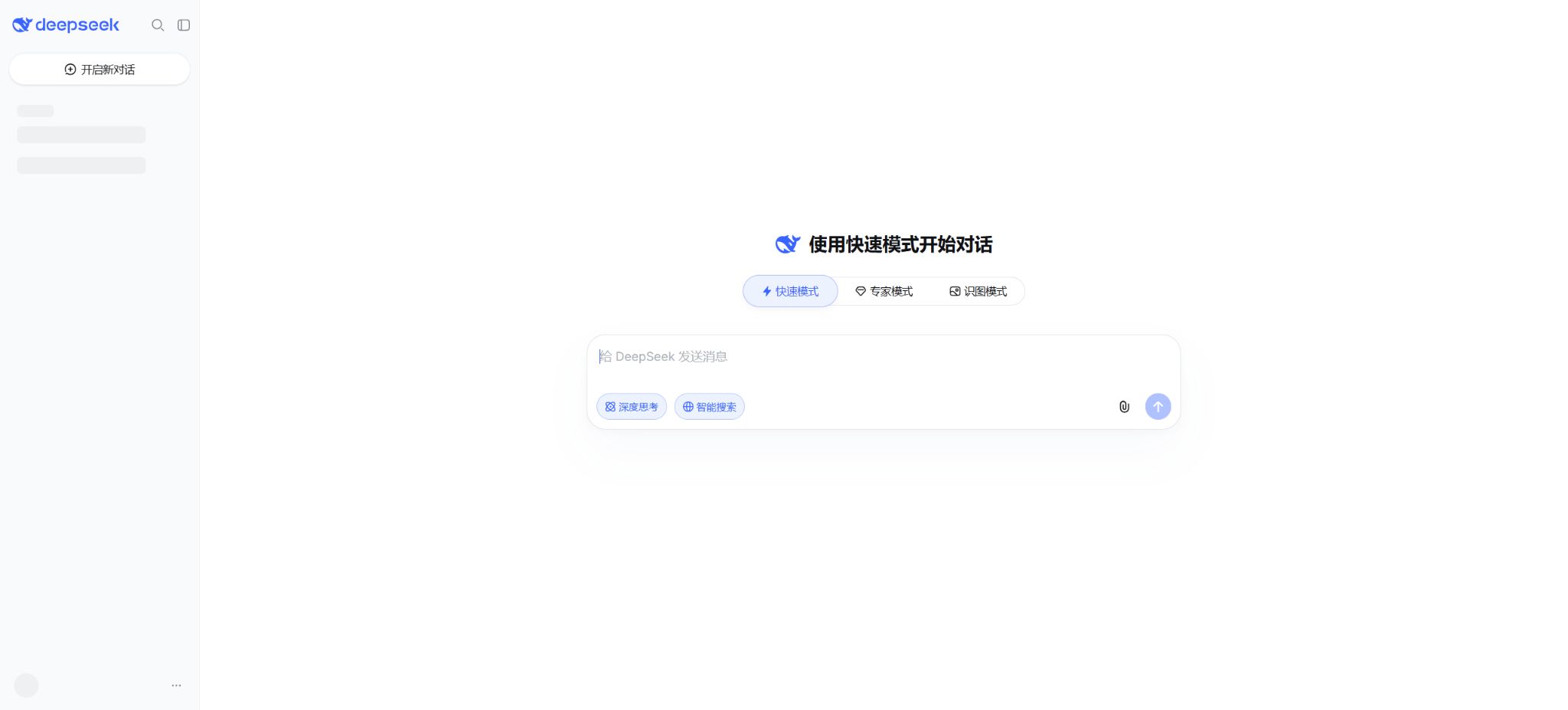
DeepSeek is a large-model brand, a free AI assistant, and a developer API platform launched by Hangzhou DeepSeek Artificial Intelligence Basic Technology Research Co., Ltd. Users can carry out tasks such as answering questions, writing, translating, solving problems, programming, performing online searches, understanding images, and reading files, either through the web interface or the official app.
Developers can access these models through interfaces that are compatible with OpenAI and Anthropic formats; they can also download the officially available model weights for research, fine-tuning, or local deployment.
As of this verification, DeepSeek’s current main development track has already entered the next phase.DeepSeek-V4In this series, R1 and V3 should no longer be referred to as the latest flagship models. V4 includes V4-Flash, which emphasizes speed and cost efficiency, as well as V4-Pro, which features a larger scale along with improved capabilities in terms of knowledge processing and complex reasoning.
On July 31, 2026, the authorities launched the official beta version of the V4-Flash API, with a focus on enhancing the capabilities of code agents and the tools used for execution; this update did not involve any changes to the V4-Pro API or to the models used in the app and web interfaces.
The “DeepSeek-R2” version that circulates on the Internet does not have any official release information; therefore, it should not be considered a real product based on such rumors.
Core functions
- General AI dialogue:It handles knowledge-based questions, content summarization, Chinese writing, translation, instructional explanations, plan formulation, and everyday decision-making. The model can switch between providing quick responses and conducting more in-depth reasoning, but errors may still occur in its outputs.
- Deep thinking:Both V4-Pro and V4-Flash support three levels of reasoning intensity: No Thinking, Think High, and Think Max. The No Thinking mode can be used to increase speed for everyday tasks, while higher levels of reasoning are more suitable for tasks involving mathematics, coding, planning, and complex analysis.
- Online search:On the consumer side, it is possible to conduct searches on the Internet and then provide comprehensive answers; this approach is suitable for obtaining information on news backgrounds, product details, and current events. Search summaries are not equivalent to the original text, so dates, numbers, citations, and policies still need to be verified by visiting the original page.
- Image recognition and image-based questions:The official mobile app now features an image recognition mode that allows users to upload photos, screenshots, or charts in order to have them analyzed, text extracted from them, and questions answered regarding them. This is a form of visual understanding; it should not be mistaken for a feature that provides professional-level text-to-image or video generation capabilities.
- File reading:It allows for the uploading of documents, and it enables summarizing the content, extracting key points, explaining concepts, and asking follow-up questions. It is suitable for initial reading of papers, reports, contracts, and learning materials. The accuracy of recognition for very large files, documents with complex formatting, scanned images, and tables can be affected by their format.
- Code and mathematics:It enables the creation, interpretation, debugging, and restructuring of code, as well as the handling of algorithms, mathematical derivations, and engineering problems. The official version of V4-Flash has been enhanced for tasks related to code agents; it is suitable for use in development tools for tasks such as repository analysis, patch creation, and terminal operations. However, the code produced must undergo testing and security reviews.
- Long context:Both the official V4-Pro and V4-Flash models support a context size of 1 million tokens, with a maximum output length of 384K. The actual usable length is also affected by factors such as the platform being used, video memory capacity, costs, latency, and client limitations.
- Agent and tool invocation:The API supports JSON output, tool calls, continuation of conversation prefixes, and FIM completion; V4-Flash additionally offers a Responses API that enables integration with code proxies and automated workflows. Tool calls can amplify model errors into actual actions, and human confirmation is required when performing tasks such as writing files, publishing content, making payments, or deleting items.
- Multi-device synchronization:Versions for Web, iPhone, iPad, and Android are available. The mobile versions support searching through past conversations, copying and downloading tables, adjusting font size, as well as uploading pictures and files; additional features will be made available gradually depending on the version and region.
How to choose between V4-Pro and V4-Flash?
V4-Flash is a MoE model with 284B total parameters and 13B active parameters; it is suitable for users who prioritize speed, low API costs, as well as for handling batch processing of text and code. V4-Pro, on the other hand, has 1.6T total parameters and 49B active parameters, and it is better suited for knowledge-intensive tasks, complex reasoning, analysis of long documents, and challenging programming tasks.
Both are pre-trained on data with more than 32T tokens, and they employ a hybrid attention architecture to reduce the computational and caching costs associated with handling contexts of millions of tokens in length.
The statement that “Pro is suitable for all tasks” is not accurate. For simple Q&A, classification, data extraction, and high-concurrency applications, Flash is generally a more cost-effective choice.
For complex research or challenging code, switch to Pro.
Think Max consumes more computing resources and output tokens; the official guidelines for local deployment recommend allocating at least 384K of context for this mode, which is why it is not suitable as the default setting for all requests.
Free use and API pricing
The DeepSeek web version and the official app are available for free at present. The official app is listed as “free” in the Apple App Store, with no in-app purchases shown. Being free does not mean unlimited access: there may be queues during peak times, and restrictions on search functions, image recognition, file uploads, the length of conversations, and the number of times a message can be resent may apply due to control measures or capacity limits.
The authorities have not promised unlimited access for end-users; the actual limit is determined by what is displayed on the account interface.
API and free chat are two separate products. Developers need to create an API Key separately and make a payment, with the cost calculated based on the number of incoming and outgoing tokens.
The current official public price is stated per million Tokens:
| Package or version | Prices, quotas, and core benefits |
|---|---|
| V4-Pro | The cost for a cache hit is 0.025 yuan, for a cache miss it is 3 yuan, and the output cost is 6 yuan. |
| Pro | V4-Pro: 0.025 yuan for a cache hit, 3 yuan for a cache miss, and 6 yuan for the output. |
The public concurrent limit for V4-Flash is 2500, while that for V4-Pro is 500; in both cases, the context limit is 1 million tokens.
The authorities have indicated that there are plans to raise API prices overall, and the increase is expected to be significant; therefore, these figures should only be used as a reference for this verification process. The actual prices should be checked in the console before the service goes live.
When both a top-up balance and a complimentary balance are available, the complimentary balance is used first; the free credit available for consumption cannot be converted into API balance.
API and developer integration
The DeepSeek API offers a Chat Completions format that is compatible with OpenAI, as well as an interface for the Anthropic format. With the existing SDKs, it is usually sufficient to modify the key, model name, and service address in order to integrate them. The current official models are deepseek-v4-flash and deepseek-v4-pro.
The previous versions deepseek-chat and deepseek-reasoner were discontinued on July 24, 2026; the model names mentioned in the old tutorials need to be updated.
V4-Flash currently supports the Responses API, while the capabilities related to Responses in V4-Pro are subject to the latest documentation. Both versions support thinking modes (with or without reflection) as well as JSON output and tool calls; however, there may be compatibility issues between the thinking mode and the forced use of a specific tool.
When building LangChain, code agents, or structured output processes, it is necessary to conduct regression tests using actual parameters; one cannot assume that all fields will behave in exactly the same way just because the interface is compatible with OpenAI.
Open-source status and local deployment
The official weights for DeepSeek-V4-Pro, V4-Flash, and their Base versions have been made public; these models make use of dedicated hardware cards.MIT LicenseThe total parameters for V4-Pro are around 1.6T, while those for V4-Flash are around 284B. The developers provide weights in FP8 format as well as in a mixed FP4/FP8 format; they also offer instructions on how to deploy these models using tools such as Transformers, vLLM, and SGLang.
R1, V3, Coder, VL, OCR, as well as several training infrastructure projects, are also made available in the official community; however, it is still necessary to check the licenses for each repository individually.
\"Open-source weights\" do not mean that a regular computer can run the entire model effortlessly. Even at lower precision levels, V4-Flash and especially V4-Pro still require significant amounts of storage, memory, video memory, as well as the capability to use multiple GPUs in parallel; moreover, a context size of millions will greatly increase the size of the KV cache.
Individual users generally find it more suitable to use the official free version, APIs, or reliable hosted inference services; before downloading quantized models, it is necessary to check their source, the degree of precision loss, the licensing terms, and the hardware requirements.
It is also necessary to distinguish between the official model weights, the research code, and DeepSeek’s online products: chat websites, account systems, online search functions, content security features, and cloud-based inference platforms have not been made available as a complete open-source application. A more accurate description in the catalog would be “the core model weights are open source, while the online products and hosting services are not”.
Supported platforms
DeepSeek offers versions for the Web, iPhone, iPad, Android, and via API. The Apple app in China requires iOS or iPadOS 15.0 or later, and it supports multiple languages.
The official Android app is also available for smartphones and tablets.
When downloading, make sure the developer is Hangzhou Deep Exploration; avoid installing third-party wrapper apps with similar names that require additional subscriptions or grant excessive permissions.
DeepSeek usage guide
Complete a basic task.
- Register for DeepSeek and create an API Key intended solely for use in a testing environment;
- Select a model based on input type, context, quality, speed, and price;
- First, use the general AI dialogue to fulfill the minimal request and check the returned structure;
- Then use deep thinking tests to evaluate stream output, parameters, and exception responses;
- Record Tokens, number of calls, latency, error rate, and cost per call;
- Move the key to the server-side key manager before integrating it into the actual application;
Create reusable professional workflows
- Different keys and quotas are used for development, testing, and production environments;
- A representative evaluation set is established based on general AI dialogue, deep thinking, and online searching;
- Set timeout, concurrency, retry, throttling, and budget limits;
- Perform checks on the output regarding facts, security, format, and sensitive information;
- Monitor changes in model version, price, latency, and failure rate;
- Prepare plans for downgrading the model, implementing circuit breaking, and taking manual control;
Which users are it suitable for
- Ordinary users who need free Chinese-language Q&A, writing, translation, online searching, and learning explanations;
- Students and knowledge workers who need to read papers, reports, screenshots, and long documents;
- Developers who need code generation, repository analysis, debugging, and Agent workflows;
- Teams and enterprises that wish to access long-context models at a lower cost in terms of tokens;
- Organizations that have multi-card hardware and wish to research, fine-tune, or deploy open-weight models on a private basis.
Usage restrictions and safety precautions
- DeepSeek’s responses may contain hallucinations, outdated information, fabricated citations, and calculation errors;
- Online searches can only improve speed, but they do not guarantee the accuracy of the results;
- Medical, legal, financial, policy-related, and academic citations must be reviewed by professionals or the original sources;
- A long context does not mean that the model can retain every detail without loss; important numbers, terms, and tables that span multiple pages should be verified separately.
- Before uploading contracts, resumes, source code, customer information, photos, and audio files, it is necessary to remove any unnecessary ID numbers, keys, trade secrets, and personal information first.
- Apple’s privacy disclosures indicate that an app may process approximate location data, contact information, user-generated content, search history, device identifiers, as well as usage and diagnostic data.
- For a company’s sensitive operations, it is necessary to assess the location where data is stored, the retention period, the mechanisms for deleting data, and the internal compliance requirements.
- While local deployment enhances data control capabilities, it also places the responsibilities for model downloading, the supply chain, access control, logging, vulnerability repair, and content compliance on the person who carries out the deployment.
- The disclosure of weights does not mean that the output is exempt from legal constraints, nor does it automatically grant third parties rights to trademarks, portraits, datasets, or the content generated.
Frequently Asked Questions
Is DeepSeek free?
The official website and app are currently free, with no paid membership options available; the API is charged on a per-token basis.
The free version may still experience long queues during peak times, as well as limitations on the number of available functions and risk control measures.
What is DeepSeek’s latest model?
The current official main version is DeepSeek-V4, which includes V4-Pro and V4-Flash. The official API for V4-Flash was made available for public testing on July 31, 2026;
There is no official announcement regarding R2 yet.
Does DeepSeek support images and files?
Supported. The official app already offers an image recognition mode, and it is continuously being improved in terms of image and file uploading.
It can be used for image understanding, text extraction, document summarization, and asking follow-up questions, but it is not a professional tool for generating images or videos.
Is DeepSeek open-source?
The weights for V4-Pro, V4-Flash and Base are made available under the MIT license, and official open-source repositories also exist for models such as R1 and V3; however, the web pages, apps, search functions and cloud platforms are not fully open-source products.
How much does the DeepSeek API cost?
Currently, for every million tokens, the cost for a hit in the V4-Flash cache is 0.02 yuan, while the cost for a miss is 1 yuan; the output cost is 2 yuan. For V4-Pro, these figures are 0.025 yuan, 3 yuan, and 6 yuan respectively.
The authorities have indicated that there could be a significant price increase, and it is necessary to reconfirm before accessing it.
Can a regular computer run V4 locally?
The full V4 model is very large in size, and it usually requires specialized multi-GPU servers. Personal computers can only rely on community-developed quantization and partitioning methods, or on smaller distilled versions of the model; as a result, trade-offs have to be made in terms of speed, context handling, and performance.
Tools similar to DeepSeek




 Guigong Network Security Registration No. 45132202000164