






Kimi
Long-form texts, in-depth analyses, and AI assistants for agent-based work, offered by the Dark Side of the Moon.
Tags:AI dialogue chatWhat is Kimi?
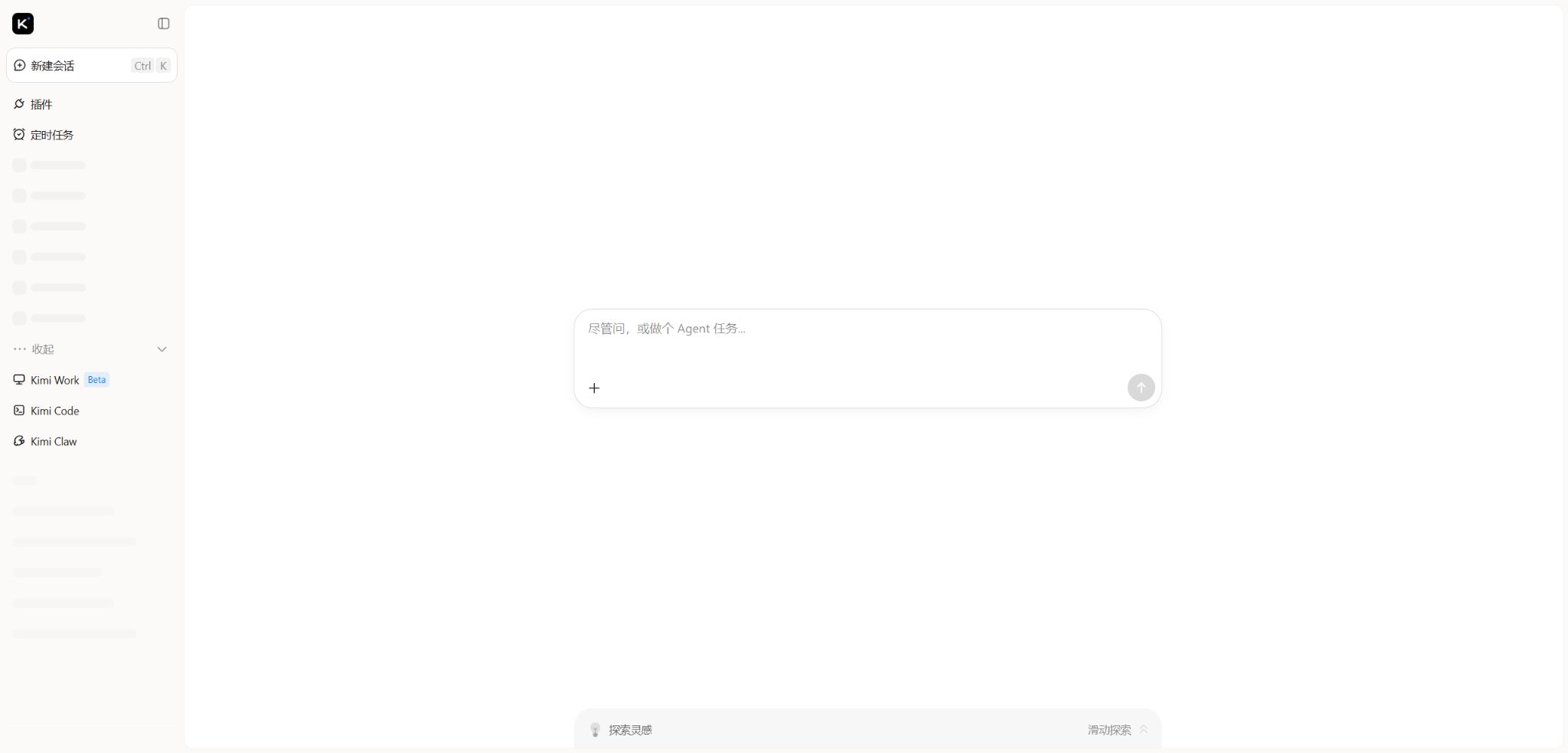
Kimi is a universal AI assistant and agent platform launched by Moon’s Dark Side. It was initially known for its capabilities in processing long texts and analyzing files; today it has been expanded to include the K3 flagship model, online research functions, Office Agent, PPT creation, website and game generation, multi-agent systems, terminal programming, local desktop tasks, as well as 24/7 cloud-based agents.
Regular users can use it via web pages and apps; knowledge workers can use Kimi Work, while developers can use Kimi Code or the open platform APIs.
Kimi K3 features 2.8 trillion parameters in total, native visual capabilities, and a context capacity of up to 1,048,576 tokens; it is designed for long-term programming, knowledge-based tasks, and complex reasoning. The value of 1 million tokens represents the maximum technical capacity of this specific model and package, but it does not mean that all Agent tasks, file uploads, and free conversations can utilize such a large context length at the same time.
Core functions
- Chatting and long-text reading:Upload PDF, Word, PPT, tables, images, and web content to perform summarization, Q&A, translation, information extraction, and cross-file comparison.
- Online searching and in-depth research:Search public web pages and compile reports with sources; members can also access specialized databases in finance, research, law, and other fields.
- Kimi Agent:Plan and execute multi-step tasks in the cloud to create documents, tables, websites, applications with databases, PPTs, and visualizations.
- Agent Swarm:Multiple sub-Agents are organized according to complexity for parallel research, development, and verification; premium packages offer more sub-tasks and concurrency.
- Goal mode and Skills:Tasks are pursued continuously in line with long-term goals, and high-quality outcomes are transformed into reusable skills for use in repeated workflows.
- PPT and Office Pilot:Visual references can be uploaded to replicate a specific style, presentations can be created, and the content and format across Word, Excel, PDF, and PPT files can be handled.
- Visual and game generation:K3 can understand images, user interfaces, and charts; it is capable of creating web pages, visualizations, and even prototypes for multi-player 3D games from a single sentence.
- Kimi Code:It serves as a terminal and an IDE programming agent that allows for reading and writing code, executing commands, searching for files and web pages; it can also be integrated with compatible tools such as Claude Code and Roo Code.
- Kimi Work:The local agent on Windows and Macs with Apple chips allows for managing folders, running Python scripts, using the WebBridge browser, installing Skills, and executing local scheduled tasks once authorized.
- Kimi Claw:Deploy OpenClaw in the cloud, on a desktop, or on an unused Android device; it enables connectivity to files, internal networks, applications, and messaging channels, making it suitable for personal agents that need to operate continuously.
Price and version comparison
| Package or version | Prices, quotas, and core benefits |
|---|---|
| Kimi membership prices | Kimi offers four tiers of individual memberships, with the following monthly subscription prices: Andante: 49 yuan per month, or 39 yuan per month when paid annually; it includes around 30 common Agent tasks, the ability to run multiple tasks simultaneously, 20 projects, and 20GB of storage space for projects. Moderato: 99 yuan per month, or 79 yuan per month on an annual basis; it provides around 60 Agent tasks, the ability to run 2 tasks simultaneously, 4 times more usage of Kimi Code, and 2 sub-task clusters. Allegretto: 199 yuan per month, or 159 yuan per month when paid annually; it offers around 150 Agent tasks, 20 times more usage of Kimi Code, 4 sub-task clusters, and access to Kimi Claw and Goal modes. Allegro: 699 yuan per month, or 559 yuan per month on an annual basis; it includes around 360 Agent tasks, the ability to run 4 tasks simultaneously, 60 times more usage of Kimi Code, access to more projects and professional databases, as well as the possibility of conducting very long conversations using up to 3 million tokens. All membership tiers share the same quota system based on actual token consumption, and they also provide features for creating PPTs, conducting research, and deploying websites. |
| Kimi K3 API price | The Kimi open platform offers an OpenAI-compatible chat interface, tool invocation capabilities, JSON Mode, structured output, automatic context caching, and support for contexts of up to a million tokens. At present, K3 is billed on a per-million-token basis: 2 yuan for cached inputs, 20 yuan for uncached inputs, and 100 yuan for outputs. When long code libraries and documents are reused across multiple conversations, automatic caching can significantly reduce the cost of inputs; however, the reasoning process and long outputs still result in higher billing amounts. Models such as K2.6, K2.7 Code, and others have different pricing structures and context limits, and online searches may also incur separate charges per transaction. Kimi memberships do not include a balance for the general open platform API; the dedicated keys generated by the Kimi Code package are subject to restrictions related to their usage within the Coding Plan, frequency limits, and model scope, and cannot be resold indefinitely as ordinary pay-as-you-go APIs. |
Kimi membership prices
Kimi offers four tiers of individual memberships, with the monthly subscription prices as follows:
- Andante:49 yuan per month, with an annual payment rate of 39 yuan per month; around 30 common Agent tasks, parallel execution of individual tasks, 20 projects, and 20GB of project storage space.
- Moderato:99 yuan per month, with an annual payment equivalent to 79 yuan per month; around 60 Agent tasks, 2 tasks running in parallel, 4 times the quota for Kimi Code, and 2 sub-task clusters.
- Allegretto:199 yuan per month; the annual payment equates to 159 yuan per month. This plan includes around 150 Agent tasks, a 20-times increase in Kimi Code usage, 4 sub-task clusters, and access to Kimi Claw and Goal modes.
- Allegro:699 yuan per month; the annual payment equivalent to 559 yuan per month. This plan includes around 360 Agent tasks, the ability to handle 4 tasks simultaneously, a 60-fold increase in Kimi Code’s functionality, access to more projects and professional databases, as well as the possibility of using up to millions of K3 tokens for extended conversations.
The member features share the same quota pool based on the actual amount of tokens consumed; PPT, research, website deployment, Kimi Work, Claw, K3, and clusters can all draw from this quota. The figure of \"around 30 to 360 tasks\" provided by the officials is an estimate based on typical usage levels, as more tokens may be required for complex tasks.
The quota is refreshed at the end of each billing period, and any unused portion is not carried over; Kimi Code offers an additional 5-hour window as well as weekly usage limits.
Even when in standby mode, Claw cloud servers can continue to consume quota based on the sandbox resources allocated to them; it is necessary to check the details before using them.
Kimi K3 API price
Kimi’s open platform offers a chat interface compatible with OpenAI, tool invocation capabilities, JSON Mode, structured output, automatic context caching, and the ability to handle contexts of up to a million tokens. At present, K3 charges based on the number of million tokens: 2 yuan for cached inputs, 20 yuan for uncached inputs, and 100 yuan for outputs.
When long code libraries and documentation are reused across multiple conversations, automatic caching can significantly reduce input costs; however, the inference process and long outputs still result in higher billing amounts.
K2.6, K2.7 Code, and other models come with different prices and requirements, and online searches may also incur separate charges per transaction. Kimi memberships do not include a balance for the general open platform API.
The dedicated keys generated by the Kimi Code package are subject to restrictions related to the purpose of the coding plan, frequency control, and the range of available models; they cannot be resold indefinitely as ordinary pay-as-you-go APIs.
Open-source models and licenses
Moon’s Dark Side has released the Kimi K3, Kimi K2 series, Kimi Code CLI, as well as various research projects on GitHub and in the model community. The code and weights related to K3 are governed by a dedicated Kimi K3 License, rather than Apache 2.0 or the standard MIT license; this license allows for use, modification, deployment, and customization, as well as incorporation into commercial products. However, model-as-a-service providers with an annual revenue of over $20 million must enter into a separate agreement with Moon’s Dark Side.
For commercial products using K3, if the monthly active users exceed 100 million or the monthly revenue exceeds 20 million dollars, it is necessary to display “Kimi K3” in a prominent position on the interface.
Internal use and invocation through official or certified inference partners are not subject to these two requirements.
K2 uses Modified MIT, and larger-scale products also have terms related to brand display. The Kimi website, app, Work cloud services, and the full Agent platform remain proprietary products.
The open-source version does not include official search functions, professional databases, sandboxes, plugins, or membership services.
The K3 model is extremely large in size; its local deployment requires a large multi-GPU cluster, and it cannot be run on ordinary computers.
Platforms and security
Kimi is available for use on Web, iPhone, iPad, Android, and HarmonyOS; Kimi Work requires Windows 10 or later, or a device with an Apple chip and macOS 12 or later.
The local scheduled tasks of Kimi Work are executed only when the computer and the application are running; tasks that are missed during sleep mode are not run automatically. In contrast, the cloud-based Kimi tasks do not require the local system to be always on.
Work and Claw allow for writing to files, executing code, operating a browser, and accessing internal networks; thus they present a higher level of risk compared to ordinary chat applications. It is recommended to request permissions on a per-request basis, to use separate directories and accounts with limited permissions for specific tasks, not to save sensitive payment information in the browser, and to review any third-party skills utilized.
Early requirements for an agent may be forgotten amid multiple rounds of revisions; important constraints should be included in the task framework and verified in stages.
Kimi usage tutorial
Complete a basic task.
- Specify the presentation topic, objectives, duration, and number of pages;
- Import reliable data into Kimi and remove any irrelevant or sensitive information;
- Use chat and long-text reading functions to generate an outline instead of finalizing the text directly;
- Select templates, illustrations, and visual hierarchies through online searches and in-depth research;
- Check each page for numbers, citations, charts, font sizes, and layout;
- Perform a full-screen preview before exporting in the desired format;
Create reusable professional workflows
- Create brand templates, title hierarchies, and a library of common pages;
- Fix the order of fixed chats and long-text reading, online searching and in-depth research, as well as the creation of Kimi Agent;
- Specify one key point per page and control the text density;
- Assign the review of facts, visuals, and presentation logic to respective responsible persons;
- Test fonts, animations, and proportions on different devices;
- Save the source files, versions, and records of final approval;
Which users are it suitable for
- Knowledge workers who read long reports, papers, contracts, and various documents
- A consulting and operations team needed for research, PPT preparation, website management, and data delivery
- Developers who use terminals, IDEs, and large codebases
- Powerful automated users who can establish permission settings, sandbox environments, and audit mechanisms.
Frequently Asked Questions
Is Kimi free?
Basic features such as K2.6 for simple chatting are available for free, while advanced agents, K3 for long-duration conversations, as well as Code, Work, and Claw functionalities are offered by membership plans costing between 49 and 699 yuan per month.
Does Kimi support 1 million Tokens?
The K3 model can handle millions of tokens, but for very long conversations on the client side Allegro is required; ordinary agents have their own limitations regarding files and context.
Does the Kimi membership include an API?
Members and the open platform’s pay-as-you-go API systems are separate; the dedicated key for Kimi Code is intended for use with specific plans and compatible programming tools, and it cannot be considered equivalent to the balance available for general API usage.
Tools similar to Kimi



 Guigong Network Security Registration No. 45132202000164