






Poe
Use multiple models on a single platform and create custom robots.
Tags:AI dialogue chatWhat is Poe?
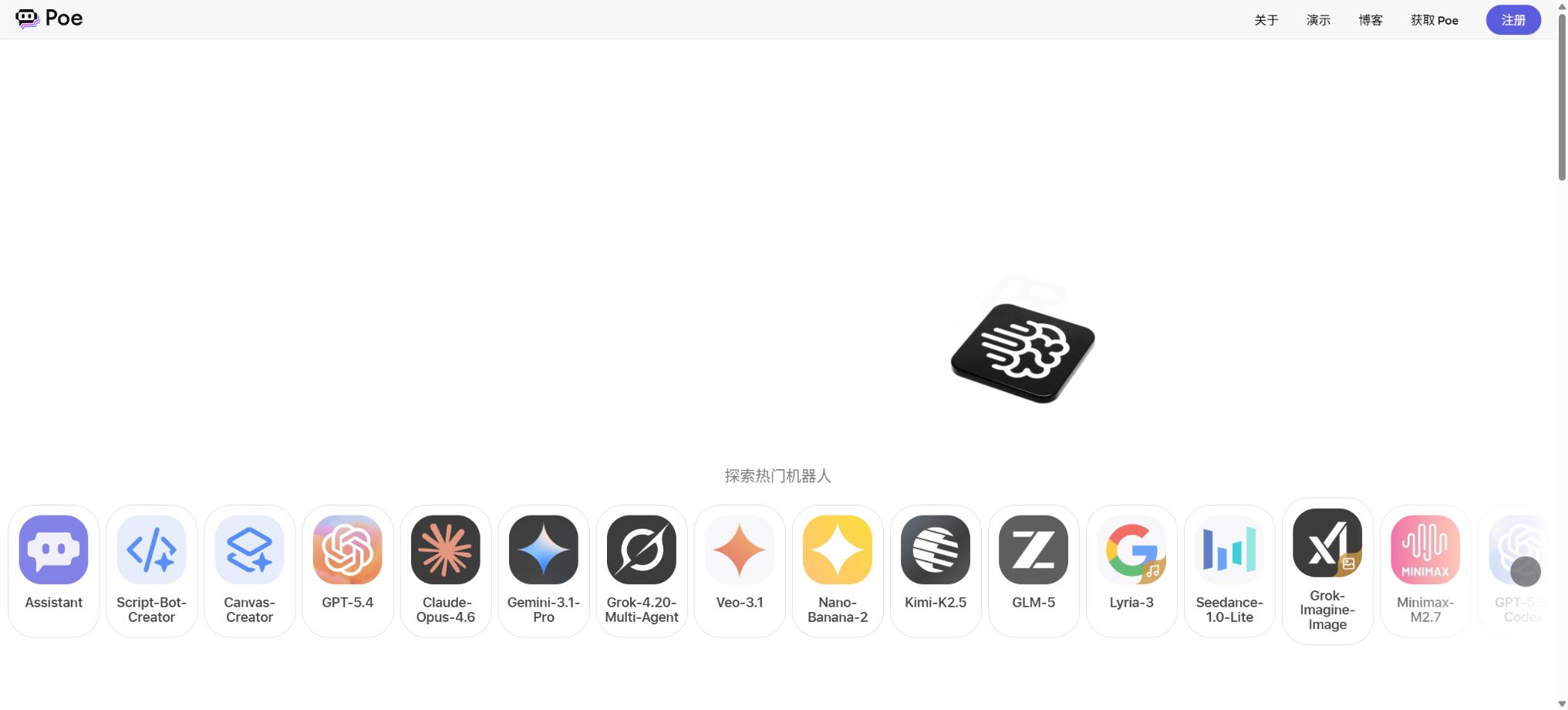
Poe is a multi-model AI platform launched by Quora, allowing users to utilize models from companies such as OpenAI, Anthropic, Google, xAI, and Meta under a single account. The platform supports text, images, videos, audio, music, code execution, and interactive applications.
Poe also offers a creator platform that enables users to configure Prompt Bot without writing any code, or to develop Server Bot, Script Bot, and Canvas App. Each model or application is billed using a unified system of compute points.
Poe’s main functions
- On a single interface, it is possible to switch between models such as GPT, Claude, Gemini, and Grok;
- Access image, video, audio, and music generation models;
- Compare the responses of different bots to the same question;
- Communicate with both users and multiple bots at the same time in a group chat;
- Upload files, images, and long texts for analysis;
- Memory retains personal preferences among official Bots;
- Temporary Chat creates temporary sessions that are not recorded in the history;
- Prompt Bot creates assistants using basic models and custom instructions;
- The Server Bot connects to its own servers, models, and business logic;
- Script Bot hosts the Python logic on Poe;
- Canvas Apps offer customizable interactive web interfaces;
- An API Key allows external programs to call the Poe Bot.
Multi-model chat
Poe brings together the official bots of various companies as well as the bots created by numerous users, in web interfaces and applications for iOS, Android, Windows, and macOS. Users can choose between inference, fast processing, long-context handling, or multimedia models depending on their needs.
Model names and versions are updated frequently, and the same company may offer several bots with different pricing structures. Before getting started, it is necessary to confirm the bot’s official identifier, the maximum length of the input context, and the associated rates.
Generation of images, videos, and audio
Poe integrates models such as FLUX, Ideogram, Runway, Luma, Pika, Veo, ElevenLabs, etc.; the list of available models is subject to change. A fee is charged each time content is generated, based on a fixed number of points or on the scale of input and output.
High-resolution, long videos, audio, and high-quality modes require significantly more resources. Setting a budget per generation in advance can help prevent the accidental depletion of credits.
Compute Points billing
Each Bot displays the estimated cost of the first message as well as detailed rate information; the fees can be fixed or may vary depending on the number of tokens read and generated. Users can set a budget per message for all conversations or for individual conversations.
The free credits are refreshed daily and do not carry over, while the subscription credits are issued on a daily or monthly basis according to the plan, and they also generally do not carry over. The longer the history of messages, the more context is available for the model, and this may result in higher consumption of credits.
Auto-manage Context and Memory
Auto-manage Context gives priority to retaining the most recent conversations, thereby reducing the amount of historical data that is sent over and over again and helping to control the score. When this feature is disabled, more earlier contexts can be retained, but the cost may increase.
Memory sorts out preferences from the new messages that appear after it is activated, on a daily basis, and can be used with most official bots. It is not shared with other users or bot creators; users can view it, turn it off, or delete it permanently.
Temporary Chat and Group Chats
Temporary Chat is not included in the history, memory, search results, share options or branches; it is deleted permanently within 24 hours of being created, yet it still consumes points. This mode is available only for Poe’s official bots.
Group chats allow multiple users and bots to interact within the same thread, making them suitable for comparison and collaboration. Members can see the messages within the group, so group chats cannot be considered private spaces.
Prompt Bot, Server Bot, and Script Bot
A Prompt Bot can be created quickly by selecting a basic Bot, writing system prompts, defining a knowledge base, and setting replies. A Server Bot, on the other hand, is hosted by its creator and can call external APIs, databases, or other Poe Bots.
Script Bot allows for the creation of applications on Poe using Python logic, thereby reducing the need for manual hosting. Developers still have to handle input validation, permissions, errors, costs, and compliance with third-party services.
Canvas Apps and Poe API
Canvas Apps are interactive applications with custom visual interfaces; they can be used to activate the Poe Bot via the Embed API and display the resulting output. They are suitable for tools, games, visualizations, and multi-step experiences.
Subscribers can create API Keys to invoke the bots on Poe from external applications. The API and chatting share the same point system, with additional points available for one-time tasks or calls that exceed the subscription limit.
Comparison of Poe function types
| Type | Creation method | Operation location | Suitable scenarios |
|---|---|---|---|
| Official Bot | Configuration of Poe and the model provider | Poe and provider services | Use mainstream models directly. |
| Prompt Bot | Base model plus prompts and knowledge | Poe | Code-free dedicated assistant |
| Server Bot | Custom code and servers | Creator server | APIs, databases, and custom logic |
| Script Bot | Python script | Poe hosting | Lightweight programmed bot |
| Canvas App | HTML, JS, and Embed API | Poe interface | Interactive tools, visualizations, and games |
Poe subscription price
The table below shows Poe’s current annual payment option in US dollars; the average monthly price is provided only for comparison purposes. The monthly payment amount, as well as the fees applicable through App Store and Google Play, plus any regional taxes and exchange rates, may vary.
| Points limit | Annual price | Converted to a monthly amount | Suitable for users |
|---|---|---|---|
| 10,000 points per day | $ | $ | Lightweight chatting and access to advanced models |
| 660,000 points per month | $ | $ | Frequent use of multiple models in daily tasks |
| 1.65 million points per month | $ | $ | High-frequency research and multimedia generation |
| 3.3 million points per month | $ | $ | High professional usage |
| 8.25 million points per month | $ | $ | Heavy-duty models, video, and API usage |
All subscriptions offer more messages, more high-quality models, as well as a higher limit for the input and chat history per bot. The number of times a particular model can be used depends on its dynamic pricing; it is not possible to determine a fixed number of messages based solely on the total points allocated.
Free, bonus points, and shared subscriptions
| Project | Rules | Precautions |
|---|---|---|
| Free points | It is distributed daily and reset at the end of a 24-hour cycle. | Do not carry forward |
| Subscription credits | It is distributed on a daily or monthly basis according to the plan. | It is usually not carried forward. |
| Additional points | Starting at about $30 per 1 million points | Valid for one year; no refund, no transfer. |
| Single-budget option | Global or per-chat settings | Confirmation is required before exceeding the budget. |
| Shared subscription | Suitable proposals can invite members. | All members share the pool, and each person can use the entire balance. |
Poe usage tutorial
Select the appropriate model and control the integration.
- First, determine whether it is a task involving text, images, videos, or code.
- Start with official bots and clearly labeled models;
- Open Rates to view fixed or dynamic pricing;
- Set the single-budget limits for global use and for current conversations;
- For short tasks, choose low-cost model testing suggestions;
- Switch to a high-quality model when needed to generate the final result;
- Check the actual consumption in Points History.
Create a Prompt Bot
- Select Create Bot and specify Prompt Bot;
- Select the base model that matches the task;
- Specify the roles, boundaries, processes, and output format;
- Add knowledge documents that have permission to be used;
- Set the temperature, source reference, and opening message;
- Test with normal, boundary, and aggressive inputs;
- Check the introduction, fees, and privacy policy before publishing.
Create a Server Bot or Canvas App
- In the Creator document, select either Server Bot or Canvas as the path.
- Create an access key and save it on the server side;
- Implement protocols, streaming responses, and error handling;
- Restrict uploads, external requests, and user input;
- Set dependencies on bots, point budgets, and timeouts;
- Test identity verification, concurrency, log masking, and deletion processes;
- Launch on a small scale and monitor costs and failure rates.
Who is Poe suitable for?
- Regular users: Experience multiple mainstream models within a single application;
- Researchers and writers: Comparing the approaches and styles of different models;
- Visual creators: They make use of models for images, videos, and audio.
- Developers: Tools built through APIs, Server Bots, and Script Bots;
- Code-free creators: Use Prompt Bot to create custom assistants;
- Product designer: Creates interactive experiences using Canvas Apps;
- Power AI users: Use unified points to allocate resources flexibly across different models.
Poe’s advantages
- One subscription covers multiple companies and various modal models;
- The new model is launched quickly, facilitating horizontal comparisons;
- Rates, budgets, and historical records make costs more transparent;
- A single bot can unlock up to around 2 million tokens of context;
- Prompt, Server, Script, and Canvas address various challenges associated with development;
- The API allows external applications to invoke the platform Bot;
- Creators can set prices for their messages and earn revenue from them.
Usage restrictions and precautions
- The list of models, their versions, and the cost per message change frequently;
- Advanced reasoning, long contexts, and videos will quickly consume points.
- Free credits and subscription points generally do not carry over.
- Automated context management may overlook earlier details of the conversation;
- The quality, privacy, and security of the Bots created by users vary greatly;
- Shared subscription members may use the entire public credit pool;
- Third-party models and Server Bots have their own data policies;
- Important facts, codes, and professional advice must be verified manually.
Privacy, security, and bot selection
Poe needs to send messages to the model or Bot service that provides responses. When using a third-party Server Bot, the content may pass through the creator’s server; therefore, for sensitive tasks it is better to opt for trusted official Bots and to review their privacy policies.
Temporary Chat messages are deleted within 24 hours and are not stored in Memory, but this applies only to official Bots. These messages are still processed to generate responses, and points are consumed in that process.
- Do not send passwords, keys, or personal sensitive information to unknown bots;
- Check whether the Bot is official, its creator’s identity, and the rates;
- Before uploading a file, verify the copyright, confidentiality, and storage requirements;
- Server Bot developers should record only the minimum amount of data and provide a mechanism for deletion;
- Set budgets and schedule regular rotations for external API keys;
- Before making the Bot public, test for injection attacks, privilege escalation, and malicious attachments.
API, GitHub, and open-source information
Poe offers API keys, Bot Query interfaces, the Poe protocol, and FastAPI Poe tools; developers can use the platform’s bots or host their own server bots. The official GitHub repository also provides quick start guides, protocols, examples, and Poe Code projects.
The Poe platform, the point system, and the hosting services are not open-source projects. Although some SDKs, protocols, and examples are available under an open-source license, this does not mean that the weights of third-party models such as GPT, Claude, and Gemini belong to Poe or can be deployed privately.
Frequently Asked Questions
Is Poe free?
It can be used for free; the system assigns points on a daily basis, which are reset after a 24-hour period. Free users have limited access to models and a limited length of context.
How much is the minimum subscription cost for Poe?
The minimum annual fee is 49.99 dollars, with 10,000 points awarded per day, which corresponds to approximately 4.17 dollars per month; the monthly subscription fees start at 4.99 dollars.
Is the Poe integral carried forward?
Free points and points from loyalty programs are generally not transferable; additionally, the extra points purchased are valid for one year, and they cannot be refunded, transferred, or exchanged for cash.
Does Poe provide an API?
Available; subscribed users can create API Keys to call the Poe Bot, with the costs deducted from their subscription or additional credits.
Is Poe open source?
The Poe platform is not open-source, but the official protocols, FastAPI Poe, Server Bot examples, and some development tools are available publicly. Third-party models also remain not open-source even when integrated with Poe.
Tools similar to Poe



 Guigong Network Security Registration No. 45132202000164