






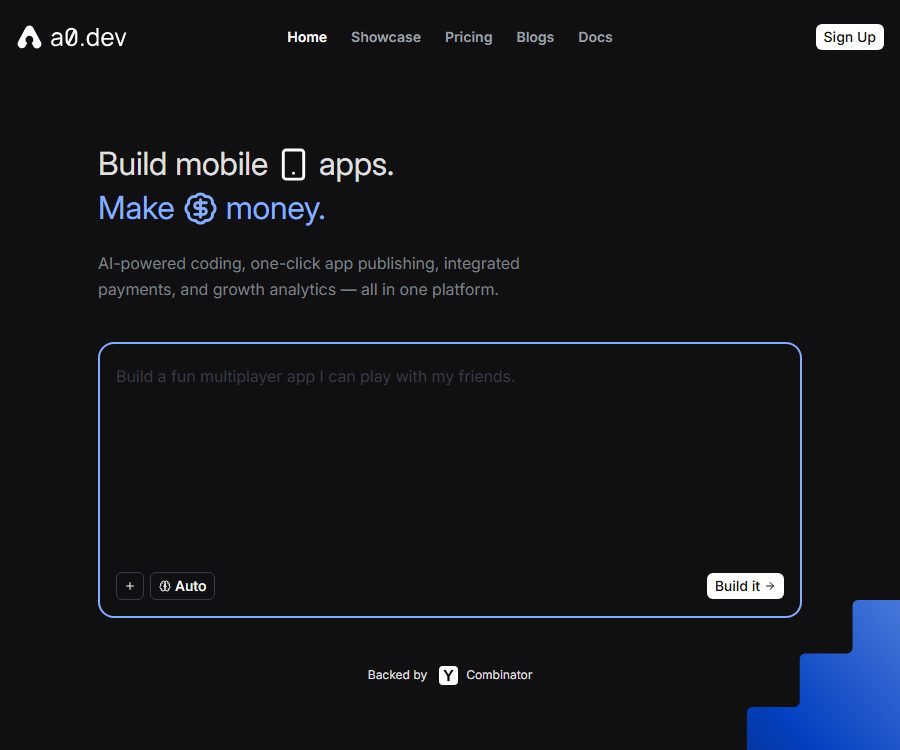
a0.dev
a0.dev – makes AI-powered meetings more efficient and simpler.
Tags:AI conference toolsWhat is a0.dev?
a0.dev is an AI mobile application development platform launched by Auraful Inc.; users can use conversations to have coding agents create and modify applications, and they can release the same application on iOS, Android, and the Web.
The platform covers code generation, databases, built-in APIs, testing, in-app payments, analytics, and store deployment; it is suitable for quickly creating prototypes, and can also be used for official products after undergoing manual engineering review.
Main functions of a0.dev
1. AI coding agent
Users describe the pages, interactions, and business rules in natural language, and the intelligent system searches for existing projects to write or modify code in real time. Clearly defining the objectives, data structure, and acceptance criteria results in more stable outcomes than simply asking to \"create a complete application\" in just one sentence.
2. Previewing and testing mobile apps
The platform supports built-in Web preview, the a0.dev mobile app, Expo Go, as well as the creation and testing of native IPA or APK files. Payment functions, push notifications, and certain native features must be tested using native builds; the browser preview cannot cover all functionalities.
3. Databases and backend
a0.dev can be used in combination with Convex or Supabase to build the data layer, thereby reducing the time required to set up authentication and a database from scratch. However, developers still need to design the permission rules, indexes, migration processes, and data backup solutions.
4. Built-in AI and image interface
The platform offers built-in APIs for AI inference and image generation, which facilitate the addition of intelligent features to applications. The costs associated with making calls, the rate at which these calls can be made, the security of the outputs, as well as the handling of user data, all need to be evaluated separately before the application goes live.
5. In-app payments
The official documentation provides guidelines and procedures for subscription-based and one-time purchase models, which can help applications develop revenue generation capabilities. Developers still need to comply with Apple’s and Google’s rules regarding payments, commissions, product configuration, and approval processes.
6. One-click publishing and OTA updates
The platform can assist in developing applications, creating App Store Connect entries and uploading them, and it also supports the deployment of certain OTA updates to multiple platforms. Automation of the release process cannot bypass the store’s review process, and changes to the native capabilities may require the application to be rebuilt.
7. Analysis and mobile management
The built-in dashboard allows users to monitor the performance of users, subscriptions, and applications; the official iOS and Android clients enable testing, editing, and deploying projects on mobile devices.
Which users are it suitable for
- Entrepreneurs and independent developers who wish to quickly test their mobile application ideas.
- Creators who are familiar with product design but do not want to set up a toolchain from scratch for a new project.
- Project teams that need to accelerate the development of React Native prototypes.
- Small teams that wish to release iOS, Android, and Web versions simultaneously.
- Subscription application developers who need built-in payment, push notification, database, and AI capabilities.
Prices and packages for a0.dev
The prices listed below were verified on August 24, 2026, on the website’s dynamic pricing page; the currency used is the US dollar. Packages, point usage, additional purchases, and taxes may vary, and the final amounts will be indicated on the account settlement page.
| Plan | Price | Monthly points | Models and support | Construction and code |
|---|---|---|---|---|
| Pro | $ | 100 points | Advanced encoding models, expanded message quota | Build unlimited applications, use custom domain names, remove branding elements, export code |
| Max | $ | 1,250 points | Top-tier models, 250 reward points per month, unlimited support calls | Includes all Pro features |
The current public pricing page shows only the Pro and Max versions; it does not specify the amount included in the long-term free plan. Creating an account may offer an initial trial period, but the free credits from previous third-party accounts cannot be considered as part of the current offers.
What other costs might arise from publishing?
- The official documentation states that to release an app for iOS, one must be a member of the Apple Developer Program; the cost is currently 99 dollars per year.
- The Google Play developer account, as well as the commission and taxes associated with app stores, shall be in accordance with the rules in force on each respective platform.
- Convex, Supabase, AI models, image generation, domain names, and other external services may incur separate charges.
- As the application grows, costs related to storage, databases, bandwidth, push notifications, and monitoring increase as usage rises.
a0.dev Usage Guide
- Create an account and define the minimum version objectives, including users, pages, data, and core processes.
- For new projects, use a structured set of guidelines to describe the interface style, navigation, data model, and acceptance criteria.
- First, let the agent generate a single process, and then gradually add login, database, payment, and push functionality.
- Check the layout and basic interactions in the web preview, then test it on a real device using the a0.dev client or Expo Go.
- Configure the database with minimum permissions, and test scenarios involving unauthenticated access, different user roles, and malicious inputs.
- Use native IPA or APK to verify permissions for payments, notifications, deep linking, camera, and files.
- Export the code and conduct reviews for dependencies, security, performance, and licensing.
- Connect your developer account, prepare screenshots of the store, privacy labels, review explanations, and a support page, then submit them.
More effective ways of writing prompts
- Focus on one user workflow at a time, to avoid having to redo both the overall architecture and the visual design simultaneously.
- Identify the differences between platforms, such as permissions for iOS and Android, navigation gestures, and safe areas.
- Write the database tables, fields, roles, and access restrictions as verifiable requirements.
- It provides error status, empty status, loading status, and offline behavior.
- After each modification, the agent is required to explain the files that are affected and to carry out targeted tests.
- Save a recoverable version before making major changes, to prevent subsequent actions from destroying existing functions.
Product advantages
- Extending from dialogue coding to building, testing, payment, analysis, and release on app stores.
- The same project covers iOS, Android, and the Web, making it suitable for small teams to carry out rapid iterations.
- It supports Convex and Supabase, reducing the workload associated with backend configuration.
- With Pro, it is possible to create and export application code indefinitely, thereby reducing the risk of platform lock-in.
- The official documentation covers native testing, payments, push notifications, deep linking, and iOS deployment.
Usage restrictions and precautions
- AI-generated code may have permission vulnerabilities, dependency risks, performance issues, and an unmaintainable structure.
- Unlimited construction does not mean unlimited AI calls; actual generation is still subject to the monthly credit limit.
- One-click publishing does not guarantee approval by Apple or Google.
- Web preview cannot fully validate payments, notifications, and other native modules.
- The costs associated with external databases and APIs, as well as issues related to downtime and data rules, are not under the control of a0.dev alone.
- Before rapid prototypes move into production, they still require manual code review, automated testing, and monitoring.
Data and Privacy
The privacy policy states that the platform processes email addresses, device and usage data, as well as source code, text, images, documents, videos, recordings, and Git information uploaded by users.
- Do not include production keys, private keys, or actual customer data in prompts or code.
- Third-party databases, models, and payment services create additional data processing pathways.
- After deleting an account or its content, the platform may retain certain information due to legal obligations and dispute resolution requirements.
- Application developers must also provide a privacy policy and a process for deleting data for the products they release.
- High-risk applications such as those related to children, healthcare, finance, and precise location require additional compliance assessments.
APIs, code export, and open-source boundaries
The a0.dev documentation index provides the OpenAPI specifications, as well as links to resources related to development tasks such as pushing data, handling payments, and publishing content. The authentication requirements, stability, and call limits for the specific platform APIs are determined by the current documentation and account permissions.
Pro and Max allow the export of user-generated application code, which means that users can continue to maintain their own projects; however, this does not imply that the source code of the a0.dev platform is open source. As of the date of verification, no open-source repository or license for the official platform was found.
Frequently Asked Questions
What kinds of applications can be developed with a0.dev?
It is primarily used to create mobile applications that can be deployed on iOS, Android, and the Web, and it allows for the integration of features such as databases, AI, payment systems, push notifications, and deep linking.
Can the code be exported?
Yes. Both the Pro and Max plans currently include code export; after exporting, it is still necessary to check the dependency licenses, build configurations, and keys.
Is it still necessary to pay to publish an iPhone app?
It is necessary. The official documentation states that users must have a valid Apple Developer account, whose cost is 99 dollars per year; in addition, there may be costs associated with external services and stores as well.
Why is Max more expensive than Pro?
Max offers more monthly points, top-tier AI models, additional reward points each month, and unlimited phone support, making it suitable for teams that generate content frequently and need extra assistance.
Summary
a0.dev is suitable for developers and entrepreneurs who wish to create and release mobile applications quickly through dialogue; its integrated capabilities for deployment, payment processing, and analysis are quite notable. Before making a choice, it is necessary to estimate the costs based on the number of points required, and to include in the overall budget the costs associated with code review, native testing, store approval processes, and external services.
Tools similar to a0.dev



 Guigong Network Security Registration No. 45132202000164