






Generate AI Books and Blog Posts in Minutes
Generate AI Books and Blog Posts in Minutes – an intelligent tool focused on AI conferences
Tags:AI conference toolsA one-sentence summary
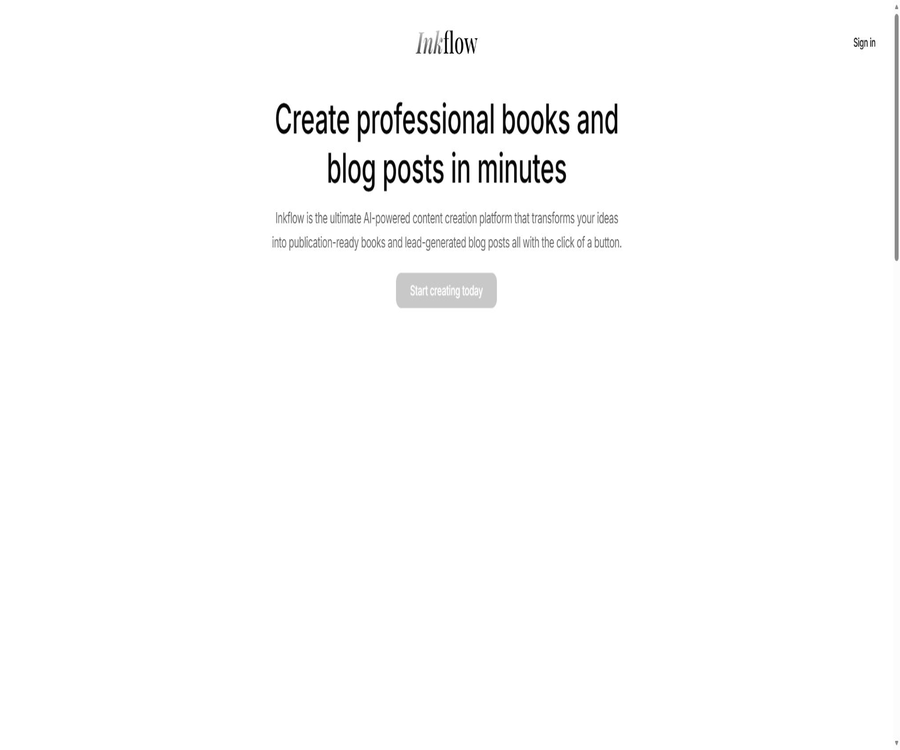
Inkflow is an AI platform for generating books and blog articles; by entering a title and an outline of the chapters, users can create a draft of the full text, which can then be reviewed within the application and exported in PDF or DOCX format.
Tool Introduction
Inkflow is aimed at authors, marketers, and content teams who need to produce large quantities of non-fiction books, guides, and blog content designed to attract visitors. It focuses on an integrated workflow that goes from outlining to generating exportable documents, rather than relying on general chat-based Q&A.
The platform offers its services through a web application; it requires an email account and a paid subscription. The official website does not provide any free plans, free trials, a native mobile app, public APIs, or a self-hosted version.
Main functions
Generate content based on the title and outline.
The user first enters the title of the book or article, and then provides the chapter structure. Inkflow uses this information to generate continuous content, making it possible to quickly expand an existing topic into an editable draft.
Generation of long AI books
The Starter plan allows for up to 10 AI-generated books per month, with each book having a maximum of around 40,000 words; the Pro plan permits up to 50 books per month. These numbers represent the upper limits set by the plans, and they do not mean that every time a book is generated it will necessarily reach these maximum lengths or quality standards.
Blog post generation
Starter allows for the creation of up to 30 blog posts per month, while Pro has no limit on the number of posts that can be created. Nevertheless, this lack of limit is still subject to reasonable use policies, service capacity constraints, and relevant terms; it does not mean unlimited concurrent operations or automatic posting.
Advanced AI models
The Starter version includes Advanced AI generation, while the Pro version offers Premium AI and priority handling. The official website does not disclose the specific names of the models, the length of the context, or the training data; therefore, it should not be assumed that certain third-party models exist as a fact.
In-app review
Once generated, the content can be viewed within the application, which makes it easy to check the structure, any repetitions, the tone, and obvious errors. The official website does not provide detailed information regarding collaborative editing, version tracking, citation management, or multi-user approval functions.
PDF and DOCX export
Both Starter and Pro versions support exporting in PDF or DOCX format, allowing users to continue formatting and editing in external word processing software. However, exporting a file does not guarantee that it will meet the standards required by e-book platforms, printing houses, or accessibility requirements.
Prioritize handling and support.
Pro includes priority handling and support for priority emails; the website indicates that a response should be provided within 24 hours. This time frame refers to the time required for a response, and it does not mean that all tasks will be completed within that fixed time.
Complete workflow
- Determine the target audience, themes, and content boundaries of a book or blog.
- Organize the titles, chapter names, and the key questions that need to be answered in each chapter.
- Log in to Inkflow and select the book or blog content type.
- Enter the title and chapter outline, then submit to generate the task.
- Check the structure, facts, repetitions, and tone within the application.
- Add original cases, data, citations, and professional insights.
- Export to PDF or DOCX for external editing and formatting.
- It is published after being checked for copyright, facts, plagiarism, and platform rules.
A tutorial for creating a non-fiction book
- First, clarify who the readers are and what problems they will be able to solve after reading it.
- Break the topic down into sequential chapters, with each chapter focusing on one core task.
- Prepare key facts, terms, examples, and content that should be avoided for each chapter.
- Enter the book title and chapter outline in Inkflow to start the generation process.
- Verify the facts chapter by chapter, and remove any paragraphs that are vague, repetitive, or contain logical inconsistencies.
- Include the author’s own experiences, methods, interviews, and verifiable evidence.
- Export to DOCX for in-depth editing, then create the final PDF or e-book file.
Tutorial on creating blog content
- Identify the target keywords, search intent, and the problems the article aims to address.
- Design the title, introduction, main sections, examples, and action recommendations.
- Enter the structure into Inkflow to generate a draft.
- Verify the brand name, price, statistical data, and time-sensitive information.
- Adjust paragraph structure, heading levels, and internal logic to avoid an AI-like tone and repetition.
- Add original images, experiences, data, and clear conclusions.
- Publish after completing SEO, copyright, and compliance checks.
Editing and pre-publication checks
- Ensure that each chapter serves the same audience and topic.
- Remove fictional quotes, data without a source, and non-existent cases.
- Standardize terminology, titles for characters, tenses, and tone.
- Check for repetitions, contradictions, and jumps between sections.
- Use professional tools to check spelling, grammar, and readability.
- Verify images, trademarks, citations, and the authorization for third-party materials.
- Redesign the directories, page numbers, and metadata in accordance with the requirements of the target platform.
- Retain records of manual review and the original materials that were used.
Which users are it suitable for
- Non-fiction authors: Quickly expand a well-developed outline into a draft of the chapters.
- Coaches and consultants: guides to production methods, supplementary materials for courses, and resources for acquiring clients.
- Content marketers: Generate blog drafts in bulk and hand them over to editors for refinement.
- Small publishing team: shorten the initial drafting phase before proceeding with manual editing and typesetting.
- Agency: Establishes structured content creation processes for multiple clients.
- Entrepreneur: Compile product knowledge, industry experience, and common issues into comprehensive content.
Typical use cases
- Generate a draft of the accompanying study guide from the course outline.
- Expand the series of blogs into a draft covering one month’s worth of content.
- Create industry guides or e-books for potential customers.
- Organize existing research notes into chapters of a non-fiction book.
- Provide draft versions with a consistent structure to the content team in bulk.
- After exporting to DOCX, it is sent to editors, designers, or clients for review.
Product advantages
- It covers both books and blogs, with a more focused focus than general chat tools.
- Driven by the title and chapter outline, it enables users to control the overall structure first.
- Starter allows for multiple full-length books and 30 blogs per month.
- It supports in-app previewing, which helps to avoid the issue of being unable to find the content after it has been generated.
- Exporting in PDF and DOCX formats facilitates use in common editing and delivery processes.
- Pro offers a higher book quota, unlimited blogs, and priority handling.
- The package prices and the main quantity limits are listed on the official website.
Usage restrictions and precautions
- Books generated by AI are only drafts and do not automatically reach publication quality.
- Models may fabricate data, cases, quotes, characters, and references.
- The official website does not offer automatic fact-checking or guarantees regarding academic citations.
- There are monthly limits on the number of books, blogs, and words for Starter.
- The unlimited number of blogs in Pro does not mean unlimited concurrent usage or freedom from constraints related to reasonable use.
- The specific underlying models, list of languages, and context length are not made public.
- Only PDF and DOCX are explicitly listed as export formats; e-book formats need to be converted separately.
- The subscription fee is paid in advance and is generally non-refundable; it is necessary to determine the actual needs before making the purchase.
- The user is ultimately responsible for the legality, accuracy, and non-infringement of the generated content.
- The platform requires users to be at least 18 years old.
Prices and packages
| Package | Price | AI book quota | Blog quota | Models and processing | Support |
|---|---|---|---|---|---|
| Starter | $ | Up to 10 books per month, with each book containing around 40,000 words at most. | Up to 30 articles per month | Advanced AI | Standard support |
| Pro | $ | Up to 50 books per month | No limits on generation | Premium AI and priority handling | Priority emails: target response time of 24 hours |
The price verification date is August 22, 2026. The subscription fee is to be paid in advance on a regular basis and, in principle, no refunds are provided; the price may be adjusted after prior notification. Taxes and fees are subject to the details shown on the Stripe settlement page.
How to choose a package
| Demand | A more suitable solution | Reason |
|---|---|---|
| A small number of books and blogs per month | Starter | The cost is low, and the allocated amount is sufficient for basic production. |
| More than 10 books are needed each month. | Pro | The maximum number of books allowed has been increased to 50. |
| A large number of blog drafts | Pro | Public tagging is allowed without restrictions on blog creation. |
| Delivery time sensitivity | Pro | Includes priority handling and support for priority emails. |
| Only write an article occasionally. | Subscribe cautiously. | The official website does not offer a pay-per-use option or a free plan. |
Supported platforms and formats
| Category | Support status | Explanation |
|---|---|---|
| Web applications | Support | Register, generate, view, and export |
| Windows | Browser access | No native client is provided. |
| macOS | Browser access | No native client is provided. |
| Linux | Browser access | No native client is provided. |
| iOS and Android | The official app has not been verified. | Applications with the same name may belong to other developers. |
| Enter | Title and chapter outline | Other import formats are not publicly available. |
| Output | PDF, DOCX | The EPUB or Kindle format is not specified. |
| Team collaboration | Not disclosed | There is no clear indication of seats and permissions. |
APIs, SDKs, and open-source status
The Inkflow official website does not provide any API, developer documentation, or official SDK, nor does it offer any GitHub repository whose ownership can be confirmed. Teams that need to establish automated, bulk connections cannot assume that web subscriptions include interface calls.
The product in question is a closed-source SaaS service; there are no publicly available options for self-hosting or private deployment. Other writing applications, digital ink projects, and code repositories with similar names available on the internet cannot be considered official products of Inkflow.io.
| Project | Verification results | Conclusion |
|---|---|---|
| Public API | Not found | Do not claim to support it. |
| Official SDK | Not found | Do not claim to support it. |
| Official GitHub | Not found | Warehouses with the same name need to be excluded. |
| Open-source product | No | Closed-source hosting services |
| Self-hosting | Not provided | The content is processed in the cloud. |
Content ownership and commercial use
The terms state that the user retains ownership of the content created through Inkflow, while granting the platform a limited license to process, store, and transmit such content for the purposes of providing the service. The user is still responsible for ensuring that the content is legal and does not violate the rights of third parties.
Having the ability to output content does not automatically resolve issues related to training data, similar expressions, trademarks, intellectual property rights, and the disclosure of AI-related information by publishing platforms. Before commercial publication, it is necessary to conduct checks regarding originality, facts, and legal aspects.
Privacy and data processing
The privacy policy specifies the email address, payment information processed by Stripe, and anonymized product analysis data. The platform states that it does not store credit card details nor sells personal information, but may share limited data for service operation or as required by law.
The policy does not disclose in detail the suppliers of the models used, the locations of the data centers, the specifics of encryption, or whether these models are used for training purposes. Before uploading any unpublished manuscripts, customer information, or trade secrets, it is necessary to obtain approval from the authorities first.
- Submit only the minimum amount of information required to generate the task.
- Obtain authorization and confirm the confidentiality requirements before uploading customer content.
- Do not include passwords, ID numbers, or financial account details in the outline.
- Export results regularly to avoid keeping the only copy in the cloud alone.
- You can request the deletion of your account and associated content through the official contact channels.
- Legal requirements may constitute exceptions that permit certain data to be retained.
Basic information
| Project | Content |
|---|---|
| Tool name | Inkflow |
| Tool type | AI book generator and blog content platform |
| Main inputs | Title and chapter outline |
| Main output | Long books, blogs, PDFs, and DOCX files |
| Price pattern | Monthly subscription |
| Starting price | $ |
| Free plan | Not disclosed |
| Age requirement | 18 years old and above |
| Main platforms | Web |
| Public API | Not provided |
| Official SDK | Not provided |
| Is it open source? | No |
| Self-hosting | Not supported |
| Price verification date | August 22, 2026 |
Recommendation score
Recommendation score: 4.1 / 5. Inkflow is suitable for creators who already have a clear outline and need to generate drafts of non-fiction books and blogs on a frequent basis; its pricing and usage limits are transparent, and the DOCX export feature facilitates further editing.
The main shortcomings are the lack of a free version, APIs, and details regarding the available models; moreover, there is no clear information regarding collaboration, citation, fact-checking, or support for e-book formats. It should serve as a tool to accelerate the drafting process, rather than an automated publishing system.
Frequently Asked Questions
Is Inkflow free?
The official website does not list any free plans or free trials. The Starter plan costs $19 per month, while the Pro plan costs $99 per month.
How long can a book be generated with Inkflow?
For the Starter plan, the maximum number of words per document is around 40,000, with a limit of 10 documents per month. Under the Pro plan, the limit is 50 documents per month; however, the official website does not specify whether the maximum word count per document differs for the Pro plan.
Can a blog be created?
Yes. The Starter plan allows up to 30 posts per month, while the Pro plan has no limit on the number of blogs that can be created; however, it is still necessary to abide by the service rules and use the resources in a reasonable manner.
Which export formats are supported?
PDF and DOCX are explicitly supported. The official website does not list EPUB, MOBI, or direct publishing to Kindle as current features.
Can the generated content be used for commercial purposes?
The terms state that the user retains ownership of the content they create, but they are still responsible for ensuring that such content is legal, does not infringe on any rights, and complies with the rules of the platform where it is posted. Important commercial content should be edited manually and subject to legal review.
Will it automatically verify the facts?
There is no guarantee of factual verification on a public level; statistical data, citations, examples, individuals, and information related to timeliness must all be verified independently by the author.
Is Chinese supported?
The official website does not provide a complete list of languages. Users who need long texts in Chinese should first check whether the console supports such functionality, and test it by using terms, long paragraphs, and proper punctuation.
Are APIs provided?
No public API or developer documentation was found. The large amount of content that can be generated on the web interface cannot be considered as something that can be accessed programmatically.
Is Inkflow open source?
No. The product is a closed-source Web service; there is no public self-hosted version nor an official source code repository available.
Can a subscription be refunded?
The terms stipulate that the subscription fee must be paid in advance and is generally non-refundable, unless otherwise specified. Before making a purchase, it is necessary to verify that the capacity, format, and language meet the requirements.
Is there a mobile app?
No official iOS or Android apps released by Inkflow.io have been identified. The app with the same name available in the app stores might be a different product.
Can the data be deleted?
Account deletion can be requested through the official contact channels; according to the policy, the email address and related content will be removed, but information required by law may remain intact.
Summary
Inkflow provides a streamlined process for creating long-form content, based on titles, outlines, AI-generated content, in-app reviews, and export to PDF or DOCX formats; it is suitable for frequent creators who have a clear idea of what they want to create and the skills to edit their work.
Before use, it is necessary to select a package based on the monthly number of books and blogs; fact verification, original content addition, copyright checks, and final formatting should be carried out manually. Teams with strict requirements regarding Chinese language, APIs, collaboration, or data storage should first consult the officials.
Similar to tools that can generate AI books and blog posts in minutes



 Guigong Network Security Registration No. 45132202000164