






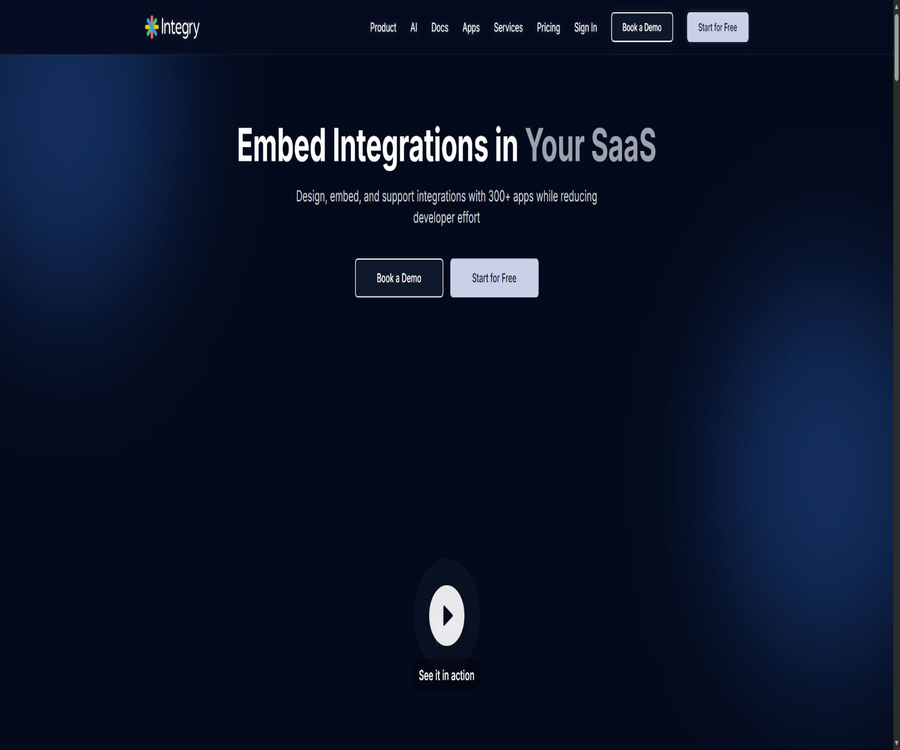
Embed 300+ integrations in your app in minutes
Embed 300+ integrations in your app in minutes, focusing on intelligent tools for AI meetings
Tags:AI conference toolsA one-sentence summary
Integry is an embedded integration platform designed for developers of SaaS products, AI assistants, and agents; it allows them to incorporate functionality such as application connection, authorization, function calls, and automated processes directly into their own products.
Tool Introduction
Integry is operated by Integry, Inc., and belongs to the category of embedded integration platforms, namely iPaaS. Its target users are not end-users who wish to automate their personal tasks, but rather software teams that need to provide native integration capabilities for their customers.
The official description of the product highlights the integration of over 300 different applications; developers can use Flows to create data synchronization processes, and they can also utilize Functions as tools that can be called by AI applications. Various documents mention numbers ranging from over 200 to over 270 or even over 300 such applications, and this varies depending on the functional modules and document versions. The actual number of available connections is determined by what is listed in the Marketplace within the account.
Core concepts
| Concept | Meaning | Actual effect |
|---|---|---|
| App | Third-party applications that can be connected, or the customer’s own applications | Provides capabilities for authentication, triggers, queries, and operations. |
| Function | Queries or operations that can be invoked independently within a certain application | Called as an AI tool or executed directly by a program |
| Flow | An integrated template composed of one or more blocks | Complete import, export, one-way or two-way synchronization |
| Integration | Instances created by end-users based on Flow | Save mappings, connect accounts, and set up runtime configurations |
| Run | An execution that is triggered by an event, a schedule, or a user action. | Execute one or more steps in a Flow |
| End User | Use customer software to create integrated users, accounts, or enterprises. | Used for connection attribution, function calls, and billing |
| Workspace | Organize and manage isolated spaces integrated together. | The enterprise version allows for the configuration of multiple workspaces. |
Main functions
Embedded applications market
The team can integrate the Integry app marketplace into its own products via pop-ups or sections within the interface, allowing end-users to discover, connect to, and manage apps without leaving the current interface. The layout and style of the interface can be adjusted, and the integrations displayed to different customers can be filtered based on packages, contracts, or tags.
- It displays the connectable applications, Flow, and the required authorization information.
- It supports connecting to, disconnecting from, and managing multiple accounts for the same application.
- Changes in the account’s connection status, disconnection status, and integration status are detected through event monitoring.
- Custom styles are allowed, allowing the integration entry point to align with the visual style of the host product.
- The enterprise solution allows for further discussion on white-label certification, localization, and multiple workspaces.
AI Functions
Integry Functions organizes the operations in third-party applications into a structure suitable for function calls; the AI assistant can select the appropriate functions, complete the necessary parameters, and carry out those actions based on the user’s instructions. The service also offers function prediction capabilities, which allow it to recommend the most relevant functions based on natural language inputs.
- List the currently available functions, and filter by application, type, or connection status.
- Obtain the parameter structure of a single function and pass it to the AI model to select and fill in the parameters.
- The Integry prediction function and parameters reduce the amount of code that developers need to write manually.
- Use Source Functions to read channels, fields, items, and other dynamic options.
- Display the pre-filled form before actual execution, allowing users to check and modify the parameters.
- Functions can be called in a borderless manner, which is suitable for background tasks and agent workflows.
Function confirmation interface
For operations that modify external data, such as sending messages, creating records, or deleting content, developers can use a confirmation interface to display the predicted parameters to the user. Executing these actions only after the user gives their approval is a better approach for high-risk operations than carrying them out entirely automatically.
Passthrough API
When the predefined functions do not cover a particular application endpoint, the Passthrough API allows requests to be sent using the identity to which the end user is already logged in. This reduces the need to implement authentication procedures repeatedly, but the development team still needs to understand the parameters, permissions, rate limits, and error responses of the target application.
Flows and low-code development
Flows is suitable for creating continuously running data integration solutions, rather than performing AI tasks only once. Teams can combine triggers, queries, actions, field mappings, and custom code to achieve import, export, and two-way synchronization.
Field mapping and custom fields
When end users set up integrations, they can map fields from the source application to fields in the target application. Dynamic fields can be loaded using Source Functions, which is suitable for CRM systems, custom forms, and situations where the structure of customer fields varies.
Authentication and credential lifecycle
Integry is responsible for managing the account connection interfaces and credentials required for Flow and Function, as well as handling the lifecycle of these credentials; it supports authentication methods such as OAuth that are allowed by target applications. Teams can also use their own developer applications to configure settings, enabling a single end user to connect to multiple accounts of the same application.
Integrated logging and visibility
The platform provides logs of Function calls and records of integrated operations, which help teams identify errors related to parameters, authentication, target interfaces, or data mapping. Starter and Growth plans specify a 30-day log retention period, while Enterprise customers can agree on a custom retention period through the contract.
Custom applications and any APIs
At the Growth level and above, it is possible to connect to any API and create custom integrations; this is suitable for internal systems or specialized software for which no pre-existing connectors are available in the catalog. The development team is still responsible for maintaining the definitions of the target interfaces, the test data, and the business rules.
Automatic updating and error handling
The Growth solution includes automatic updates, error handling, and comprehensive visibility into integrations, all with the aim of reducing the maintenance effort required when third-party applications change. Automatic updates cannot replace regression testing; it is still necessary to monitor changes in fields and permissions for critical processes.
The complete workflow in AI applications
- Create an account and a workspace in Integry to obtain the application key and application secret.
- Assign stable and unique user identifiers to end users within the host product.
- On the server side, an HMAC SHA266 signature is calculated using the application secret and the user identifier.
- Use the JavaScript SDK to display the app market, or trigger the connection interface when a certain feature is needed.
- Confirm that the target application is connected, and retrieve the available Functions or have Integration execute function predictions.
- Pass the function structure and user instructions to the AI model to obtain the function name and candidate parameters.
- For operations that modify external data, a confirmation screen is displayed to allow the user to verify the target and parameters.
- Call the Function and handle the successful result, pagination cursor, or error message.
- Monitor failed calls in the logs, and establish recovery procedures for expired permissions, rate limiting, and field changes.
Why must signatures be generated on the server side?
The JavaScript SDK requires an application key, a user identifier, and a signature generated from an application secret. The application secret should not be included in the browser code; therefore, the signature must be generated by a trusted server and then sent to the frontend to initialize the SDK.
Tutorial on using Flows integration
- Determine whether import, export, or two-way synchronization is required, and specify the source system and the target system.
- Select an application in the workspace, and configure the trigger conditions, queries, actions, and authentication methods.
- Run each step using a test account to verify pagination, null values, duplicate records, and error responses.
- Create a Flow and set up field mappings, variables, filtering criteria, as well as any necessary custom code.
- Label the Flow, and then decide which packages or customers can see it in the embedded interface.
- Embed the market in the testing environment to verify the processes for creating, editing, disabling, and deleting integrated elements.
- Before going live, prepare solutions for handling expired permissions, rate limiting of the target application, field deletion, and duplicate executions.
- After deployment, use logs to monitor the adoption rate and failure rate, and conduct regression testing when there are changes in third-party interfaces.
The process by which end-users create integrations
- Open the integrated marketplace within the host application and select the target app.
- Complete the authorization for the target application and select the account to be connected to.
- Select a Flow, enter the trigger conditions, and complete the field mapping.
- Test the connections and data samples to verify that the results are written to the correct locations.
- Enable integration and view the status and operation logs within the host product.
- Edit the mapping when adjustments are needed, or temporarily disable or delete the integration.
Developing interfaces and SDKs
| Ability | Method of provision | Primary uses | Precautions |
|---|---|---|---|
| JavaScript SDK | Importing npm packages or scripts | Embed in app stores, connect accounts, and display the Function interface | The signature should be generated on the server side. |
| Functions API | Server API | List, predict, read, and execute Functions | The end-user identity and a valid connection are required. |
| Passthrough API | Server API | Calling the target endpoint that has not yet been wrapped as a Function | The caller is responsible for understanding the target interface. |
| Flow embedding | JavaScript SDK | Display, create, and manage integrations | Some SDK methods are still indicated in the documentation as upcoming. |
| Custom API connection | Growth and above | Connect internal or vertical systems that are outside the directory. | It requires manual configuration and maintenance. |
Framework compatibility
The official SDK is a JavaScript package designed for browsers; it can be used to support frameworks based on JavaScript and HTML, and it is compatible with server-side rendering solutions such as Next.js and Nuxt. Some of the Flow methods described in the SDK documentation are marked as upcoming, so it is necessary to rely on the actual interfaces available in the current version before implementing them.
Version and License
As of August 22, 2026, the public npm package is named @integry/sdk; the version displayed on the page is 4.8.9, and it is licensed under the Apache-2.0 license. This license applies to the SDK packages distributed, but it does not mean that the Integry cloud platform, the connector backend, or the Flow runtime service as a whole are open source.
Prices and packages
At present, Integry offers a model that combines a free trial period, billing based on the number of end users, and enterprise contracts. The official pricing page does not show fixed contract amounts for the Starter, Growth, or Enterprise plans; it only states that the Starter plan includes 10 end users, with an additional cost of $10 per extra user.
| Package | Public price | Primary interests | Throughput and logging | Suitable for users |
|---|---|---|---|---|
| Starter | Contract price; includes 10 end users, $10 extra for each additional user | All applications, function prediction, interface-free calls, Passthrough API, custom fields, and the authentication marketplace | Basic throughput; 30-day logs | The team that has started integrating Functions into AI products |
| Growth | Contract price; a free trial is available upon request | Includes Starter, along with the ability to add any API, support for two-way synchronization, import/export functions, custom integrations, customized embedding options, and API access. | Standard throughput; 30-day logs | SaaS teams that require automated integration on the user side |
| Enterprise | Contact sales | Includes Growth, and adds white-label certification, user change history, workspaces, localization, and Vault access. | Custom throughput and logging; enterprise SLA | Complex permissions, scalable support, or compliant procurement |
| Enterprise add-ons | Custom quote | Single tenant, professional services, hosting support, and HIPAA BAA | In accordance with the contract terms | Organizations with needs for isolation, medical compliance, or outsourced operation and maintenance |
For all plans, access to the application directories and the number of team members are not restricted by the number of packages; the number of integrations is also unrestricted as indicated in the comparison table. However, this “no restriction” does not mean there are no limits on throughput, end users, fair use, or third-party interfaces – the contract remains the basis for final billing.
How does the end user calculate it?
An End User generally refers to the user, account, or enterprise that will integrate or invoke functions within the customer’s product. If the host product relies on workspace-based sharing for integration, the identity of the workspace or account can be used as the user identifier; however, the team should have the sales team confirm prior to signing whether such a mapping is in line with the billing rules.
How to choose a package
- Statistics estimate the number of end users or customer accounts that will be connected to external applications.
- Distinguish between a single function call and the need for continuous data synchronization.
- It is sufficient to evaluate the capabilities of the Starter’s Functions before invoking the AI tool.
- Evaluate Growth when two-way synchronization, import/export, or custom APIs are required.
- For white-label certification, multiple workspaces, single-tenant or enterprise SLAs, please contact Enterprise Sales.
- Include third-party application quotas, retry attempts in case of failures, and support services in the total cost.
- During the free trial period, use real-scale anonymized data to verify throughput and logging.
- Before signing, confirm the base contract price, excess rules, log retention, exit procedures, and data deletion.
Which users are it suitable for
- SaaS product team: Integrates the application market that customers need directly into the product.
- AI assistant developers: Enable models to query or interact with external applications such as Slack, CRM, and project management tools.
- Agent platform: Handles account connections, function structures, confirmation interfaces, and execution logs in a unified manner.
- Vertical software companies: Connect industry systems and internal services through custom APIs.
- Product and Engineering Teams: Flow is used for importing, exporting, and two-way synchronization.
- Enterprise software suppliers: Control the visible integrations based on customer plans and configure a white-label experience.
- Early-stage startup teams: First use a free trial to assess the level of integration adoption, and then decide on the contract terms.
Typical use cases
- Create tickets in the customer service AI, query customer records, or send team messages.
- In CRM products, allow customers to synchronize contacts, transactions, and custom fields.
- Import tasks into project management software and synchronize status changes to other systems.
- Integrate an app market into the marketing tools, allowing customers to authorize and configure data flows on their own.
- A confirmation form is displayed before the agent performs external write operations, thereby reducing the risk of errors.
- For endpoints not covered by the predefined functions, the Passthrough API is used to make the calls.
- Different connectors or Flows are displayed according to the customer’s subscription level.
- It offers enterprise clients multiple workspaces, white-label certification, and a localized integration experience.
Product advantages
- It covers both AI Functions and continuously running Flows, eliminating the need to purchase separate infrastructure for these two types of use cases.
- It provides an account connection interface and credential lifecycle management, reducing the need for repeated authentication development.
- The embedded market allows end-users to carry out discovery, authorization, and configuration within the host product.
- Function prediction, dynamic Source Functions, and confirmation interfaces are suitable for the tool call chain in AI applications.
- It supports interface-free calls, and also allows for manual confirmation before performing high-risk actions.
- Growth offers two-way synchronization, import/export functions, and custom API connections.
- Log, event, and integration visibility help engineering teams support end users.
- The JavaScript SDK can be installed via npm and is compatible with common front-end frameworks.
Usage restrictions and precautions
- With an open pricing model, there is no fixed base contract amount, so it is not possible to estimate the total cost at merely $10 per additional user.
- The number of available applications varies across different documents; it is necessary to check the actual list in the account before making a selection.
- The Flow management methods for some JavaScript SDKs are still marked as upcoming, so it is not possible to plan their implementation based on the announced interfaces.
- Permissions, rate limits, fields, and interface changes in third-party applications can still affect the stability of the integration.
- AI functions may predict incorrect operations or parameters; actions such as writing, sending, and deleting should require user confirmation.
- The Passthrough API merely reuses the connection credentials; it does not interpret or maintain the target interface on behalf of the developer.
- 30 days of log data may not be sufficient to investigate issues related to low-frequency or long-term data; companies need to consider options for extended retention.
- Connecting multiple accounts from the same end user increases the complexity related to permissions and data isolation.
- The use of unstable user identifiers across different customers can lead to incorrect assignment of integrations.
- The platform is a managed business service; its core backend cannot be deployed independently using public SDKs.
- HIPAA BAA and single-tenant arrangements are Enterprise add-ons and cannot be assumed to be included by default.
Security check before going live
- Apply the minimum permissions to each connector and document the authorized purposes.
- It ensures that application secrets remain only on the server side, and do not appear in browser packets, logs, or error pages.
- Design identifiers that are stable, unpredictable, and not reused across tenants for end users and workspaces.
- Add confirmation interfaces for functions that have side effects such as sending, updating, deleting, and making payments.
- Test scenarios for token refresh, authorization revocation, multi-account connection, and employee departure.
- Design idempotent and recovery strategies for throttling, timeouts, duplicate executions, partial successes, and field changes.
- It is confirmed that the log does not record tokens, sensitive parameters, or complete business data.
- Sign the applicable data processing agreement, and verify the sub-processors, data locations, and deletion procedures.
Privacy and security
Integry ensures that both transmitted and static data are encrypted, while also minimizing any exposure and retention of such data. The security page lists the statements related to SOC, GDPR, CCPA, and HIPAA; the Flows document mentions SOC 2 as well. However, the specific types of reports, audit cycles, and scope of coverage should be verified in the Trust Center or during the procurement process.
The privacy policy states that the integrated data of customers or end-users will not be used for purposes other than those related to providing services, nor will it be monetized; such data is accessed only when a customer requests troubleshooting and gives consent. The platform stores third-party authentication tokens as well as the minimum information required to carry out the necessary actions, and it handles the data of end-users related to the embedded SDK on behalf of the customers.
| Data or control | Public explanation | Enterprises should also confirm this. |
|---|---|---|
| Third-party credentials | Save the token or the credentials required for the call. | Key custody, rotation, employee access, and revocation timelines |
| Integrate business data | In principle, it is processed solely for the purpose of providing services. | Disk persistence, caching, retry queue, and failed replicas |
| Operation log | Starter and Growth remain for 30 days | Field masking, downloading, enterprise retention, and deletion |
| Website logs | It is usually retained for about 30 days. | Security event exceptions and backup cleanup |
| Cross-border processing | It may be processed and stored in the United States and other countries. | Current contract transfer mechanism and data areas |
| Delete request | Provide access, correction, deletion, and portability requests | Completion deadline, caching scope, and backup scope |
| Medical data | Enterprise can purchase HIPAA BAA add-ons. | Specific service boundaries and prohibited features |
| Single tenant | Enterprise add-ons | Network, database, key, and operations isolation scopes |
Publicly available privacy and security texts still contain terms such as Privacy Shield; compliance cannot be determined solely based on the information presented on a page. In cases involving data from the European Union or industries that are subject to regulations, it is necessary to obtain the current data processing agreements, a list of sub-processors, cross-border transfer provisions, audit reports, and proof of data deletion.
APIs, GitHub, and open source status
Integry offers a Functions API, a Passthrough API, and documented JavaScript SDKs. The npm packages are released under the Apache-2.0 license; however, as of the date of verification, no official GitHub repository maintained by Integry and corresponding to the current SDKs was found.
| Project | Current conclusion | Explanation |
|---|---|---|
| Functions API | Provide | Functions can be listed, predicted, read, and invoked. |
| Passthrough API | Provide | Calling an unpredefined endpoint using a connected identity |
| JavaScript SDK | Provide | The package is named @integry/sdk, and it can be integrated into the market and Function interfaces. |
| Python SDK | No independent official packages have been identified. | The API documentation providing Python request examples does not equate to a Python SDK. |
| Official GitHub | Not confirmed. | Do not consider third-party repositories with the same name as the source code of the product. |
| SDK license | Apache-2.0 | The information on the public npm package page is authoritative. |
| Platform source code | Not open | Cloud-based operation, connectors, and the management dashboard are part of the commercial services. |
| Private deployment | Unpublished general self-hosting solutions | The Enterprise single-tenant add-ons are not equivalent to those built using open-source solutions. |
Supported platforms and technical formats
| Platform or format | Support status | Explanation |
|---|---|---|
| Web management backend | Support | Build Flows, manage Functions, users, and logs |
| JavaScript frontend | Support | Embed the market and operation interface through SDK |
| Next.js and Nuxt | Support | The document documentation can be used with server-side rendering frameworks. |
| React Web applications | Support | It can be integrated using the JavaScript SDK. |
| Server API | Support | Execute functions, make predictions, and perform custom calls |
| iOS native SDK | Not verified. | It is possible to create the desired experience using the server-side API. |
| Android native SDK | Not verified. | It is possible to create the desired experience using the server-side API. |
| Desktop client | It does not belong to the main forms. | Integry is designed for integration into other software. |
| Self-hosted version | Not disclosed | Enterprise can inquire about single-tenant add-ons. |
Basic information
| field | Content |
|---|---|
| Tool name | Integry |
| Development company | Integry, Inc. |
| Tool type | Embedded iPaaS, AI Functions, and user-side integration platforms |
| Main products | Functions, Flows, Embedded Marketplace, and Authentication Management |
| Application scale | The official website lists over 300 options, but the actual number is determined by the account directory. |
| Primary users | SaaS teams, AI application and agent developers |
| Price pattern | Free trial, end-user billing, and enterprise contracts |
| Public incremental price | $ |
| Is registration required? | It is necessary. |
| Whether API is provided | Yes |
| Official SDK | JavaScript SDK |
| SDK license | Apache-2.0 |
| Official GitHub | No public warehouses were detected. |
| Is the platform open source? | No |
| Primary deployment pattern | Managed cloud services and embedded frontends |
Recommendation score
Its rating is 4.3 out of 5 points. Integry brings together application authorization, market integration, AI functions, confirmation interfaces, and continuous synchronization in a single platform, making it suitable for SaaS and AI product teams that do not want to handle the maintenance of numerous user-side integrations from scratch.
The main shortcomings are the lack of transparency regarding the amount specified in the base contract, version differences in the number of applications that can use the relevant tools as well as in certain SDK functionalities, and unclearities surrounding the native mobile SDKs and those available on GitHub. Before proceeding with a formal purchase, it is necessary to use actual use cases to test aspects such as connector coverage, throughput, error recovery, and the billing mechanism for end users.
Frequently Asked Questions
What is Integry?
Integry is an embedded integration platform that enables software teams to incorporate application connectivity, AI function calls, and data synchronization processes into their products.
What is the difference between Integry and tools like Zapier for personal automation?
Integry focuses on serving software development teams, and it integrates authorization, configuration, and management interfaces into the host products for use by their end users. It is not designed primarily for individuals to create personal automations on external platforms.
How many applications does Integry support?
The official website currently focuses on more than 300 integrations, but the numbers indicated in the Functions and older Flows documents differ. When making a choice, it is necessary to verify the required applications, triggers, and actions in an actual account.
What are integral functions?
Functions are queries or operations that can be called independently within third-party applications; they serve as tools through which AI models can select and enter parameters, which are then executed by Integry with the authorization of end users.
Can users be prompted to confirm before performing AI operations?
Yes. Developers can display a pre-filled Function interface, allowing users to check or complete the parameters before invoking the function; this is suitable for sending messages, creating records, and other operations that have side effects.
Is Integry free?
Integry offers a free trial period, but for ongoing use a subscription model with pricing based on usage is applied. The available information on the public page does not specify the fixed base cost of each plan; therefore, it cannot be considered a tool that is permanently free.
How much does Starter cost?
The public specification for the Starter package includes 10 end users; an additional fee of $10 applies for each extra user, although the amount specified in the base contract is not indicated. The total cost, the minimum commitment requirement, and the rules regarding any excess usage need to be confirmed on the purchase or contract page.
When is Growth needed?
Growth should be considered when the product requires two-way synchronization, import/export functions, connectivity to any API, custom integration, automatic updates, or full visibility into integrated systems.
Does Integry provide APIs?
Available. The Functions API allows for listing, predicting, reading, and invoking functions, while the Passthrough API enables the use of connected identities to call target endpoints that are not pre-defined.
Is an official SDK provided?
It provides a JavaScript SDK that can be incorporated using npm packages or scripts, and is used for integrating into app stores, connecting to accounts, and displaying the Function interface.
Is Integry an open-source tool?
No. The public JavaScript SDK package is licensed under the Apache-2.0 license, but the Integry cloud platform, the connectors, as well as the backend and management services are commercial, closed-source products.
Is there an official GitHub repository?
As of the verification date, no official GitHub repository corresponding to the current product and SDK was found. Third-party projects with the same name cannot be used as sources for the integration code.
Is Chinese supported?
Enterprise lists localization capabilities, but its official documentation and management interface are primarily in English. When a Chinese-language interface is required, it is necessary to verify during the trial period what can be translated and whether dynamic content can be localized.
Will the data be used to train AI models?
The Integry privacy principle states that integrated data is used solely for providing services and not for commercial purposes; however, the public policies do not provide separate, comprehensive guidelines regarding model training for all AI functions. Companies should specify in the data processing agreements the scope of use for prompts, parameters, and the results of those operations.
Is HIPAA included by default?
No. On the current pricing page, HIPAA BAA is listed as an additional enterprise feature; for medical data services, it is necessary to first establish the contract terms, the scope of services, and the types of data that can be processed.
Is it possible to deploy it in a private manner?
There is no publicly available self-hosted version. Enterprise users can purchase a single-tenant add-on, but single-tenant hosting does not mean that one can deploy the code in their own environment after obtaining it.
Summary
Integry is suitable for teams that wish to provide native application connections within SaaS or AI products. It allows agents to carry out external operations using Functions, and it enables import/export and two-way synchronization through Flows.
During the trial period, it is necessary to first verify whether the target application can indeed carry out the required operations, and to check aspects such as signing, tenant isolation, user confirmation, failure recovery, and log retention. Since the base contract price is not disclosed, the decision to make a purchase must take into account the number of end users, throughput, level of support, as well as any additional enterprise-related costs in order to determine the total cost.
A tool similar to one that allows you to embed 300+ integrations in your app within minutes



 Guigong Network Security Registration No. 45132202000164