






Daft Art
Daft Art, an intelligent tool focused on AI conferences
Tags:AI conference toolsA one-sentence summary
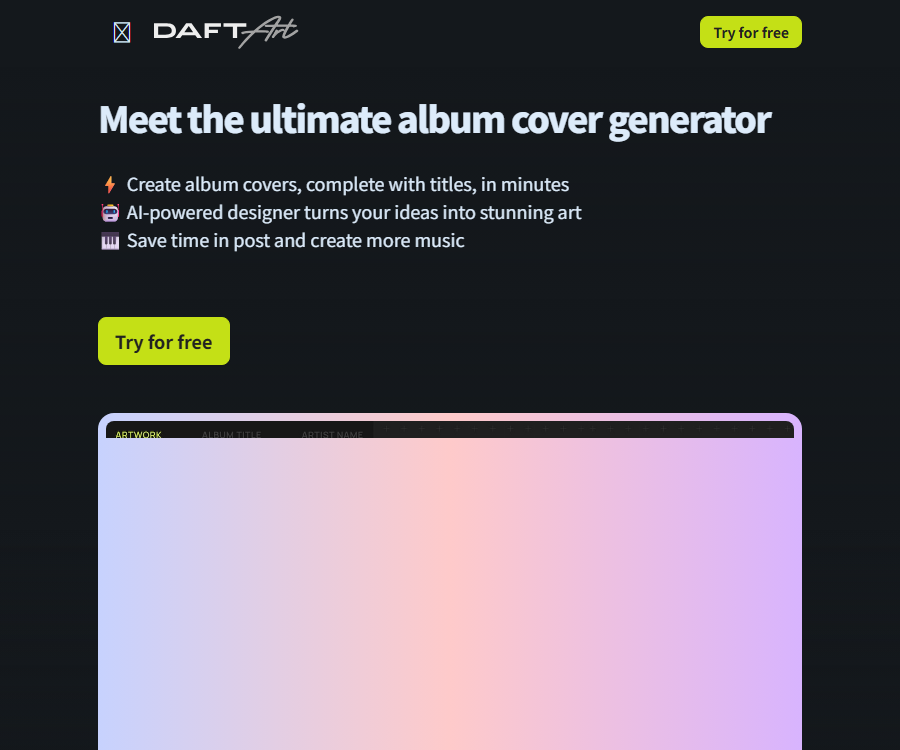
Daft Art is an AI design tool designed specifically for creating covers for music albums, singles, and podcasts; it generates high-resolution square images suitable for use on various distribution platforms, based on predefined aesthetic styles, text descriptions, and a title editor.
Tool Introduction
The Daft Art service is designed for musicians, producers, bands, and podcast creators who lack professional design skills. Users do not need to set up any local models or image-processing software; they simply need to select a style, describe the desired image, and generate it repeatedly.
Its advantage lies in focusing the workflow on cover design, rather than offering a full-fledged general image editor. The final product still needs to be checked for similarities, text, characters, trademarks, content policies, and the rules of the distribution platform.
Main functions
Planning the aesthetic style
The platform offers organized visual aesthetic options to help users choose based on the musical atmosphere, genre, and brand style, rather than starting from a blank slate. The selected style serves only as a starting point; it does not guarantee that the resulting work will be completely different from other works.
Generate a cover from a text description
After the user enters details such as subject, composition, colors, lighting, materials, and mood, multiple candidate images can be generated. The more specific the descriptions, the easier it is to compare different approaches while maintaining visual consistency.
Generate unlimited times
All three current permits state that an unlimited number of album covers can be created within their valid period. \"Unlimited\" refers to normal creative use, subject still to the availability of the service, content rules, and reasonable restrictions.
Editing of titles and artist names
The built-in editor allows you to add album and song titles as well as artist names, and to adjust the font, text color, and overall style. For more complex formatting, letter spacing, masks, and printing controls, external design software may still be necessary.
Export issuance specifications
The official website states that high-resolution square covers with a size of 3000×3000 pixels can be downloaded; such formats meet the requirements of most music distribution and streaming platforms. Before uploading, it is still necessary to check the file format, color settings, and content specifications for each individual platform.
Work preservation and download
All options allow users to save the created covers and download them at any time. The privacy policy states that the platform will retain the photos, documents, or files submitted by users; it is advisable to back up important documents in one’s own storage as well.
Standard creation process
- Determine the type of work, the audience, the musical mood, and the visual clichés to be avoided.
- Prepare three to five keywords, including subject, scene, color, lighting, and material.
- Select the aesthetic style that best matches the musical temperament and generate multiple distinct candidates.
- Filter out images that are too similar to well-known figures, trademarks, characters, or existing albums.
- Add the artist’s name and the title of the work in the editor, and check the readability of the thumbnail.
- Download high-definition files and preview them on your phone, in streaming lists, and as background images.
- Keep the creation records and the final file, then submit them to the distribution platform.
High-quality prompt tutorial
- First, describe the feelings that music evokes, such as severity, dreaminess, restlessness, or nostalgia.
- Specify the number of subjects, their positions, the distance from the camera, and the area left reserved for the title.
- Add two to three primary colors along with specific lighting effects; avoid using too many styles that conflict with each other.
- Describe photography, collage, painting, or abstract materials, but avoid explicitly asking for reproductions of living artists’ works.
- In each round, only one dimension is adjusted and the results are recorded, which makes it easier to determine which words are truly effective.
- After selecting the composition, fine-tune the text and colors; do not require the model to spell things correctly during the generation phase.
Title formatting tutorial
- Keep the artist’s name and the title of the work within a length that allows them to be recognized on the cover thumbnail.
- Choose a text color with high contrast based on the lighting conditions, and avoid placing it on complex textures.
- Give priority to using one or two types of fonts in order to establish a clear hierarchy of importance.
- Check whether the text obscures people, key objects, or the visual focus.
- After exporting, zoom in to check for edges, spelling errors, garbled characters, and unnatural characters.
- If a lyric book, back cover, or a complete brand identity is needed, turn to professional design software.
Which users are it suitable for
- Independent musicians: Quickly create candidates for single, EP, and album covers.
- Music producer: Establishes a visual direction for demos, beat packs, and release plans.
- Band: Explore the style that reflects the group’s preferences before starting formal filming or commissioning a design.
- Podcast creator: Generate a square cover for the show and add the show title.
- Recordings and content team: Prepare internal proposals and A/B visual drafts in bulk.
- Design beginners: Use specialized workflows to create basic covers without having to learn complex software.
Typical use cases
- Quickly compare various emotions and color schemes for the upcoming single.
- Create a series of covers with consistent composition but different themes for continuously released projects.
- Hand the AI-generated draft images to designers to carry out further work on the font, logo, and overall brand design.
- Prepare different visual versions for the podcast season, special episodes, and individual episodes.
- Before posting on social media, test audience reaction with a draft cover.
- Create uploadable basic square covers when the budget is limited.
Prices and passes
As of August 2026, Daft Art uses one-time, time-limited passes that require no subscription. The official website makes it clear that the product is no longer free; users must purchase a Pro account in order to start creating content.
| Pass | One-time price | Validity period | Generate quota | Suitable for users |
|---|---|---|---|---|
| 7-Day Pass | 9.97 dollars | 7 days | No restrictions on the cover within the validity period. | Single issuance or short-term projects |
| 30-Day Pass | 24.97 dollars | 30 days | No restrictions on the cover within the validity period. | Multiple works within a month |
| 180-Day Pass | 99 dollars | 180 days | No restrictions on the cover within the validity period. | Continuous publishing and frequent creation |
All passes include planning options, export in high-definition format, title editing, as well as saving and downloading functions. Information regarding taxes, payment methods, the start date of the pass, and access to the content after its expiration can be found on the settlement page.
How to choose among different options
| Demand | Recommend Pass | Reason | Confirm before purchasing |
|---|---|---|---|
| Create only one official cover. | 7-Day | It has the lowest cost and allows sufficient iterative progress within a week. | Does the timing start immediately after purchase? |
| Prepare an EP or multiple versions | 30-Day | There is time for comparison, formatting, and rework. | Validity period and download permissions |
| Continuous releases over half a year | 180-Day | Lowest average daily cost | Service disruptions and long-term rights |
| Just want to try it for free. | No suitable solution available at the moment. | The official website has clearly stated that it is no longer free. | You can first view the public examples. |
The pricing page is in conflict with the terms.
The current pricing page clearly states that payment is to be made in a single installment, with no subscription required, and it lists passes valid for 7, 30, and 180 days. The terms of service still contain the old provisions regarding a free tier, monthly subscriptions in US dollars, automatic renewal, and no refund in case of cancellation.
- When making a purchase decision, it is important to first check the prices and payment options displayed on the product page and the checkout page.
- If the payment button shows options for automatic renewal or periodic subscription, such options should be disabled before submission, and confirmation from support should be sought.
- Save the settlement summary, account details, and purchase date for verification in case of disputes.
- The current public page does not clearly outline the Pass refund policy; therefore, it should not be assumed that a refund is possible.
- Inconsistencies between terms and pricing represent a real risk; the 180-day Pass option, in particular, requires confirmation in advance.
Cover specifications and output
| Project | Current instructions for Daft Art | Pre-issuance check | Additional tools |
|---|---|---|---|
| Size | 3000×3000 pixels | Minimum platform size and square aspect ratio | Image editor |
| Composition | AI-generated square cover | Thumbnail recognition and secure cropping | Mobile and desktop preview |
| Text | Supports titles and artist names. | Spelling, font licensing, and readability | Professional typesetting software |
| High resolution | All Passes include | Details, artifacts, and sharpness | Manual repair if necessary |
| File format | The public pricing is not clearly specified. | The formats and colors accepted by the distributor | View file properties after export |
Copyright and Commercial Use
The FAQ on the official website states that Daft Art does not claim any rights to the creation of covers, and users are free to use these works. This statement does not mean that the platform guarantees exclusive copyright over the images or that they will not be similar to works created by third parties.
- AI-generated images may inadvertently resemble materials protected by copyright or trademarks.
- Do not enter unauthorized portraits, logos, characters, or protected materials.
- Conduct a reverse search for characters, brands, fonts, and prominent visual elements prior to commercial release.
- Different countries may have varying regulations regarding the copyright status of purely AI-generated works.
- When exclusive brand assets are required, sufficient human effort should be invested in their creation, along with documentation of the relevant processes.
- Upon receiving a complaint regarding rights, the original documents, relevant notifications, and records of any modifications should be retained, and the issue should be addressed promptly.
Content rules
- The service must not be used to commit illegal acts, infringe on intellectual property rights, or violate others’ privacy.
- It is not allowed to generate deceptive, fraudulent, or malicious false information, nor any personal data that can identify individuals.
- Child exploitation, self-harm, support for terrorism, and violence against protected groups are prohibited.
- The platform may refuse services, change eligibility criteria, limit functions, or discontinue certain services.
- The responsibility for reviewing and creating the cover lies with the publisher.
Privacy and data processing
- The platform collects names, email addresses, payment information, files submitted by users, as well as device and usage data.
- Payment information may be processed by third-party payment services; the specific scope shall be as indicated in the settlement privacy policy.
- The privacy policy states that user data will not be sold or monetized to generate profit.
- The data may be shared with third parties required to provide the services, and is subject to their respective privacy policies.
- Personal information is retained for the purposes of providing services, compliance with legal requirements, handling disputes, and fulfilling contractual obligations; there is no fixed uniform deadline for this retention.
- Data may be stored or processed outside the country where the user is located.
- Users can request access to, correction of, or deletion of their data, and the platform will require identity verification.
Product advantages
- Focusing on music and podcast covers, the process is simpler than that of general AI drawing tools.
- The planning style lowers the barrier for beginners to create complex instructions.
- Unlimited generation is allowed during the valid period, making it suitable for comparing a large number of options at once.
- Built-in editing for titles and artist names; no need to switch to separate tools for basic formatting.
- A 3000-pixel square output meets the common specifications of most distribution platforms.
- A one-time pass does not involve any commitment to a long-term subscription.
Usage restrictions and precautions
- There is no free option for creating content at the moment; creation can only start after purchasing a Pass.
- The Pass expires on a daily basis; it is necessary to have the prompt, title, and release plan ready before purchasing it.
- The so-called unrestricted generation may still be subject to limitations such as fair use policies, system capacity, or content rules.
- AI-generated text and complex details may contain errors; it is best to add titles manually using the built-in editor.
- The built-in editing capabilities are quite basic; complex commercial visuals still require the work of designers.
- The fact that the platform does not claim any rights does not mean that users automatically obtain registrable exclusive copyrights.
- The pricing page and the terms of service provide conflicting descriptions regarding the subscription and free tiers.
- The privacy policy does not specify a definite deadline for deleting the generated files; sensitive materials should be uploaded with caution.
Supported platforms
| Platform | Support status | Primary uses | Notes |
|---|---|---|---|
| Web browser | Support | Create, edit, save, and download | Main entrance |
| Google login | Support | Enter Studio | You can also use an email address. |
| Desktop software | No findings were detected. | No local installation required | Use the web version |
| iOS and Android Apps | No findings were detected. | You can try moving the browser. | It should not be written as a native application. |
| API | No public interfaces were found. | Verifiable automated access is not supported. | Do not fabricate. |
| Plugin | No findings were detected. | No instructions regarding direct connection to distribution platforms | Upload it yourself after downloading. |
APIs, GitHub, and open source status
No public API, official SDK, or verifiable core GitHub repository for Daft Art was found. The product is delivered as a hosted web application and is not an open-source project.
Websites that contain album covers, content related to Daft Punk or projects with the same name cannot be considered official Daft Art resources. The ability to download images does not mean that the model files or the source code of the website are made available.
Basic information
| Project | Content |
|---|---|
| Tool name | Daft Art |
| Tool type | AI album, single, and podcast cover generator |
| Target users | Musicians, producers, bands, podcasts, and artists |
| Output size | 3000×3000 pixels |
| Text editing | Supports titles, artist names, fonts, and colors. |
| Price pattern | One-time pass for 7, 30, and 180 days |
| Free version | There is none currently. |
| Minimum price | 7 days for $9.97 |
| API | No findings were detected. |
| Official GitHub | No findings were detected. |
| Is it open source? | No |
Recommendation score
The recommendation score is 4.1 out of 5. Daft Art has a clear purpose, and its processes for creation and formatting are straightforward; the 7-day Pass is suitable for independent musicians who have a specific deadline for releasing their music and need to complete the production process quickly.
The main shortcomings are the lack of a free trial, limited editing capabilities, no guarantee of exclusive copyright ownership, and clear contradictions between the current pricing page and the old terms of service.
Frequently Asked Questions
Is Daft Art free?
It’s not free. The current pricing FAQ clearly states that one must purchase a Pro Pass in order to start creating covers.
What is the lowest price?
The 7-Day Pass costs 9.97 dollars once, and during its validity period, all functions can be used an unlimited number of times.
Is a subscription required?
The current pricing page states that no subscription is required; all three options are one-time, time-limited passes. Since the old terms still mention monthly subscriptions, it is necessary to check the payment type before making a payment.
Can I add an album title?
Yes, the built-in editor allows you to customize the title of the work, the artist’s name, the font, the text color, and the overall style.
What is the output size?
The official website states that high-resolution square covers with a size of 3000×3000 pixels can be downloaded, meeting the requirements of most music distribution and streaming platforms.
Can it be used for commercial purposes?
The official website states that it does not claim any rights over the generated covers, and users are free to use them. However, users still need to check for third-party copyright, trademark, portrait, and font licensing issues.
Do the works created have exclusive copyright?
Not necessarily. AI-generated content may be similar to works created by humans, and different jurisdictions have varying approaches to determining the copyright status of purely AI-created works.
Are APIs provided?
No public APIs or SDKs were found. The current workflow involves creating, editing, and downloading content in the web-based Studio.
Is Daft Art open source?
It is not open source; no official source code repository or open source license has been found.
What should be considered before purchasing an 180-day pass?
Confirm the start time of the Pass, refunds, downloads after expiration, service interruptions, and whether settlement is done in a single step; also save the details of the benefits available on the purchase page.
Summary
Daft Art combines aesthetic choices, AI-generated content, title formatting, and export settings for file size into a dedicated album cover creation process, suitable for music creators who want to obtain a finished product quickly.
The most logical approach is to prepare a complete creative brief before purchasing the Pass, to make iterative improvements during its validity period, and to carry out manual formatting, similarity checks, and rights verification on the final images before releasing them publicly.
Tools similar to Daft Art


 Guigong Network Security Registration No. 45132202000164