






Numbers in Social Research – AI Agents for Social Media Analysis
Leveraging the \"AI+Social Power\" strategy, by collecting data from social media across all platforms, utilizing specialized large-scale models for analysis, and applying these tools to specific industry scenarios, it provides brands and organizations with end-to-end support that covers data collection, insights generation, and decision-making.
Tags:AI table data processingUnderstanding what Social Research is in numbers
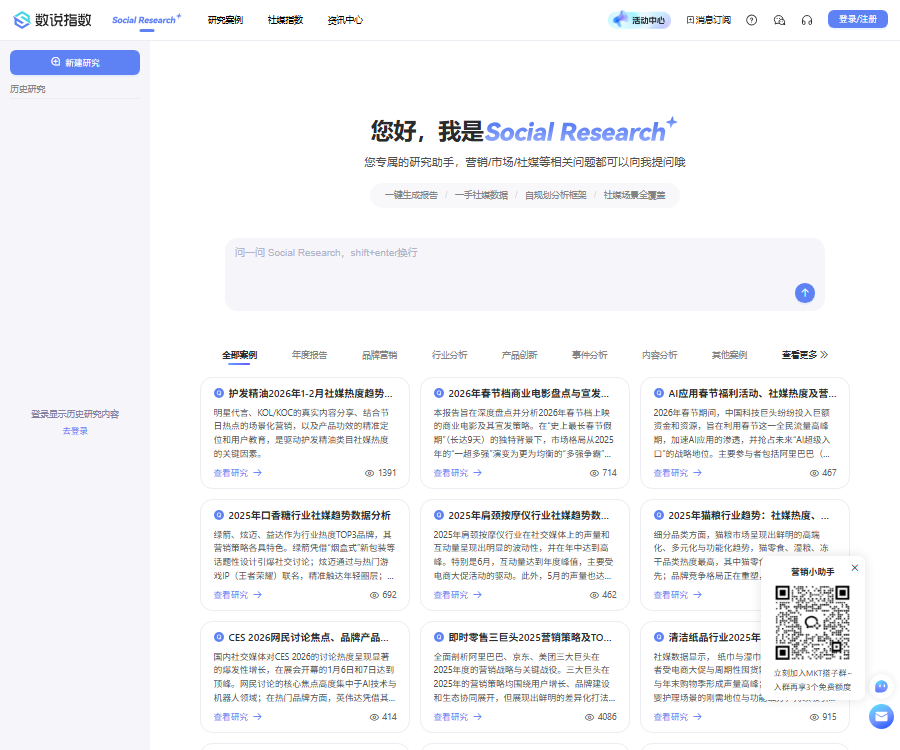
ShuShuo Social Research is an AI agent for social media marketing research, part of the ShuShuo Stories platform.
It combines search engine data with social media data to automatically develop analysis frameworks and generate research reports.
Core functions
| Functions | Main function | Suitable scenarios |
|---|---|---|
| Automatic research planning | Break down the problem into an analysis framework | Complex marketing research |
| Social media data retrieval | Obtain volume, interaction, and content data | Brand and public opinion analysis |
| Online information search | Add public web pages and up-to-date information | Events and industry context |
| Report generation | Summarize conclusions, charts, and references | Reporting and decision support |
| Research template | Reuse of validated analysis frameworks | Periodic monitoring |
| Case library | View examples of public research | Learn how to ask questions and structure reports. |
Social media data capabilities
The product integrates the social media data analysis capabilities of ShuShuoShiGuo with the data processing logic provided by ShuShuo.
- Used to analyze social media presence, engagement levels, sentiment, and popular content.
- According to official information, the core data allows for real-time updates as well as historical retrieval.
- It covers platforms such as Weibo, Douyin, Bilibili, Zhihu, and product recommendation sites.
- Different platforms use different data definitions; these should be standardized before making comparisons across platforms.
- When original data is needed, it can be verified further by using data aggregation tools.
Automatic research process
The agent will plan the analysis steps based on the problem, select the appropriate tools, and evaluate the results iteratively.
- Understand the user’s research subject, objectives, and time frame.
- Establish a framework for analyzing brands, consumers, content, or competitors.
- Select search engines, social media data, and other required materials.
- Perform searches, statistics, and content summarization.
- Evaluate the quality of the answers, fill in missing data, or adjust the approach.
- Organize the conclusions, charts, references, and citation information.
The official beginner’s guide states that a single study usually takes around 30 to 60 minutes.
Suitable for which marketing tasks
- Brand analysis: Reach, interaction, word of mouth, and mental image.
- Competitor analysis: Comparison of communication strategies, popular content, and events.
- Category insights: market trends, consumer demands, and niche opportunities.
- Activity review: Marketing milestones, endorsements, collaborations, and the effectiveness of campaigns.
- Public opinion analysis: Negative events, discussion topics, and emotional shifts.
- User research: pain points, use cases, and content feedback.
- Annual summary: A compilation of the brand’s activities and performance metrics for the entire year.
Research template
A research template can save a set of proven analysis dimensions, comparison logic, and questioning methods.
- The template allows for entering a name, description, preset questions, and an analysis framework.
- When creating a new study, select a template directly and then enter the core proposition.
- Suitable for monthly reports, quarterly reports, competitor tracking, and post-event reviews.
- The template should regularly update the platform name, metrics, and business objectives.
- A reuse framework cannot replace adjustments specific to a particular project.
Reports, citations, and charts
Upon completion of the task, a structured report will be generated, along with access points for verifying the information and data.
- By expanding the thought process, it is possible to view the Agent’s analysis framework and the steps involved in data acquisition.
- Click on the superscript in the text or on “Source” to view reference information and detailed data.
- The reports and charts allow for the download of CSV files containing the underlying data, which facilitates further analysis.
- Reports can be sent using the sharing function, or exported as PDF.
- Citing a source does not necessarily mean that the conclusion is correct; it is still necessary to examine the original materials.
A guide to using Social Research in numerical terms
- Register and log in to your account, then go to the page for creating new research projects.
- Describe the research subject, the problem, and the purpose of use in natural language.
- Add channels, regions, time ranges, brands, and a list of competitors.
- When a fixed framework is required, select or create a research template.
- Research is initiated, with 1 quota unit consumed per task.
- Wait for the Agent to complete planning, searching, evaluation, and report compilation.
- View the thought process, sources, charts, and data definitions.
- Manually verify the key conclusions before exporting to PDF or CSV.
How to formulate a good research question
- Do not simply write “analyze a certain brand”; instead, specify the business problems that need to be addressed.
- Specify the statistical period to prevent data from different years from being mixed together.
- List the brands, platforms, or products that need to be compared.
- Specify key metrics such as volume, interactivity, emotion, influencers, or content.
- Explain the target audience of the report and the desired format for the conclusions.
The platform does not require specialized prompts, but the more specific the input, the easier it is to keep the scope of the research under control.
Limits and prices
The official product specifications for September 2025 specified the following price ranges, which were reviewed on August 30, 2026.
| Project | Public explanation | Validity period |
|---|---|---|
| Registration gift | 3 free quotas | Refer to the current account page. |
| Single-use limit | 9.9 yuan per use | Valid forever |
| 10-transaction quota package | 99 yuan per 10 times | Valid forever |
| Research consumption | 1 quota per research session | Deducted when submitting the task |
Early official articles indicated different numbers of gifts, suggesting that the limits for these promotions could change; it is therefore necessary to refer to the account after registration and the settlement page for accurate information.
Prices, free gifts, exchange offers, and refund policies may change; the terms applicable are those stated on the purchase page, the settlement page, and the current agreement.
How to verify the results
- First, verify whether the time range and data platform meet the requirements of the research.
- Check the definitions of volume, interaction level, and emotional indicators.
- Download the underlying table of the chart to recalculate key ratios and rankings.
- Open the referenced materials to verify the brand’s actions and the timing of events.
- Identify the specific content of abnormal peaks and the nodes through which they propagate.
- Cross-verify with the company’s own sales or deployment data before making a formal decision.
API, SDK, and open-source status
- API: As of the time of verification, no public developer API documentation was found.
- SDK: No verifiable official SDK has been found.
- Open source: No complete source code for the product or an official open license was found.
- Deployment: It is currently primarily used through the Shushuo Index Web platform.
The use of data tools in the report does not mean that the platform makes its APIs available to ordinary developers, nor does it indicate that the product is open source.
Usage restrictions and precautions
- The report may contain factual errors, omissions, or incorrect causal inferences.
- The popularity on social media cannot be equated directly with sales volume, market share, or brand value.
- The scope of data collection and the level of interaction available on different platforms may vary.
- When dealing with personal information, it is necessary to comply with privacy and data compliance requirements.
- Business decisions should be made based on a comprehensive analysis of research findings, operational data, and marketing data.
Frequently Asked Questions
What can Social Research mainly do?
It can automatically handle the breakdown of marketing issues, analyze social media data, and generate structured reports.
How long does a study take?
The official beginner’s guide indicates that it usually takes around 30 to 60 minutes; during this time, the page can be closed or refreshed.
How much quota is consumed per study?
Each research initiative consumes 1 quota unit; the rules regarding failures or refunds are specified on the account page.
How much is Social Research?
The official statement is that the price per use is 9.9 yuan, while a package of 10 uses costs 99 yuan; the current price is as indicated on the settlement page.
Can the report be exported?
Sharing and exporting PDFs are supported, and the charts in the reports can also be downloaded in CSV format.
Can it view the original materials?
The report provides sources and citation links; some of the data can also be verified further using DataSay Aggregation.
Does it provide APIs or open-source code?
As of the time of verification, no public APIs, official SDKs, complete source code, or open licenses were found.
A tool similar to NumberSay Social Research – an AI agent for social media analysis





 Guigong Network Security Registration No. 45132202000164